
How many medical marijuana strains are available in pharmacies and why this number is not static
One plant name, several pharmacy items, sixteen manufacturers, and no public stock level. Where do different numbers of available strains come from and why can an item disappear between deliveries.
How many medical marijuana strains are available in Polish pharmacies?
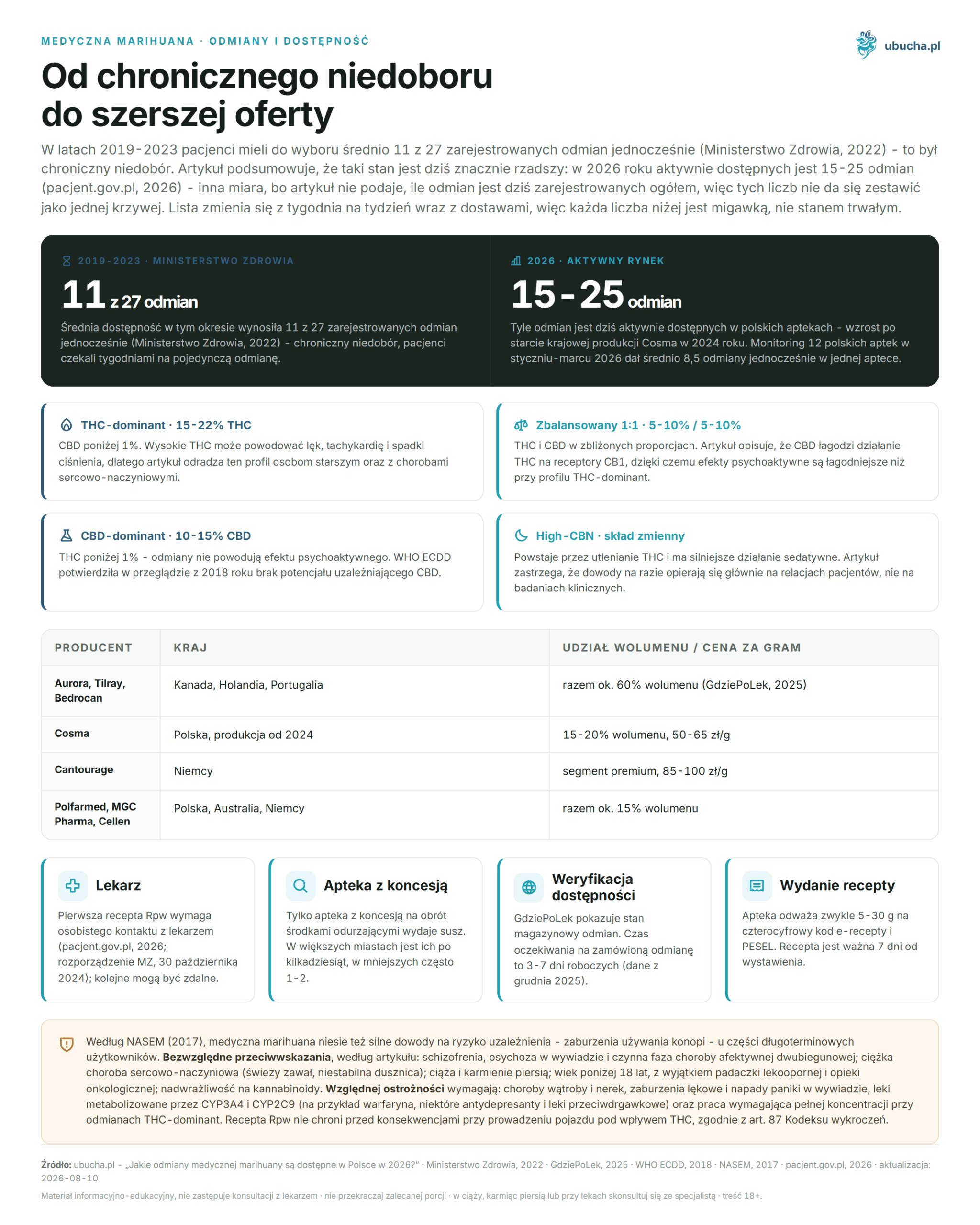
It depends on what is counted. The list of pharmacy items compiled for this service includes 141 sales items, which when reduced to plant names gives 85 strains from 16 manufacturers. The number of names actually available in a given week is clearly lower and no one publishes it in a verifiable form.
The difference between these numbers is not a reading error, but a result of two different units. A pharmacy item is a specific strain from a specific manufacturer in a specific package. A strain is the name of the plant under which such an item is sold. The same name can appear with five manufacturers at once, and then one strain corresponds to five items in the list. Those who count items get a higher number. Those who count plant names get a lower one. Both are correct and both describe something different.
The third number, the one most interesting to the patient, does not exist in public form. No one maintains an open register of stock levels in pharmacies authorized to trade in narcotic substances, and the state changes with each delivery and each filled prescription. Therefore, in this service, we provide a list of names currently in circulation and state clearly that it is a list of items, not a guarantee of availability. You can find the current state of this list in the list of medical marijuana strains.
Why do different sources provide different numbers of strains?
Because each counts something different and rarely states exactly what. One source provides sales items, another plant names, a third only the names of manufacturers, and a fourth estimates how many of these can realistically be ordered in one week. Four correct methods yield four different numbers.
A good example is the number that has opened this page until now. It spoke of a range from fifteen to twenty-five strains and attributed them to eight manufacturers named. We do not quote it here in full because four of those manufacturers are not on any list on which we base this service, and one of the names appears to be a misspelled name of an existing company. Repeating such a sentence, even with a disclaimer, would leave those names on the page and allow them to wander further.
Our own list gives different numbers: eighty-five cultivars in one hundred forty-one pharmacy items from sixteen manufacturers. The discrepancy does not arise from the market, but from the counting method. That sentence did not provide either the measurement date or the unit, so it cannot be determined which segment of the market it described. A number without those two pieces of information ages faster than the text in which it stands, and the reader has no way to check whether it pertains to their pharmacy.
Hence the principle adopted in this service: with every number of strains, we write what has been counted and where the list comes from. Without this, two true numbers look like a contradiction, and the difference between them arises solely from the method, not from the market.
Why does a strain disappear from the pharmacy between deliveries?
Most often because it is carried by only one manufacturer. In the list, 64 out of 85 strains have exactly one company supplying them, so one break in delivery removes such a name from circulation entirely. With names carried by several companies, the disappearance of one of them is much less noticeable.
| How many manufacturers carry the name | How many strains | What this means for availability |
|---|---|---|
| one | 63 | a break at this manufacturer removes the name from circulation |
| two | 12 | the second version may be available, though it differs in declared content |
| three | 8 | the name rarely disappears from the market entirely |
| four | 1 | single case in the entire list |
| five | 1 | the best-supplied name in the list |
The distribution is therefore very uneven, and it is this that accounts for the impression that the assortment is jumping. Three-quarters of the names hang on one supplier, and with such a structure, a market crisis is not needed for an item to disappear for several weeks. One batch held for re-testing or one delay at the border is enough.
The second reason is simpler and less dramatic. A pharmacy with a permit orders raw material for specific prescriptions, not for stock, because the herb in the Rpw category is associated with record-keeping and a limited shelf life. An item present in the wholesaler does not have to be on the shelf in the pharmacy where the patient arrives with a prescription. Between one link and the other stands an order that someone must place, and the time in which the wholesaler will fulfill it. This is enough for the same name to be available immediately in one city and only after a week in another.
What do imports and domestic production change in the continuity of supplies?
They change the length of the journey that a batch must take before it reaches the pharmacy. Herb imported from abroad goes through more links and more documents than herb released for circulation in the country, and each link is a place where the delivery can be delayed. The list of strains does not show this, however.
The list records one company name with each item and does not determine at which stage of the chain that company stands. It may be a grower, it may package someone else’s raw material, or it may only release a batch for circulation. For this reason, we do not assign individual names to the country of cultivation nor do we numerically divide the market into imports and domestic production. That would be a guess based on the sound of the name, and such a guess can be wrong by an entire continent.
What this list shows indisputably is concentration. Three names carry 65 out of 85 strains: S-LAB stands with 38 items, Tilray with 14, Synoptis Pharma with 13. A market built this way reacts to problems of one company as a whole, regardless of whether its herb came from abroad or is from domestic cultivation. Shortening the chain helps with timeliness, but does not change the fact that with most names, alternatives simply do not exist. Who stands with which strain, we detail in separate entries about manufacturers.
What does the list of strains not say about availability?
It does not say how much herb is lying in the wholesaler, when the next delivery will come, or which pharmacy has a given item on the shelf today. It is a list of names currently in circulation, not a stock level. The permit for the admission of raw material can also be revoked and expires five years after issuance.
This last limit is more often overlooked than it deserves. The list of names looks like a permanent document, but it is a snapshot of the legal state as of the day it was compiled. An item can fall from it without any event on the part of the pharmacy, solely because the permit has expired or the manufacturer did not apply for its extension. A text describing such a list as a list of what is available for purchase misleads from the day of publication.
The second thing the list does not say for formal reasons. Cannabis herb is a pharmaceutical raw material dispensed by a doctor’s prescription in the Rpw category, so which item is even in play is determined by the content of the prescription, not the state of the list. A patient with a prescription for a specific raw material cannot simply take another name from the list, even if it is currently available. Therefore, this service maintains a list of names, and information about substitutes is left to the attending physician and pharmacist.
What does a change in the available strain mean for ongoing therapy?
That it is determined by the attending physician, not the list. A different item means a different manufacturer, a different batch, and different testing of that batch, so even the same plant name does not guarantee the same raw material. Comparative studies on the effects of such a change are not in public circulation.
The lack of such studies is the answer here, not a gap in the text. No one has conducted a clinical trial in which patients were switched from one manufacturer’s item to another under the same trade name and measured what happens. It is known, however, that the declared content of active substances has an allowable tolerance, and the volatile profile may differ in subsequent batches, depending on cultivation and post-harvest processing. Two batches of the same name are therefore not the same material, even though the label looks identical.
Symptoms reported after cannabis herb are described for the entire group of raw materials, not for a single name. In these descriptions, dry mouth, daytime drowsiness, dizziness upon rapid standing, increased heart rate, and anxiety that intensifies with dosage are repeated. A symptom that appeared after switching to another item should be reported to the attending physician, not compared with descriptions circulating online. What the numbers on the package mean and how to read the profile of a single strain, we break down in a separate text, and the actual content of active substances is discussed there, where it is the topic.
Frequently asked questions about the availability of strains
How many medical marijuana strains are in Polish pharmacies?
The list of pharmacy items compiled for this service includes 141 sales items, which means 85 plant names from 16 manufacturers. The number of names available in one week is lower and is not published anywhere.
Why does the number of available strains differ between sources?
Because sources count different things: sometimes sales items, sometimes plant names, sometimes the companies supplying them. Without a stated counting unit, two true numbers look like a contradiction.
Why does a strain disappear from the pharmacy between deliveries?
Most often because it is carried by only one manufacturer. This applies to 64 out of 85 names in the list, so one break in delivery removes such an item from circulation entirely.
Does domestic production mean more reliable supplies?
A shorter path from cultivation to pharmacy has fewer links where a batch can get stuck. However, the list of strains does not measure timeliness, so it cannot be read which channel is more reliable.
Does the list of strains show the stock level of the pharmacy?
No. The list is a record of names currently in circulation, not a stock level. Availability in a specific pharmacy is confirmed only by that pharmacy.
What to do if the prescribed strain is not available in the pharmacy?
The matter is resolved by the attending physician, and availability is confirmed by the pharmacy with a permit to trade in narcotic substances. The list of names currently in circulation does not replace this conversation.
Editorial text: ubucha.pl editorial team. Cannabis herb is a pharmaceutical raw material dispensed by a doctor’s prescription in the Rpw category. The material is for informational purposes and does not replace medical advice.