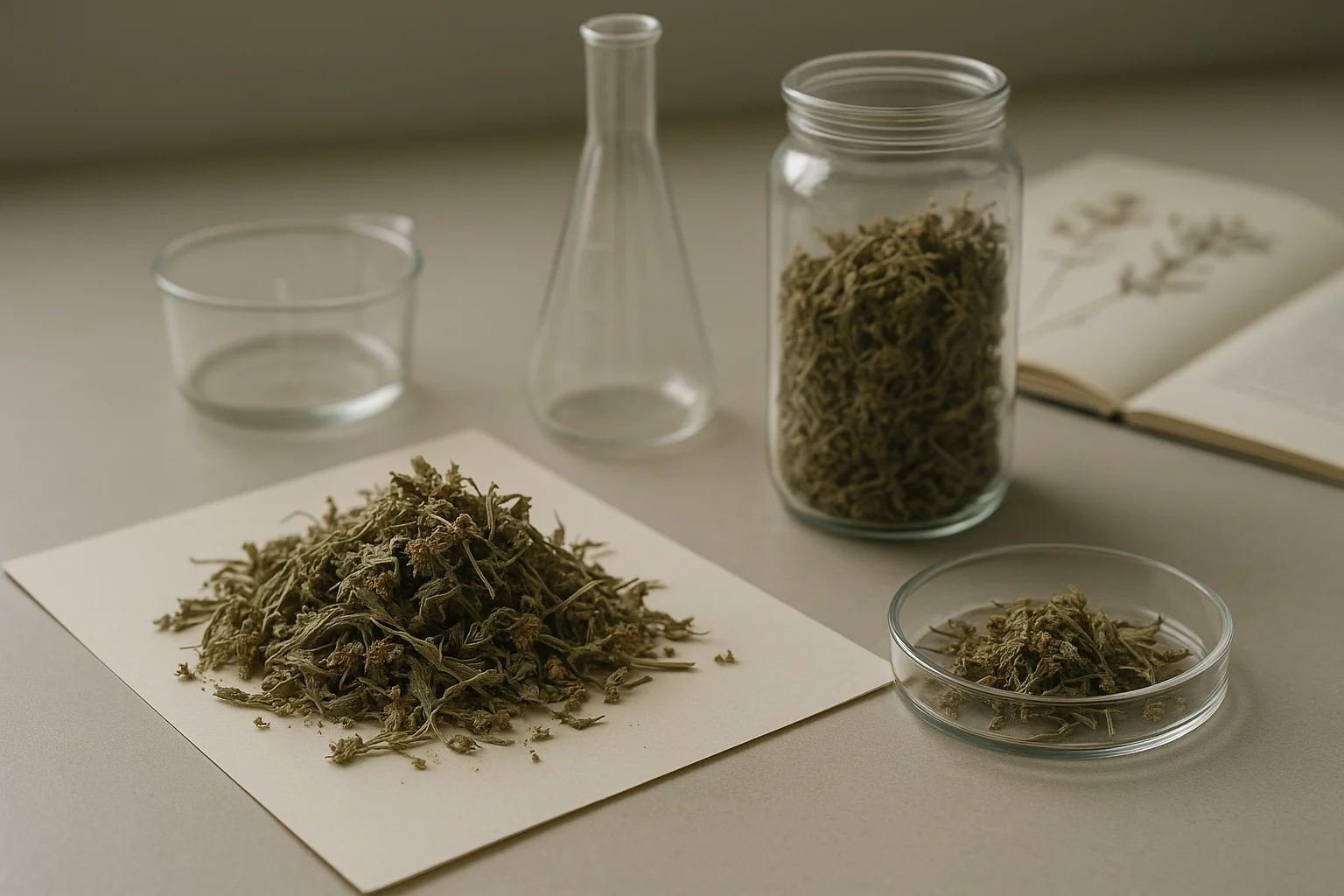

Sweet Berry Kush (Cannabis flos S-LAB): lineage from Banana OG and Purple Punch
A hybrid from Banana OG and Purple Punch, supplied to Polish pharmacies by a single producer. The profile composition is described by one database, and two ways of indicating the leading terpene give different answers for this position.
| Strain card | Sweet Berry Kush |
|---|---|
| Producers | S-LAB (1 pharmacy position) |
| Medical brand | same as producer |
| Alternative names | none |
| Category according to sources | hybrid |
| Leading terpene | limonene |
| Other terpenes | humulene caryophyllene pinene terpinolene |
| Lineage | established Banana Og × Purple Punch |
| Source consistency | one source |
- Who supplies it. Exclusively S-LAB, so there is nothing to compare versions with, and a supply break means no availability of this strain, not another version of it.
- Profile. Limonene leads, alongside humulene, caryophyllene, pinene, terpinolene. We do not provide percentage shares, as sources count them against different totals.
- Origin. Established lineage, parents are Banana Og and Purple Punch.
- What is missing. The profile describes one source, so there is nothing to compare it with.
What is Sweet Berry Kush and what strains were crossed to create it?
This is a hybrid from the cross of Banana OG and Purple Punch, supplied to Polish pharmacies by a single producer. The lineage comes from a Polish-language commercial description, independently repeated by four other industry services. No breeding registry or approval document for this parent pair confirms it, as the permit describes the product, not its breeding origin.
The word hybrid appears in the same catalog entry from which the profile composition comes, and is a seller’s declaration, not a result of analysis. The division into indica and sativa strains is based on the plant’s morphology and trade tradition, not on composition designation, so for someone reading a prescription, it carries less information than a list of volatile substances. In this case, both things actually come from the same place, so one does not confirm the other.
The term Kush in the name says nothing about origin. In this context, it is carried by ten cultivars, and half of them have no established parents, so the common word connects them only in the catalog. The same applies to the term Berry: it suggests a scent direction, not a common ancestor with positions that have berry in their name. The lineage of this strain leads to Banana OG and Purple Punch, and neither of these two names stands alone on the Polish pharmacy list.
Which producers supply this strain to Polish pharmacies?
One: S-LAB. In the listing on which this cluster stands, Sweet Berry Kush has exactly one pharmacy position, so there is no competitive version to compare composition or availability with. The registered name is Cannabis flos SWEET BERRY KUSH, and we provide the content separately as a range.
| Producer | Registered name without numerical part | Declared content | Declared genetics | Source of description |
|---|---|---|---|---|
| S-LAB | Cannabis flos SWEET BERRY KUSH | THC 16.2-19.8%, CBD no more than 1% | hybrid | budcare.pl |
The number in the registered name is a value declared by the producer, not a result of measuring a specific batch. The permissible deviation reaches one-tenth of this value in both directions, so an honest record for this position is the range 16.2-19.8%, not a single number copied from the label. The content of the second described component is given only as an upper limit.
One supplier also means that a supply break has no substitute under the same name. Permits expire, can be suspended, and batches leave the wholesaler at a pace that is not visible from the level of the office, so a position present in the catalog in spring can disappear from circulation before autumn. The database from which we take the profile marked this strain as unavailable at the time of review, and that in itself is information.
The state of the wholesaler changes faster than any strain description, which is why we keep a list of positions currently in circulation in a separate listing of strains available in Polish pharmacies and refresh it there. The producer is responsible in this cluster for thirty-eight out of eighty-five described cultivars, which is the largest part of the catalog; its portfolio is described separately. The raw material from this group reaches the pharmacy as a herb dispensed only with a doctor’s prescription, unlike products collected in the store category of herb.
What does Sweet Berry Kush smell and taste like?
- humulene humulene
- caryophyllene caryophyllene
- limonene limonene (leading in the pharmacy list)
- pinene pinene
- terpinolene terpinolene
The catalog from which the profile comes assigns it berry and citrus notes and a floral-fruity finish. These are descriptive labels entered by the seller, not a result of scent measurement in the laboratory, so they are closer to a directional announcement than to a feature confirmed by measurement. The aroma also changes between batches and with storage time.
The composition recorded for this strain includes pinene, limonene, and caryophyllene, with smaller amounts of humulene and terpinolene. In sensory descriptions, limonene is associated with citrus notes, pinene with resinous, and caryophyllene with peppery. The berry label from the catalog has no obvious counterpart in this list, and since both things come from the same entry, one does not confirm the other. The database provides shares for these components, but when summed, it comes to 77 percent, not one hundred, so the denominator remains unknown and the numbers themselves stay outside the text.
No analytical certificate for a single batch has been published for this position, and that is the only document that would link the scent description with measurement. Volatile substances decrease during drying and when stored in heat, so two packages of the same name can smell differently, even when coming from the same producer. For the same reason, the taste impression during vaporization depends on the device’s setting: some components evaporate earlier, and the first inhalation carries a different set than the last.
How long does it take for this strain to take effect and how long does the effect last?
This is determined by the route of administration, not the name on the package. For Sweet Berry Kush, no absorption measurement or blood concentration has been published, so the ranges below describe the behavior of cannabis herb during vaporization and after ingestion, and attributing them specifically to this position would be an overinterpretation of data from a completely different level.
The route of administration determines the course more than the strain itself, and the ranges below describe it, not this cultivar, as pharmacokinetic studies for a single cultivar have not been published.
| Vaporization | After ingestion | |
|---|---|---|
| First sensations | after a few minutes | from half an hour to two |
| Onset | another ten to thirty minutes | slow, over several hours |
| Total duration | within two to four hours | after six, sometimes eight hours |
| Typical error | none | taking a dose after thirty minutes, which gives both doses at once |
No leaflet describing absorption exists for Sweet Berry Kush, as the raw plant material is dispensed in the pharmacy, not a drug form tested for blood concentrations. The course therefore depends on the method of administration written by the doctor on the prescription and on how much raw material goes into the vaporizer chamber at once.
What is known and what is not known about the effects of this strain?
Nothing is known about the strain itself that comes from a study. It has not been conducted in any clinical or observational trial, and what can be described pertains to individual substances from its profile, studied separately and in animal models, which is two floors lower than a patient in the office.
Our evidence base assigns limonene to this position and carries two studies on rodents for it.
| Study | Model and route of administration | What was shown |
|---|---|---|
| do Vale TG et al., 2002 Phytomedicine PMID:12587690 |
rodent (mouse, intraperitoneal administration) | Limonene administered intraperitoneally in mice showed muscle relaxant effects (rota-rod test) from a dose of 50 mg/kg and prolonged sleep time induced by pentobarbital at a dose of 200 mg/kg (about 2.6 times); in the elevated plus maze test, already at a dose of 5 mg/kg, it reduced the number of entries into the open arms, which the authors described as an anxiogenic effect, not anxiolytic. |
| Fakhri S et al., 2025 Behavioural Pharmacology PMID:40622197 |
rodent (rat and mouse) | Limonene reduced paw swelling induced by carrageenan in rats and pain responses in the formalin test in mice; the effect was linked to the l-arginine/nitric oxide/cGMP/KATP channel pathway and involvement of opioid and benzodiazepine receptors. |
The boundary of these results weighs as much as they do. No anxiolytic effect of limonene has been demonstrated in humans. It has also not been shown that isolated limonene acts anxiolytically in animals; the only available data from the elevated plus maze test showed in mice the opposite effect, reducing the number of entries into the open arms even at a low dose.
The rest of what circulates about this strain in sales descriptions and user reports has no status as evidence and has not been collected in a way that allows anything to be counted. From the data alone, a separate matter arises: our pharmacy listing indicates limonene as the leading component for this position, while the catalog providing shares places pinene first. Two ways of counting give two answers, so both terpene axes, the one about limonene and the one about pinene, describe the same position.
What side effects have been reported from this strain?
Nothing has been reported specifically for this name. Reports go into the system described by the product’s batch number, not the cultivar name, so there is no compilation of symptoms or their frequency that could be attributed solely to this position, and nothing like that will arise from user reports.
Reports of side effects are collected for the medicinal product with a batch number, not for the strain name, so the following pertains to cannabis herb as a group of raw materials. The most commonly reported are dry mouth, red eyes, and increased heart rate. Less frequently described are dizziness upon rapid standing, daytime drowsiness, and temporary worsening of short-term memory, as well as anxiety increasing with dosage. A separate matter is medications taken concurrently, especially sedatives and those affecting coagulation: their assessment requires knowledge of the entire list of preparations, not just the description of the plant. We do not provide the frequency of these symptoms numerically, as public compilations for cannabis herb in Poland do not separate them by individual products.
For this strain, there is also a lack of a batch certificate, so even the composition on which predicting reactions would be based is known from a single entry in the catalog. With one supplier and one pharmacy position, there is also no second version of the same strain to check whether the described reactions recur regardless of the batch.
Can the vaporizer be set to release the entire profile of this strain?
No. The components recorded for it boil at very different temperatures, and the highest of them exceeds the threshold at which the herb begins to burn instead of vaporizing. Every setting is therefore a choice of part of the profile, not a way to extract it in full, and no device model changes that.
At atmospheric pressure, pinene boils at 156.2°C, limonene at 177.8°C, and terpinolene at 184°C. Caryophyllene under the same conditions requires 257.5°C, which is above the temperature at which the plant material chars; the same compound has also been measured at 130°C, but under reduced pressure of 14 mmHg. Humulene has no atmospheric measurement in our source, only 99.5°C at 3 mmHg. Separate entries are dedicated to each of these components: caryophyllene, humulene, and terpinolene.
This is where tables come from that set one component lower than another against physics: they compare measurements taken under different pressures. We separately explain why such comparisons contradict themselves and why the number displayed by the device is not the temperature of the herb in the chamber. The physics of vaporization is described in a separate text. The setting remains part of the conversation with the doctor conducting the therapy, not a setting to be copied from the internet.
Which strains from Polish pharmacies share a parent with it?
| Strain | Common parent | Leading terpene | Producers |
|---|---|---|---|
| Mimosa | Purple Punch | pinene | S-LAB |
One: Mimosa. Both positions have Purple Punch in their lineage, both are supplied by the same producer, and only this pair in the entire listing shares a documented parent with Sweet Berry Kush. The second parent, Banana OG, has left no other offspring in this catalog, so the siblings of this strain end with one name.
Mimosa comes from Clementine and Purple Punch, so there is only one common ancestor, not both. The common parent does not carry the composition: the recorded profile of Mimosa contains linalool, which has not been noted in this strain, while the strain described here has humulene and terpinolene, which are not present in that entry. We describe Mimosa separately.
The common part of the name can be confused with kinship and leads in this listing to a dead end. Northern Berry comes from Northern Lights #5 and Blueberry, Shishkaberry from DJ Short Blueberry and Afghani, and Strawberry OG from Bruce Banner #3 and SFV OG IBL; none of these three has Banana OG or Purple Punch in their lineage. The term Kush behaves the same way: it is carried by ten positions, and five of them have no established parents, so they are connected only by the alphabet.
Frequently asked questions
Is Sweet Berry Kush available in Polish pharmacies?
The database from which its profile comes marked this position as unavailable at the time of review. Availability changes with deliveries and approval decisions, and we maintain the current state in a listing of strains available in Polish pharmacies.
How much THC does the producer declare for this strain?
The declared value is in the range of 16.2-19.8%, as the permissible deviation from the number provided by the producer is one-tenth of that number. The CBD content is stated as no more than 1%.
Does the terpene profile of this strain confirm more than one source?
No. It is described by one source, the database budcare.pl, and the second database used in this cluster does not have this strain at all.
Does the term Kush in the name indicate kinship with other Kush strains?
No. In this listing, the term Kush is carried by ten cultivars, and five of them have no established parents, so the common word in the name says nothing about origin.
Is Sweet Berry Kush an indica or sativa strain?
The catalog describes it as a hybrid, without indicating dominance. This is a declaration from one entry, and the division itself is based on the plant’s morphology and trade tradition, not on composition designation.
Are Mimosa and Sweet Berry Kush siblings?
They share one parent, Purple Punch, so they are closer to half-siblings. The second parent is different in both cases, and the recorded profile composition also differs despite the common ancestor.
Cannabis herb is a pharmaceutical raw material dispensed with a doctor’s prescription in the Rpw category. The material is informational in nature and does not replace medical advice or information from the medicinal product leaflet. Editorial text: editorial team ubucha.pl.