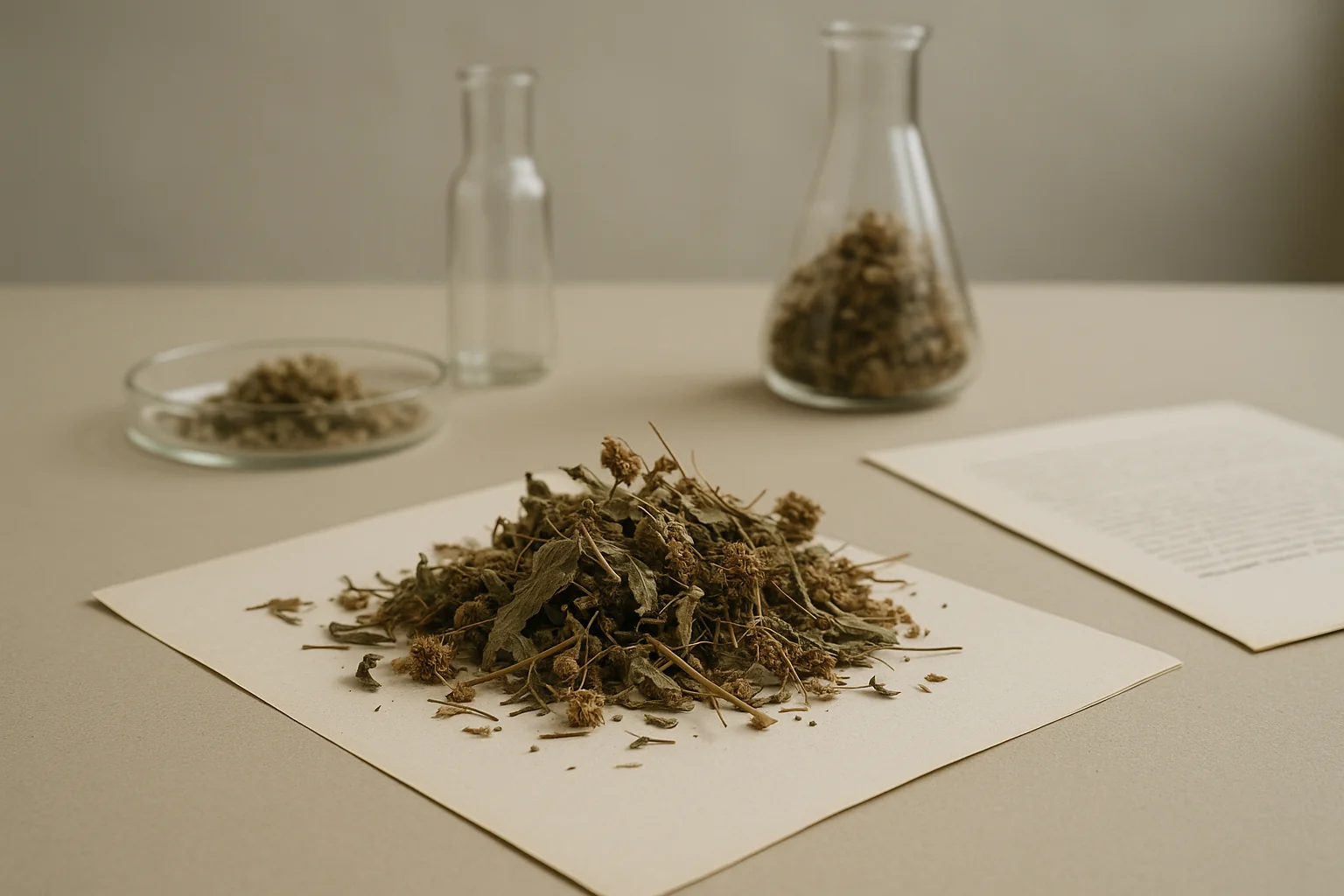

Vapor Pressure, Not Boiling Point: What Determines the Loss of Terpenes from Dried Cannabis
The boiling point is not a threshold below which terpenes stand still. We explain what really governs their evaporation from dried cannabis and why published temperature tables are not comparable.
| Data Sheet | Measurement Status |
|---|---|
| Terpenes with atmospheric measurement | 6 out of 11 |
| Terpenes only under reduced pressure | 1 out of 11 number not comparable to others |
| Terpenes without specified pressure | 4 out of 11 |
| Works in the evidence base | 2 |
- How many studies. 2 works from 2022 to 2023, all listed in the table below along with the model.
- What has not been demonstrated. No study has been published measuring how much terpene from heated dried cannabis actually reaches the lungs and blood in humans. It is known in what order the components evaporate and what portion decomposes along the way, but not in
- What you won’t find here. Dosage recommendations or strain indications. The selection is determined by the attending physician, and cannabis is a substance dispensed only by prescription.
- How to read this. The results of studies on rodents or in cell cultures do not directly transfer to a patient using dried cannabis, and the column with the model indicates what the work was actually about.
How does the temperature set on the vaporizer differ from the temperature of the dried cannabis?
The setting on the device describes the temperature of the heating element or airflow, not the temperature of the raw material itself. Ground dried cannabis absorbs heat unevenly, and with each inhalation, the air drawn through the chamber cools it. No one has publicly measured the scale of this discrepancy, so no numerical correction can be provided here.
The heating element reaches the set value faster than the raw material surrounding it. The heat must still penetrate into the portion, and this conducts it poorly, so the edges can be hotter than the center. Each inhalation passes cool air through the chamber and lowers the temperature of the bed for a few seconds, after which the heater warms it back up. The number on the display thus describes the operating point of the device, not the state of the raw material at that same moment.
| Study | Model and route of administration | What was demonstrated |
|---|---|---|
| Zhu J et al., 2022 Scientific Reports PMID:35773373 |
laboratory measurement by thermal desorption coupled with gas chromatography and mass spectrometry, five monoterpenes at temperatures typical for vaporization | Among the five studied monoterpenes, the proportion of the parent compound that survived heating unchanged ranged from 97 to 98 percent for the most resistant to just 11 to 28 percent for the most unstable. The most resistant was myrcene, the most unstable was terpinolene, and the difference between the extreme values is nearly ninefold. This is not a share in the profile, but the percentage of the substance that did not decompose, and the denominator here is the amount introduced into the measurement. The oxidation products had molecular weights of 134, 150, or 152, among which p-(1-propenyl)-toluene, beta-pinon, and fenchol were likely identified. The authors note that the toxicity of inhaling these products is unknown, while allergic and irritating reactions to oxidized monoterpenoid oils are well documented. |
| Eyal AM et al., 2023 Cannabis and Cannabinoid Research PMID:35442765 |
analysis of own and literature data, review work with measurements of composition at various stages of processing | The authors reviewed the documentation reaching patients and their caregivers and found incorrect data and confusion between the concepts of boiling, vaporization, and evaporation, including incorrectly stated boiling points of cannabinoids. The rate of loss of individual components is determined by their relative vapor pressure at a given temperature, not the boiling point. Loss begins during drying and curing and intensifies during decarboxylation, with monoterpenes evaporating first. During vaporization, terpenes are inhaled before cannabinoids, and commercial cannabis products are poorer in terpenes, especially monoterpenes, than the plants from which they were derived. Terms like full spectrum are directly called misleading by the authors, as no product replicates the composition of the plant. |
Does a terpene only evaporate at its boiling point?
No. Evaporation occurs at any temperature where a molecule gathers enough energy to detach from the surface of the liquid. The boiling point only means that the vapor pressure has equaled the surrounding pressure, and it is not a threshold for activation. The rate of loss is determined by the vapor pressure.
The distinction is physical, not linguistic. Above every liquid, there is vapor at a specific pressure, and it is this pressure, not any threshold, that indicates how quickly molecules escape from the surface. Boiling is the moment when vapor forms throughout the volume because its pressure has equaled that of the surroundings. Below this temperature, nothing happens less; it happens more slowly.
Eyal’s team reviewed the documentation reaching patients and those caring for them and found false data and confusion among three separate phenomena: boiling, vaporization, and evaporation. A separate entry on this list is the boiling points of cannabinoids simply stated incorrectly.
This misunderstanding underpins the entire popular targeting of a single terpene. Since everything evaporates at a given temperature, only at different speeds, no setting releases one compound while retaining the others. This same work adds another point: during vaporization, terpenes reach the lungs before cannabinoids, with monoterpenes doing so first.
What is vapor pressure and why does it rise so steeply?
Vapor pressure is the pressure exerted by vapor in equilibrium with its liquid. It rises steeply with temperature because it depends on it exponentially, not proportionally. Therefore, a small increase in heat can significantly accelerate evaporation, even though no threshold has been crossed along the way.
This steepness has a visible effect on composition. The vapor rising above heated dried cannabis does not replicate the composition of the raw material but is shifted towards compounds with higher vapor pressure at that moment. The lighter the molecule, the earlier and more abundantly it enters the gas phase, while heavier ones remain in the material longer. The order of evaporation thus results from comparing vapor pressures among components, not from ranking their boiling points.
For dried cannabis, this gives a repeatable order at every stage of thermal processing: first monoterpenes, then sesquiterpenes, and finally cannabinoids. This order does not change depending on whether the heat comes from drying, curing, or the heating chamber. Only the rate changes, and with it, how much remains in the raw material for later. The relative vapor pressure is the only criterion that predicts anything here.
The boiling number itself describes one point of this relationship, additionally lying above the conditions under which the dried cannabis is typically heated. The rest of the process remains outside the table, although it determines the rate of loss.
Why are terpene boiling temperature tables not comparable?
Because a significant portion of the circulating numbers does not have specified pressure, and without it, the boiling temperature describes nothing. We checked in PubChem all eleven terpenes described in this project. Only six of them have records along with atmospheric pressure, and two have no boiling point in the database.
The division came out as follows. Atmospheric pressure stated directly: caryophyllene, limonene, linalool, myrcene, pinene, and terpinolene. Measurement only under reduced pressure: humulene. Number without any information about pressure, thus not comparable to the previous ones: nerolidol and ocimene. No boiling point in the database: bisabolol and farnesene.
Humulene shows what the damage is. The only record the database holds for it is 99-100 degrees Celsius measured at a pressure of 3 mm Hg, thus almost in a vacuum. Taken out of this context and placed in a comparison next to atmospheric values, such a number ceases to be a rounding and becomes a falsehood. The same mechanism is seen with caryophyllene, which appears in the database twice: 257.5 degrees under atmospheric pressure and about 130 degrees under a pressure of 14 mm Hg.
| Terpene | Boiling Point from PubChem (degrees Celsius) | Measurement Pressure |
|---|---|---|
| pinene | 156.2 | 760 mm Hg |
| myrcene | 166.8 | 760 mm Hg |
| limonene | 177.8 | 760 mm Hg |
| terpinolene | 184 | 760 mm Hg |
| linalool | 195.5 | 760 mm Hg |
| caryophyllene | 257.5 | 760 mm Hg |
| humulene | 99-100 | 3 mm Hg |
| nerolidol | 276 | not provided in the record |
| ocimene | 177 | not provided in the record |
| bisabolol | not in the database | not in the database |
| farnesene | not in the database | not in the database |
Circulating comparisons mix these four cases in one column and do not indicate which row comes from where. Why the discrepancy persists even when pressure has been stated, is described on a separate page of this cluster.
When does the loss of terpenes from dried cannabis begin?
Much earlier than during heating before inhalation. Losses begin when the collected material dries and cures, and intensify during decarboxylation. Monoterpenes disappear the fastest, so the raw material reaching the patient has less of them than the plant from which it was derived. This difference is inherent in the process itself.
The review work by Eyal bases this on measurements taken after subsequent processing steps. Finished cannabis products thus have fewer terpenes than the plants from which they started, with the lightest fraction being the most diminished. Hence the authors’ criticism of terms like full spectrum: no product replicates the composition of the plant, so the name promises something that is not present inside.
The conclusion for reading tables is uncomfortable. The boiling point describes a pure compound in a flask, not the content of the chamber into which the dried cannabis enters after collection, after drying, and after months of storage. Even a correctly measured number thus refers to something different than the material the patient actually has in hand.
The state of the raw material therefore depends on its thermal history, which no one provides to the patient. Two portions of the same strain, dried differently and stored differently, enter the chamber with different reserves of volatile components, and the temperature comparisons remain silent on this difference.
Does a terpene survive heating unchanged?
Not every terpene and not entirely. Among the five studied monoterpenes, the proportion of molecules exiting from heating unchanged ranged from 97 to 98 percent at one end to 11 to 28 percent at the other. The range between the extremes is nearly ninefold.
This number says nothing about the share in the profile of the dried cannabis. The denominator is the amount of substance introduced into the measurement, and the numerator is the part that exited unchanged. The rest did not evaporate without a trace: it transformed into oxidized derivatives with masses of 134, 150, or 152, among which probable p-(1-propenyl)-toluene, alongside beta-pinon and fenchol, were mentioned.
The most resistant in this measurement was myrcene, the least stable was terpinolene.
Hence the second correction to the tables. Even if the boiling number were stated correctly and with pressure, it would describe an unchanged compound, not what actually rises from the chamber. Part of the material changes into something else along the way, which no temperature table mentions.
What does this mean for the patient?
That the decision on the route of administration is made by the attending physician, not by a table found online. Dried cannabis is a pharmaceutical raw material dispensed by prescription in the Rpw category, so the choice of method of intake remains part of the therapy. This page describes the state of knowledge, and no number is provided as guidance.
From the two discussed works, no value emerges for prescribing to a device. What emerges is something else: the order in which components leave the dried cannabis and that some of them do not reach the vapor in unchanged form. Both things occur under any thermal conditions, only at different speeds, so there is no threshold beyond which one begins and the other ends.
This also works the other way around. The absence of evidence is not evidence of absence: that no one has measured how much terpene reaches the bloodstream does not mean that none reaches at all. It only means that the claim about the effect of such or such heat selection has no current support in human measurement.
A list of currently available products in Polish pharmacies is maintained by the hub of this cluster. The store category dried cannabis is a separate compilation, maintained outside this list.
What has not been studied about the vaporization of terpenes from dried cannabis?
The most important link. No one has measured in humans what portion of the terpene leaving the heated bed reaches the lungs and bloodstream. The evidence base for this project contains not a single study involving humans on this axis, and both discussed works end before the boundary of the body.
The review work describes the composition of the material at various stages of processing, that is, what happens to the raw material. The laboratory measurement describes the composition of the vapor produced in the apparatus, that is, what exits the chamber. None of them goes further, to absorption, concentration in the blood, and the effect felt by the patient.
This gap is practically overlooked. Circulating tables provide temperatures with an accuracy of one degree and assign effects to them, although there is a lack of a link connecting the number with anything measured in humans. The declared precision is inversely proportional to the coverage in data.
Nothing has also been demonstrated that would justify selecting heat for a single terpene from the table. The order of evaporation is known, the percentage of the compound that survived heating has been measured under laboratory conditions, while the further fate of what is inhaled remains unstudied.
Popular guides close this gap with one sentence: a given terpene evaporates at a given temperature and therefore produces a given effect. No one has measured the second half of this sentence in patients.
Frequently Asked Questions
Does a terpene not evaporate at all below its boiling point?
It evaporates. The boiling point is the temperature at which the vapor pressure equals the surrounding pressure, not a threshold for activation of evaporation. Below it, evaporation occurs more slowly, but it occurs all the time, even during drying and storage of the raw material.
Why do two tables provide different boiling temperatures for the same terpene?
Most often because one number comes from a measurement under atmospheric pressure, and the other from reduced pressure. In PubChem, caryophyllene has both records: 257.5 degrees under atmospheric pressure and about 130 degrees under a pressure of 14 mm Hg. Without specified pressure, such numbers cannot be compared.
Does heating decompose terpenes?
Partially. Among the five studied monoterpenes, the proportion of molecules exiting from heating unchanged ranged from 97 to 98 percent at one end to 11 to 28 percent at the other. The resulting oxidized derivatives had masses of 134, 150, or 152.
Can one terpene be isolated by selecting heat?
No. At a given temperature, all components evaporate, only at different speeds depending on vapor pressure. There is no threshold that releases one compound while retaining the others, so selecting heat for a single entry from the table has no basis in the physics of evaporation.
What has not been demonstrated in studies on the vaporization of terpenes from dried cannabis?
No study has been published measuring how much terpene from heated dried cannabis actually reaches the lungs and blood. It is known in what order the components evaporate and what portion decomposes along the way, but it is not known how much of this reaches the body or whether it has any measured effect. It has also not been demonstrated that setting the vaporizer to the temperature given in the table as the boiling point of a specific terpene leads to inhaling that particular terpene.
Who decides on the method of taking dried cannabis?
The attending physician. Dried cannabis is a pharmaceutical raw material dispensed by prescription in the Rpw category, so the choice of route of administration and inhalation parameters remains a therapeutic decision. This page describes the state of evidence and does not replace consultation.
Do terpenes leave dried cannabis together with cannabinoids?
No. A review work from 2023 states that during vaporization, terpenes reach the lungs before cannabinoids, with monoterpenes doing so first. The composition of the vapor thus changes during the inhalation itself and between successive inhalations.
The material is for informational purposes only and is not a therapeutic recommendation or encouragement to use. Dried cannabis is a pharmaceutical raw material dispensed by prescription in the Rpw category. Editorial text: editorial team ubucha.pl.