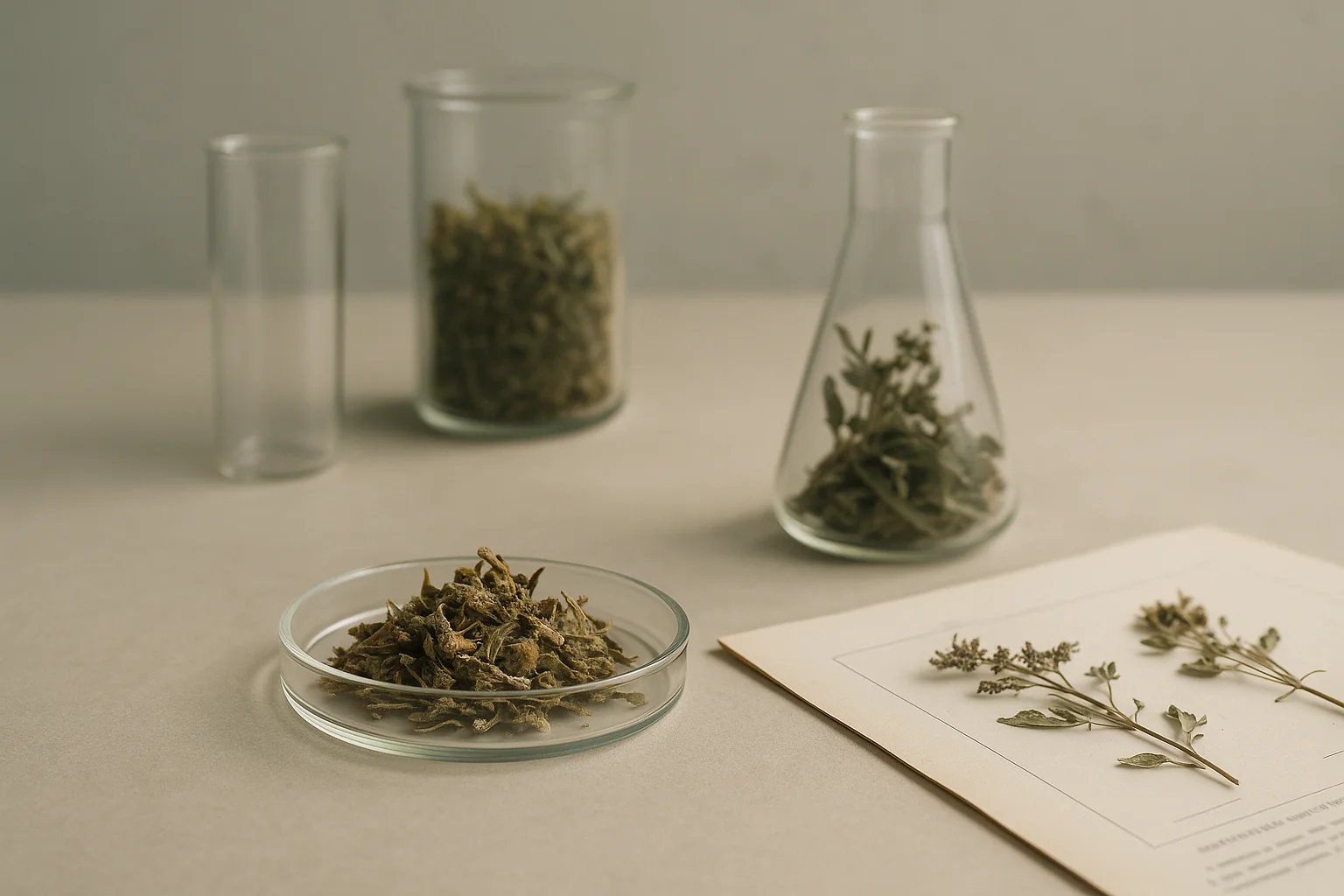

Black Tuna (Cannabis flos S-LAB): who supplies it and what is unknown about it
A strain with undisclosed lineage, introduced to Polish pharmacies by a single producer. What does the terpene profile from one source say about it, and what is not resolved by two studies on pinen?
| Strain card | Black Tuna |
|---|---|
| Producers | S-LAB (1 pharmacy position) |
| Medical brand | the same as the producer |
| Alternative names | none |
| Category according to sources | hybrid with sativa dominance |
| Leading terpene | pinen |
| Other terpenes | caryophyllene limonene linalool nerolidol ocimene |
| Lineage | unknown |
| Source consistency | one source |
- Who supplies it. Exclusively S-LAB, so there is nothing to compare versions with, and a break in supply means the absence of this strain, not another version of it.
- Profile. It leads with pinen, alongside caryophyllene, limonene, linalool, nerolidol, ocimene. We do not provide percentage shares because sources count them against different totals.
- Origin. Lineage is unknown. This is a result, not a gap to fill: we do not add parents based on name similarity.
- What is missing. The profile describes one source, so there is nothing to compare it with.
Where does Black Tuna come from and can its lineage be established?
It cannot. The lineage of Black Tuna has not been disclosed by the breeder, and available descriptions do not consistently indicate any parental pair. In the database of this cluster, the strain has an unknown value and remains so: entering parents by intuition would create a false kinship with cultivars that share only part of the name.
The name suggests much, but means nothing. In this collection, a common element may be a pure coincidence: cultivars bearing the same word may have disjoint origins or be completely unknown, so relying on the name when reconstructing genealogy leads nowhere. Therefore, with this strain, you will not find a sentence about parents, even if it sounds credible.
A source describing Black Tuna classifies it as a hybrid with sativa dominance, but this information also comes from one compilation, not from two independent ones. The division into sativa and indica, by the way, says more about the plant’s growth form than about what a patient experiences after vaporization, and does not replace a description of the chemical composition.
The lack of lineage is not a gap in this text, but its result. Commercial breeders rarely publish complete crosses, and the registration documentation for pharmaceutical raw materials does not require indicating parents, as the quality of the batch depends on repeatability, not genetic history. A strain without disclosed lineage enters the pharmacy on the same terms as any other.
Who introduces Black Tuna to Polish pharmacies?
One entity. In the collected data, the strain is introduced to the Polish market exclusively by S-LAB, so there is no choice between versions from different producers or comparison of batches. The entire presence of Black Tuna in pharmacies depends on the commercial and logistical decisions of one company, not on parallel submissions from several suppliers.
| Producer | What distinguishes this version | Basis of description |
|---|---|---|
| S-LAB | The only version recorded in the Polish market; the terpene profile described for it by one compilation | Pharmacy compilation budcare.pl |
| Other producers in the cluster | No version of this strain, so there is nothing to compare between suppliers | Collected data on availability |
We provide THC content as a range, not as a single number, and this is due to the tolerance allowed for the raw material. The producer’s declaration allows for a deviation of around ten percent in either direction, so for this strain, it is reasonable to read the THC content as 16.2-19.8%. A batch at the upper limit of the range and a batch at the lower limit both comply with the same declaration.
A single supplier has one more consequence, less obvious than the lack of choice of versions. A break in production, a change in registration, or a withdrawal of a series means that the strain disappears from pharmacies entirely, without a substitute position from another producer. The remaining positions of this producer are described in a separate text about S-LAB, and the current state of availability is led by a compilation of strains available in Polish pharmacies. Each of these positions is dispensed by prescription from a doctor in the Rpw category, while our store shelf with dried flowers collects products from industrial hemp, which this mode does not cover.
What does Black Tuna smell like and where does this smell come from?
- caryophyllene caryophyllene
- limonene limonene
- linalool linalool
- nerolidol nerolidol
- ocimene ocimene
- pinen pinen (leading in the pharmacy list)
Resinous and piney, as far as the chemical profile suggests. The smell of the dried flower comes from volatile compounds, and in this strain, the composition indicates pinen as the leading position, which is a note associated with pine resin. However, sensory descriptions are not measured in a laboratory and remain a report, not a parameter of the batch.
The rest of the profile adds background. Caryophyllene brings a peppery tone, limonene a citrus note, linalool a floral scent, nerolidol a woody aroma, and ocimene a herbal-sweet note. The proportions between them determine what is felt upon opening the package, but precisely the proportions are not provided by any available source for this strain in a way that allows for comparison.
The smell is not constant over time. Terpenes are volatile, so dried flower stored in warmth with air access loses the lightest fractions first, and these are responsible for the first impression. The same strain from two batches or from two storage moments can smell noticeably different and this does not indicate a mistake in dispensing.
The taste in vaporization spreads together with the smell, as the temperature set on the device extracts compounds one after another, not all at once. At lower settings, primarily light resinous notes may be noticeable, while at higher settings, heavier, spicier background comes through. The order of evaporation is broken down in a separate text about the temperatures at which terpenes leave the dried flower.
How long does it take for Black Tuna to take effect and how long does it last?
It depends on the route of administration, not on the strain name. Vaporized dried flower acts quickly and briefly, while ingested it acts slowly and lasts longer, and the difference between the two counts in hours. For Black Tuna, there is no separate measurement, so the ranges below describe the behavior of the raw material in the body.
The route of administration determines the course more than the strain itself, and the ranges below describe it, not this cultivar, as pharmacokinetic studies for a single cultivar have not been published.
| Vaporization | After ingestion | |
|---|---|---|
| First sensations | after a few minutes | from half an hour to two |
| Onset | another ten to thirty minutes | slow, over several hours |
| Total effect fades | within two to four hours | after six, sometimes eight hours |
| Typical mistake | none | taking a dose after thirty minutes, which gives both doses at once |
The practical significance of this is one: the time to reach for the raw material translates into the length of the episode, not just its intensity. The strain shapes the character of the effect, while the schedule determines the route of administration and it decides whether the evening dose will end before sleep or only in the morning.
What has been shown in studies on pinen, and what remains anecdotal?
Very little has been shown and only outside of humans. Two studies on pinen, the leading component of this strain’s profile, concern mice and cell culture. Everything read in commercial descriptions about the effect of Black Tuna on well-being comes from user reports or from producer materials, not from clinical research.
| Study | Model and route of administration | What was shown |
|---|---|---|
| Kim DS et al., 2015 The American Journal of Chinese Medicine PMID:26119957 |
test tube (mouse peritoneal macrophages, culture) | Alpha-pinen reduced the secretion of IL-6, TNF-alpha, and nitric oxide in cultured mouse peritoneal macrophages stimulated by LPS, and the expression of iNOS and COX-2, by inhibiting MAPK and NF-kB pathways. |
| Yang H et al., 2016 Molecular Pharmacology PMID:27573669 |
rodent (mouse, oral administration) | Orally administered (-)-alpha-pinen prolonged NREM sleep time in mice and shortened sleep latency (EEG/EMG recording), acting as a partial modulator binding directly to the benzodiazepine site of the GABA-A receptor, without affecting NREM sleep intensity or REM sleep duration. |
No anxiolytic or analgesic effects of pinen have been demonstrated in humans; available data only concern its effect on sleep in mice after oral administration and its anti-inflammatory action on mouse macrophages in culture.
The terpene profile of this strain is described by one source, a Polish pharmacy compilation, and lists caryophyllene, limonene, linalool, nerolidol, ocimene, and pinen. You will not find percentage shares here, and this is not an oversight: compilations provide values without a common denominator, and summed they can yield significantly less than the total sample, so comparing them between strains would be blind counting.
What side effects have been reported for this strain?
None attributed to this strain. The reporting system in Poland links observation with a specific medicinal product and batch number, not with the name of the cultivar, so a separate compilation for Black Tuna simply does not exist. What can be described relates to all dried flower dispensed in pharmacies, not to this one position.
Reports of side effects are collected for the medicinal product with a batch number, not for the strain name, so the following pertains to hemp flower as a group of raw materials. The most commonly reported are dry mouth, red eyes, and increased heart rate. Less frequently described are dizziness upon rapid standing, daytime drowsiness, and temporary worsening of short-term memory, as well as anxiety increasing with dosage. A separate issue is medications taken concurrently, especially sedatives and those affecting coagulation: their assessment requires knowledge of the entire list of preparations, not just the description of the plant. We do not provide the frequency of these symptoms numerically, as public compilations for hemp flower in Poland do not separate them by individual products.
It is worth distinguishing two things that are often mixed in strain descriptions. THC content affects how easily one can exceed the threshold at which anxiety or increased heart rate occurs; the range of 16.2-19.8% places this strain in the middle of the scale found in Polish pharmacies. The terpene composition, however, has no documented effect on the frequency of such symptoms in humans, although it is often presented in commercial materials as if it did.
At what temperature is the dried flower with pinen vaporized?
Lower than intuition suggests. Pinen is one of the lightest compounds in this profile and evaporates earlier than most others, so at high settings, it disappears from the first puffs. However, temperature tables from different sources provide different values for the same compound, so it is better to read them as a guideline rather than a setting.
The discrepancy between tables has a mundane cause. The boiling point measured for a pure compound under laboratory conditions is not the same as the temperature at which the same compound leaves the plant material in the device’s chamber. Additionally, the number displayed on the vaporizer describes the heater or chamber, not the dried flower lying in it. This difference is broken down in a separate text about the vaporizer setting versus the actual temperature of the dried flower.
For the profile led by pinen, this means that a session conducted from lower settings to higher allows for the lighter fractions to be received first, and only then the heavier background. None of these numbers indicate how much substance actually passes into the inhaled aerosol, as this is not measured under home conditions. Why temperature compilations can be incomparable is explained in a text about discrepancies between tables.
Which strains from Polish pharmacies are related to it?
None, whose kinship could be demonstrated. The pedigree graph in this cluster does not assign Black Tuna any parents or siblings, and with undisclosed lineage, there is nothing to derive a connection from. An empty list is a result here, not a lack of data, and it will not be filled in by intuition.
However, one can indicate a different kind of proximity, based on composition rather than genealogy. Strains in which pinen occupies a leading position are described in a common discussion of this compound, and the other positions in the profile have their own separate texts: caryophyllene, limonene, linalool, nerolidol, and ocimene.
This kind of proximity should not be read as lineage. Two strains with similar compositions may come from completely disjoint breeding lines, and two sibling strains can differ in profile, as the content of volatile compounds is also determined by the cultivation method and post-harvest processing. Kinship thus speaks of the history of seeds, while composition speaks of what actually ended up in the package, and these two orders cannot be overlaid without measuring a specific batch. A complete list of positions available in Polish pharmacies is led by the list of available strains, updated with changes in the assortment.
Frequently asked questions about the Black Tuna strain
Is the lineage of Black Tuna known?
No. The breeder has not disclosed the parental pair, and available descriptions are not consistent with each other, so in this cluster, the strain has an unknown origin. The common element of the name with other cultivars proves nothing here.
How many producers supply Black Tuna to Polish pharmacies?
One. In the collected data, the strain is introduced to the market exclusively by S-LAB, so there are no versions from competing producers that could be compared.
What THC content is reported for this strain?
Considering the allowable tolerance of the producer, the THC content falls within the range of 16.2-19.8%. A single number from the label describes a declaration, not the measurement result of a specific batch of dried flower.
Which terpene leads in the profile of Black Tuna?
Pinen, according to the only source describing the composition of this strain. Besides it, caryophyllene, limonene, linalool, nerolidol, and ocimene are mentioned, without providing percentage shares.
Has the sedative effect of pinen been demonstrated in humans?
No. The effect on sleep has been noted in mice after oral administration, and the second of the available studies concerned the culture of mouse macrophages. Transferring these results to humans would be an overinterpretation.
Does Black Tuna have sister strains in Polish pharmacies?
No. Without established lineage, it is impossible to indicate siblings, and the kinship graph in this cluster leaves an empty list for this strain.
In what mode is this strain dispensed?
Exclusively by prescription from a doctor, in the Rpw category. Hemp flower remains a pharmaceutical raw material, and the decision on its use lies with the attending physician.
Editorial text from ubucha. Hemp flower is a pharmaceutical raw material dispensed exclusively by prescription from a doctor in the Rpw category. The material is informational in nature, describes the state of evidence, and does not replace consultation with the attending physician.