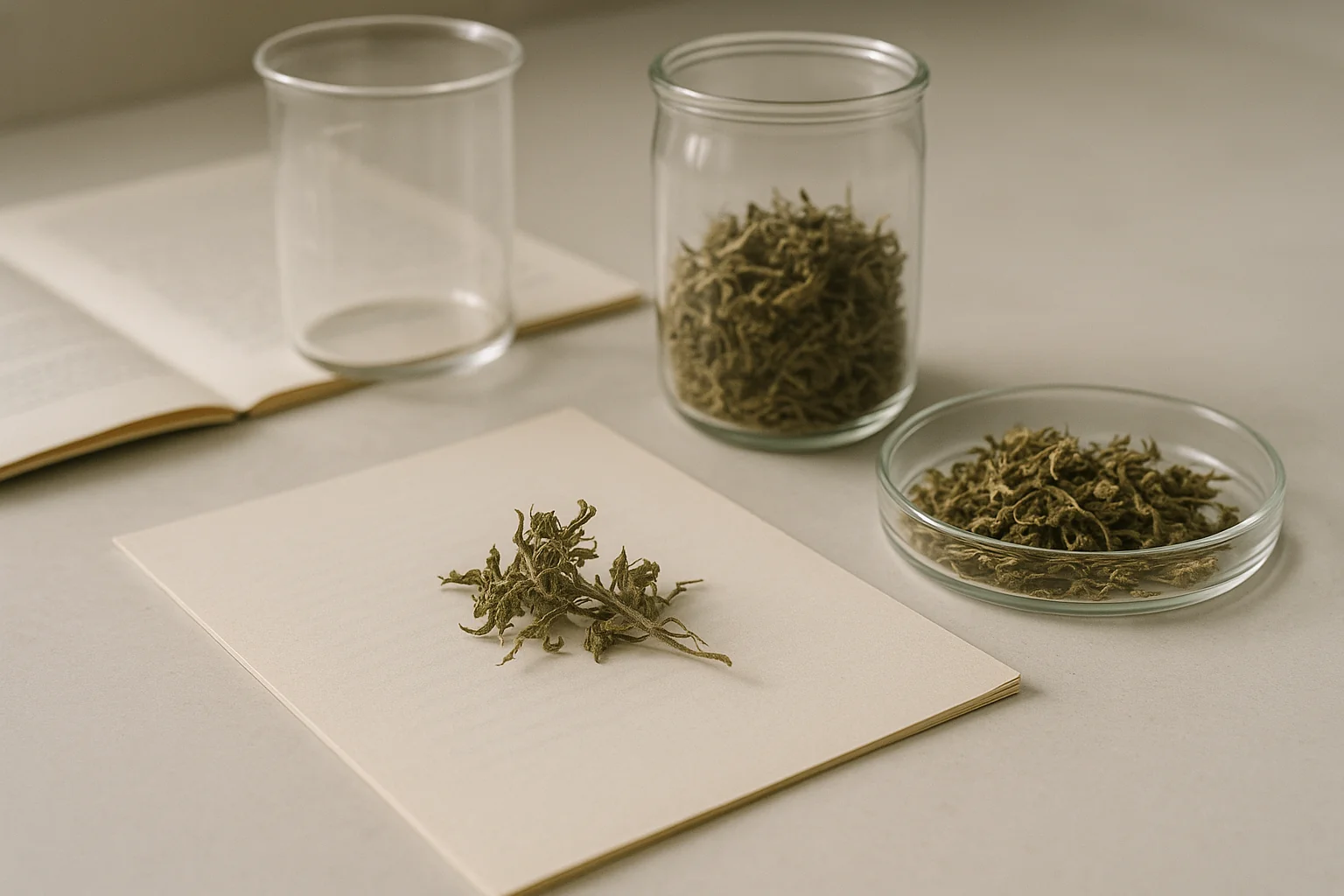

Frosted Cherry Cookies and Purps: the same THC range, different leading terpene, different lineage
Two strains from the same three producers, with identical declared THC range. They are separated by the leading terpene, documentation of origin, and whether both Polish databases provide the same composition.
| Feature | Frosted Cherry Cookies | Purps |
|---|---|---|
| Producers | S-LAB, Synoptis Pharma, Tilray (3 entries) | S-LAB, Synoptis Pharma, Tilray (4 entries) |
| Category by sources | hybrid-indica / indica (sources inconsistent) | hybrid-indica / indica (sources inconsistent) |
| Leading terpene | myrcene | caryophyllene |
| Other terpenes | humulene caryophyllene limonene pinene | bisabolol humulene limonene linalool myrcene nerolidol pinene |
| Lineage | established Cherry Cookie × The White | unknown |
| Source agreement | consistent | divergent |
- Profile. Frosted Cherry Cookies leads with myrcene, Purps leads with caryophyllene.
- Availability. Both are supplied by S-LAB, Synoptis Pharma, Tilray, so one order can include both.
- Origin. The lineage of one is established, the other is not, so we cannot compare them by origin.
- What this table does not say. It does not include the declared content as a single number or price. Which strain is suitable for whom is determined by the attending physician, not by the comparison of features.
What do these two strains really differ in?
In the leading terpene, lineage, and degree of source agreement. Frosted Cherry Cookies is described by myrcene, Purps by caryophyllene. The first has parents listed by the breeder, the second has none at all. The declared THC content is the same in both cases, so the number on the package does not separate these two entries.
The distinction begins with which compound sets the tone for the entire profile. With Frosted Cherry Cookies, myrcene is at the top of the list, mentioned alongside pinene, while with Purps, the dominance of caryophyllene over the rest of the list is clear and repeats in both databases. This is not a difference in aroma, but a difference in the evidence: myrcene and caryophyllene have different studies behind them, conducted in different models, and conclusions from one do not transfer to the other.
The second axis of distinction is lineage. The breeder of Frosted Cherry Cookies explicitly described what was used for crossing, and this description can be quoted today. With Purps, there is no such statement anywhere. The name itself circulates in the market in several variants, from Californian clone lines to material sold under a similar name by various seed banks, and none of them can be attributed to a pharmaceutical position. The origin recorded as unknown is the result of verification here, not an empty field in the table.
The distinction is also visible in the descriptions of aroma, although these are the softest material in the entire documentation. The cards for Frosted Cherry Cookies list citrus, berry, pine, and herbal notes, while the cards for Purps list spicy, peppery, and earthy, and one of the pharmaceutical entries for Purps has instead a floral-fruity description.
What connects them?
The producers, THC range, and the way they are described in Polish databases. Both are supplied by the same three entities: S-LAB, Synoptis Pharma, and Tilray. Both have an empty sibling list in the pedigree graph and are sometimes classified as a hybrid with indica dominance, sometimes as pure indica.
The set of compounds in the profile is also common. All five terpenes listed for Frosted Cherry Cookies appear in the list for Purps: humulene, caryophyllene, limonene, myrcene, and pinene. Purps adds four more names that are not present in the first strain. The smaller set is therefore entirely contained within the larger one, and the divergence between them concerns the order and length of the list, not that one database listed a compound unknown to the other.
The path to market looks similar. Both strains appear in the registry in more than one entry, with different declared strengths, under a name that carries a number along with a note about the allowed deviation. The same trade name thus stands on the shelf in two documentation variants, and the pharmacy dispenses the one it currently has in stock.
However, they are not connected by name. Frosted Cherry Cookies shares a part with Girl Scout Cookies and Zookies, and its parent recorded as The White has nothing to do with White Widow, despite one common word. Purps is listed alongside Big Purple Dragon and Purple Octane, whose lineages lead completely elsewhere. A common term does not create an edge in the lineage graph, and the sibling list of both strains remains empty.
Which source describes the composition of each and do both say the same thing?
For Frosted Cherry Cookies, both listings provide the same composition, while for Purps they differ from each other. Source agreement in this collection is rare: out of twenty-five strains described by both services, three overlap, and twenty-two have compositions listed divergently. So, one typical page and one exceptional page have occurred here.
Agreement for the first strain concerns the complete set of ingredients: both services list humulene, caryophyllene, limonene, myrcene, and pinene, without a single excess entry on either side. This does not mean that the descriptions are identical. One of them provides shares and places myrcene on par with pinene, while the other provides only the order and opens with pinene. Thus, what the profile consists of is agreed upon, but not what leads it.
For Purps, the divergence is much deeper. The shorter list mentions four compounds: caryophyllene, nerolidol, bisabolol, and limonene. The longer one adds humulene, linalool, myrcene, and pinene, effectively doubling the list. One thing remains common: both services place caryophyllene at the forefront. A reader who first encounters one source and then the other will see two different descriptions of the same pharmaceutical entry.
We do not provide shares in percentages, and there is a reason for that. In the same database, five values recorded for Frosted Cherry Cookies sum to 79, while eight values for Purps give 99. Neither of these sums reaches one hundred, and both are different, so it is unclear what whole these numbers refer to. Placed next to the name of the compound, they would look like a measurement, but they are not.
What THC content do the pharmaceutical entries for each strain declare?
Exactly the same, and this is the most inconvenient result here. Both strains enter the market in several separate registry entries with two different nominal strengths, and when all are combined, the THC content range turns out to be identical: 16.2-24.2% for both.
This range consists of two declarations. The lower one, when accounting for the allowed deviation, gives a range of 16.2-19.8%, the higher one a range of 19.8-24.2%, and only the sum of both is what is visible in the aggregate comparison. Frosted Cherry Cookies has entries at both levels, Purps does too, so even this internal structure of the range looks the same for them.
The content is given as a range, not as a single number, because the manufacturer’s declaration is a nominal value with an allowed deviation in both directions. However, the deviation alone does not explain the entire width of the range. If there were a single declaration behind it, the upper limit would exceed the lower by about one-fifth, but here it exceeds it by nearly half. The rest comes from the fact that under each of these two names stand several separate registry entries, often from different producers. For the comparison of both strains, this results in one conclusion: the number printed on the package is not a distinguishing feature here.
How quickly do they start to work and how long does the effect last?
Equally fast or equally slow, because the method of intake determines this, not the strain name. For neither of these two entries is there a separate study measuring concentration over time, so the only fair ranges are those described for inhalation and for oral intake.
The method of administration determines the course more than the strain itself. After vaporization, the substance passes from the lungs to the blood almost immediately, so the first sensations appear after a few minutes, the intensity increases for another ten to thirty minutes, and the whole effect fades within two to four hours. After ingestion, the substance first passes through the intestine and liver, so the first sensations are awaited from half an hour to two hours, and the episode lasts six, sometimes eight hours. Hence the most common mistake with oral administration: those who think nothing is happening after thirty minutes and take another dose will receive both doses at once. The above ranges describe the method of administration, not the strain; pharmacokinetic studies for a single cultivar have not been published.
For the comparison of the two strains, this has one consequence. If someone feels a difference in the onset speed, its source is more likely the method of intake and the pace of dosing rather than the composition of the plant, as both are dispensed to the pharmacy as dry herb, not as a ready oral form. The method of administration is determined, after all, by the attending physician, the same one who writes the prescription.
What is known and what is not known about the effects of both strains?
Nothing certain about the strains themselves. Neither has been the subject of a study involving patients, and the material that can be referenced concerns individual terpenes from their profiles, studied in rodents and in vitro. The table below collects five such studies along with the model in which they were conducted.
| Study | Model | What was shown | Identifier |
|---|---|---|---|
| do Vale TG et al., 2002, Phytomedicine | rodent (mouse, intraperitoneal administration) | Myrcene administered intraperitoneally (100-200 mg/kg) reduced the locomotor activity of mice in the open field test, prolonged sleep time induced by pentobarbital (at 200 mg/kg about 2.6 times), and reduced the number of entries into the open arms of the elevated plus maze, which the authors described as a weak anxiogenic effect, not anxiolytic. | PMID:12587690 |
| Rao VS et al., 1990, Journal of Pharmacy and Pharmacology | rodent (mouse) | Myrcene (10-40 mg/kg) reduced pain responses in mice in hot plate and writhing tests induced by acetic acid; the effect was reversed by naloxone and yohimbine, indicating involvement of alpha2-adrenergic receptors and release of endogenous opioids. | PMID:1983154 |
| Wagner JK et al., 2024, NeuroSci | rodent (mouse, vapor inhalation) | With short inhalations mimicking inhalation in humans, beta-myrcene acted anxiolytically in the elevated plus maze in female mice, and in males only with a single inhalation. Unlike linalool, myrcene did not produce a synergistic effect with cannabidiol in either sex. | PMID:39728677 |
| Gertsch J et al., 2008, Proceedings of the National Academy of Sciences (PNAS) | mouse (in vivo) and in vitro (receptor binding, human cells) | (E)-caryophyllene selectively bound to the CB2 receptor (Ki = 155 nM) and inhibited carrageenan-induced paw edema in wild-type mice, but not in CB2 receptor-deficient mice (Cnr2-/-), indicating a mechanism dependent on CB2; the study did not include any anxiety tests. | PMID:18574142 |
| Klauke AL et al., 2014, European Neuropsychopharmacology | rodent (mouse) | Oral caryophyllene reduced the late inflammatory phase of pain in the formalin test in a CB2 receptor-dependent manner, with no effect on the early phase; in a neuropathic pain model, it alleviated thermal hyperalgesia and mechanical allodynia without developing tolerance with chronic administration. | PMID:24210682 |
The first three entries concern myrcene, the compound attributed to Frosted Cherry Cookies, and do not speak with one voice. Intraperitoneal administration gave a different direction than vapor administration, and the study on pain responses describes a completely different mechanism, involving alpha2-adrenergic receptors.
In humans, it has not been shown that myrcene alone alleviates insomnia at doses typical for inhalation of dry herb. The direction of the effect in rodents depends on the method of administration and sex: after intraperitoneal injection in 2002, a slightly anxiogenic effect was described, while after vapor administration in 2024, an anxiolytic effect was noted in females. These two results do not cancel each other out; they show that the conclusion depends on conditions that no popular strain database provides.
The last two entries concern caryophyllene, the leading compound in the Purps profile. Both point to the same cannabinoid receptor type 2, and one of them shows this in the strongest available way: the effect disappears in mice lacking this receptor. The mechanistic pathway is therefore clearer here than with myrcene, but it still does not come from humans.
In neither of the two studies was caryophyllene tested on humans or in vapor form from dry herb; both works concern oral or systemic administration in mice in pain and inflammation models, not sleep or mood.
What adverse effects have been reported for each of these two strains?
Separately, there are no such data for either. Reporting from safety monitoring is associated with a specific medicinal product and batch number, not with the name of the cultivar, so the comparison of Frosted Cherry Cookies with Purps in this regard has no basis. Below is a description concerning dry herb as a group of raw materials.
Reports of adverse effects are collected for a medicinal product with a batch number, not for the strain name, so the following concerns hemp dry herb as a group of raw materials. The most frequently reported effects are dry mouth, red eyes, and increased heart rate. Less commonly described are dizziness upon rapid standing, daytime drowsiness, and transient worsening of short-term memory, as well as anxiety that increases with dosage. A separate issue is medications taken concurrently, especially sedatives and those affecting coagulation: their assessment requires knowledge of the entire list of preparations, not just the description of the plant. We do not provide the frequency of these symptoms numerically, as public compilations for hemp dry herb in Poland do not separate them by individual products.
If numbers were to appear separately for each of these names, they would still need to be read cautiously. A larger number of reports usually follows greater sales, not a worse safety profile, and both strains may be available at different times and in different numbers of pharmaceutical entries. Comparing raw numbers of reports would therefore give a picture of the market, not a picture of risk.
Where to check which of them is currently in pharmacies?
In the availability list that we maintain separately, not in this text. The assortment changes from month to month, as it depends on the importer’s deliveries and which entries currently have valid permits, not on how the strain has been described in the database.
The aggregate list of strains currently available in Polish pharmacies is in the list of currently available strains, and that is where changes in the assortment are recorded. A full description of each of these entries individually, along with a list of producers and origin, can be found on the strain page Frosted Cherry Cookies and on the strain page Purps.
The availability of one and the other changes independently of each other. In the last review, some entries for Frosted Cherry Cookies were described as unavailable, while another entry for the same strain was in stock; for Purps, the situation looked similar, but it concerned different producers. The strain does not disappear from the market entirely, but rather leaves it in entries, and that is why the question of availability makes sense only with a date.
There is also a category in the store for hemp dry herb, but that shelf is completely separate from the pharmaceutical one: that product comes from a different plant, is purchased without a prescription, and has a THC content below the threshold set in regulations, so it does not share either the dispensing method or the legal basis with the raw material described above.
Frequently asked questions
Are Frosted Cherry Cookies and Purps the same strain under two names?
No. They are two separate entries with different terpene profiles: the first is led by myrcene, the second by caryophyllene. However, they are connected by the fact that they are supplied by the same three producers and that the declared THC content falls within the same range.
Which of these two strains has a documented lineage?
Frosted Cherry Cookies. The breeder explicitly stated that they used their own cut of Cherry Cookie and the strain The White. The origin of Purps is recorded as unknown in this comparison because no available source indicates the parents of the entry sold under that name in pharmacies.
Why do you not provide percentage shares for terpenes?
Because it is unknown what whole these shares refer to. In the same database, five values recorded for Frosted Cherry Cookies sum to 79, while eight values for Purps give 99, and neither of these sums reaches one hundred. A number without a denominator looks like a measurement, but it is not.
Can these strains be distinguished by THC content?
No. Both have entries in the registry with two declared levels, and when combined, the THC content range turns out to be identical: 16.2-24.2%. The whole difference lies outside this number, namely in the profile composition and how much is known about it.
Does either of them work more strongly for sleep or pain?
It is not known, as no such comparison has been conducted. Available studies concern isolated terpenes given to mice, not dry herb taken by patients, and can yield conflicting results even within a single compound.
Is the dry herb from the store category the same as these two strains?
No. Hemp dry herb with cannabidiol sold without a prescription comes from a different plant and is subject to different regulations than the pharmaceutical raw material described in this text. They are two separate shelves and should not be compared.
Hemp dry herb is a pharmaceutical raw material dispensed by prescription in the Rpw category, and the material is informational in nature and does not replace a conversation with the attending physician. The editorial text was prepared by the ubucha.pl team.