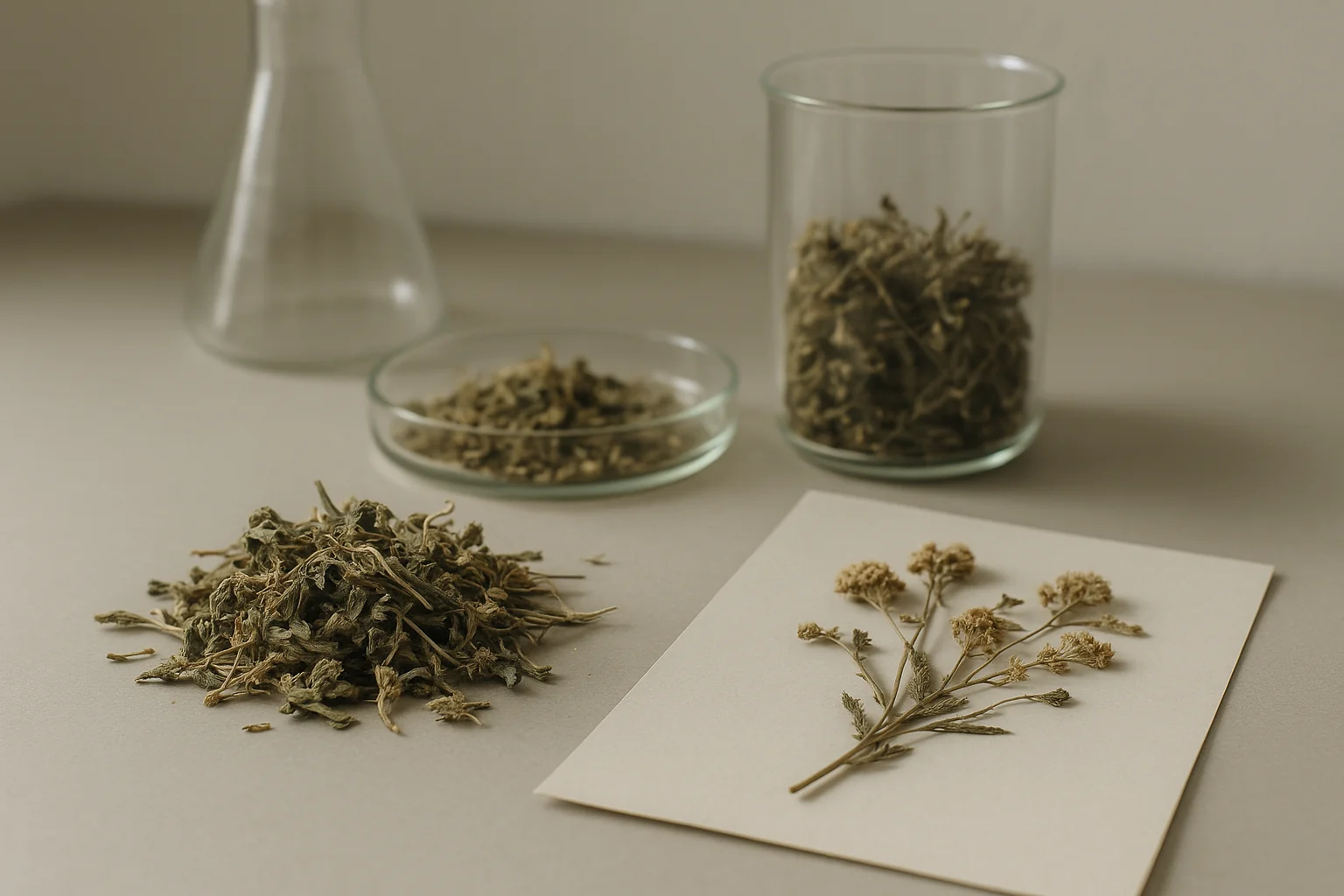

Tilray Sirius (Cannabis flos Tilray): lineage of Chemdawg and caryophyllene from the registry
What the records say about the Tilray Sirius strain: the parental pair Chemdawg and Alien Tech, caryophyllene leading the profile described by one source, and the declared potency given with the producer's tolerance.
| Strain card | Tilray Sirius |
|---|---|
| Producers | Tilray (1 pharmacy position) |
| Medical brand | the same as the producer |
| Alternative names | none |
| Category according to sources | indica |
| Leading terpene | caryophyllene |
| Other terpenes | bisabolol humulene limonene linalool myrcene nerolidol pinene |
| Lineage | established Chemdawg × Alien Tech |
| Source consistency | one source |
- Who supplies it. Exclusively Tilray, so there is nothing to compare versions, and a supply break means no availability of this strain, not another version of it.
- Profile. It features caryophyllene, alongside bisabolol, humulene, limonene, linalool, myrcene, nerolidol, and pinene. We do not provide percentage shares, as sources calculate them against different totals.
- Origin. The lineage is established, with parents being Chemdawg and Alien Tech.
- What is missing. The profile describes one source, so there is nothing to compare it with.
What is Tilray Sirius and what do the collected records say about its origin?
Tilray Sirius is a cannabis flower product from the producer Tilray, listed in the Polish pharmacy registry as a single entry. Collected sources consistently state its lineage: Chemdawg crossed with Alien Tech. Aside from the lineage and the assignment of the leading terpene, there is little information about this product, and that is the correct answer, not a gap to be filled.
The lineage is stated in three places at once. The service weedstrain.com directly lists the parent pair Chemdawg and Alien Tech under this trade name. The Wiki medbud.wiki maintains a separate strain page for this producer. The Leafly catalog describes the strain Alien Dawg with a note that Tilray sells it under its own trade name Sirius. The third record uniquely explains the discrepancy in names between catalogs and is the only one without a counterpart in the Polish register of medicinal products.
In the registry from which this cluster derives its pharmacy composition, the trade name Sirius appears twice: once under the producer S-LAB, and once with the producer prefix as Tilray Sirius. The project treats these two entries as separate listings and describes them as such. This text pertains solely to the Tilray position. Whether both are based on the same plant material is not clarified by the records: one has the lineage of recorded parents, the other has none at all, and none of the collected sources equate them or negate that equality. The position of the second producer is described in this cluster in a separate entry.
Which producers supply this strain to Polish pharmacies?
One. In the pharmacy registry on which this cluster stands, the Tilray Sirius position appears once and comes from Tilray, a producer that offers fourteen strains in Polish pharmacies. The registry does not note a second version of the same position, so there is nothing to compare between producers. The table below shows what each record carries for this position separately.
| Record | What it carries for Tilray Sirius |
|---|---|
| Pharmacy strain registry | Producer Tilray, leading terpene caryophyllene, one position |
| Terpene database budcare.pl | Zero entries under this name |
| Terpene database medweed.pl | Zero entries under this name |
| Lineage graph of the cluster | Parents recorded as Chemdawg and Alien Tech |
| Siblings comparison | One strain from Polish pharmacies: GMO |
Two zeros in the middle of the table mean exactly what they say. The terpene composition of this position is not publicly documented: both databases from which this cluster derives profiles have no entries under this name, and the only trace remains the assignment of the leading terpene in the pharmacy registry. Such an assignment indicates what the registry’s editorial team considered the primary note, and does not replace the result of sample analysis. Listing the terpene here would mean transferring numbers collected under another entry to this position, so there is no list here.
The number of producers under one name changes over time and is not a characteristic of the strain. The permit for the admission of raw material seems to be for a limited time, the producer may change along with the supplier of the material, and the wholesaler can remain empty for weeks without any formal movement. Therefore, we keep the inventory status in one place, not in every entry about the strain: the current list is maintained in a comprehensive overview of available strains. Other positions from the same producer are collected in a separate entry about Tilray.
What does Tilray Sirius smell and taste like?
- bisabolol bisabolol
- humulen humulen
- caryophyllene caryophyllene (leading in the pharmacy registry)
- limonen limonene
- linalol linalool
- mircen myrcene
- nerolidol nerolidol
- pinen pinene
The source description lists four notes for this position: camphor, spicy, peppery, and pine. These are provided by one source, the same one that maintains the profile composition, so it is a report from a single service, not a result of organoleptic testing conducted according to an announced protocol. The second source does not note either smell or taste here.
The profile composition described for this position includes eight compounds: caryophyllene, myrcene, nerolidol, limonene, humulene, pinene, linalool, and bisabolol. The highest share is attributed to caryophyllene, which aligns with the leading terpene from the pharmacy registry. We do not record shares numerically, as the source provides them without a denominator.
Caryophyllene is responsible for the peppery and spicy note. This same compound gives sharpness to black pepper, is found in cloves and hops, and it is the one behind the impression that commercial descriptions usually call woody or earthy. Thus, two of the four noted notes align with the first compound in the composition.
Descriptions of smells in Polish strain listings are editorial labels, not results of organoleptic testing conducted according to an announced protocol. Two services can assign completely different adjectives to the same registry position, as each compiles its own list of acceptable terms and decides how many to use. Additionally, the smell depends on the batch and how long the flower has been stored and in what, as terpenes are volatile and diminish over time. Those expecting a repeatable smell from the strain name expect more from the plant material than it provides.
How long does it take for this strain to take effect and how long does the effect last?
This is determined by the method of administration, not by the fact that this position is named as such. For Tilray Sirius, no one has measured either the onset of action or its duration. What can be stated honestly pertains to the method of intake and is the same for the entire group.
The method of administration determines the course more than the strain itself, and the ranges below describe it, not the cultivar, as pharmacokinetic studies for a single cultivar have not been published.
| Vaporization | After ingestion | |
|---|---|---|
| First sensations | after a few minutes | from half an hour to two |
| Onset | another ten to thirty minutes | slowly, over several hours |
| Total duration | within two to four hours | after six, sometimes eight hours |
| Typical error | none | taking a dose after thirty minutes, which gives both doses at once |
For this position, there is not even material for a cautious assumption. Since there is neither published composition nor personal measurement behind it, the mere assignment of the leading terpene from the registry does not allow guessing whether the course deviates from the above in any direction.
What has been demonstrated, and what has not been demonstrated about the effects of this strain?
Nothing has been demonstrated for the strain itself. There is no study in which volunteers were given this position and the effect measured. Everything below pertains to caryophyllene as a single chemical compound assigned to this strain by the pharmacy registry, not by a published measurement of the sample’s composition.
| Study | Model and method of administration | What was demonstrated |
|---|---|---|
| Gertsch J et al., 2008 Proceedings of the National Academy of Sciences (PNAS) PMID:18574142 |
mouse (in vivo) and test tube (receptor binding, human cells) | (E)-caryophyllene selectively bound to the CB2 receptor (Ki = 155 nM) and inhibited carrageenan-induced paw swelling in wild-type mice, but not in CB2 receptor-deficient mice (Cnr2-/-), indicating a CB2-dependent mechanism; the study did not include any anxiety tests. |
| Klauke AL et al., 2014 European Neuropsychopharmacology PMID:24210682 |
rodent (mouse) | Oral caryophyllene reduced late inflammatory pain in mice in the formalin test in a CB2 receptor-dependent manner, with no effect on the early phase; in a neuropathic pain model, it alleviated thermal hyperalgesia and mechanical allodynia without developing tolerance with chronic administration. |
The limits of these studies must be stated directly. In neither of the two studies was caryophyllene tested on humans or in inhaled form from flower; both works pertain to oral or systemic administration in mice in pain and inflammation models, not sleep or mood. Everything else circulating about this strain is either catalog material from the producer or patient reports, thus describing impressions, not measured effects.
What side effects have been reported from this strain?
None specifically for it. The reporting system does not recognize strain trade names, so there is not a single report under the name Tilray Sirius, and there will not be until events are described by the medicinal product’s batch number. The following pertains to cannabis flower as a group, not this single position.
Reports of side effects are collected for the medicinal product with a batch number, not for the strain name, so the following pertains to cannabis flower as a group of raw materials. The most commonly reported are dry mouth, red eyes, and increased heart rate. Less frequently described are dizziness upon rapid standing, daytime drowsiness, and transient worsening of short-term memory, as well as anxiety increasing with dosage. A separate issue is medications taken concurrently, especially sedatives and those affecting coagulation: their assessment requires knowledge of the entire list of preparations, not just the description of the plant. We do not provide the frequency of these symptoms numerically, as public listings for cannabis flower in Poland do not separate them by individual products.
Neither the lineage nor the assigned terpene changes anything here. A report enters the system with the medicinal product’s batch number, and the strain name does not carry a batch number, so breaking such a collection into individual pharmacy positions remains beyond the reach of anyone working solely with public sources.
What is known about the vaporization temperature for this strain?
Less than popular tables promise. For this position, no one has announced a recommended range, and the only hard numbers that can be cited here pertain to caryophyllene itself and come from a chemical database, not from a study on the vaporization of flower by patients. No such study exists in the evidential base of this cluster.
The public database PubChem lists caryophyllene under CID 5281515 and provides a boiling point of 256-259 °C at 760 mm Hg. A second entry in the same database mentions 130 °C, but at 14 mm Hg, which is under pressure several dozen times lower than atmospheric. Combining both numbers in one column yields a result without physical sense, and this is how most terpene temperature tables circulating online are created.
The boiling point is not, in fact, the threshold at which a terpene begins to vaporize. Vaporization also occurs below this point, and its rate increases with temperature smoothly, so targeting a setting for one chosen compound remains a superficial act. Additionally, the number on the device describes the heating element or air, not the temperature of the flower itself, which cools with each draw and heats unevenly. A broader discussion is covered in a separate entry about vaporization of terpenes, and caryophyllene itself is dedicated to a entry about this terpene. The method of taking the raw material is determined by the attending physician.
Which strains from Polish pharmacies are related to it?
| Strain | Common parent | Leading terpene | Producers |
|---|---|---|---|
| GMO | Chemdawg | myrcene | Four 20 Pharma |
One: GMO. The lineage graph of this cluster connects both positions through a common parent, which is Chemdawg, and aside from this one pair, it does not establish any other connection for Tilray Sirius among strains present in Polish pharmacies. The second parent, Alien Tech, does not appear in the graph with anything else.
GMO has its parents recorded as Chemdawg and Girl Scout Cookies, so exactly half of the parental pair is common. It is supplied to pharmacies by a different producer than this strain, which clearly shows that kinship and supplier are two independent orders. GMO itself is described in this cluster in a separate entry.
Further, the graph becomes sparser than the names would suggest. Chemango Kush has GMO among its parents, meaning it is one generation further and is not a sibling. Krypton has a parent recorded as Chemdawg 91, and that is a separate entry in the graph, not the same as Chemdawg, so there is no connection from here. Gorilla Glue carries in its lineage Chem’s Sister: a common name component with zero common parent.
The matter of the trade name itself stands separately. The second position listed in the registry under the name Sirius has its lineage recorded as unknown, so the graph does not connect it with anything, including this strain. A common name is not a premise for kinship in this context and does not work the other way around: its absence does not exclude anything.
Frequently asked questions about the Tilray Sirius strain
Is Tilray Sirius and Sirius the same strain?
The records do not resolve this. The pharmacy registry maintains both names as two separate entries under different producers, and the lineage graph has recorded parents only for one of them. This cluster describes them as two separate entries and should be read as such: as two records, not as an established identity or an established difference.
What lineage does Tilray Sirius have?
The collected sources record the parental pair as Chemdawg crossed with Alien Tech. One of them adds that the producer maintains under this trade name a strain known elsewhere as Alien Dawg. The Polish register of medicinal products does not have a field for lineage, so this is a catalog entry, not an official one.
How many producers supply this strain to Polish pharmacies?
One, Tilray. The number of producers under the strain name changes over time, as permits expire, and positions may be withdrawn and reintroduced. The current state of availability is maintained in a comprehensive overview of strains, not in this entry.
Is the terpene composition of this strain known?
Yes, but it is described by only one source. It lists eight compounds, with caryophyllene having the highest share, which aligns with the leading terpene from the pharmacy registry. The second database does not maintain an entry under this name, so there is no confirmation from the other side.
Has this strain been studied in humans?
No. No study has been published in which this position was given to humans. The studies cited in this text pertain to a single terpene administered to mice and cell systems, not to flower inhaled by patients.
Can cannabis flower be purchased without a prescription?
No. Cannabis flower is a pharmaceutical raw material dispensed by a doctor’s prescription in the Rpw category, and its use and method of administration are determined by the attending physician.
The material is informational and does not replace medical advice nor encourage the use of any product.
Editorial text: editorial team ubucha.pl