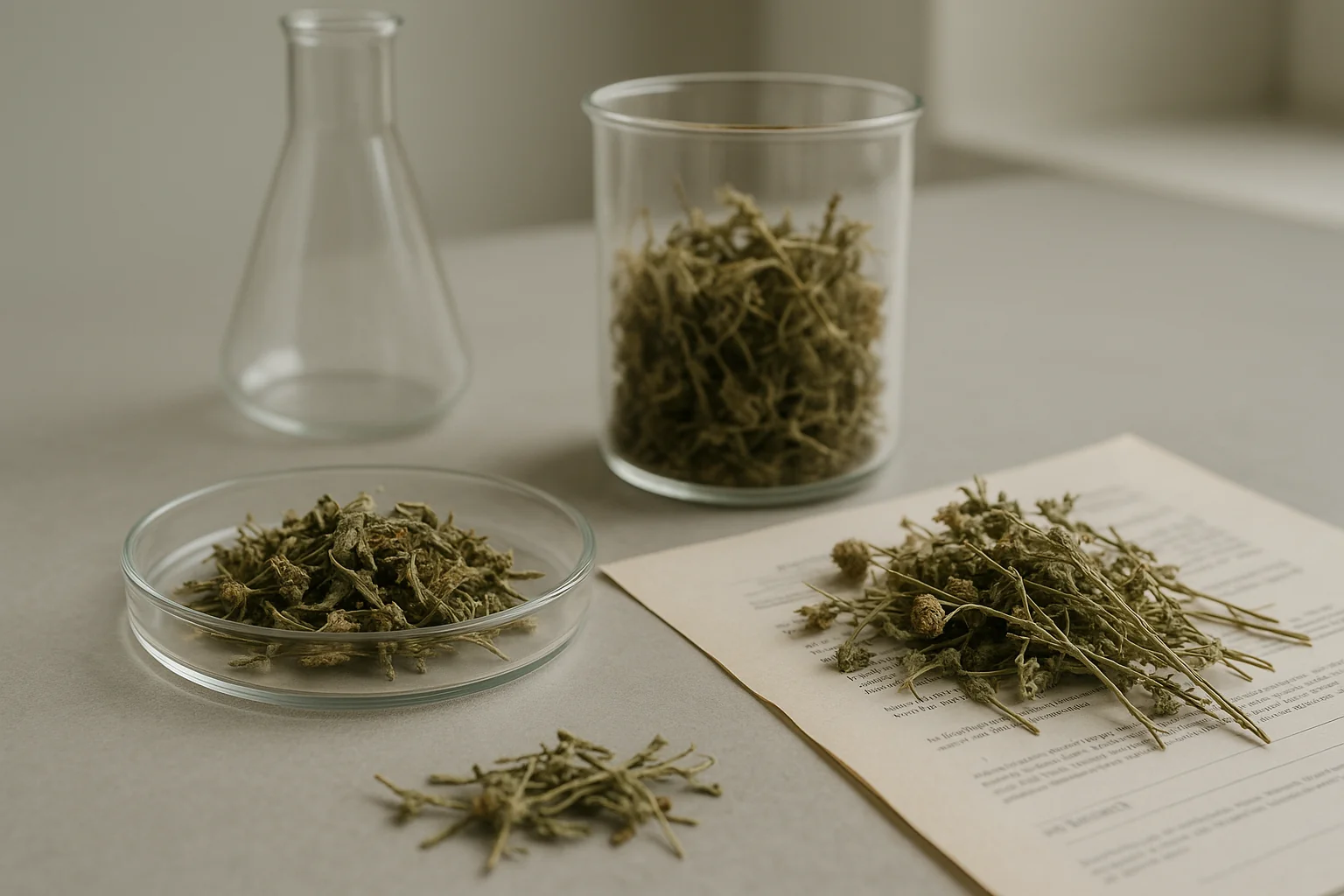

Wappa (S-LAB and Synoptis Pharma): berry-mandarin aroma and caryophyllene
Wappa is a herb with a fruity-berry scent with notes of mandarin and skunk, in which the terpene composition is led by caryophyllene. The strain's lineage has not been established, and pharmacy versions are supplied by S-LAB and Synoptis Pharma.
Preparation: redakcja ubucha.pl.
| Strain card | Wappa |
|---|---|
| Producers | S-LAB, Synoptis Pharma (2 pharmacy positions) |
| Medical brand | same as producer |
| Alternative names | none |
| Category according to sources | hybrid with indica dominance |
| Leading terpene | caryophyllene |
| Other terpenes | humulene linalool myrcene pinene |
| Lineage | unknown |
| Source consistency | one source |
- Who supplies. 2 producers (S-LAB, Synoptis Pharma) in 2 positions, which may differ in declaration and origin of the raw material.
- Profile. It leads with caryophyllene, alongside humulene, linalool, myrcene, pinene. We do not provide percentage shares, as sources count them against different totals.
- Origin. Lineage unknown. This is a result, not a gap to fill: we do not add parents based on name similarity.
- What is missing. The profile describes one source, so there is nothing to compare it with.
What is Wappa and where does it come from?
It is unknown which parents Wappa inherited its composition from. Available descriptions consistently classify it as a hybrid with indica dominance, but none indicate the parental strain pair. The declared THC content is in the range of 19.8-24.2% when considering the producer’s tolerance. The name itself does not determine its origin.
The note of unknown lineage is not a gap in our database, but a state of public sources. The name Wappa functions in the Paradise Seeds catalog, however, belonging to a breeding line does not replace information about the parental strain pair. Reconstructing it from the sound of the name would create false relationships, which is why we leave this field empty and state it directly.
According to classification, descriptions assign Wappa to hybrids with indica dominance. This is a descriptive category, not a measurement result, so it speaks more about how the strain is positioned in catalogs than about what will be found in a specific batch of the herb.
In Polish pharmacies, Wappa is available as hemp flower in the Rpw category, which means a pharmaceutical raw material dispensed by a doctor’s prescription. What exactly is contained in the package is determined by the analysis certificate attached to the batch, not the strain name visible on the label. The range mentioned above arises from the fact that the producer’s declaration allows for deviation in both directions, so a single number would be a false precision here.
Which producers supply Wappa to Polish pharmacies?
Two: S-LAB and Synoptis Pharma. Both companies introduce the herb under the same strain name, in the same dispensing category. However, publicly available materials do not describe how one producer’s version differs from the other’s, and that is an honest answer to the question about differences. The current list of packages is maintained by the cluster hub.
| Producer | Dispensing category | What is known about this version |
|---|---|---|
| S-LAB | Rpw, prescription only | Flower herb under the name Wappa; the description of the version is limited to the strain name and declared content, without a separate batch characteristic |
| Synoptis Pharma | Rpw, prescription only | Flower herb under the name Wappa; materials do not indicate that the terpene composition is marked and published separately for each batch |
The strain name is not a guarantee of the raw material’s identity in this arrangement. The same cultivar managed by two different farms, in a different cycle and with a different drying method, produces batches with different proportions of individual terpenes. Therefore, the above comparison tells who supplies Wappa, not that both versions are interchangeable.
The availability range changes throughout the year and is not a feature of the strain. A batch disappears from circulation when the series ends and returns when the producer releases another; between one moment and the next, the pharmacy simply will not dispense it. For this reason, this text does not contain either a list of packages or rates: the current assortment is maintained in the overview of strains available in Polish pharmacies, and that is where it is worth checking the status today.
The remaining positions from both companies gather separate entries: a catalog overview of S-LAB and a catalog overview of Synoptis Pharma.
What does Wappa smell and taste like?
- humulene humulene
- caryophyllene caryophyllene (leading in the pharmacy list)
- linalool linalool
- myrcene myrcene
- pinene pinene
Fruity-berry, with a distinct note of mandarin and a skunky background that reveals its origin from the Paradise Seeds line. It is this fruity direction that distinguishes Wappa from herbs described as bread-citrus, although the scent remains a descriptive impression rather than a measurement result. The nose decides here earlier than the table.
The composition given for this strain includes five positions: humulene, caryophyllene, linalool, myrcene and pinene. We consciously do not add percentage shares to any of these positions. Databases publish numbers without a common denominator, and the sums of the same sets come out either far below the total or much closer to it, so the share next to the compound name would pretend to be a measurement that no one has performed in a comparable way.
This composition describes one source, the Polish database budcare.pl, and there is nothing to compare it with. For strains described by two databases, there is usually a discrepancy in the order of terpenes; here such control is simply lacking, so the list above should be read as a report from one publisher, not as a market consensus.
Between the scent and the list of compounds, there is no simple correlation. The mandarin note is associated with the citrus fraction, while in the given composition, caryophyllene leads, which is rather attributed to pepper and wood. The discrepancy arises from the fact that olfactory impressions are also determined by compounds present in trace amounts, which routine measurement does not cover at all.
How long does it take for Wappa to take effect and how long does the effect last?
Depending on the method of administration, not the strain. Vaporization gives the first sensations within a few minutes and closes the episode that same evening, while oral administration shifts the onset by hours and similarly prolongs the end. No measurement has been published for Wappa that would change this picture. The description below therefore concerns the route that the raw material takes in the body.
The method of administration determines the course more than the strain itself, and the ranges below describe just that, not this cultivar, as pharmacokinetic studies for a single cultivar have not been published.
| Vaporization | Oral ingestion | |
|---|---|---|
| First sensations | within a few minutes | from half an hour to two |
| Onset | another ten to thirty minutes | slow, over several hours |
| Total duration | within two to four hours | after six, sometimes eight hours |
| Typical error | none | taking a dose after thirty minutes, which gives both doses at once |
The practical conclusion for this strain is short: the composition of Wappa does not shorten or prolong the above ranges, as absorption method determines them, not the character of the aroma. The raw material dispensed in Polish pharmacies in the Rpw category is herb intended for vaporization, so the patient usually follows the first of the described paths.
What is known and what is not known about the effects of this strain?
There are no studies on Wappa itself. What can be cited pertains to caryophyllene, the leading terpene in its profile, and comes from studies on mice and receptor binding tests. Everything else is user reports or producer material. Distinguishing these two orders is more important here than the length of the list.
| Study | Model and method of administration | What was shown |
|---|---|---|
| Gertsch J et al., 2008 Proceedings of the National Academy of Sciences (PNAS) PMID:18574142 |
mouse (in vivo) and test tube (receptor binding, human cells) | (E)-caryophyllene selectively bound to the CB2 receptor (Ki = 155 nM) and inhibited carrageenan-induced paw swelling in wild-type mice, but not in CB2 receptor-deficient mice (Cnr2-/-), indicating a CB2-dependent mechanism; the study did not include any anxiety tests. |
| Klauke AL et al., 2014 European Neuropsychopharmacology PMID:24210682 |
rodent (mouse) | Oral caryophyllene reduced late inflammatory pain in mice in the formalin test in a CB2 receptor-dependent manner, with no effect on the early phase; in a neuropathic pain model, it alleviated thermal hyperalgesia and mechanical allodynia without developing tolerance with chronic administration. |
The boundary of these two studies is worth placing exactly where the authors do.
In neither of the two studies was caryophyllene tested on humans or in inhaled form from the herb; both works concern oral or systemic administration in mice in pain and inflammation models, not sleep or mood.
The rest of what circulates about Wappa has a different status. Descriptions of mood after a session, times of day, or comparisons with other strains come from user reports and catalog descriptions, not from studies with a control group. This does not mean they are fabricated; it means they cannot be verified or repeated, and that is how they should be read. A broader collection of this is found in the entry about caryophyllene.
What side effects have been reported from this strain?
None specifically attributed to it. Safety monitoring is conducted for the medicinal product identified by the batch number, and the strain name is not a reporting unit in this system. Reports after Wappa herb therefore fall into the pool describing hemp herb as a whole group of raw materials. Below is what results from this pool.
Reports of side effects are collected for the medicinal product with a batch number, not for the strain name, so the following pertains to hemp herb as a group of raw materials. The most commonly reported are dry mouth, red eyes, and increased heart rate. Less frequently described are dizziness upon rapid standing, daytime drowsiness, and temporary worsening of short-term memory, as well as anxiety increasing with dosage. A separate issue is medications taken concurrently, especially sedatives and those affecting coagulation: their assessment requires knowledge of the entire list of preparations, not just the description of the plant. We do not provide the frequency of these symptoms numerically, as public compilations for hemp herb in Poland do not separate them by individual products.
For Wappa, nothing separate can be derived from this compilation, and it should be read that way. The reporting path goes through the attending physician or directly to the monitoring system for adverse effects of medicinal products, and the reference point remains the batch number from the package, not the strain name on the label.
At what temperature should this strain be vaporized?
There is no single correct value for Wappa, and we do not provide any. What we have are boiling points of pure compounds: caryophyllene leading in this profile boils only above 256 degrees Celsius, while myrcene at around 167. However, the number itself says less than it seems, and below this is broken down into caveats.
Lower settings first extract the more volatile fractions, namely in this composition myrcene and pinene, making the vapor lighter in perception and less pronounced in taste. Higher settings reach for humulene and caryophyllene, along with a greater load of the cannabinoid itself; the risk of burning the material also increases, after which only smoke remains from the fruity aroma.
However, the tables are not consistent. The boiling temperatures given for the same compounds differ between compilations to such an extent that a setting chosen for one of them diverges from the other; a separate entry shows where these discrepancies come from.
Additionally, the setting on the display is not the temperature of the herb in the chamber. The discrepancy between the device reading and what happens to the material can be significant and depends on the design of the vaporizer and how packed the load is; this is described in the entry about the difference between the setting and the temperature of the raw material. The order in which aromatic compounds leave the herb is further broken down in the entry about their evaporation.
Which strains are related to Wappa?
None whose relationship could be demonstrated. Without an established parental pair, there is nothing to build sibling strains from, and assigning them based on similarly sounding names would lead to connections without breeding basis. The empty field is a result, not a lack of data. Therefore, there is no list of sister strains below.
The pedigree graph in this collection connects strains only where sources provide specific parents. Wappa does not enter it, as its origin remains unknown. Adding relatives based on intuition would be the worst possible solution: the reader would receive a connection that looks like a fact, but in reality arose from the similarity of letters in the name.
Instead of siblings, it makes more sense to compare it based on measurable traits. The first point of reference is the leading terpene: strains where caryophyllene also comes to the forefront are compared in a separate entry. The second is the producer, as one company’s catalog may be stylistically more consistent than a random set of cultivars with a common ancestor.
The third point of reference remains the availability list itself. A complete overview of strains present in Polish pharmacies, along with producers and leading terpenes, can be found in the overview of currently available medical marijuana strains. From there, it is easier to find herb with a similar composition than from the name Wappa itself, which does not lead anywhere further.
Frequently asked questions about the Wappa strain
Is the lineage of the Wappa strain known?
No. Available sources do not provide a parental strain pair, and the classification is limited to the designation hybrid with indica dominance. Reconstructing the origin from the sound of the name would create false connections, which is why the lineage field remains empty in this description, and this is information, not a gap.
Which terpene leads in the profile of the Wappa strain?
Caryophyllene. Alongside it, the given composition includes humulene, linalool, myrcene, and pinene. We do not provide percentage shares next to these names, as databases publish numbers without a common denominator, and the sums for the same sets diverge between sources. The composition itself describes one source.
What THC content is declared for the Wappa strain?
It is in the range of 19.8-24.2%. We provide a range, not a single number, because the producer’s declaration allows for deviation in both directions; a single value would suggest precision that the batch designation does not have and cannot have. Each series also has its own analysis certificate, and it is this that determines.
Does the Wappa strain have siblings available in Polish pharmacies?
This cannot be determined. Siblings are derived from a parental pair, and this is not documented for Wappa, so the list remains empty. Comparisons are worth seeking based on the leading terpene or the producer, as these traits are described and verifiable. A common part of the name proves nothing here.
Has the effect of the Wappa strain itself been studied?
No. Publications that can be cited here concern caryophyllene administered to mice, not the herb of that name. Transferring their conclusions to a patient vaporizing Wappa would be an overinterpretation, as both the species and the method of administration differ. Both works are described above along with what they did not show.
Is Wappa consistently available in pharmacies?
No. Availability depends on whether the producer currently has a released batch, so the strain can disappear from circulation for weeks and return without notice. The status on a given day is shown in the overview of available strains, updated independently of this description. The pharmacy dispenses it only by prescription in the Rpw category.
Hemp flower is a pharmaceutical raw material dispensed by a doctor’s prescription in the Rpw category. The above text is for informational purposes and does not replace medical consultation.