
CanPoland: a Polish company whose cannabis did not grow in Poland
The name suggests Polish cultivation, but CanPoland is the responsible entity, not the grower. Two positions of cannabis entered pharmacies in 2023, and no subsequent delivery has arrived since then.
| Manufacturer card | CanPoland |
|---|---|
| Strains in the list | 2 |
| Pharmaceutical positions | 5 |
| Exclusive strains | 1 (no one else supplies them) |
| Medical brand | the same as the manufacturer |
| Leading terpene in the portfolio | caryophyllene in 1 of 2 |
| Strains without established pedigree | 0 |
- Scale. 2 strains in the list, in 5 pharmaceutical positions.
- What you won’t buy elsewhere. 1 of them is supplied exclusively by this manufacturer, so a break in its supply means no availability of these strains, not another version of them.
- Portfolio profile. It leads with caryophyllene, in 1 of 2 strains, alongside myrcene.
- Pedigrees. All strains from this manufacturer have an established pedigree with a specified source.
Who is CanPoland and where does the cannabis sold under this name come from?
CanPoland is a pharmaceutical company based in Łódź, responsible for two pharmaceutical positions of cannabis flower, but it does not cultivate cannabis itself. The plant grows outside of Poland: industry reports from 2023 indicate Canadian cultivation, and the company itself lists three directions for raw material supply without naming the grower.
The name is misleading, and it is better to say this right away. The company describes itself on its own website as the first pharmaceutical company with Polish capital engaged in international trade of medical marijuana. The word trade does all the work in this sentence. In a development announcement from May 2021, the management announced the establishment of a subsidiary that would conduct laboratory research and would start cultivation only when Polish law allows it. Therefore, there was no cultivation at that time, and during a fundraising in January of the same year, the co-founder spoke about waiting for the opportunity to conduct cultivation in the country.
Informational material for pharmacists, issued by the distributor, lists two roles. As the responsible entity, it names CanPoland S.A. with an address on Beskidzka Street in Łódź, and as the distributor, it names the Pharmaceutical Company AMARA from Kraków. The third role, that of the entity that sowed and harvested the plant, is not named at all in the leaflet. An industry portal reporting the entry of both positions into pharmacies stated directly that the cannabis in the distribution of this company does not come from Poland, indicating Canadian cultivation. This is a press release, not a registration document, and we treat it as such here.
Does CanPoland have capital ties with a foreign supplier?
It has a connection with a Canadian investor, but not in the company responsible for the cannabis. The Canadian ICC entered the subsidiary The Health Company Poland in February 2020 and took half of its shares. The shareholder of CanPoland itself became a Polish pharmacy group, not this Canadian investor.
The subsidiary was established at the same Łódź address as CanPoland, and it sells non-pharmaceutical products, not raw material for compounding. The register shows it as an active entity, established in January 2020 under a different name. The second capital entry was TT Pharma belonging to Pelion, a Polish pharmacy group, which at the end of 2020 acquired about thirty percent of CanPoland’s shares. Public sources do not show that the Canadian partner has shares in the company responsible for the cannabis.
What does not follow from this: no one has stated that it was the Canadian partner who supplied the plant material for the two positions from 2023. Capital ties and supply agreements are two different things, and only the former is publicly confirmed. This same announcement also mentioned subsidiaries in Lithuania and one of the Scandinavian countries, indicating expansion sideways, not towards its own field. A separate note concerns the names. CanPoland and Canopy Growth are two different entities in this list, despite the similar beginning of both names.
Which strains from this producer reach Polish pharmacies?
Two, and both are currently in question. CanPoland registered Shishkaberry and Gorilla Glue as pharmaceutical raw material in the form of flower, in packages of ten grams. The database describing pharmaceutical positions currently marks each of them as withdrawn, and after one delivery from 2023, no subsequent one has arrived.
| Strain | Leading terpene | Pedigree | Who else supplies it |
|---|---|---|---|
| Gorilla Glue | caryophyllene | established | Four 20 Pharma, PhytoPur Bio, Suprobion |
| Shishkaberry | myrcene | established | only this manufacturer |
The difference between these two positions does not end with the name. Gorilla Glue has three other manufacturers in the Polish list, so the disappearance of the CanPoland version did not remove this strain from pharmacies. For Shishkaberry, there is no other manufacturer in this list besides CanPoland, and it is the only such position from this company. Therefore, the withdrawal of one position removes the entire strain from the market, not just one of its versions.
The leaflet also divides both positions by genetics, and here the sources cease to agree. The manufacturer describes the weaker version as a hybrid with an indica dominance, and the stronger one as a hybrid with a sativa dominance. The profile database simply records both as hybrids, and for the other versions of Gorilla Glue from other manufacturers, it indicates indica dominance, which is the opposite of the leaflet. There is no resolution, as none of these sources show the study on which their division is based.
What does the terpene profile of the two CanPoland positions say?
It says that the positions differ in leading terpene. For Gorilla Glue, it is caryophyllene, while for Shishkaberry, it is myrcene with a significant presence of ocimene. We do not provide the shares in numbers, as for these two positions they sum up to ninety-eight and one hundred one, so the denominator is different for each of them.
A sum exceeding one hundred is an argument in itself here. If four numbers describing one position add up to one hundred one, they are not shares in the entire profile, but something else, which the source does not name. Transferring such a number to a text about raw material issued by a doctor’s prescription makes it a measurement, which it is not. Therefore, we present the composition as composition: what is stated in the profile and what predominates in it.
The description of both positions comes from one source. The second Polish profile database does not have any of these flowers under the name CanPoland, only an extract, so a comparison of two independent descriptions cannot be made here. This same database describes the stronger version’s aroma as diesel, spicy, piney, and earthy, while for the weaker version, it does not record any aroma at all. The leading terpene of each of them has its own axis in this cluster: caryophyllene and myrcene.
How does the raw material from this producer differ from others?
By the role the company plays in the chain, not by what happens to the plant. CanPoland operates a pharmaceutical raw material production facility and a wholesale in Łódź, repackages drugs from parallel imports, and purchases plant material based on supply agreements. The harvest takes place elsewhere and with someone else.
On its own website, the company states that it has signed three supply agreements for raw material from the EU, Canada, and Africa. This is the only public indication of origin, and none of these directions is attributed to a specific position. The facility in Łódź is described as a line capable of producing raw material in the form of flower and oil, also on behalf of foreign brands. Production in this sense means processing raw material, repackaging it, and releasing batches, not growing the plant.
Standardization looks the same as with other manufacturers, and this is also an answer. The declared content is not the result of measuring the batch that the patient receives. The leaflet shows it on a prescription template with a note about a ten percent deviation, and with such a deviation, the stronger version falls within the range of 19.8-24.2% THC. For the weaker version, our data does not carry ranges, so there are no numbers for it here. The company does not publish certificates of analysis for individual batches, just like the rest of the manufacturers in this list.
How long does it take for this producer’s cannabis to take effect and how long does the effect last?
Just like any other cannabis flower, because the course is determined by the method of administration, not by the manufacturer or the strain name. CanPoland’s leaflet states that the onset of action occurs five to ten minutes after vaporization, but this number describes the route of administration, not this specific batch of raw material, and has not been measured on either of the two positions described on this page.
This same document lists a heating range from 105 to 230 degrees Celsius. We quote this number as the content of the manufacturer’s document, not as a setting guideline: the range of one hundred twenty-five degrees describes the limits of the method, not a recommendation for the patient, and does not say anything about how much of each component passes into the vapor at a given setting. The method of administration is determined by the attending physician.
The route of administration determines the course more than the strain itself. After vaporization, the substance passes from the lungs to the blood almost immediately, so the first sensations appear after a few minutes, the intensity increases for another ten to thirty minutes, and the whole effect lasts for two to four hours. After ingestion, the raw material first passes through the intestine and liver, so the first sensations are waited for from half an hour to two, and the episode lasts six, sometimes eight hours. Hence the most common mistake with oral administration: those who think nothing is happening after thirty minutes and take another dose will receive both doses at once. The above ranges describe the route of administration, not this strain; pharmacokinetic studies for a single cultivar have not been published.
For both of CanPoland’s positions, there is nothing that would narrow this picture. The manufacturer has not published its own measurements of concentration over time, and the registration of pharmaceutical raw material does not require such data. What remains is what is visible on the leaflet: a recommendation to administer in the evening for the weaker version and during the day for the stronger one, which is a division based on declaration, not measurement.
What is known and what is not known about this producer’s raw material?
What is known is what is in the register and on the leaflet: two positions of flower, declared content, method of dispensing by prescription, and lack of reimbursement. It is not known who cultivated the plant, in which country, and under what regime, as the company does not publish either certificates of analysis or the name of the grower.
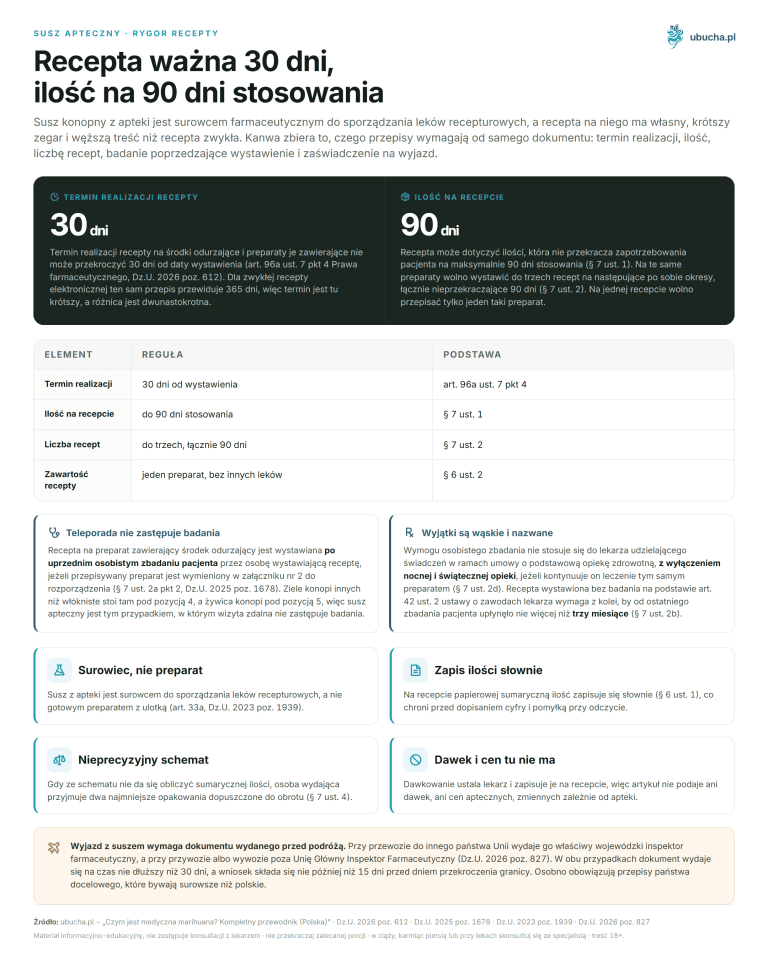
Little comes from the documents, and what little there is is hard. Both positions were registered on January 23, 2023, the cannabis reached pharmacies in the fall of the same year, it is dispensed by Rpw prescription, and the raw material is not subject to reimbursement. The prescription is valid for thirty days, and the prescribed amount cannot exceed the demand for ninety days of therapy. The package contains ten grams, which the leaflet converts to one thousand seven hundred milligrams of active substance in the weaker version.
The producer’s material is everything that the leaflet says about the effects. The weaker version is attributed to calming and sleep, the stronger one to energy and mood improvement, and one of them even mentions reducing depression. None of these sentences is supported by a single study, a single batch number, or a single concentration designation. These are commercial dispositions written in the language of the leaflet, not results of patient observations.
The third layer is patient reports. They circulate on forums and groups, can be detailed, but no one collects them in a register, and they cannot be attributed to the batch from which they originated. With one delivery from three years ago, even consistent reports say nothing about the cannabis that could return to pharmacies.
What adverse effects have been reported after using this producer’s raw material?
None separately. Reports go to supervision under the batch number of a specific product, not under the company’s name, so there is simply no public compilation assigned to the two CanPoland positions. The manufacturer’s leaflet lists symptoms, but it does so for cannabis flower in general and without providing any frequency.
Reports of adverse effects are collected for a medicinal product with a batch number, not for a strain name, so the following concerns cannabis flower as a group of raw materials. The most commonly reported are dry mouth, red eyes, and increased heart rate. Less frequently described are dizziness upon standing up quickly, daytime drowsiness, and temporary worsening of short-term memory, as well as anxiety increasing with dosage. A separate issue is medications taken concurrently, especially sedatives and those affecting coagulation: their assessment requires knowledge of the entire list of preparations, not just the description of the plant. We do not provide the frequencies of these symptoms numerically, as public compilations for cannabis flower in Poland do not separate them by individual products.
The list from CanPoland’s leaflet is longer than the above and constructed differently. It adds low blood pressure, conjunctival redness, abdominal pain, and coordination disorders, and separately warns against combining with opioids and alcohol. It also lists contraindications: psychosis, schizophrenia, addictions, and pregnancy and breastfeeding. None of these items has a number associated with it, so the list states what is sometimes described, not how often.
Frequently asked questions about CanPoland
Does CanPoland cultivate cannabis in Poland?
No. The company operates a pharmaceutical raw material production facility, a wholesale, and repackaging of drugs in Łódź, and purchases plant material from suppliers. In a 2021 announcement, it stated it would launch its own cultivation only when Polish law allows it.
Where does the cannabis sold under the name CanPoland come from?
From outside Poland. The company lists three directions of raw material supply agreements on its website, and an industry portal reporting the entry of both positions into pharmacies indicated Canadian cultivation. The name of the grower is not provided by either the leaflet or the company itself.
How many positions from CanPoland are in the Polish raw material register?
Three: two forms of flower and one extract. This entry concerns the two flower positions, namely Shishkaberry and Gorilla Glue, registered on January 23, 2023.
Is CanPoland’s cannabis currently available in pharmacies?
The database describing pharmaceutical positions marks both as withdrawn. The delivery from 2023 remains the only one, and the company has not announced another. The current state is verified in the comparison of available strains, not in the manufacturer’s description.
Is CanPoland the same company as Canopy Growth?
No. They are two separate entities present in Polish pharmacies, and the similarity at the beginning of both names is coincidental. CanPoland is based in Łódź and is responsible for two flower positions, while Canopy Growth is responsible for several.
Is cannabis from CanPoland subject to reimbursement?
No, and the manufacturer’s leaflet emphasizes this in capital letters. The raw material is dispensed only by Rpw prescription, the prescription is valid for thirty days, and the prescribed amount cannot exceed the demand for ninety days of therapy.
The complete list of strains currently available in pharmacies is in the list of currently available strains, and the store’s assortment in the Flower category.
Cannabis flower is a pharmaceutical raw material dispensed by a doctor’s prescription in the Rpw category, and advertising medicinal products dispensed by prescription to the public is prohibited. The material is informational and does not replace a conversation with the attending physician.
Editorial text: ubucha.pl editorial team.