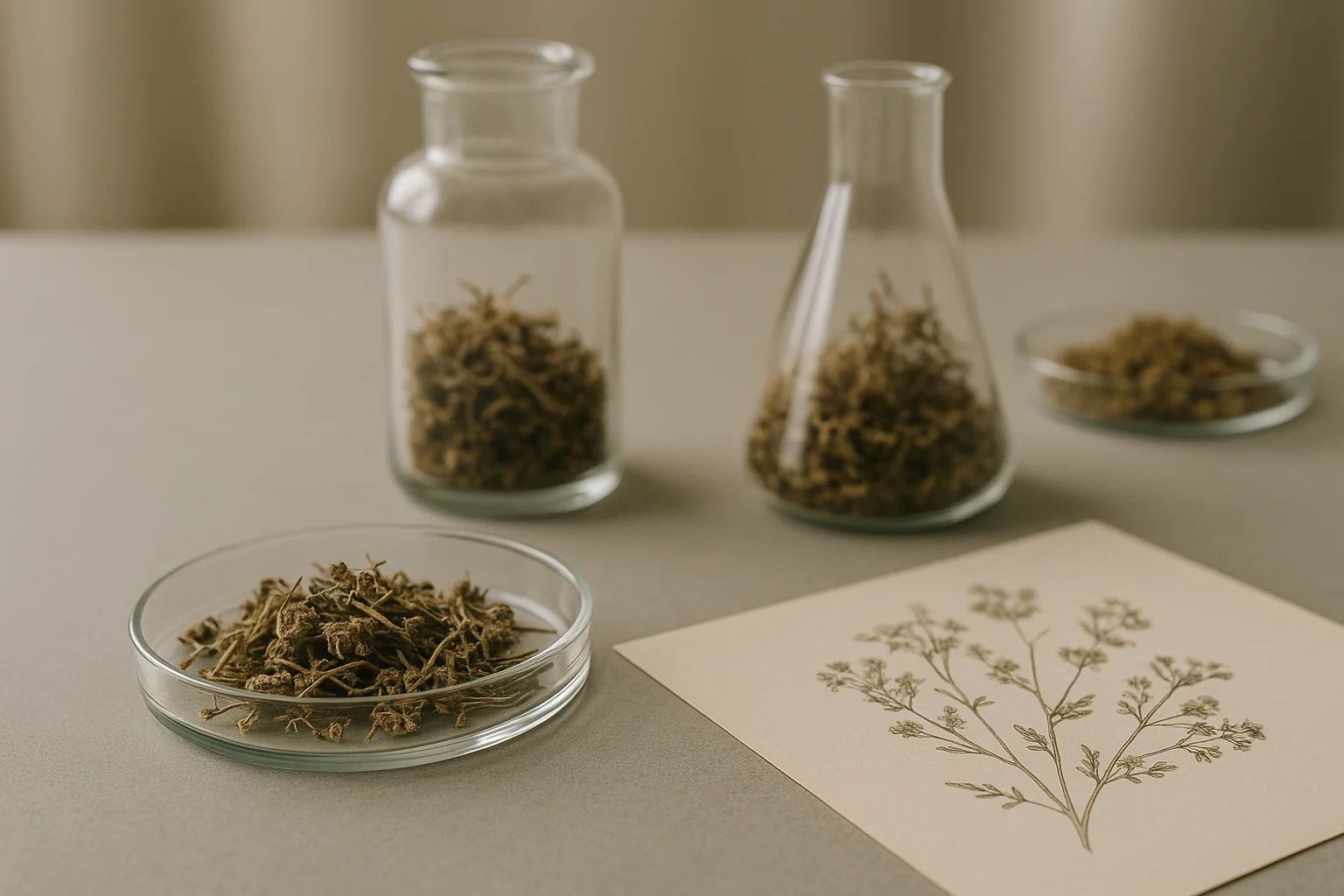

Myrcene: twenty strains from the list, three studies on mice, zero in humans
Beta-myrcene is the leading terpene for twenty strains from Polish pharmacies and is present in the composition of sixty-seven. Three studies that examined it were conducted on mice, and the direction of their result changes with the route of administration.
| Terpene card | myrcene |
|---|---|
| Strains with this leading terpene | 20 out of 85 |
| Present in profiles | 67 out of 85 |
| Studies in the evidence base | 3 |
| Research model | rodent |
| Boiling point | 166.8 °C |
| Measurement condition | atmospheric pressure (760 mmHg) |
- In the pharmacy list. It leads in 20 out of 85 strains and is the leading terpene for them according to pharmacy data.
- Evidence. 3 studies from 1990 to 2024, all on animals or in cell culture, none on patients using the herb.
- Temperature. 166.8 °C, with the measurement condition determining whether the number means anything.
- What we do not provide. Percentage share in the profile, as the denominator in sources varies and numbers are not comparable between strains.
What is myrcene and where does it occur outside of cannabis?
Myrcene is a volatile monoterpene with the formula C10H16 and a molecular weight of 136.23, composed of an open carbon chain, without a ring. The public card on PubChem lists it under number 31253 as beta-myrcene, and among natural sources outside of cannabis, it mentions bay leaf oil, verbena, hops, and lemongrass, which are plants whose scent no one associates with cannabis.
In the pharmacy list of this cluster, myrcene is the leading terpene for twenty out of eighty-five cultivars, meaning for thirty-one entries out of one hundred forty-one. It is only surpassed by caryophyllene, indicated for thirty strains. This position comes from pharmacy labels, not from editorial choice: we count what the manufacturer has stated on the packaging, and nothing more.
Outside of pharmacies, the same compound works as a raw material in the fragrance industry. The HSDB record available through PubChem lists its use in fragrance compositions, flavoring, in insect repellent preparations, and as an additive to detergents, and primarily its role as an intermediate in the production of terpenic alcohols. The same record states that it is industrially obtained from the pyrolysis of beta-pinene, another terpene present in cannabis. This is significant for the rest of the text: the amount that a chemical plant worker is exposed to and the amount contained in a few milligrams of herb are two different exposures, and the literature on the pure substance describes the former.
How long does it take for myrcene to reach the body and how long does it stay?
It is unknown, as no one has measured this separately for myrcene inhaled from the herb. Public literature describes the action of the entire raw material according to the route of administration, not the fate of a single molecule from the profile, so a fair answer is this: the time intervals below belong to the route of administration, not to this terpene.
Two things can be given here numerically, both related to the compound, not the patient. Pure beta-myrcene boils at atmospheric pressure around 166.8 degrees Celsius, which comes from the average of two measurements taken at 760 mm Hg. How much of this compound leaves the herb when heated and how much of it enters the blood is not provided by any entry collected in this project. The distance between these questions is greater than it seems: the first concerns a vessel with a reagent, the second fragmented plant material in the chamber of the device, where the compound sits in resin glands along with the rest of the profile.
The route of administration determines the course more than the strain itself. After vaporization, the substance passes from the lungs to the blood almost immediately, so the first sensations appear after a few minutes, intensity increases for another ten to thirty minutes, and the whole effect lasts for two to four hours. After ingestion, the raw material first passes through the intestine and liver, so the first sensations are waited for from half an hour to two, and the episode lasts six, sometimes eight hours. Hence the most common mistake with oral administration: those who think nothing is happening after thirty minutes and take another dose will receive both doses at once. The above intervals describe the route of administration, not this strain; pharmacokinetic studies for a single cultivar have not been published.
Does the boiling point of myrcene say anything about the vaporizer setting?
No. The boiling point describes the pure substance in a laboratory vessel, not the herb in the device chamber, and is not a setting for the equipment. For beta-myrcene, the public database holds four records from four institutions, of which two carry the pressure at which they were measured, and only those two can be compared.
The average of these two gives 166.8 degrees Celsius at 760 mm Hg. The other records state 167 degrees and a range of 166-167 degrees, but without information about the pressure, so they did not enter the average. The institutions behind these four records are CAMEO Chemicals, HSDB, HMDB, and JECFA. The pressure is not a note for pedants: in the same database, humulene has the only measurement made at 3 mm Hg, almost in a vacuum, resulting in 99.5 degrees. Comparing such a number with a measurement under atmospheric pressure would be comparing two different quantities. There is no record of myrcene from reduced pressure at all, so its number can be compared with the rest of the table.
What this number does not say: at what temperature myrcene leaves the crushed flower, how much remains after heating, and how much reaches the lungs. The herb is not a vessel with a pure reagent; the compound sits in it in glands along with the rest of the profile, so the boiling point of the pure substance is an upper reference point, not a moment of evaporation from the plant material. For this reason, we do not provide any device settings or methods of intake: they do not arise from anything stated in the data of this project.
What have studies shown about the effects of myrcene?
Three studies, all on mice. This is the extent of the evidence base for myrcene in this project, and not one entry included humans. Two administered the compound via injection into the peritoneal cavity, the third as inhaled vapor, and the direction of the result changes with this difference.
| Study | Model and route of administration | What was shown |
|---|---|---|
| Rao VS et al., 1990 Journal of Pharmacy and Pharmacology PMID:1983154 |
rodent (mouse) | Myrcene (10-40 mg/kg) reduced pain responses in mice in hot plate and writhing tests induced by acetic acid; the effect was reversed by naloxone and yohimbine, indicating involvement of alpha2-adrenergic receptors and release of endogenous opioids. |
| do Vale TG et al., 2002 Phytomedicine PMID:12587690 |
rodent (mouse, intraperitoneal administration) | Myrcene administered intraperitoneally (100-200 mg/kg) reduced the locomotor activity of mice in the open field test, prolonged sleep induced by pentobarbital (by about 2.6 times at 200 mg/kg), and reduced the number of entries into the open arms of the elevated plus maze, which the authors described as a weak anxiogenic effect, not anxiolytic. |
| Wagner JK et al., 2024 NeuroSci PMID:39728677 |
rodent (mouse, inhaled vapor) | With short inhalations mimicking inhaled administration in humans, beta-myrcene acted anxiolytically in the elevated plus maze in female mice, and in males only with a single inhalation. Unlike linalool, myrcene did not produce a synergistic effect with cannabidiol in either sex. |
The base is not a collection of three independent teams. Viana GS is associated with two of the three entries, the one from 1990 and the one from 2002, so the older material comes from one research line, not from repetitions in different centers. The 1990 study concerned pain responses and itself indicated an indirect mechanism: the effect disappeared after administration of naloxone and yohimbine. The 2002 study measured the animals’ mobility, the length of sleep after pentobarbital, and behavior in the elevated plus maze, and its authors described the result as weakly anxiogenic.
The 2024 entry is the only one that mimics inhaled administration in humans and is the only one that separates the result by sex. The anxiolytic effect was observed in females, in males only with a single inhalation, and there was no enhancement of cannabidiol’s effect in either sex, unlike for linalool studied in the same setup. None of the twenty-two entries that this project collected for eleven terpenes included humans, and two of them do not even concern mammals. The doses from injections were given in milligrams per kilogram of animal body weight, which is a measure that cannot be translated to what a human receives when inhaling the herb.
What has not been shown about myrcene?
What is most often repeated about it has not been shown. Popular strain descriptions associate it with drowsiness and support this with a study on mice that were given an injection into the peritoneal cavity, a route that the patient does not use. The evidence base of this project sets a boundary directly, and its statement reads literally:
In humans, it has not been shown that myrcene alone alleviates insomnia at doses typical for inhalation of the herb. The direction of the effect in rodents depends on the route of administration and sex: after intraperitoneal injection in 2002, a slightly anxiogenic effect was described, and after inhalation in 2024, an anxiolytic effect in females. These two results do not cancel each other out; they only show that the conclusion depends on conditions that no popular strain database provides.
Three things in this statement weigh more than they appear. First: the authors of the 2002 study themselves described their result as weakly anxiogenic, which is in the opposite direction to what is popularly attributed to myrcene. Second: the result from 2024 depends on the sex of the animal, and a conclusion dependent on sex cannot be recorded as a statement about the compound’s effect on humans. Third: none of these studies measured how much myrcene leaves the herb or how much reaches the blood, so the dose at which any of this would occur remains unknown.
This material also contains a negative result, which is also a result. The 2024 study checked whether myrcene enhances the effect of cannabidiol administered simultaneously, and found no such enhancement in either sex, although in the same setup it found it for linalool. The statement about the interaction of terpenes, repeated in strain descriptions without reservations, has been checked for this pair and came out negative.
What adverse effects have been reported after myrcene?
None, if the question concerns myrcene as a separate substance. Safety monitoring is conducted by product batch number, not by the name of the compound from the profile, so a list of symptoms attributed specifically to this terpene in people using the herb has not been created and there is nothing to compile it from. Below is what is known about the raw material.
Reports of adverse effects are collected for medicinal products with a batch number, not for the strain name, so the following concerns cannabis herb as a group of raw materials. The most commonly reported are dry mouth, red eyes, and increased heart rate. Less frequently described are dizziness upon rapid standing, daytime drowsiness, and transient worsening of short-term memory, as well as anxiety increasing with dosage. A separate issue is medications taken concurrently, especially sedatives and those affecting coagulation: their assessment requires knowledge of the entire list of preparations, not just the description of the plant. We do not provide the frequency of these symptoms numerically, as public compilations for cannabis herb in Poland do not separate them by individual products.
The situation looks different for the pure compound. Myrcene in industrial form is a reagent described in databases of hazardous substances, and concentrated volatile terpenes can irritate the respiratory tract and skin. However, this is an observation about liters of reagent in a facility, not about a few milligrams dispersed in herb alongside a dozen other compounds. Transferring it directly to inhaling the herb would be the same mistake as transferring results from injections in mice to a patient: the quantity, form, and route change, along with the significance of the number.
Which strains from Polish pharmacies have myrcene as the leading terpene?
Twenty names, and their compilation is in the table below this paragraph along with the manufacturer and the number of registration entries. The indication comes from the pharmacy list, not from the descriptive database, so it speaks to what the producer has declared for a given entry, not what someone has measured in the flower.
| Strain | Manufacturers | Pedigree |
|---|---|---|
| Afghan Kush | Canopy Growth | unknown |
| Animintz | S-LAB | established |
| Blueberry | S-LAB, Tilray | established |
| Cataract Kush | S-LAB, Synoptis Pharma, Tilray | established |
| Deep Breath | Canopy Growth | unknown |
| Desert Flame | Medezin | unknown |
| Electric Honeydew | Aurora | established |
| Equiposa | Aurora | unknown |
| Frosted Cherry Cookies | S-LAB, Synoptis Pharma, Tilray | established |
| Gastro Pop | Four 20 Pharma | established |
| GMO | Four 20 Pharma | established |
| Hindu Kush | Canopy Growth, Cosma | unknown |
| Humble Warrior | Suprobion | unknown |
| Jack Herer | S-LAB, Tilray | established |
| Krypton | Canopy Growth | established |
| Mystic Wonder | Suprobion | established |
| Orange Cream Pop | Cosma | established |
| Shishkaberry | CanPoland | established |
| Ultra Jack | Canopy Growth | established |
| White Widow X | Canopy Growth | established |
Thirty-one registration entries that this twenty occupies in the list are unevenly distributed. The most is held by Cataract Kush, with four, while Frosted Cherry Cookies and Blueberry have three each, and thirteen strains are listed with one entry each. On the side of manufacturers, Canopy Growth appears most frequently, with six cultivars, followed by S-LAB with five and Tilray with four. There are ten entities in this group, with Medezin and CanPoland having one each. Five names from this twenty provide more than one manufacturer, while the remaining fifteen are listed under one. This is significant when reading the label: the leading terpene is a declaration assigned to the registration entry, so the same trade name from two manufacturers can have two separate entries.
The composition of this list changes over time and this is not a flaw of the compilation, but a property of the market: permits expire, supplies run out, and new entries come under a different registration name. The current state of availability is led by a compilation of available strains, and products with cannabis herb have been gathered in a separate category of the store.
How does the pharmacy list differ from the composition provided by profile databases?
By answering different questions. The pharmacy list indicates the leading terpene and gives twenty strains for myrcene, while profile databases list it in the composition of sixty-seven. Merging both numbers into one would give a value that none of these sources confirms, so we keep them separate.
Both lists overlap in nineteen names. Forty-eight cultivars have myrcene in their composition, although the register did not indicate it as leading, and in the other direction, only White Widow X goes: the pharmacy label places myrcene next to it, and there is no public profile for this strain at all. A separate case is GMO, where the register states myrcene, while profile databases attribute the largest share to farnesene. This looks like a data error, but is simply a result of the fact that the label and the descriptive database measure different things.
Hence the rule that we do not place a share next to the name of the terpene. We calculated this on our own data: in the BudCare database, myrcene appears in 110 entries out of 146, and the sum of declared shares of all terpenes in one entry is 46, in another 118, with a median of 85. Five entries exceed one hundred, meaning they declare more total than the total has. The denominator is therefore unknown and different in each entry, and a number without a denominator in a text about a drug looks like a measurement, which it is not. The second database, MedWeed, does not provide shares at all: it lists myrcene for fourteen out of sixty-five entries and organizes terpenes by weight, placing it first in nine of those fourteen.
Frequently asked questions about myrcene
Does myrcene induce sleep?
In humans, this has not been shown. In the 2002 study, mice slept longer after intraperitoneal injection of pentobarbital, but that is a result in rodents and with a route of administration that the patient does not use. No entry in the database of this project has measured sleep in humans after myrcene.
How many strains from Polish pharmacies have myrcene as the leading terpene?
Twenty out of eighty-five cultivars described in this cluster, which corresponds to thirty-one entries out of one hundred forty-one in the list. Only caryophyllene has more, indicated for thirty strains. Profile databases are counted separately, which list myrcene in the composition of sixty-seven strains.
Does myrcene have anxiolytic effects?
It depends on the conditions, and this is not an excuse. After intraperitoneal injection in 2002, a slightly anxiogenic effect was described, while after inhalation in 2024, an anxiolytic effect was observed in female mice. The direction thus changes along with the route of administration and the sex of the animal, and there is no single statement about humans from this.
Why do you not provide how much myrcene is in a strain?
Because the denominator is unknown. In the BudCare database, myrcene appears in 110 entries out of 146, and the sum of declared shares of all terpenes there is sometimes 46, sometimes 118, with a median of 85. Five entries exceed one hundred, so the number placed next to the name of the terpene would look like a measurement, which it is not.
At what temperature does myrcene boil?
About 166.8 degrees Celsius at atmospheric pressure, which is the average of two records measured at 760 mm Hg. Two further records in the same database were given without pressure, so they did not enter the average. This number describes the pure substance and is not a vaporizer setting.
Has myrcene been studied in humans?
No. The evidence base of this project has three entries for myrcene, and all were conducted on mice: two with intraperitoneal administration, one with inhaled vapor. None of the other entries collected for the eleven terpenes in this cluster included humans.
Cannabis herb is a pharmaceutical raw material dispensed by prescription in the Rpw category. The material is informational in nature and does not replace the advice of a doctor or pharmacist.
The editorial text was prepared by the editorial team of ubucha.pl.