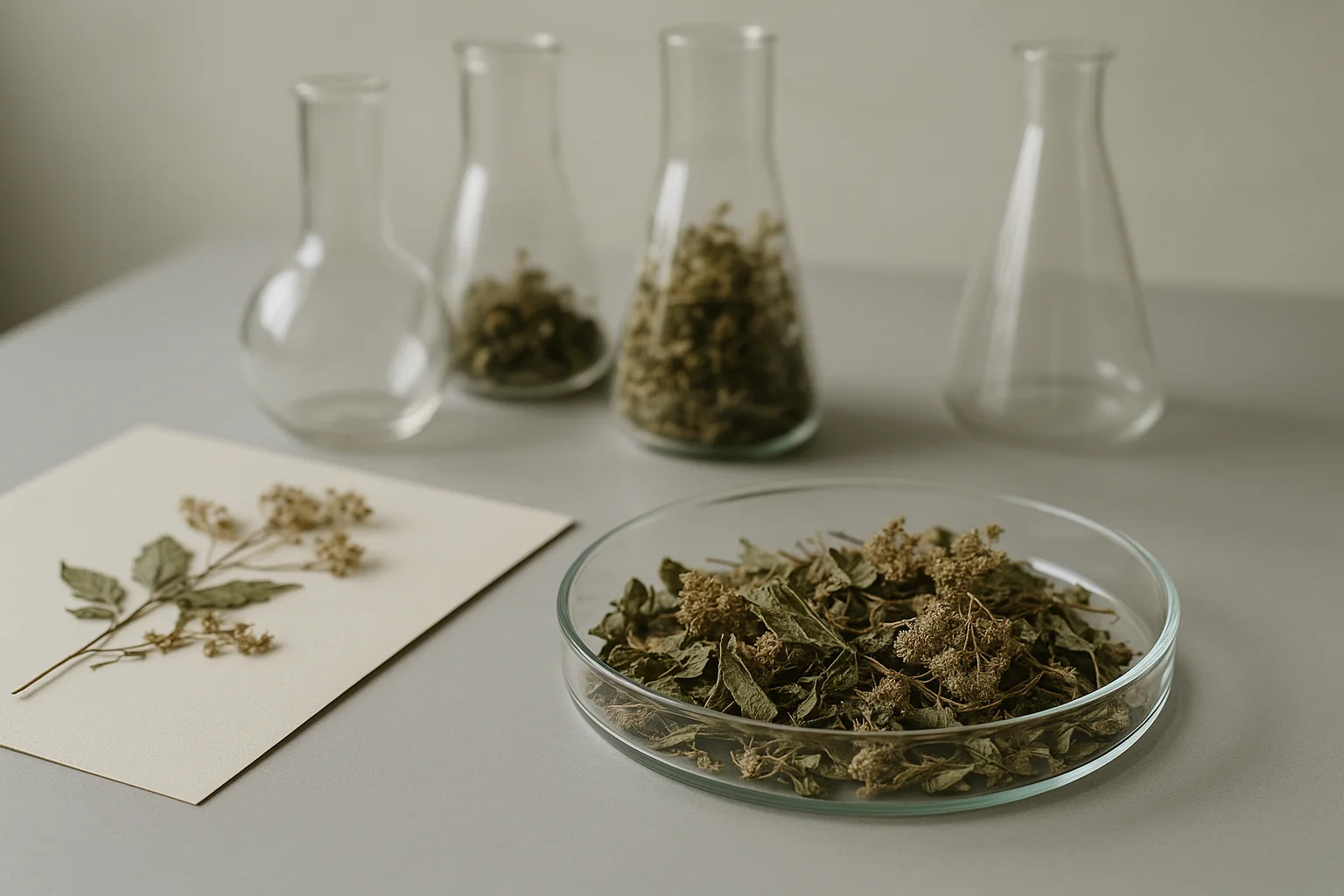

Spiced Latte (Cannabis flos S-LAB): two pharmaceutical positions and the caryophyllene profile
The S-LAB strain present in Polish pharmacies in two positions with different declared potency. We gather what can be confirmed today about its lineage, terpene composition, and the limits of evidence.
| Strain card | Spiced Latte |
|---|---|
| Producers | S-LAB (2 pharmaceutical positions) |
| Medical brand | the same as the producer |
| Alternative names | none |
| Category according to sources | hybrid / hybrid-sativa (sources inconsistent) |
| Leading terpene | caryophyllene |
| Other terpenes | humulene limonene linalool myrcene |
| Lineage | established Jean Guy × Alien Dawg |
| Source consistency | one source |
- Who supplies. Exclusively S-LAB, so there is nothing to compare versions with, and a break in supply means the absence of this strain, not another version of it.
- Profile. It leads with caryophyllene, alongside humulene, limonene, linalool, and myrcene. We do not provide percentage shares because sources count them against different totals.
- Origin. Established lineage, parents are Jean Guy and Alien Dawg.
- What is missing. The profile describes one source, so there is nothing to compare it with.
What is Spiced Latte and where does this strain come from?
It is a hybrid supplied to Polish pharmacies by a single producer, and its lineage is described by only one found publication: Jean Guy crossed with Alien Dawg. There is no second, independent confirmation, so we treat the origin of this strain as a preliminary determination, not as a fact verified by two paths.
The publication from which this lineage comes describes a specific product from S-LAB, not an entry in the breeding register. No one announces the birth certificate of the cultivar, so the origin of the strain is reconstructed from commercial materials and breeder reports. For Spiced Latte, such material was found to be one, and this necessitates a more cautious record than with names confirmed in several independent places. It describes a specific position from S-LAB, not every plant sold anywhere under that name: strain names are not protected like the trade names of drugs, so the same label in another country may be placed on material of completely different origin.
The contradiction begins already with the type of plant. One of the databases describing the Polish market classifies this herb as a hybrid with a sativa predominance, while the other simply as a hybrid. The difference is not cosmetic: the division into indica and sativa is often treated today as a trade label, not as a description of the plant’s chemistry, and with this strain, it is evident directly, as the same pharmaceutical position receives two different labels in two places.
Which producers supply Spiced Latte to Polish pharmacies?
One. The entire turnover of this name is conducted by S-LAB, and the strain appears in two pharmaceutical positions differing in declared potency of the raw material. No other producer has reported herb under this name in our country, so comparing two versions of the same strain from different suppliers is not feasible here.
| Pharmaceutical position | Producer | THC content considering tolerance | CBD content | Status in the database at the time of data collection |
|---|---|---|---|---|
| Cannabis flos S-LAB, weaker version | S-LAB | 16.2-19.8% | not more than one percent | marked as unavailable |
| Cannabis flos S-LAB, stronger version | S-LAB | 19.8-24.2% | not more than one percent | marked as unavailable |
The registered name of both positions is Cannabis flos S-LAB and carries a number indicating the declared content. We do not transcribe this number because the producer allows a deviation of around ten percent in either direction from the value it declares. The weaker version falls within the range of 16.2-19.8%, the stronger within the range of 19.8-24.2%, and two packages from the same shelf may differ in potency more than their common label suggests.
Availability is a separate matter here. In the database from which the composition description comes, both positions were marked as unavailable at the time of data collection, and this is a snapshot from one day, not a feature of the strain. Permits for the admission of raw material expire, wholesalers receive goods in batches, and pharmacies dispense what is currently in stock. We maintain the current status in the list of strains available in Polish pharmacies, and we describe the entire assortment of this producer separately in the text about S-LAB.
What does Spiced Latte smell and taste like?
- humulene humulene
- caryophyllene caryophyllene (leading in the pharmaceutical list)
- limonene limonene
- linalool linalool
- myrcene myrcene
Spicy and citrusy, on an earthy background. This is how the database from which its profile comes describes this herb, adding a pine note. However, descriptions of the smell remain the impression of the evaluating person, not a measurement, so read them as a hint regarding the character of the herb, not as a parameter of the raw material.
The composition behind this describes one source, and that is the whole basis: humulene, caryophyllene, limonene, linalool, and myrcene. Caryophyllene leads in this set and is responsible for the peppery impression. Humulene is the same compound that gives character to hops, and limonene pulls the scent towards citrus peel.
For each of these names, a number could be placed, but no one from the outside knows what to relate it to. The shares that the same database assigns to the five components of the Spiced Latte profile sum up to eighty percent, not one hundred. The missing fifth part is either compounds outside this five or another way of counting, which cannot be resolved from the outside. A number without a known denominator looks like a measurement in a text about a drug, and it is not, so only the composition remains.
To the taste, there is also the name, which promises coffee with spices. Strain names are arranged by breeders, not chemists, and nothing guarantees that the descriptor from the label will match what the patient feels. With this strain, part of the spicy description has coverage in the composition, while the coffee part is not visible in it.
How long does it take for Spiced Latte to take effect and how long does the effect last?
After vaporization within a few minutes, after ingestion much later. For this strain, no one has measured this separately, so the only thing that can be honestly provided is the course dependent on the route of administration, common for cannabis herb regardless of the trade name and declared potency.
The route of administration determines the course more than the strain itself, and the ranges below describe just that, not this cultivar, because pharmacokinetic studies for a single cultivar have not been published.
| Vaporization | After ingestion | |
|---|---|---|
| First sensations | within a few minutes | from half an hour to two |
| Onset | another ten to thirty minutes | slow, over several hours |
| Total duration | within two to four hours | after six, sometimes eight hours |
| Typical error | none | taking a dose after thirty minutes, which gives both doses at once |
Both pharmaceutical positions of S-LAB share the same name and the same profile description, and differ in declared THC content. This difference concerns how much active substance the same portion of raw material carries, not when the effect appears and fades.
What is known and what is not known about the effects of Spiced Latte?
Nothing that would pertain exclusively to this trade name. Clinical trials are planned for a drug with a known composition, not for a cultivar, so the evidence we have here was collected for caryophyllene, the leading component in this profile, and it comes from mice and cell cultures.
| Study | Model and route of administration | What was shown |
|---|---|---|
| Gertsch J et al., 2008 Proceedings of the National Academy of Sciences (PNAS) PMID:18574142 |
mouse (in vivo) and test tube (receptor binding, human cells) | (E)-caryophyllene selectively bound to the CB2 receptor (Ki = 155 nM) and inhibited carrageenan-induced paw swelling in wild-type mice, but not in CB2 receptor-deficient mice (Cnr2-/-), indicating a CB2-dependent mechanism; the study did not include any anxiety tests. |
| Klauke AL et al., 2014 European Neuropsychopharmacology PMID:24210682 |
rodent (mouse) | Oral caryophyllene reduced late inflammatory pain in mice in the formalin test in a CB2 receptor-dependent manner, with no effect on the early phase; in a neuropathic pain model, it alleviated thermal hyperalgesia and mechanical allodynia without developing tolerance with chronic administration. |
The rest of what circulates around this name has a different status. Descriptions of effects on commercial websites and patient reports from forums are observational material without a control group, without a blind trial, and without measuring content in a specific package. This does not mean they are untrue. It only means that conclusions about effectiveness cannot be based on them, nor can such conclusions be transferred to another patient.
The boundary of this evidence is as important as its content. In neither of the two studies was caryophyllene tested on humans or in inhaled form from herb; both works concern oral or systemic administration in mice in pain and inflammation models, not sleep or mood.
What side effects have been reported after Spiced Latte?
None, if the question pertains to this specific name. Reports are collected here divided by medicinal product and batch number, and the name of the cultivar is not a label in this system under which anything can be searched. Therefore, below is what is known about cannabis herb in general.
Reports of side effects are collected for medicinal products with a batch number, not for strain names, so the following pertains to cannabis herb as a group of raw materials. The most commonly reported are dry mouth, red eyes, and increased heart rate. Less frequently described are dizziness upon rapid standing, daytime drowsiness, and temporary worsening of short-term memory, as well as anxiety increasing with dosage. A separate matter is medications taken concurrently, especially sedatives and those affecting coagulation: their assessment requires knowledge of the entire list of preparations, not just the description of the plant. We do not provide the frequency of these symptoms numerically because public compilations for cannabis herb in Poland do not separate them by individual products.
With this strain, there is one more circumstance. Both pharmaceutical positions bear the same name, and differ in declared content, so even if reports were collected by strain name, they would mix two raw materials of different potency in one bag.
At what temperature is this strain vaporized?
There is no single temperature for the strain; there are boiling temperatures of individual components of its profile, and these diverge by dozens of degrees. Among the values measured at atmospheric pressure, myrcene boils the lowest, while caryophyllene, the leading component in this profile, boils the highest, and they are separated by over ninety degrees.
| Profile component | Boiling point at atmospheric pressure | Measurement under reduced pressure |
|---|---|---|
| Myrcene | 166.8 °C | not available in the database |
| Limonene | 177.8 °C | not available in the database |
| Linalool | 195.5 °C | not available in the database |
| Caryophyllene | 257.5 °C | 130 °C at 14 mmHg |
| Humulene | not available in the database | 99.5 °C at 3 mmHg |
This comparison also shows why the temperature tables circulating online can contradict each other. Some values were measured at atmospheric pressure, some under reduced pressure, and the latter lowers the boiling temperature: caryophyllene has both numbers in databases and they are separated by over one hundred twenty degrees. Humulene shows this most sharply, as the database has no atmospheric value for it at all, only a measurement under reduced pressure. If inserted without qualification into one column with myrcene, it would appear to be the most volatile compound of the entire five. A table that does not indicate this compares incomparable values. We break this down in a separate text about the evaporation of terpenes from herb.
Additionally, the setting on the vaporizer is not the temperature of the herb in the chamber, as the sensor is located near the heating element, not in the plant. For both reasons, the above numbers describe the properties of individual compounds measured in the laboratory, not a recipe for operating the device. What has been shown for caryophyllene itself is collected in the text about this terpene.
Which strains are related to Spiced Latte?
None, and what is in the data leads one generation higher. Jean Guy, one of the two parents, is also available in Polish pharmacies and has its own entry in this cluster. Alien Dawg does not have such an entry, and the origin of Jean Guy itself remains undetermined.
Siblings would arise if another cultivar from this set had the same parents. There is none: in the pedigree graph covering eighty-five strains from Polish pharmacies, Spiced Latte is the only position with Jean Guy or Alien Dawg on the parent side. Twenty-five of those eighty-five strains do not have an established origin, so any potential connections often have nowhere to be recorded. Jean Guy itself is one of those positions, and we describe it separately.
The similarity of names changes nothing here. The term dawg is used in Polish pharmacies for strains derived from Chemdawg, while the term alien appears in lineages from Alien Cookies F2 and Alien Tech. This is a coincidence of words, not kinship, as none of these names signifies Alien Dawg.
One caveat remains open. The source from which we take the lineage of the strain Tilray Sirius notes in passing that Tilray sells Alien Dawg under its own trade name. If this identification were confirmed, the second parent of Spiced Latte would stand in Polish pharmacies under a different label. Our graph does not accept this as an edge, as it is based on a single mention, so we do not derive any kinship from it.
Frequently asked questions about the Spiced Latte strain
Who supplies Spiced Latte to Polish pharmacies?
One producer, S-LAB, in two pharmaceutical positions with different declared potency of the raw material. No other company has reported herb under this name in our country.
What is the THC content in this strain?
Considering the producer’s ten percent tolerance, the weaker position falls within the range of 16.2-19.8%, and the stronger within the range of 19.8-24.2%.
Is Spiced Latte a sativa or a hybrid?
It depends on the source. One database describing the Polish market lists it as a hybrid with a sativa predominance, while the other simply lists it as a hybrid, and this discrepancy cannot be resolved today.
Which terpene leads in the profile of this strain?
Caryophyllene. The profile is described by one database and lists five components, without providing a denominator to which their shares relate.
Does Spiced Latte have siblings among strains from Polish pharmacies?
No. No other strain from this set has Jean Guy or Alien Dawg on the parent side, and Jean Guy itself is present in pharmacies as a separate position.
Can this herb be purchased without a prescription?
No. It is a pharmaceutical raw material dispensed only by a doctor’s prescription, in the Rpw category. Cannabis herb available without a prescription is a different product and is subject to different regulations.
Cannabis herb is a pharmaceutical raw material dispensed by a doctor’s prescription in the Rpw category, and advertising medicinal products dispensed by prescription to the public is prohibited. The material is informational and does not replace medical consultation.
Editorial text: editorial team ubucha.pl.