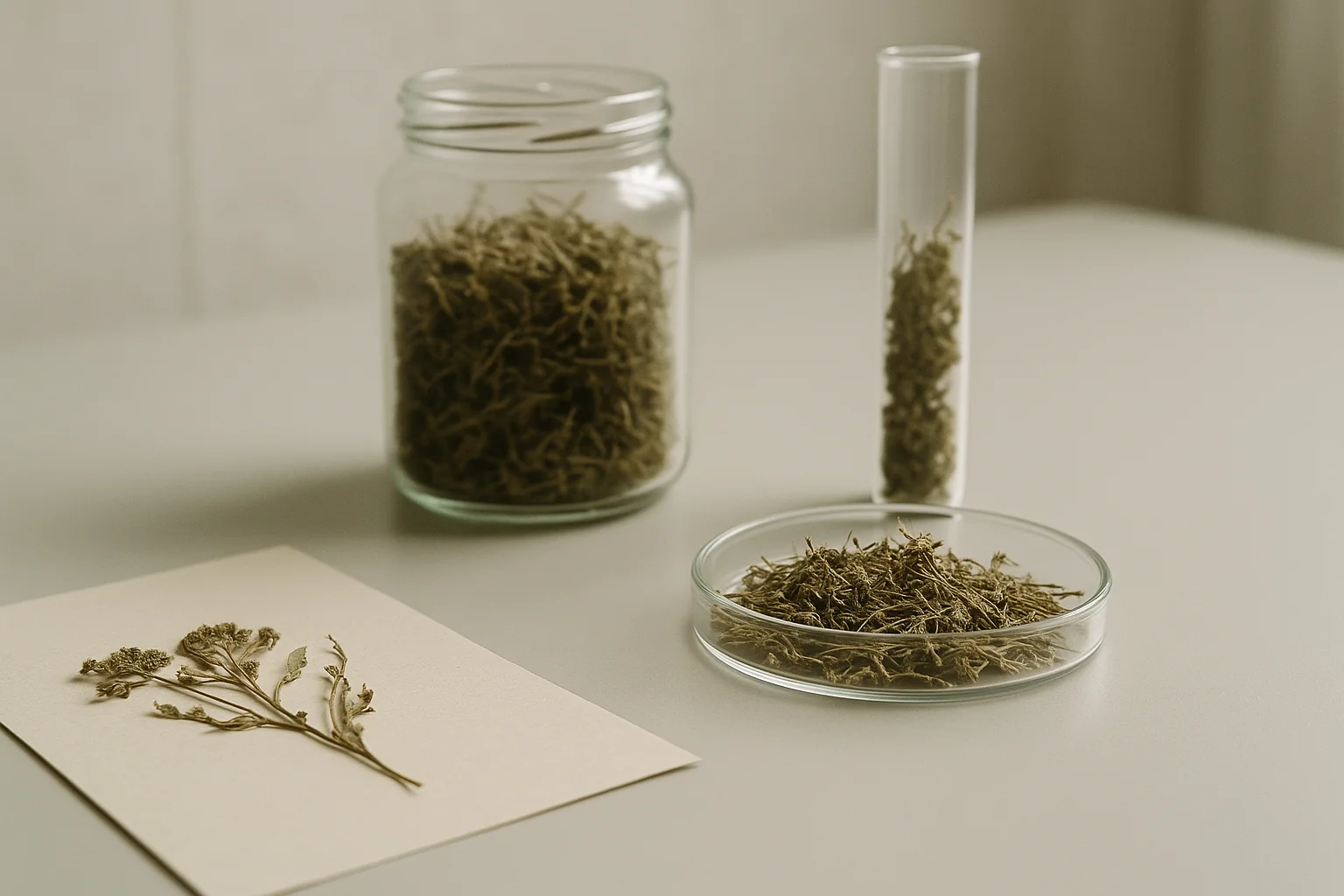

Sherbert Scotti (Cannabis flos S-LAB): lineage from Sunset Sherbet and Biscotti
A hybrid from a single producer, with established origins and a terpene composition described by one source, without a laboratory and without a denominator. We show what this means when reading the pharmacy record.
| Strain Card | Sherbert Scotti |
|---|---|
| Producers | S-LAB (1 pharmacy position) |
| Medical Brand | same as producer |
| Alternative Names | none |
| Category by sources | hybrid with indica dominance |
| Leading Terpene | caryophyllene |
| Other Terpenes | humulene linalool nerolidol |
| Lineage | established Sunset Sherbet × Biscotti |
| Source Consistency | one source |
- Who supplies it. Exclusively S-LAB, so there is nothing to compare versions with, and a break in supply means the absence of this strain, not another version of it.
- Profile. Led by caryophyllene, alongside humulene, linalool, nerolidol. We do not provide percentage shares because sources count them against different wholes.
- Origin. Established lineage, parents are Sunset Sherbet and Biscotti.
- What is missing. The profile describes one source, so there is nothing to compare it with.
What is Sherbert Scotti and where does this strain come from?
Sherbert Scotti is a hybrid resulting from the cross of Sunset Sherbet with Biscotti, supplied to Polish pharmacies by a single producer. The lineage is established and comes from a commercial description quoting the breeding line, while the terpene composition has not been publicly described, so the strain has known origins with unknown chemistry.
The origin is based on a single entry: a Polish industry service states for this position directly “Genetics: Sunset Sherbet x Biscotti”. In the cluster from which this text originates, the established lineage has 60 out of 85 cultivars, and Sherbert Scotti belongs to that larger half. However, a single commercial entry is less than a breeder’s card, so it is more accurate to speak of the lineage declared by the seller than of the lineage confirmed by documentation.
Both parents appear in the same graph at other positions. Sunset Sherbet is also behind the strain Gelato 33, and Biscotti is behind the strain Purple Octane, and it is these two connections that define the entire documented neighborhood of Sherbert Scotti in Polish pharmacies.
In the list, the position appears under the registered name starting with “Cannabis flos S-LAB”, with an attached numerical component. We intentionally omit this component. The number in the name is a value declared by the producer, subject to a tolerance of around ten percent in either direction, so quoted alone it looks like a measurement, which it is not. One commercial catalog assigns the strain to hybrids with indica dominance, but does not specify on what basis this division was made.
Who supplies this strain to Polish pharmacies?
One producer: S-LAB. In the comparison on which this cluster stands, Sherbert Scotti has one pharmacy position and no competitive version, so it is not possible to compare two series of the same cultivar. The table below shows what is known about this position and what the pharmacy record does not provide.
| Feature of the position | What the pharmacy record states | What it does not state |
|---|---|---|
| Producer | S-LAB, the only one for this strain | whether the raw material comes from one cultivation or several |
| Registered Name | Cannabis flos S-LAB with an attached numerical component | the tolerance that this component carries |
| Genetics | hybrid with indica dominance, according to one catalog | the method by which this dominance was established |
| Leading Terpene | caryophyllene, according to the description of the position and with the highest share in the composition | the laboratory that measured this composition, and the denominator for the shares |
| Lineage | Sunset Sherbet crossed with Biscotti | the breeder’s document confirming this line |
| Availability | position present in the list at the time of writing | how long it will remain in warehouses |
S-LAB is responsible in this cluster for 38 cultivars, making it the largest single collection among all producers present here. The name of the producer itself says little about a specific position: under one banner stand strains with different lineages, different leading terpenes, and different degrees of documentation. What connects the positions of this producer beyond the banner, we analyze separately.
The pharmacy composition can be unstable, and this is not a flaw of this strain, but a way the market operates. The raw material enters circulation based on a permit with a specified term, arrives in batches, and disappears from warehouses when the batch runs out, not when someone announces a withdrawal. A prescription issued for one name can therefore end up on an empty shelf, even though a month earlier the same name was available without issue. The current state of what can actually be purchased is maintained in the list of available medical marijuana strains, and only there do we provide prices. A separate matter is hemp flower sold without a prescription, which does not share a common approval path with pharmacy raw material; such positions are collected in the flower category.
What does Sherbert Scotti smell and taste like?
- humulene humulene
- caryophyllene caryophyllene (leading in the pharmacy record)
- linalool linalool
- nerolidol nerolidol
The aroma description exists in one commercial catalog and lists four notes: woody, floral, spicy, and earthy. There is no measurement or second independent report behind it, so it is a characteristic of the seller, not a confirmed property. The same page assigns a relaxing effect to the strain, which is a sales label.
The spicy note aligns with what can be expected from the leading terpene. Caryophyllene is the same sesquiterpene responsible for the sharpness of black pepper and the spicy character of cloves, so its presence in the description and the word “spicy” in the same paragraph are not coincidental. However, this is a match of two descriptions, not a confirmation of one measurement by another. What has been shown about caryophyllene and what has not is analyzed in a separate text.
Smell is not a quality parameter and is not suitable as a selection criterion. It changes with drying, storage methods, and the passage of time, as terpenes are volatile and diminish from an open package faster than cannabinoids. A patient comparing two batches by smell is also comparing their age and storage conditions, which are not stated in any description. Grinding the raw material just before use releases more volatile components at once, causing the same batch to smell stronger than yesterday, even though nothing has changed in it.
How long does it take for Sherbert Scotti to take effect and how long does it last?
This depends on the route of administration, not the strain name. For Sherbert Scotti, no blood concentration measurements have been published, so the only thing that can be honestly provided are the ranges described for vaporization and for oral administration. The following paragraph describes these two routes, not this strain.
The route of administration determines the course more than the strain itself, and the ranges below describe it, not this cultivar, as pharmacokinetic studies for a single cultivar have not been published.
| Vaporization | After swallowing | |
|---|---|---|
| First sensations | after a few minutes | from half an hour to two |
| Onset | another dozen to thirty minutes | slow, over several hours |
| Total duration | within two to four hours | after six, sometimes eight hours |
| Typical error | none | dosing after thirty minutes, which gives both doses at once |
One pharmacy position does not change anything in this calculation. If someone measured the effect of a specific series of this strain, the result would pertain to that series, not the cultivar: dried flower differs between harvests, while the pharmacy record does not provide either the harvest date or the batch number, by which such measurements could be compared.
What has been shown and what has not been shown in studies on this strain?
Nothing directly about it. Studies concern caryophyllene as a single compound, not the flower of this name, and the profile composition of Sherbert Scotti describes only one source and does so without a laboratory and without a measurement date. Below, two things are separated: the results of two studies on this terpene and what comes solely from the commercial description.
The weakness of this documentation has a specific form. The composition lists four compounds: caryophyllene, linalool, humulene, and nerolidol, with the highest share being caryophyllene. It is provided by one source, without the name of the laboratory, without a measurement date, and without indicating to what whole the shares relate. They sum up to 68 percent, so almost one third of the declared total remains unnamed. That is why we do not provide shares with the names of terpenes in this service at all: a value without a denominator looks like a measurement, but it is not.
| Study | Model and route of administration | What was shown |
|---|---|---|
| Gertsch J et al., 2008 Proceedings of the National Academy of Sciences (PNAS) PMID:18574142 |
mouse (in vivo) and test tube (receptor binding, human cells) | (E)-caryophyllene selectively bound to the CB2 receptor (Ki = 155 nM) and inhibited paw swelling induced by carrageenan in wild-type mice, but not in CB2 receptor knockout mice (Cnr2-/-), indicating a CB2-dependent mechanism; the study did not include any anxiety tests. |
| Klauke AL et al., 2014 European Neuropsychopharmacology PMID:24210682 |
rodent (mouse) | Oral caryophyllene reduced the late inflammatory phase of pain in mice in the formalin test in a CB2 receptor-dependent manner, with no effect on the early phase; in a neuropathic pain model, it alleviated thermal hyperalgesia and mechanical allodynia without developing tolerance with chronic administration. |
The limits of both studies must be stated directly. In neither of the two studies was caryophyllene tested on humans or in inhaled form from flower; both studies concern oral or systemic administration in mice in pain and inflammation models, not sleep or mood. The results from rodents cannot be translated to what a patient experiences after vaporizing flower, as both the species and the route of administration, as well as the form of the compound administered, differ.
On the other side stands the sales material: the label of a relaxing effect and assignment to hybrids with indica dominance. These are catalog categories, built from user descriptions and naming traditions, not results of observations conducted according to protocol. Including them in the same column with the studies from the table above would blur the distinction between evidence and label, and that distinction is the entire content here.
What side effects have been reported from this strain?
None under this name. The national reporting system links observation with the medicinal product and batch number, not with the cultivar, so there is no separate compilation for Sherbert Scotti, and with the current reporting method, it will not be created. Below is a description concerning hemp flower as a whole group of raw materials.
Reports of side effects are collected for the medicinal product with a batch number, not for the strain name, so the following concerns hemp flower as a group of raw materials. The most commonly reported are dry mouth, red eyes, and increased heart rate. Less frequently described are dizziness upon rapid standing, daytime drowsiness, and temporary worsening of short-term memory, as well as anxiety increasing with dosage. A separate matter is medications taken concurrently, especially sedatives and those affecting coagulation: their assessment requires knowledge of the entire list of preparations, not just the description of the plant. We do not provide the frequency of these symptoms numerically, as public compilations for hemp flower in Poland do not separate them by individual products.
With this strain, there is one more limit. It has one position in the list and one producer, so even if someone started collecting observations by cultivar name, the sample would be too small to read anything from it. Any symptom noticed should be reported to the attending physician or directly to the Registration Office, always with the batch number read from the packaging.
At what temperature should this strain be vaporized?
It is not possible to provide a single number, as the boiling point of the terpene is not the vaporizer setting. For caryophyllene, source records state boiling under atmospheric pressure around 256-259 degrees Celsius and a separate measurement of 130 degrees under reduced pressure, and these two values describe completely different conditions.
The difference between them is not a technical detail. The lower value was measured at a pressure of 14 mmHg, which is several dozen times lower than what is present in a room, while the vaporizer operates under atmospheric pressure. A table that transcribes this 130 degrees as “caryophyllene vaporization temperature” and places it next to device settings transfers a laboratory measurement without the conditions under which it was made. We explain separately where discrepancies between such tables come from and we have collected the temperature records for individual terpenes in another place.
The second trap lies in the device itself. The number on the display describes the heating element or the air entering the chamber, not the ground raw material, and there can be a difference of several dozen degrees between the two depending on the design and how full the chamber is. Therefore, the same setting on two vaporizers gives a different effect, even though the displays show the same value. We describe separately why settings should not be confused with the temperature of the flower in another text.
Which strains from Polish pharmacies are related to it?
| Strain | Common Parent | Leading Terpene | Producers |
|---|---|---|---|
| Gelato 33 | Sunset Sherbet | limonene | Cantourage |
| Purple Octane | Biscotti | caryophyllene | S-LAB |
Two: Gelato 33 and Purple Octane. The first shares the parent Sunset Sherbet with Sherbert Scotti, the second shares Biscotti, and both are present in Polish pharmacies. Beyond this pair, the pedigree graph of this cluster does not connect any other position with it, even though several names sound very similar.
Gelato 33 originates from Sunset Sherbet crossed with Thin Mint GSC, and it reaches Polish pharmacies from a different producer than Sherbert Scotti. A common parent does not imply common chemistry here: with Gelato 33, the leading terpene is indicated as limonene, while with Sherbert Scotti it is caryophyllene, so two strains with half of the same ancestry diverge on the most important parameter of description. The profile of Gelato 33 is described by only one source.
Purple Octane comes from a three-way cross where Biscotti meets Sherb BX1 and Jealousy F2, and it is supplied by the same producer as Sherbert Scotti. Here, the leading terpene is common, as caryophyllene is indicated in both positions. Comparing this pair can therefore be more interesting than comparing siblings from Sunset Sherbet, although it must also be remembered that one strain has a profile described by one source, and the other has no description at all.
Similarities in names lead in this cluster to confusion more often than anywhere else. Among the parents recorded in the graph, there are four different forms with the component “sherb”: Sunset Sherbet, Blue Sherbet, Garlic Sherbert, and Sherb BX1. Only the first connects with Sherbert Scotti. Blue Sherbet is the parent of the strain King Sherb, Garlic Sherbert stands behind the strain Mystic Wonder, and neither of these two has a common ancestor with the strain described here. Kinship is read from the parents, not from the syllables in the trade name.
Frequently Asked Questions
Can Sherbert Scotti be purchased without a prescription?
No. It is hemp flower in the Rpw category, issued only on a prescription written by a doctor. Other hemp products are available without a prescription, which go through a completely different approval path and are not pharmaceutical raw materials.
What is the leading terpene in this strain?
Caryophyllene. It is indicated by both the description of the pharmacy position and the only commercial catalog that describes this strain. However, the consistency of two records does not replace a laboratory measurement, which has not been published for this strain.
What THC content is declared for this strain?
Range 16.2-19.8%. The producer provides a single nominal value, which carries a tolerance of around ten percent in either direction, so a single number would appear to be a measurement result. The current declaration is read from the packaging and the list.
Are Sherbert Scotti and King Sherb one family?
No. Both names carry the component “sherb”, but the parents are different: Sherbert Scotti comes from Sunset Sherbet and Biscotti, King Sherb from OG Kush Breath and Blue Sherbet. A common word in the trade name does not prove kinship in either direction.
How does Sherbert Scotti differ from Purple Octane?
Both strains have a common parent Biscotti, the same producer, and the same terpene indicated as leading. They differ in the rest of the lineage and the state of the description: the profile of Purple Octane is described by one source, while the profile of Sherbert Scotti is not described by any.
Where to check if this strain is currently available in the pharmacy?
In the list of available strains, which we update separately and in which we also keep prices. The description of the strain is not suitable as a source of information about availability, as the position can disappear from warehouses within a few days of the batch running out.
Hemp flower is a pharmaceutical raw material issued by a doctor’s prescription in the Rpw category. The material is informational in nature and does not replace medical consultation or recommendations contained in the product documentation. Editorial text: editorial team ubucha.pl.