
How Apple Cider Vinegar Gummies Are Made - Complete Guide 2026
How apple cider vinegar gummies are made, how much acetic acid they really contain, and what meta-analyses of human studies say about vinegar. No marketing.
Apple cider vinegar gummies are sold today alongside vitamins and collagen, with labels promising the same benefits as a tablespoon of vinegar taken on an empty stomach, but without the sour taste. This promise has one weak point that packaging does not mention: it does not state how much acetic acid one gummy actually delivers. Meanwhile, clinical studies cited in marketing were conducted on liquid vinegar in doses of several milliliters daily. This article shows how gummies are made, how to calculate the active ingredient content on your own packaging, and what meta-analyses of human studies say about apple cider vinegar, not test-tube experiments. We warn upfront: some numbers circulating online in this category do not come from any scientific work.
KEY INFORMATION
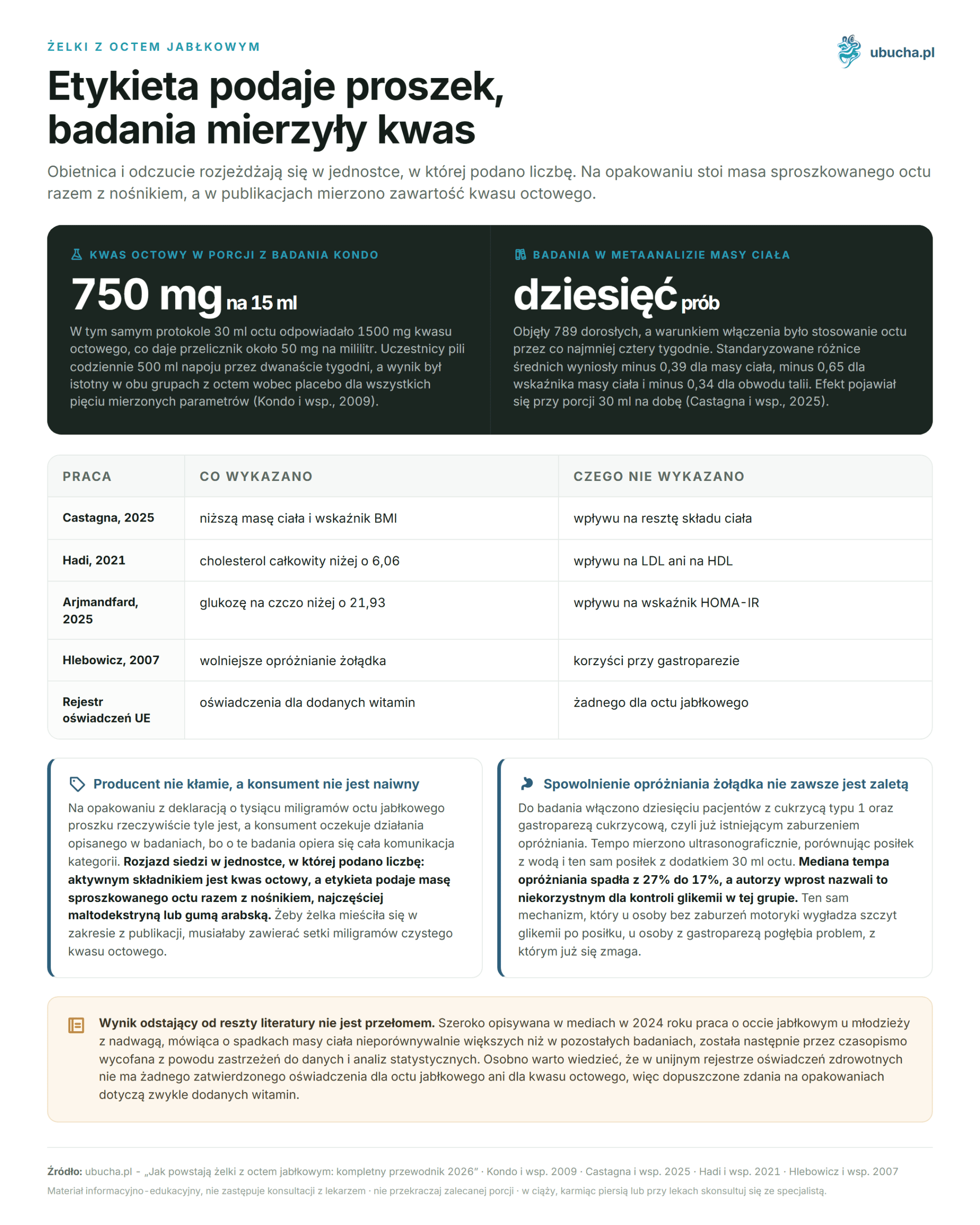
• Clinical studies used a 15 ml vinegar dose corresponding to 750 mg acetic acid, and 30 ml corresponding to 1500 mg (Kondo 2009, Bioscience Biotechnology and Biochemistry).
• A meta-analysis of ten studies with 789 participants showed a small but significant effect of vinegar on body weight and BMI (Castagna 2025, Nutrients).
• A meta-analysis of nine studies found no significant effect of vinegar on LDL or HDL cholesterol (Hadi 2021, BMC Complementary Medicine and Therapies).
• Manufacturers declare the mass of powdered vinegar, not acetic acid mass, so these numbers are easily confused.
• The European Food Safety Authority has not approved any health claim for apple cider vinegar.
What are apple cider vinegar gummies?
They are a dietary supplement in gummy candy form, where the carrier of the active ingredient is powdered apple cider vinegar embedded in a pectin or gelatin matrix. Formally, it is food, not medicine, and is subject to different regulations than medicinal products. The manufacturer does not have to prove efficacy before marketing the product.
The English category name, apple cider vinegar gummies, is also used on Polish packaging and in search engines. The idea itself is not new: converting liquid ingredients into gummy form has been used for years with vitamins, melatonin, and collagen. What is new is applying this to an ingredient whose effect depends directly on the consumed amount.
Apple cider vinegar is produced by a two-step fermentation. First, yeast converts apple sugars into alcohol, then acetic acid bacteria oxidize alcohol into acetic acid. In unfiltered versions, a cloudy sediment of bacteria and cellulose remains in the bottle, commonly called the mother of vinegar. This component disappears during gummy production, as explained below.
It is important from the start to distinguish three things often conflated in product descriptions. First, vinegar as a food product. Second, acetic acid, the chemical compound responsible for measurable metabolic effects studied in clinical trials. Third, polyphenols and other apple components, which have been studied much less. When a label mentions vinegar, it almost never states how much acetic acid it contains.
This text mainly concerns the second item, as it underpins all manufacturer claims. We separately compare gummies and liquid for practical use.
How much acetic acid does a tablespoon of liquid vinegar provide?
About 750 mg per 15 ml serving, roughly the volume of a tablespoon. This number is not an editorial estimate but comes directly from the clinical study protocol. Kondo et al. reported in Bioscience, Biotechnology, and Biochemistry that a drink containing 15 ml vinegar provided 750 mg acetic acid, and 30 ml provided 1500 mg (Bioscience, Biotechnology, and Biochemistry, 2009).
This simple ratio is useful for any packaging: one milliliter of apple cider vinegar contains about 50 mg acetic acid. This corresponds to about 5% concentration, typical for edible vinegars sold in Europe.
This ratio is the reference point throughout the article, allowing comparison of comparable things. Study doses are described in milliliters of vinegar, while gummy content is declared in milligrams of powder. Until both are converted to milligrams of acetic acid, any comparison is meaningless.
Secondly, studies tested daily intake over many weeks, not a single dose. In Kondo’s study, participants drank the beverage for twelve weeks. Meta-analyses often require at least four weeks of use. A one-time vinegar intake was not studied.
Thirdly, the carrier matters. Kondo’s study administered vinegar diluted in half a liter of beverage, not as pure liquid poured into the mouth. This is practically important because undiluted vinegar irritates mucous membranes and enamel. Anyone trying to replicate the protocol at home should also replicate the dilution.
How to calculate how much acetic acid is in one gummy?
Starting with what the label does not say. A declaration like one thousand milligrams of apple cider vinegar describes the mass of powdered raw material, not the acetic acid mass. The powder is made by drying vinegar with a carrier, usually maltodextrin or gum arabic, so acetic acid is only part of that mass.
Checking takes a minute and requires three steps. Find the mass of powdered vinegar per gummy on the packaging. Look for a separate item named acetic acid or powder acidity; if absent, the manufacturer does not disclose the most important product data. Compare the result with the dose used in studies, i.e., 750 mg acetic acid per day.
The last step is decisive in this category. Even if the entire declared powder mass were pure acetic acid, two gummies of one thousand milligrams each would equal the 40 ml vinegar dose in Kondo’s study. Since the powder contains a carrier, the real content is much lower, and a manufacturer who does not disclose it prevents any comparison.
We noticed while reviewing descriptions in this category that the most frequently repeated number online in Polish, claiming tens of milligrams of acetic acid per gummy, does not come from any publication or market research. It circulates among articles citing each other. Therefore, we do not provide it here and do not recommend basing purchase decisions on it.
Instead, we propose a simpler test. If the packaging lacks a separate acetic acid content declaration, treat the product as a flavored gummy with added vitamins, not as an equivalent of the vinegar dose used in clinical studies.
How is apple cider vinegar powder made?
By evaporating water from the liquid and binding the residue with a carrier, usually by spray drying or freeze-drying. In spray drying, vinegar mixed with a carrier is sprayed into a hot air chamber where water evaporates in fractions of a second, and the falling powder collects at the bottom. In freeze-drying, the raw material is frozen, then ice is removed bypassing the liquid phase under reduced pressure.
The carrier is not a cosmetic additive but a condition for powder formation. Vinegar itself is acidic and hygroscopic; without maltodextrin or gum arabic, a sticky mass would form that cannot be dosed or stored. The carrier accounts for most of the mass declared on the label as apple cider vinegar.
During drying, another process occurs that marketing omits. Unfiltered apple cider vinegar contains live acetic bacteria, but spray drying temperature and subsequent gummy production steps are hostile to them. Apple cider vinegar gummies are not probiotic products, even if the packaging highlights the mother of vinegar.
Some producers address this by adding spore-forming bacteria that better withstand heat treatment. This is a separate ingredient with separate effects, described in separate studies; it is not restoring vinegar microflora but adding a different microorganism to the same candy.
Acetic acid itself is a stable compound and survives the process without significant loss. Therefore, the question of gummy efficacy is not whether production destroys the active ingredient but how much of it ends up in one piece.
How does gummy production proceed step by step?
In five stages, each imposing a limitation on the final composition. The sequence is similar across the gummy candy industry regardless of the functional ingredient. The table below shows what happens at each stage and the implications for the finished product.
| Stage | What happens | Effect on composition |
|---|---|---|
| Raw material preparation | Vinegar is dried with carrier into powder | Powder mass is many times greater than acetic acid mass |
| Matrix preparation | Pectin or gelatin is dissolved in hot syrup | Sugar is a technological, not just flavor, ingredient |
| Adding functional ingredients | After cooling, powder, vitamins, and flavors are added | Stage limits how much powder the matrix can hold |
| Forming | Mass is cast into silicone molds or starch | Piece size sets the upper dose limit |
| Final processing | Cooling, polishing, packaging, batch control | Certificate of analysis is created here, worth requesting |
The third stage is most interesting because it explains why a gummy cannot contain a clinical study dose. Powdered vinegar is acidic and hygroscopic, and the gummy matrix has limited tolerance for both. Adding powder beyond a certain threshold softens the gummy, disrupts pectin gelation, and shortens product shelf life.
The limitation is technological, not commercial. Even a manufacturer wanting to enclose a tablespoon of vinegar equivalent in one piece could not do so without changing the product form to a capsule or powder sachet.
Pectin or gelatin: what does matrix choice change?
It changes who can eat the product, how it behaves in the mouth, and how much fiber it provides. Regarding acetic acid content, matrix choice practically does not change anything, although product descriptions sometimes suggest otherwise.
Pectin is a plant polysaccharide obtained from apple peels or citrus fruits. It gels in the presence of acid and sugar, which is convenient in a vinegar product. It is suitable for vegans, gluten-free, and provides a small amount of soluble fiber. It requires stricter acidity control during production.
| Feature | Pectin | Gelatin |
|---|---|---|
| Origin | Plant-based, fruit peels | Animal, collagen |
| Vegan diet | Suitable | Not suitable |
| Texture | Shorter, more brittle | Elastic, chewy |
| Acid sensitivity | Requires pH control | Easier to process |
| Additional value | Small amount of soluble fiber | Amino acids in negligible dietary amounts |
Gelatin is derived from animal collagen and provides a more elastic structure, easier to produce. It is unsuitable for plant-based diets or kosher/halal certification without additional producer confirmation. The argument about collagen’s nutritional value does not apply here because the amount per piece is negligible for diet.
The practical conclusion is small and should be so. Matrix choice depends on diet and taste preference, not expected metabolic effect.
What else is on gummy labels?
Sugar or its substitute, gelling agents, flavors, colorants, and in most products in this category, added B vitamins. The last is often the most interesting because it is often the only ingredient with an approved health claim.
Sugar serves a technological function in gummies. It participates in pectin gelation, binds water, extends shelf life, and masks the powder’s sour taste. Sugar-free versions replace it with sugar alcohols or intense sweeteners, which changes texture and may cause digestive discomfort in sensitive individuals.
Colorants may be natural, such as beet concentrate, turmeric, or carotene, or synthetic. Synthetic colorants are permitted in the EU but some require warnings about possible adverse effects on children’s activity and attention. If the product is intended for homes with children, this warning is a clear indicator.
Separately, look at the nutrition facts section. It lists energy value and sugar content per serving, which may be defined as one or two pieces. Manufacturers do not always calculate serving size the same way, so comparing two packages without checking serving definitions leads to incorrect conclusions.
What you almost never find on the label is the measured acetic acid content in the finished product. This data exists in the batch certificate of analysis and can be requested from the manufacturer. Refusal to provide it is as informative as the number itself.
Does apple cider vinegar help with weight loss?
In human studies, yes, but the effect size is barely noticeable in practice. The latest and broadest analysis was published by Castagna et al. in Nutrients (Nutrients, 2025). The authors searched four databases, reviewed 2961 records, and included ten randomized studies with a total of 789 adult participants.
Inclusion required at least four weeks of vinegar use and body composition measurements. Random-effects analysis showed significant reductions in body weight, BMI, and waist circumference. Standardized mean differences were -0.39, -0.65, and -0.34 respectively, with confidence intervals excluding zero. No significant effects were found for other body composition parameters.
Subgroup analyses indicated effects appeared with up to twelve weeks of use, 30 ml daily dose, in overweight, obese, or type 2 diabetes individuals. Sensitivity analysis excluding high risk of bias studies confirmed results for weight and BMI.
The authors cautiously conclude vinegar may be a useful adjunct in short-term management of excess body weight in adults with metabolic disorders. An adjunct, not a method. Heterogeneity among studies was high, meaning individual trial results varied.
Note one thing: the dose at which effects appeared was 30 ml vinegar daily, equivalent to 1500 mg acetic acid. This number will be important when discussing gummies. We expand on weight loss in a separate article.
What exactly did the Kondo study show?
That daily vinegar intake for twelve weeks reduces body weight, BMI, visceral fat area, waist circumference, and serum triglycerides compared to placebo. Kondo et al. published the study in Bioscience, Biotechnology, and Biochemistry (Bioscience, Biotechnology, and Biochemistry, 2009). It was double-blind, with adult Japanese obese participants.
Participants were randomly assigned to three groups balanced for baseline weight, BMI, and waist circumference. Each group drank 500 ml beverage daily: one with 15 ml vinegar, one with 30 ml vinegar, and one placebo without vinegar. The study lasted twelve weeks.
Results were statistically significant in both vinegar groups versus placebo for all five measured parameters. The authors concluded daily vinegar consumption may help prevent metabolic syndrome by limiting obesity.
This study is most frequently cited and often misrepresented in this category. Numbers of participants and precise weight and triglyceride reductions circulating online are not in the abstract. We provide what the paper states directly: design, dose, duration, and result direction.
Two limitations are evident. The population was ethnically and obesity-level homogeneous, so extrapolation to other groups is cautious. Vinegar was diluted in half a liter beverage, important for tolerance but differing from typical supplement use.
Does apple cider vinegar lower blood sugar?
In type 2 diabetes, meta-analyses show significant reductions in fasting glucose and glycated hemoglobin. Arjmandfard et al. analyzed seven controlled studies and assessed evidence certainty using GRADE (Frontiers in Nutrition, 2025).
Vinegar lowered fasting glucose by 21.93 mg/dl and glycated hemoglobin by 1.53 units, while increasing insulin by 2.06 micro units/ml. No effect on HOMA-IR insulin resistance index was found. Dose dependence was noted: each additional milliliter daily was associated with a 1.255 mg/dl fasting glucose decrease, with stronger effects above 10 ml.
This last number is more important for evaluating gummies than the main result. Dose dependence means effects do not appear abruptly at any vinegar amount but increase with dose. Products delivering fractions of a milliliter equivalent acetic acid lie below measurable effect ranges.
Separately, the initial study that sparked interest was Johnston, Kim, and Buller’s brief 2004 report in Diabetes Care titled “Vinegar improves insulin sensitivity after a high-carbohydrate meal in insulin-resistant subjects or type 2 diabetes” (Diabetes Care, 2004).
One must be honest: this two-page report from 2004 lacks an abstract in bibliographic databases, so circulating glycemia reduction percentages are unverifiable without full text. We provide what the title and later meta-analyses confirm: effect direction, not magnitude. More on vinegar and insulin resistance separately.
Does apple cider vinegar improve lipid profile?
Partially, and much less than product descriptions suggest. Hadi et al. conducted a systematic review with meta-analysis including nine studies and ten arms (BMC Complementary Medicine and Therapies, 2021). Included were clinical trials lasting at least two weeks with vinegar alone.
Vinegar significantly lowered total cholesterol by 6.06 mg/dl, fasting glucose by 7.97 mg/dl, and glycated hemoglobin by 0.50 units. Importantly, no significant effect was found for LDL, HDL cholesterol, fasting insulin, or HOMA-IR.
This finding directly impacts marketing claims. Statements about vinegar lowering bad cholesterol lack support in pooled analyses. A 6 mg/dl total cholesterol reduction is real but hard to distinguish from natural measurement fluctuations in individuals.
Subgroup analysis showed significant total cholesterol and triglyceride reductions in type 2 diabetes patients at doses up to 15 ml daily and use longer than eight weeks. In healthy individuals, vinegar was associated with increased fasting glucose and HDL cholesterol, showing effect direction depends on baseline status.
The practical conclusion differs from advertising slogans. Apple cider vinegar is not a lipid intervention; a person with diagnosed hypercholesterolemia needs treatment, not a supplement.
How strong is the evidence for apple cider vinegar?
Moderate and based on few studies, as meta-analyses state directly. This question is asked less often than efficacy but is essential to interpret previous numbers.
First, study count. Castagna’s analysis included ten randomized trials, Hadi’s nine studies in ten arms, Arjmandfard’s seven controlled studies. These numbers mean a single new study can shift pooled results significantly. Apple cider vinegar is a fresh and under-researched topic.
Second, result heterogeneity. Castagna’s meta-analysis showed high heterogeneity for all three significant endpoints; Hadi’s analysis showed very high heterogeneity for glycated hemoglobin. High heterogeneity means individual studies gave divergent results, and the average is a broad midpoint.
Third, study quality. Arjmandfard’s team assessed evidence certainty with GRADE, used by clinical guideline authors. This is good practice and signals awareness of material limitations. Castagna also performed sensitivity analysis excluding high risk of bias studies; results for weight and BMI remained, supporting their validity.
Fourth, blinding. Vinegar has a distinct taste and smell, so participants usually know if they received active or control product. This common nutrition study problem cannot be eliminated without artificial administration forms. Expectation effects contribute to measured outcomes.
The reader’s conclusion is neither enthusiastic nor dismissive. Apple cider vinegar has several well-designed human studies with consistent effect direction and small magnitude. This suffices to consider it a reasonable dietary addition but is insufficient to build a treatment plan.
Why don’t study results translate to gummies?
Because all discussed studies used liquid vinegar doses of about 10 to 30 ml daily, and a gummy cannot contain such a dose. This is not a criticism of manufacturers but a consequence of gummy candy physics described in the production section.
Let’s summarize numbers from cited publications. Kondo used 15 ml and 30 ml daily doses, i.e., 750 mg and 1500 mg acetic acid. Castagna’s meta-analysis found weight effects at 30 ml daily. Hadi’s meta-analysis found lipid changes at doses up to 15 ml daily. Arjmandfard’s analysis showed glucose effects increasing with dose, stronger above 10 ml.
The documented effective range is roughly 10 to 30 ml liquid daily. For a gummy to fit this range, it would need to contain hundreds of milligrams of pure acetic acid, not hundreds of milligrams of powder where acetic acid is only one component.
This explains the discrepancy consumers feel as lack of effects. Manufacturers do not lie when stating one thousand milligrams of apple cider vinegar powder per gummy, as that powder is present. Consumers are not naive expecting study-described effects, as marketing is based on those studies. The discrepancy lies in the unit used to state the number.
The honest conclusion is simple and non-salesy. If the goal is the metabolic effect described in cited studies, a liquid dose from those studies is needed. If the goal is a convenient, tasty dietary supplement providing a small amount of acetic acid and vitamins, gummies fulfill that role without harm, as long as no weight loss promises are made.
Is slowing gastric emptying a benefit?
For some, yes; for others, a direct risk. This mechanism is often presented only as a benefit in product descriptions. The issue is resolved by Hlebowicz et al.’s study published in BMC Gastroenterology (BMC Gastroenterology, 2007).
The study included ten patients with type 1 diabetes and diabetic gastroparesis, an existing gastric emptying disorder. Gastric emptying rate was measured ultrasonographically, comparing a meal with water and the same meal with 30 ml apple cider vinegar added. Median emptying rate dropped from 27% to 17%, statistically significant.
The authors’ conclusion is a warning, not encouragement. Vinegar further slows gastric emptying in these patients, which may be detrimental for glycemic control. This is the full content of the study and should be cited as such.
This distinction matters for anyone considering supplementation. The same mechanism that smooths postprandial glucose peaks in people without motility disorders worsens problems in those with gastroparesis. Supplements do not differentiate situations.
Practically, this means contraindications for apple cider vinegar are not fine print. People with diagnosed gastroparesis, gastroesophageal reflux disease, or peptic ulcer disease should discuss vinegar use in any form with their doctor before use.
Who might be harmed by apple cider vinegar gummies?
Primarily people with gastrointestinal diseases and those treated for diabetes. Acetic acid irritates mucous membranes and regular use promotes enamel erosion; gummy form reduces but does not eliminate this problem compared to liquid.
The first group includes people with reflux disease, stomach and duodenal ulcers, and gastroparesis. Gastroparesis has direct clinical evidence as described above. In other cases, the ingredient’s nature is the concern.
The second group includes people taking glucose-lowering medications. Meta-analyses show vinegar lowers fasting glucose and glycated hemoglobin in type 2 diabetes, acting in the same direction as treatment. Adding vinegar to stable pharmacotherapy is a treatment change requiring physician consultation, not self-decision.
The third group includes children, pregnant, and breastfeeding women. Not due to evidence of harm but lack of evidence of safety: studies were conducted on adults, and supplements do not undergo safety assessment in these populations before marketing.
Separately, people with eating disorders should be mentioned. Products sold with appetite and weight control promises target disease mechanisms, not nutritional needs. This contraindication is unmentioned on packaging but practically important.
One practical note for candy-form products: gummies look and taste like sweets and must be stored out of children’s reach. This is obvious until you consider how such packaging looks in a home cupboard.
How does Polish law treat apple cider vinegar gummies?
As food, specifically as dietary supplements, not medicinal products. This classification has three consumer consequences: no efficacy proof required before marketing, mandatory product notification before first marketing, and strict limits on packaging claims.
Notifications go to the Chief Sanitary Inspectorate, which maintains a publicly accessible register of notified products. Checking if a product is registered is free and quick. However, this is not approval or quality assessment, only recording the notification.
The second oversight layer prohibits attributing medicinal properties to food. Supplements cannot be advertised as treatments for diabetes, obesity, or hypercholesterolemia; crossing this line violates regulations regardless of claim truth.
The third layer concerns health claims in the EU. A manufacturer may assign a specific effect only if the claim is in the EU register of authorized health claims (European Commission health claims register). No such claim exists for apple cider vinegar or acetic acid.
This explains the characteristic language on packaging in this category: supporting form, traditional ingredient, part of daily routine. These phrases are not accidental marketing style but consequences of not being allowed stronger statements. Approved claims usually concern added vitamins, not vinegar itself, and this difference is worth recognizing on labels.
How to choose gummies if you want to buy them?
Focus on ingredient transparency, not front-of-package promises. The list below organizes what can be checked before purchase without debating efficacy.
- Separate declaration of acetic acid content, not just powdered vinegar mass. Its absence is the strongest warning sign in this category.
- Clear serving size definition in nutrition facts to allow package comparison.
- Sugar content per serving, important especially for glycemic control.
- Matrix type stated explicitly if you follow a plant-based diet or need certification.
- Product presence in the sanitary inspection notification register.
- Availability of batch certificate of analysis on request, including active ingredient content.
- Clear warnings for people with reflux, diabetes, and pregnant women, not hidden in fine print.
Red flags mirror this list. Promises of specific kilogram loss, detox slogans, citing mother of vinegar without explaining what remains after drying, no acetic acid information, and advertising based solely on a media personality’s recommendation.
If you want to see full ingredient declarations in gummies, browse gummies available in the store: composition and serving size are visible before purchase, before the package reaches home.
When do gummies make sense, and when is liquid better?
Gummies make sense when the alternative is no vinegar at all. Liquid makes sense when the goal is the effect described in clinical studies. This distinction suffices to decide and does not require resolving which form is better independently of the goal.
Arguments for gummies are practical and real. The taste does not discourage, so adherence is higher. Acid contact with teeth is shorter than drinking diluted vinegar. The product is portable and can be taken without water or a glass. For many, these three factors determine whether supplementation lasts more than a week.
The argument for liquid is one but decisive for metabolic effects. Only liquid can deliver the dose at which anything was measured. All studies discussed used vinegar in liquid form, diluted in water or beverage.
A practical intermediate solution is role separation instead of choosing one form. At home, diluted liquid before the main meal; on the go, gummies as convenient supplements. Just remember liquid provides the effect, gummies maintain habit continuity.
There is a third form worth knowing: capsules with vinegar powder. They contain no sugar, are usually vegan-friendly, and allow higher powder doses than one gummy. The same rule applies: declared acetic acid content counts, not powder mass on the label.
What effects should not be expected?
Rapid weight loss, body detoxification, cellulite impact, or treatment replacement. It is worth stating this clearly because these expectations drive category sales, yet none is supported by the studies discussed above.
The real effect size comes from standardized mean differences in Castagna’s meta-analysis: -0.39 for weight and -0.65 for BMI, at 30 ml vinegar daily and up to twelve weeks observation. These are small to moderate effects, and some included studies had participants on calorie-restricted diets, so vinegar alone is not responsible for all changes.
Another caution is what happens to sensational reports in this field. A widely covered 2024 study on vinegar in overweight youth, reporting weight losses far exceeding other studies, was later retracted due to data and statistical concerns. We do not cite it here and advise against relying on articles that still do.
This case is a good lesson in reading headlines. An outlier result is not a breakthrough just because it is larger. More often, it signals something requiring verification, with journals checking months later.
Realistic expectations are modest. With regular use for eight to twelve weeks at study doses, one can expect a small effect on weight and, in type 2 diabetes, measurable glycemic parameter changes. Everything else belongs to marketing, not literature.
Summary: what to remember about apple cider vinegar gummies
First, the active ingredient is acetic acid, but labels state powdered vinegar mass with carrier. Until manufacturers declare acetic acid separately, comparing products to study doses is impossible.
Second, the documented effective vinegar range is 10 to 30 ml liquid daily, roughly 500 to 1500 mg acetic acid. Kondo used 15 ml and 30 ml; Castagna’s meta-analysis found effects at 30 ml; Hadi’s at doses up to 15 ml.
Third, evidence is stronger for glycemic parameters in type 2 diabetes than for weight loss or lipids. Hadi’s meta-analysis found no effect on LDL or HDL cholesterol; Arjmandfard’s found fasting glucose lowered by 21.93 mg/dl and glycated hemoglobin by 1.53 units.
Fourth, the gastric emptying slowing mechanism is not purely beneficial. In diabetic gastroparesis patients, vinegar worsened the disorder, and authors called this detrimental for glycemic control.
Fifth, gummies are a convenient and pleasant supplement form and that is their true advantage. If convenience determines whether you use vinegar at all, that is a real benefit. If you expect study effects, use diluted liquid at study doses and consult a doctor if you take diabetes medications or have gastrointestinal issues.
Frequently Asked Questions
How much acetic acid does a tablespoon of apple cider vinegar contain?
About 750 mg per 15 ml serving, roughly the volume of a tablespoon. This figure comes directly from the Kondo 2009 study protocol, where a 15 ml vinegar drink corresponded to 750 mg acetic acid, and a 30 ml drink to 1500 mg. This gives a conversion of about 50 mg acetic acid per milliliter.
Do apple cider vinegar gummies help with weight loss?
A meta-analysis of ten studies with 789 participants showed a small effect of liquid vinegar on body weight, BMI, and waist circumference, with a 30 ml daily dose used for up to twelve weeks. Gummies provide only a fraction of that dose, so applying these results to gummies is unjustified.
Does apple cider vinegar lower cholesterol?
Only total cholesterol and only slightly. A meta-analysis of nine studies found vinegar lowered total cholesterol by 6.06 mg/dl, but no significant effect was found for LDL or HDL cholesterol. A person diagnosed with hypercholesterolemia needs treatment, not a dietary supplement.
Why don’t manufacturers disclose acetic acid content?
Because regulations do not require it, and the number would look unfavorable compared to clinical study doses. Labels state the mass of powdered vinegar, which largely consists of a carrier, usually maltodextrin or gum arabic. The absence of a separate acetic acid declaration is the strongest warning sign in this category.
Do ACV gummies contain live bacterial cultures?
No. Acetic bacteria present in unfiltered vinegar do not survive drying or subsequent gummy production steps. Some producers add spore-forming bacteria that withstand heat treatment, but these are different microorganisms with different effects, not a restoration of vinegar microflora.
Who should avoid apple cider vinegar?
People with gastroesophageal reflux disease, peptic ulcer disease, and gastroparesis. In a study of ten patients with type 1 diabetes and diabetic gastroparesis, vinegar reduced median gastric emptying rate from 27% to 17%, which was considered detrimental for glycemic control in this group.
Does apple cider vinegar affect diabetes medications?
It may act in the same direction. A meta-analysis of seven studies in type 2 diabetes patients showed fasting glucose reduction by 21.93 mg/dl and glycated hemoglobin reduction by 1.53 units. Adding vinegar to stable pharmacotherapy is a treatment change and requires consultation with the attending physician.
Are apple cider vinegar gummies registered in Poland?
They are subject to mandatory notification to the Chief Sanitary Inspectorate before first marketing, and the notification register is publicly accessible. However, this is not approval or efficacy assessment. The EU register of health claims contains no approved claim for apple cider vinegar.
This article is for informational and educational purposes and does not replace consultation with a doctor. If you are pregnant, breastfeeding, taking medications, or have chronic conditions, consult a specialist before using supplements or herbs.
Author: Michał Waluk · Published: 2026-05-11 · Updated: 2026-08-10