
Cannabis and Insomnia: What Meta-Analyses Showed and What They Did Not Measure
Three systematic reviews with meta-analysis describe the impact of cannabinoids on sleep. We gather their results along with boundaries: heterogeneity, risk of error, and what was not present in these studies.
| Indication Card | State of Evidence |
|---|---|
| Works in the Evidence Base | 3 |
| Research Model | systematic review with meta-analysis of randomized studies, 54 studies, 2477 participants, systematic review with meta-analysis of randomized studies, 6 studies, 1077 participants, systematic review with meta-analysis, 5 studies |
| Latest Work | 2026 |
| What Was Not Demonstrated | None of these works studied cannabis flower dispensed in Polish pharmacies or any single strain. They examined preparations with known doses: nabilone, cannabidiol, and standardized extracts. Improvement pertains to the assessment made by the patient in the questionnaire, not the measured structure of sleep, and the variability of results between studies exceeds what a meta-analysis can average. It was not shown that the strain name predicted anything about sleep. |
- How Much Evidence. 3 works from 2020 to 2026, all listed in the table below along with the model.
- What Was Not Demonstrated. None of these works studied cannabis flower dispensed in Polish pharmacies or any single strain. They examined preparations with known doses: nabilone, cannabidiol, and standardized extracts. Improvement pertains to the assessment made by the patient in the questionnaire.
- What You Won’t Find Here. Dosage recommendations or strain indications. The choice is made by the attending physician, and cannabis flower is a substance dispensed only by prescription.
- How to Read This. The result of a study on rodents or in cell culture does not directly transfer to a patient taking flower, and the column with the model indicates what the work was actually about.
What Did Meta-Analyses of Cannabis in Sleep Disorders Show?
Moderate effect on paper and wide variability underneath. Three systematic reviews with meta-analysis consistently see improvement in sleep assessment after cannabinoids compared to placebo, but some confidence intervals brush against zero, and the variability between studies is so large that the average describes more of a range of results than a typical patient.
The latest of these works, a systematic review with meta-analysis of six randomized studies involving 1077 participants (Sleep Medicine Reviews, 2025, PMID:40929927), reports an advantage of cannabinoids over placebo in subjective sleep quality at 0.53 standard deviations, with a confidence interval from 0.03 to 1.02. In a narrower subgroup of people with insomnia or poor sleep quality, the result rises to 0.60, with a range from 0.09 to 1.11. The lower limit of both intervals lies just above zero, so the same data allow for a moderate effect as well as one that is practically invisible.
This same work separates preparations, and this separation says more than the average. Where something other than pure cannabidiol was administered, the effect reaches 0.82 with a range from 0.24 to 1.40. Pure cannabidiol gives 0.13 with a range from minus 0.38 to 0.65, which is statistically insignificant. Averaging two such different interventions gives a number that does not describe either of them, and the strain name does not appear in this division at all.
| Work | Model and Route of Administration | What Was Demonstrated |
|---|---|---|
| Bhagavan C et al., 2020 CNS Drugs PMID:33244728 |
systematic review with meta-analysis, 5 studies (2 randomized, 3 non-randomized), a total of 219 participants | Three non-randomized studies showed improvement in the Pittsburgh Sleep Quality Index by 1.89 points by the fourth week of observation (176 participants) and by 2.41 points in the eighth week (166 participants). One randomized double-blind study involving 32 people showed an advantage of nabilone over amitriptyline by 3.25 points on the insomnia severity scale after two weeks. |
| da Silva GHS et al., 2025 Sleep Medicine Reviews PMID:40929927 |
systematic review with meta-analysis of randomized studies, 6 studies, 1077 participants | Cannabinoids improved subjective sleep quality compared to placebo by 0.53 standard deviations (95 percent confidence interval from 0.03 to 1.02), and in the subgroup of people with insomnia or poor sleep by 0.60 (from 0.09 to 1.11). Preparations other than pure cannabidiol performed stronger (0.82; from 0.24 to 1.40), while pure cannabidiol did not yield a statistically significant effect (0.13; from minus 0.38 to 0.65). The heterogeneity of results reached 88 to 89 percent. |
| Wilson J et al., 2026 The Lancet Psychiatry PMID:41856154 |
systematic review with meta-analysis of randomized studies, 54 studies, 2477 participants | In people with insomnia, cannabinoids extended sleep time measured by an electronic device by 0.54 standard deviations (from 0.14 to 0.95) and recorded in a sleep diary by 0.55 (from 0.01 to 1.09). At the same time, the odds ratio for any adverse event was 1.75 (from 1.25 to 2.46), which corresponds to one additional person with an adverse event for every seven treated. The high risk of systematic error was 44 percent in the included studies. |
Why Do the Same Data Give Such Different Conclusions?
Because the variability between studies eats the result. Heterogeneity in the 2025 meta-analysis reached 88 to 89 percent, in the 2026 review, the high risk of systematic error was attributed to 44 percent of the included works, and the studies differ in preparation, dosage, and method of measuring sleep more than they differ from placebo.
Heterogeneity indicates what part of the variability between studies comes from real differences rather than chance. A value close to ninety percent means that the results of individual works diverge almost entirely due to what those works differed in: preparation, dosage, length of observation, and condition of participants. The average calculated from such a set is a numerically correct number, yet it does not describe any single study.
The risk of systematic error is the second layer of the same problem. In the 2026 review, which included 54 randomized studies and 2477 participants, a high risk of error was assigned to 44 percent of the included works. This does not mean that their results are untrue; it means that the way they were conducted allows for a shift in the result towards an effect that was not present.
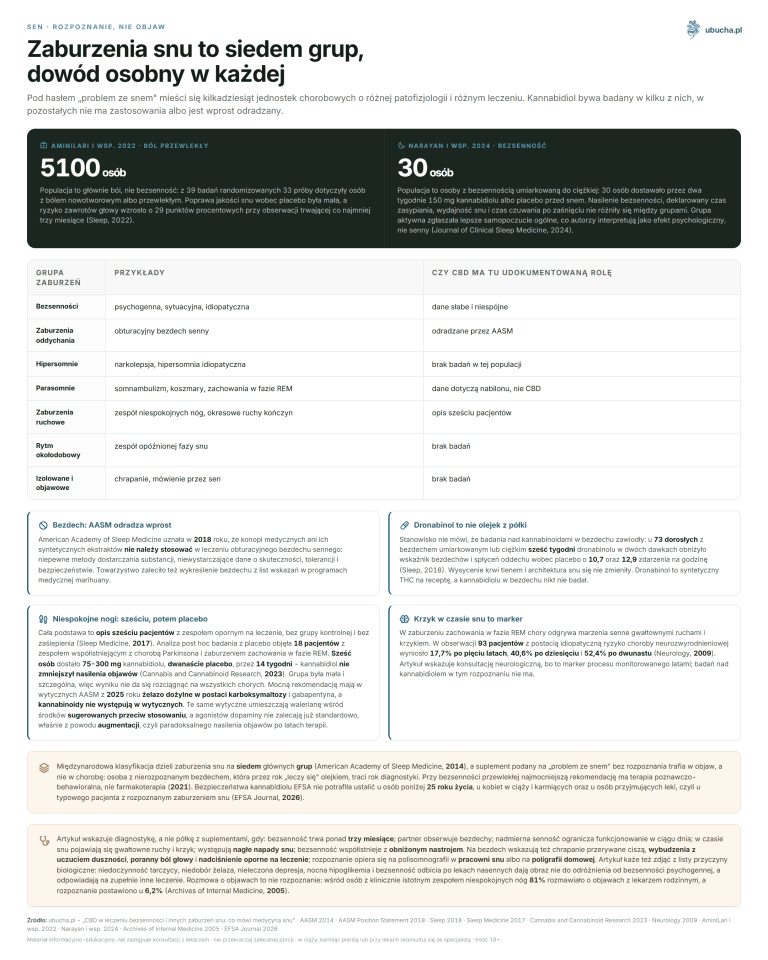
None of these works studied cannabis flower dispensed in Polish pharmacies or any single strain. They examined preparations with known doses: nabilone, cannabidiol, and standardized extracts. Improvement pertains to the assessment made by the patient in the questionnaire, not the measured structure of sleep, and the variability of results between studies exceeds what a meta-analysis can average. It was not shown that the strain name predicted anything about sleep.
Does Improvement Relate to Measured Sleep or Self-Reported Sleep?
Both, but not to the same extent and not in the same works. The 2026 review found an extension of sleep recorded by an electronic device in people with insomnia, while earlier works relied on questionnaires filled out by patients. These are two different measures, and their agreement can be poor.
The 2026 review, based on 54 randomized studies, reports for people with insomnia an extension of sleep by 0.54 standard deviations in the recording from the electronic device and 0.55 in the diary kept by the patient. Both measures performed similarly, but the lower limit of the interval for the diary is 0.01, which is practically zero.
An older systematic review with meta-analysis of five studies, two of which had randomization and three did not (CNS Drugs, 2020, PMID:33244728), mainly relies on questionnaires. Three non-randomized studies showed improvement in the Pittsburgh Sleep Quality Index by 1.89 points by the fourth week in 176 participants and by 2.41 points in the eighth week in 166 participants. One randomized double-blind study involving 32 people showed an advantage of nabilone over amitriptyline by 3.25 points on the insomnia severity scale after two weeks. A non-randomized study without a control group does not distinguish the effect of the preparation from the natural course of insomnia, so the first two numbers weigh less than the third.
What Strain Characteristics Matter Here?
None, as far as we are asking about evidence. In sleep studies, preparations with known doses were administered, not flower with a trade name, so there is no work that compared two strains with each other for this indication. The characteristics most often mentioned are chemotype and terpene composition, and both remain hypotheses.
Chemotype, meaning which cannabinoid dominates in the raw material, is the only characteristic that meta-analyses say something about, and they say something inconvenient for strain catalogs. In the 2025 review, preparations containing something more than pure cannabidiol performed significantly better than those with pure cannabidiol, but the comparison concerned ready-made preparations with known doses, not flower with declared tetrahydrocannabinol content. Transferring this result to flower would require assuming that the dose given in the study corresponds to the dose inhaled from a vaporizer, and no one measured that.
The terpene profile is often cited as an explanation for differences between strains described as nighttime, but no one controlled it in sleep studies. Separate texts in this series gather what is known about myrcene and linalool. In the data collected for this service, two public databases provide different compositions for most commonly described strains, so the declared profile is often a feature of the source, not the plant. How to read such a description is explained in a separate strain profile guide.
How Long Does the Effect Last After Vaporization, and How Long After Ingestion?
Shorter after vaporization than the night lasts, longer after ingestion. With sleep problems, this difference translates into whether the episode will include just falling asleep or extend into the next morning. The course is determined by the route of administration established by the physician, not the name of the raw material printed on the package.
The route of administration determines the course more than the strain itself. After vaporization, the substance passes from the lungs to the blood almost immediately, so the first sensations appear after a few minutes, intensity increases for another ten to thirty minutes, and the whole effect wears off within two to four hours. After ingestion, the raw material first passes through the intestine and liver, so the first sensations are waited for from half an hour to two, and the episode lasts six, sometimes eight hours. Hence the most common mistake with oral administration: who thinks after thirty minutes that nothing is happening and adjusts the dose will receive both doses at once. The above intervals describe the route of administration, not the strain; pharmacokinetic studies for a single cultivar have not been published.
In sleep studies, preparations with known doses were administered. With flower, such certainty does not exist: the amount absorbed depends on the route of administration, not the number printed on the package. Why the vaporizer setting does not equal the temperature of the raw material is explained in a separate text in this series.
What Does the Doctor Decide, and What Does the Patient Decide?
The indication, preparation, and dosage are decided by the attending physician, as cannabis flower is a pharmaceutical raw material dispensed in the Rpw category, meaning by prescription with a secondary document. The patient decides whether to go to the doctor at all and what to say about their previous treatment and other medications taken.
European guidelines for insomnia management prioritize cognitive-behavioral therapy, and pharmacological treatment is described as a step taken jointly with the physician when the first approach is insufficient. Cannabis flower does not have a registered indication for sleep disorders in Poland: it is a raw material from which the pharmacy prepares a medication based on a prescription, and the assessment of a specific case belongs to the attending physician. This order describes someone else’s document, not a recommendation from this site: no description in the store establishes an indication or determines whether the first approach has been exhausted.
The patient brings to this conversation things that the doctor cannot read from any database: the course of previous treatment, a list of medications taken, and what really happens at night. Without this part, no meta-analysis translates to a single case, as the averaged result knows nothing about the person sitting in the office. The dispensing process is described separately in a text about obtaining a prescription for medical marijuana, and the list of available items for a given month is collected in a summary of currently available strains.
What Adverse Effects Were Reported in Sleep Studies?
More frequent than in the placebo group. In a systematic review with meta-analysis of 54 randomized studies (2477 participants, The Lancet Psychiatry, 2026, PMID:41856154), the odds ratio for any adverse event was 1.75, with a range from 1.25 to 2.46, which corresponds to one additional person with an adverse event for every seven treated.
Reports of adverse effects are collected for the medicinal product with a batch number, not for the strain name, so the following pertains to cannabis flower as a group of raw materials. The most common are dry mouth, red eyes, and increased heart rate. Less frequently reported are dizziness upon standing quickly, daytime drowsiness, and transient worsening of short-term memory, as well as anxiety increasing with dosage. A separate issue is medications taken concurrently, especially sedatives and those affecting coagulation: their assessment requires knowledge of the entire list of preparations, not just the description of the plant. We do not provide the frequencies of these symptoms numerically, as public compilations for cannabis flower in Poland do not separate them by individual products.
The above odds ratio describes events of any kind, not their severity, and comes from studies on preparations with known doses, not on flower dispensed in pharmacies. What is known about cannabinoids in anxiety disorders is collected in a separate text in this series, as anxiety can be both a cause of poor sleep and a reported adverse effect. The state of evidence regarding lack of appetite is collected in another text in this series, where the research results diverge from common belief more strongly than here.
Frequently Asked Questions
Is cannabis flower a registered medication for insomnia?
No. Cannabis flower is a pharmaceutical raw material dispensed by a doctor’s prescription in the Rpw category, not a ready-made medication with a registered indication for sleep disorders. The attending physician decides on its use in a specific case.
Do strains described as nighttime work better for sleep than others?
It is unknown. None of the discussed works compared strains with each other, and the division into daytime and nighttime strains comes from commercial descriptions, not from research. It has not been shown that the strain name predicts anything about sleep.
What does a heterogeneity of 88 to 89 percent mean?
That the results of individual studies diverge almost entirely due to real differences between them, not due to chance. The average calculated from such a set is numerically correct, but does not describe any of the averaged studies.
Does pure cannabidiol improve sleep quality?
In a systematic review with meta-analysis of six randomized studies (PMID:40929927), pure cannabidiol yielded 0.13 standard deviations with a range from minus 0.38 to 0.65, which is statistically insignificant. Preparations containing something more performed stronger.
Were sleep measurements taken with a device, or were patients just asked about it?
Both methods were used. The 2026 review (PMID:41856154) describes an extension of sleep recorded by an electronic device, while older works relied on questionnaires filled out by patients. None of these meta-analyses summarize the measured structure of sleep.
Who decides on the use of cannabis flower for sleep problems?
The attending physician. Flower is dispensed by a doctor’s prescription in the Rpw category, so the indication, preparation, and dosage are determined by them, not by a description on the store’s website. This text describes the state of evidence and is not a therapeutic recommendation.
This material is for informational purposes only and does not replace medical advice. Cannabis flower is a pharmaceutical raw material dispensed only by a doctor’s prescription in the Rpw category. Editorial text: editorial team ubucha.pl.