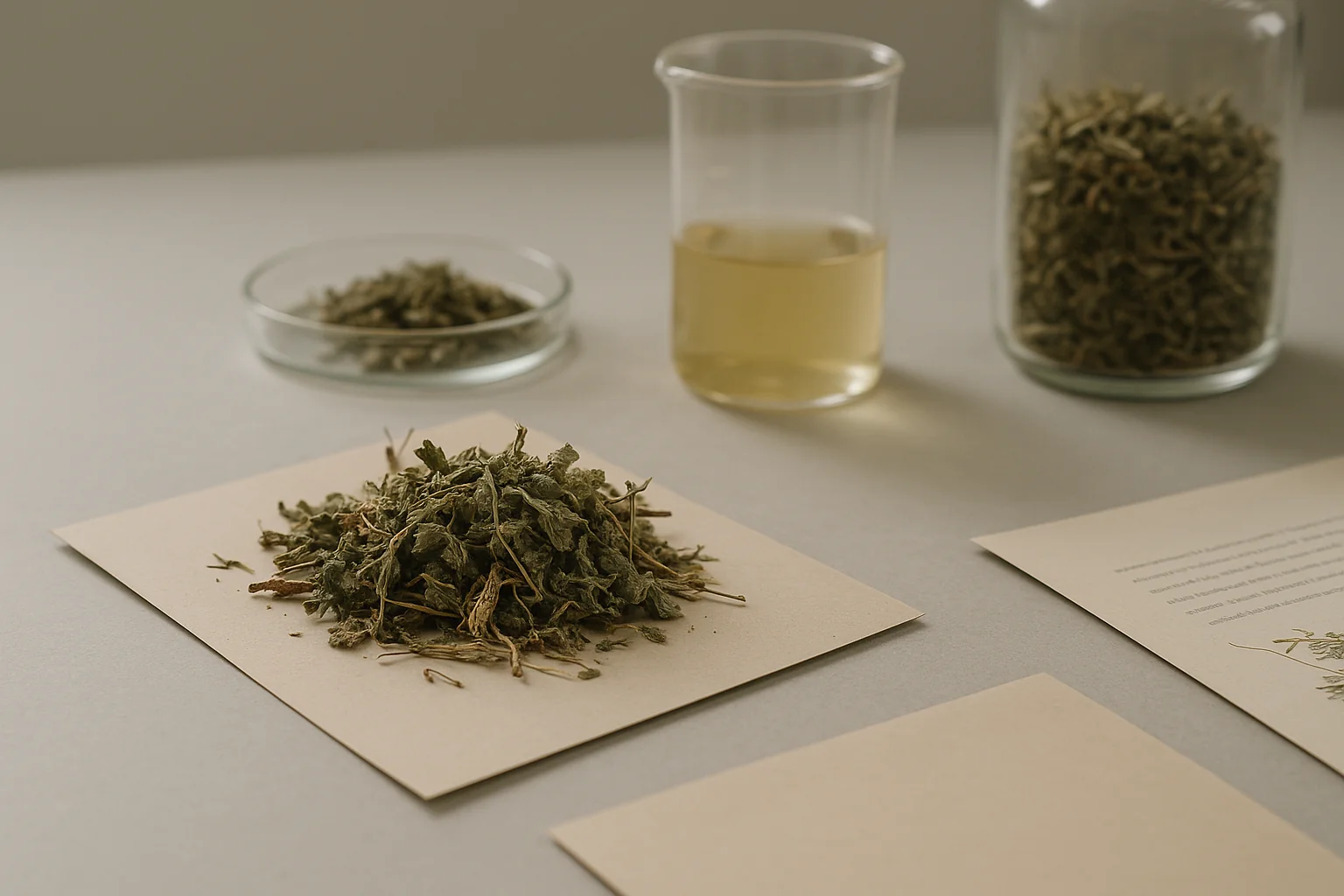

Chemango Kush (Cannabis flos Aurora): four siblings in pharmacies and caryophyllene
Chemango Kush was created from a double cross and reaches Polish pharmacies in one version. In the pedigree graph, it shares a parent with four other strains dispensed by prescription.
| Strain card | Chemango Kush |
|---|---|
| Producers | Aurora (1 pharmacy position) |
| Medical brand | the same as the producer |
| Alternative names | none |
| Category according to sources | indica |
| Leading terpene | caryophyllene |
| Other terpenes | humulene limonene linalool myrcene nerolidol |
| Lineage | established Og Kush × Wedding Cake × Gmo × Fuel |
| Source consistency | divergent (2 sources) |
- Who supplies. Only Aurora, so there is nothing to compare versions with, and a supply break means no availability of this strain, not another version of it.
- Profile. It leads with caryophyllene, alongside humulene, limonene, linalool, myrcene, and nerolidol. We do not provide percentage shares because sources count them against different totals.
- Origin. The lineage is established, with parents being Og Kush and Wedding Cake and Gmo and Fuel.
- What is missing. Two sources describe the profile differently, so the further part of the set is disputed, not established.
Where does Chemango Kush come from and what does its lineage reveal?
The lineage of this strain consists of two pairs. The breeder San Rafael ’71 records it as a cross of the OG Kush pair with Wedding Cake and the GMO pair with Fuel, meaning four parent strains instead of the usual two. Both bases describing the Polish market assign it indica genetics, and it only reaches pharmacies in the Aurora version.
The name combines two clues. The “chem” part indicates a fuel-chemical line brought in by Fuel and GMO, while “mango” points to a fruity note detected in the aroma. However, the word at the end of the name is not evidence of origin. This word repeats in this combination with ten cultivars, and for five of them, the origin remains undetermined. This group also includes OG Kush, which is the formal parent of the described strain: its own parents cannot be identified today, so the name clue ends one generation higher.
The value of such a record lies in the fact that it can be verified with the breeder themselves, rather than read from a label. Only this allows building a graph of relationships instead of guesses. Where the breeder is silent or available sources contradict each other, the word “unknown” stands in this combination and remains so, because guessing based on the name creates connections that no one has confirmed. With Chemango Kush, the record is complete, so the strain has a documented place in the network of connections, and conclusions about sibling relationships in the further part of the text are based on specific parents.
Which pharmacy versions of this strain are available in Poland?
One. Chemango Kush reaches Polish pharmacies exclusively as Aurora’s flower, described in the register as Cannabis flos, and there is currently no second producer of this name. Therefore, comparing versions comes down to one row, and the differences between packages result from the production series, not from a different recipe.
| Producer | Registered name | Genetics | Leading terpene | Dispensing mode |
|---|---|---|---|---|
| Aurora | Cannabis flos | indica, consistent in both sources | caryophyllene | category Rpw, prescription only |
A comparison with one row is a snapshot, not a feature of the strain. Permissions and actual wholesale stocking change with the rhythm of deliveries, so a position available in spring may be unreachable in summer, and then return under a different series, sometimes with a different batch number and different test results. Therefore, the current assortment along with prices describes a separate, updated list of available strains, not this text.
Aurora leads in the Polish assortment with ten strain positions, and the one described belongs to its stronger declarations; the catalog of this producer along with the way of marking series is described separately. It is worth separating two things that often mix in search results: pharmacy flower in the Rpw category is available on prescription and is not sold in retail, while hemp flower offered as a consumer product is a completely different category and is subject to different regulations.
What does this flower smell and taste like?
- humulene humulene
- caryophyllene caryophyllene (leading in the pharmacy list)
- limonene limonene
- linalool linalool
- myrcene myrcene
- nerolidol nerolidol
Aroma descriptions mention five notes. Two of them are citrus and pine, the third is fuel diesel, the fourth is earth, and the fifth is mango, from which the second part of the name derives. The order of sensations changes depending on whether the flower has just been opened or already ground. The producer does not publish its own sensory description.
Individual notes can be linked to the volatile composition, though not one to one. The citrus tone usually pairs with limonene, earthy and slightly green with myrcene, and the peppery finish with caryophyllene, which leads in this strain. However, the aroma also depends on compounds present in trace amounts and on how the flower has been stored, so two packages of the same name may not smell identically.
The description of the aroma remains the softest part of the entire profile. It does not come from measurement, but from notes of services cataloging the market, and these are created based on the impressions of individual people. The fruity part of the name additionally acts as a hint: those who know that mango is in the name find it easier to detect. Treating such a description as a fixed feature of the strain would be an abuse, as it changes with the batch, drying conditions, and storage time.
How long does it take for the effect to appear and how long does it last?
The route of administration determines this. The same flower will act differently when inhaled and differently when swallowed, and the difference concerns both the onset time and the duration of the episode. For Chemango Kush itself, no measurements have been announced, so the numbers below concern hemp material as such. The high declared THC content does not change this.
The route of administration determines the course more than the strain itself, and the ranges below describe it, not this cultivar, because pharmacokinetic studies for a single cultivar have not been published.
| Vaporization | After swallowing | |
|---|---|---|
| First sensations | after a few minutes | from half an hour to two |
| Build-up | another dozen to thirty minutes | slow, over several hours |
| Total passes | within two to four hours | after six, sometimes eight hours |
| Typical error | none | taking a dose after thirty minutes, which gives both doses at once |
It is worth adding what the second unknown is. The producer declares one THC value, and the allowable deviation is ten percent in either direction, so the actual content falls within the range of 26.1-31.9%. Providing a single number would suggest precision that is not present here: two batches of the same name can differ by several percentage points and both remain compliant with the declaration. With oral administration, this range weighs more than with vaporization, because the swallowed portion cannot be adjusted gradually during use.
Which claims about this strain are supported by research?
None. Published works concern only caryophyllene itself studied in rodents and cell systems, not the flower of this name. Everything that catalogs attribute to Chemango Kush as a strain remains a commercial description or the account of individual people. Separating these two orders weighs more than the length of the list.
However, two works worth mentioning point to the terpene, as strain descriptions usually end with a general bibliography.
| Work | Model and route of administration | What was shown |
|---|---|---|
| Gertsch J et al., 2008 Proceedings of the National Academy of Sciences (PNAS) PMID:18574142 |
mouse (in vivo) and test tube (receptor binding, human cells) | (E)-caryophyllene selectively bound to the CB2 receptor (Ki = 155 nM) and inhibited carrageenan-induced paw swelling in wild-type mice, but not in CB2 receptor-deficient mice (Cnr2-/-), indicating a CB2-dependent mechanism; the study did not include any anxiety tests. |
| Klauke AL et al., 2014 European Neuropsychopharmacology PMID:24210682 |
rodent (mouse) | Oral caryophyllene reduced late inflammatory pain in the formalin test in a CB2 receptor-dependent manner, with no effect on the early phase; in a neuropathic pain model, it alleviated thermal hyperalgesia and mechanical allodynia without developing tolerance with chronic administration. |
Neither of the two studies tested caryophyllene on humans or in inhaled form from the flower; both works concern oral or systemic administration in mice in pain and inflammation models, not sleep or mood.
The profile composition itself is also not established. Two services describing the Polish market provide it differently: budcare.pl additionally lists humulene and linalool, which medweed.pl does not have for this position, while both sites agree on caryophyllene, nerolidol, limonene, and myrcene. We do not transcribe percentage shares from here. Each source counts them against a different basis, and the summed values for the same positions do not reach one hundred, but scatter from the forties to over eighty. A number expressed in percentages is then incomparable between services, so we provide the composition as a composition.
What side effects have been reported from this flower?
There are no separate reports for Chemango Kush. A report goes to supervision assigned to a specific package of the medicinal product along with the batch number, not to the commercial name of the cultivar. Therefore, no data set is created that allows counting how often a given symptom appears specifically after this position. Below is a description for the entire group of raw materials.
Reports of adverse effects are collected for the medicinal product with a batch number, not for the strain name, so the following concerns hemp flower as a group of raw materials. The most common symptoms are dry mouth, red eyes, and increased heart rate. Less frequently reported are dizziness upon rapid standing, daytime drowsiness, and temporary worsening of short-term memory, as well as anxiety that increases with dosage. A separate issue is medications taken concurrently, especially sedatives and those affecting coagulation: their assessment requires knowledge of the entire list of preparations, not just the description of the plant. We do not provide the frequency of these symptoms numerically, as public compilations for hemp flower in Poland do not separate them by individual products.
For this position, there is one more circumstance. The declared THC content is among the highest in the pharmacy assortment, and the intensity of symptoms such as anxiety or increased heart rate increases with the amount of substance taken, not with the strain name. The same volume of flower therefore carries a stronger dose than with strains with lower declarations, which, with unchanged measuring methods, can be confused with a different character of the plant. The assessment of this risk belongs to the attending physician, as it requires knowledge of other medications being taken.
At what temperature does the flower with a predominance of caryophyllene vaporize?
There is no single correct value, as the boiling point of the terpene and the vaporizer setting are two different quantities. Caryophyllene boils at atmospheric pressure only around 257 degrees, which is significantly higher than the burning limit of the flower, and yet it can be detected in vapors much earlier.
This is due to a simple fact. In a resin mixture, each component evaporates long before its boiling point, as its partial pressure matters, not the behavior of the pure substance in a flask. Additionally, some numbers circulating in popular tables were measured under reduced pressure: for caryophyllene, a reading close to 130 degrees has also been published, but at several millimeters of mercury column, which is not the conditions present in a vaporizer. Comparing both readings in one column is a mistake repeated by most guides, and why such tables remain incomparable, we explain separately.
The profile of this strain is also shifted towards heavier components. Caryophyllene, nerolidol, and humulene are sesquiterpenes with distinctly higher boiling points than limonene or myrcene, which means that at low settings, the vapor mainly carries these lighter ones, and the characteristic peppery note appears only higher. We dedicate a separate text to caryophyllene along with what has been researched about it. The choice of setting remains a matter of equipment and the physician’s recommendation, as the scale on the display describes the heater, not the temperature of the flower itself.
Which pharmacy strains share a parent with it?
| Strain | Common parent | Leading terpene | Producers |
|---|---|---|---|
| Farm Gas | Gmo | limonene | Aurora |
| Sourdough | Wedding Cake | limonene | Aurora |
| Wedding Pie | Wedding Cake | caryophyllene | S-LAB |
| Wedding Pop Triangle | Wedding Cake | caryophyllene | Medalchemy |
Four. In the pedigree graph of Chemango Kush, it has four siblings present in Polish pharmacies: Farm Gas, Sourdough, Wedding Pie, and Wedding Pop Triangle. Only one strain in this set has more siblings, while most have none, as their parents have not been named anywhere.
Relationship does not distribute evenly. It shares GMO, which is a parent from the second pair, with Farm Gas. The remaining trio converges on Wedding Cake: Sourdough was created by crossing Wedding Cake with Sour Diesel, Wedding Pie with Wedding Cake and Grape Pie, and Wedding Pop Triangle with Wedding Cake and Triangle Kush.
| Strain | Common parent | Second parent |
|---|---|---|
| Farm Gas | GMO | Sour Diesel |
| Sourdough | Wedding Cake | Sour Diesel |
| Wedding Pie | Wedding Cake | Grape Pie |
| Wedding Pop Triangle | Wedding Cake | Triangle Kush |
The two parents of the described strain do not create any kinship, and this is a conscious decision. OG Kush and Fuel currently function as broad families of style, not as individual, identifiable plants, so two strains having them in their lineage do not become siblings because of that. For the same reason, a common word in the name does not determine anything: the same word ends the names of ten positions in this set, and for five of them, the lineage remains undetermined, while Blood Orange Kush descends from lemon kush and guava kush, which is from a completely different pair than the described strain. Therefore, the similarity in sound can be misleading in both directions: sometimes two unrelated cultivars have the same word in their name, and sometimes siblings do not have it at all, like Farm Gas.
The practical conclusion from this map remains cautious. A common parent may be visible in the volatile composition, but does not promise a similar effect profile, as the profile is also determined by phenotype selection and growing conditions in a specific facility. Siblings thus indicate where to look further, not what to expect.
Frequently asked questions about Chemango Kush
Is Chemango Kush available without a prescription?
No. Hemp flower for medical purposes has an Rpw category in Poland and is dispensed only by a doctor’s prescription for a specific medicinal product.
How many producers supply this strain to Polish pharmacies?
One. The strain is available in the pharmacy assortment only in the Aurora version, described in the register as Cannabis flos.
Which terpene leads in the profile of this strain?
Caryophyllene. Both services describing the Polish market place it first, although they differ regarding the rest of the composition.
Why do we provide the THC content as a range?
Because the register allows a deviation of ten percent from the declared value. For this position, it gives 26.1-31.9%, and a single number would suggest precision that a single batch does not confirm.
Which pharmacy strains are related to it?
Farm Gas, Sourdough, Wedding Pie, and Wedding Pop Triangle. It shares the parent GMO with the first, and Wedding Cake with the others.
Does the “kush” part in the name indicate a relationship with other kush strains?
No. In this set, this part is carried by ten cultivars, and half of them have no established lineage at all. Kinship is determined by the record of parents with the breeder, not the sound of the name.
Has a pharmacokinetic study been published for Chemango Kush itself?
No. The available time ranges describe the route of administration, not a single cultivar, and should be read as such.
Hemp flower is a pharmaceutical raw material in the Rpw category, dispensed only by a doctor’s prescription. This text is for informational purposes, describes the state of available data, and does not replace medical consultation or pharmaceutical advice.
Author: ubucha