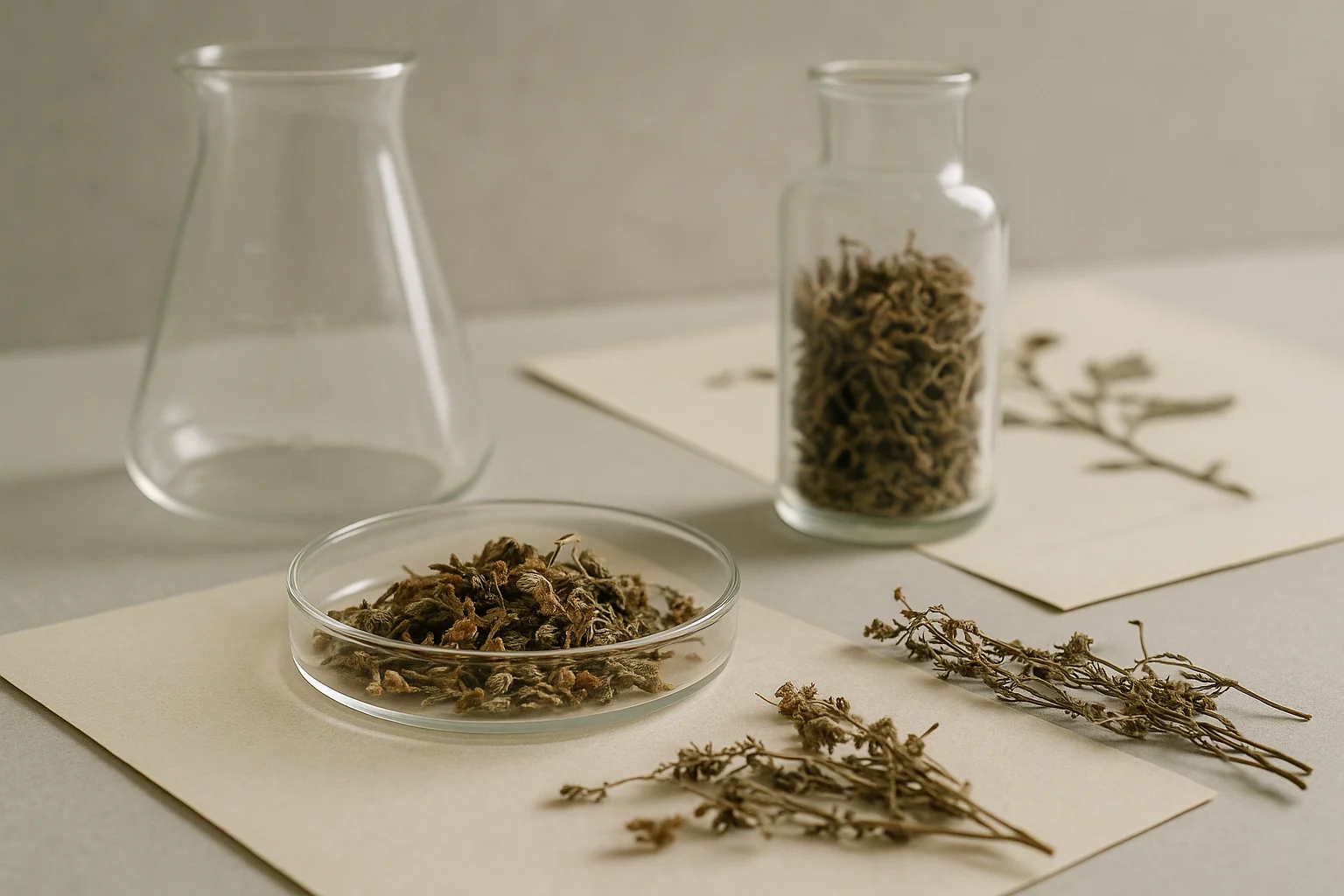

Penelope (Cannabis flos Canopy Growth): low declared THC and pinene content
Penelope is the only position from Canopy Growth with a declared THC content in the range of 7.2-8.8%, one of the two lowest in this comparison. The lineage remains unknown, and the profile composition is described by one source.
| Strain card | Penelope |
|---|---|
| Producers | Canopy Growth (1 pharmacy position) |
| Medical brand | the same as the producer |
| Alternative names | none |
| Category according to sources | hybrid with sativa dominance |
| Leading terpene | pinene |
| Other terpenes | caryophyllene myrcene |
| Lineage | unknown |
| Source compliance | one source |
- Who supplies. Exclusively Canopy Growth, so there is nothing to compare versions with, and a supply break means the absence of this strain, not another version of it.
- Profile. It features pinene, alongside caryophyllene and myrcene. We do not provide percentage shares because sources count them against different totals.
- Origin. Lineage is unknown. This is a result, not a gap to fill: we do not add parents based on name similarity.
- What is missing. The profile is described by one source, so there is nothing to compare it with.
What is Penelope and where does this strain come from?
The lineage of Penelope is unknown: no available source provides its parents. It reached Polish pharmacies as a registered position Cannabis flos, Canopy Growth, described by one source as a hybrid with sativa dominance, with a declared THC content in the range of 7.2-8.8%, which is one of the two lowest values in this comparison.
The entry “unknown” is not a gap to fill here, but a result: the breeder has not announced the cross or the descriptions that can be found contradict each other. Penelope is not an exception in this regard, as the origin of 25 cultivars out of 85 present in this cluster is not established. Adding parents by intuition would cost more than it gives: once a cross is entered, it then travels across subsequent pages and after a few rewrites, it stops differing in appearance from a lineage confirmed by the breeder.
What is known for sure about this position can be summarized in a few sentences. It is supplied by one producer, the profile composition comes from one database, and the action labels that this database adds (“stimulating”, “balanced”) are its own catalog classification, not a result of measurement or clinical observation. The name Penelope itself is a trade designation and does not carry information about composition or origin, and in the pharmacy list, a product description stands next to it, not the name of the cultivar.
Which producers supply Penelope to Polish pharmacies?
One. The entire description pertains to one registered position of Canopy Growth, which the source database assigns to the medical brand Spectrum Therapeutics, that is, the medical arm of the same group. Therefore, there are no competitive versions to compare and nothing to differentiate the table beyond what the registered name itself carries.
| Producer | Registered name without numerical part | Declared THC content | Source of profile description | Status in the source database |
|---|---|---|---|---|
| Canopy Growth (medical brand Spectrum Therapeutics) | Cannabis flos, Canopy Growth | 7.2-8.8% | budcare.pl | marked as withdrawn |
The number entered in the registered name is not the result of analyzing a specific batch, but a declaration, from which a deviation of up to one-tenth of the value is allowed. Eight spread in both directions gives a range from 7.2 to 8.8%, and that is why this text states a range, not a round number from the packaging. The same name also carries a declaration for cannabidiol, similar in size to the THC declaration, but we do not provide a calculated range for it because such a field is not included in the order, and calculating it independently would mean placing a self-generated number in a text about a drug. The proportion itself is rare for pharmaceutical raw material: the remaining 64 positions with a given range have a lower limit no lower than 16.2%.
Presence in the pharmacy is a separate matter from the permission itself. A position disappears from circulation when the producer stops sending batches, when the wholesaler does not renew orders, or when the permission expires without extension. The database from which this description of composition comes marks Penelope as withdrawn, so we treat it as a historical position until a new supply appears. The current list of what can actually be purchased is kept separately, in the overview of strains currently available in pharmacies. The store category hemp flower includes products available without a prescription and does not contain raw material dispensed by a doctor’s prescription.
What does Penelope smell and taste like?
- caryophyllene caryophyllene
- myrcene myrcene
- pinene pinene (leading in the pharmacy list)
The source describing this position mentions three notes: pine, camphor, and pepper. This is a record of an impression, not a measurement result, and comes from one source, so it speaks more about what its authors expected than about what a patient feels when opening a jar from a specific batch.
The mentioned volatile components align with a description consistent with what is seen in the profile. The resinous note corresponds to pinene, which leads in shares in this position; a sharper, spicy accent is usually associated with caryophyllene; myrcene is often described as earthy and most often accounts for the background. What is not present in this description is also information: there is no citrus or floral note because the database does not assign this position either limonene or linalool.
Numerical shares next to the names of components have been deliberately omitted here, and the reason is arithmetic. The three positions in the profile sum to 60 in the source, not to one hundred, so it is unknown what part of the material has been described at all or what is included in the missing remainder. In the same database, 145 positions give 46 different sums, from 14 to 125, and six exceed one hundred. A number pulled from such a set looks like a measurement, but is a fraction with an unknown denominator.
How long does it take for Penelope to take effect and how long does the effect last?
The route of administration determines this. Inhalation gives the first sensations within a few minutes, swallowing only after several dozen, and this difference is greater than any documented difference between cultivars. For Penelope itself, there is no measurement, so the ranges below describe hemp flower administered by one route or the other.
The route of administration determines the course more than the strain itself, and the ranges below describe it, not this cultivar, because pharmacokinetic studies for a single cultivar have not been published.
| Vaporization | After swallowing | |
|---|---|---|
| First sensations | within a few minutes | from half an hour to two |
| Onset | another dozen to thirty minutes | slow, over several hours |
| Total duration | within two to four hours | after six, sometimes eight hours |
| Typical error | none | dosing after thirty minutes, which gives both doses at once |
The low declared content does not shift these ranges. The onset and duration depend on how the substance enters the bloodstream, not on how much a single dose carries. What changes with this position is something else: at the lower limit of the declaration, the same dose carries noticeably less active substance than at the upper limit, and dosing should be the responsibility of the attending physician, not the description of the strain.
What is known and what is not known about the effects of Penelope?
Almost nothing is known about the strain itself. No clinical study for Penelope has been published, nor for any single cultivar, so only studies on pinene examined separately can be cited: in mice and in cell culture, not in patients taking the flower.
The first of these concerns sleep.
| Study | Model and route of administration | What was shown |
|---|---|---|
| Kim DS et al., 2015 The American Journal of Chinese Medicine PMID:26119957 |
in vitro (mouse peritoneal macrophages, culture) | Alpha-pinene reduced in cultured mouse peritoneal macrophages stimulated by LPS the secretion of IL-6, TNF-alpha, and nitric oxide, as well as the expression of iNOS and COX-2, by inhibiting MAPK and NF-kB pathways. |
| Yang H et al., 2016 Molecular Pharmacology PMID:27573669 |
rodent (mouse, oral administration) | Orally administered (-)-alpha-pinene prolonged NREM sleep time in mice and shortened sleep latency (EEG/EMG recording), acting as a partial modulator binding directly to the benzodiazepine site of the GABA-A receptor, without affecting NREM sleep intensity or REM sleep duration. |
The second study does not even concern the whole animal, only cells in culture.
The boundary of both studies is recorded directly, because without it, it is easy to read them as a promise: No anxiolytic or analgesic effects of pinene have been demonstrated in humans; available data only concern the influence on sleep in mice after oral administration and anti-inflammatory effects on mouse macrophages in culture. Beyond that, there remains descriptive material: action labels from the database and patient reports, which no one has collected in a way that allows them to be counted.
What side effects have been reported after Penelope?
None under the name Penelope. This strain appears in the list as a single position from one producer, and reports are described by the product’s batch number, not the plant’s name, so in public compilations, it is impossible to isolate what happened specifically after it, and not after any other flower.
Reports of side effects are collected for a medicinal product with a batch number, not for the strain name, so the following pertains to hemp flower as a group of raw materials. The most commonly reported are dry mouth, red eyes, and increased heart rate. Less frequently described are dizziness upon rapid standing, daytime drowsiness, and transient worsening of short-term memory, as well as anxiety increasing with dosage. A separate matter is medications taken concurrently, especially sedatives and those affecting coagulation: their assessment requires knowledge of the entire list of preparations, not the description of the plant. We do not provide the frequency of these symptoms numerically because public compilations for hemp flower in Poland do not separate them by individual products.
There is also no public certificate of analysis for this position that would link a specific batch to the profile description. The database on which we base the composition is a descriptive collection, not documentation of batch release: it does not contain batch numbers or testing dates, so it is impossible to trace from a symptom to the material that preceded it.
At what temperature should Penelope be vaporized?
There is no setting assigned to this strain. The volatile components in its profile boil at widely varying temperatures: alpha-pinene around 156 degrees Celsius, myrcene around 167, and caryophyllene only above 250, so no single setting encompasses the entire set at once, and the distance between the extreme readings exceeds one hundred degrees.
| Profile component | Boiling point at atmospheric pressure | Reading under reduced pressure |
|---|---|---|
| alpha-pinene | around 156.2 degrees Celsius | no such measurement in the set |
| myrcene | around 166.8 degrees Celsius | no such measurement in the set |
| caryophyllene | around 257.5 degrees Celsius | 130 degrees at 14 mmHg |
Numbers from such a table describe pure substance in a flask, not the plant in a chamber. The temperature displayed on the device refers to the heater or incoming air, and the material can be cooler by even several dozen degrees, depending on how densely it was packed and how long the inhalation lasts. We dedicate a separate text to the discrepancy between the device reading and the state of the material itself, and to what happens to the volatile components during heating, another one.
Discrepancies between tables have measurable explanations. Some entries come from measurements under reduced pressure: caryophyllene boils above 250 degrees at atmospheric pressure, and in one source, it is listed with 130 degrees at 14 mmHg, and both values are correct, only describing different conditions. For pinene, the difference is small, as sources provide 155 and 156.2 degrees, but the mere fact that there are two values is enough not to read either as a threshold. Where these contradictions come from, we break down at the temperature tables.
Which strains are related to Penelope?
None. Sixty lineages in this comparison list parents by name, and Penelope does not stand in any of them either as a parent or as a child of a documented cross, so there is no sibling to derive from. An empty list is a result here, not a lack of data.
The name also does not provide a clue, as none of the remaining 84 positions shares even one word with Penelope. This is rare: in the same comparison, the term “kush” is carried by ten cultivars, five of which have established origins, and five do not have it at all, so a common word in the name is often confused with kinship more than anything else. With Penelope, there is not even such a temptation, as the name stands alone in the cluster.
What actually connects this strain with other positions is of a different kind. The same producer supplies five other strains to Polish pharmacies, and a separate text about the raw material Canopy Growth collects them in one place. The declared content range matches numerically with Equiposa, which is produced by someone else, so the coincidence of declarations says nothing about genetics. Pinene leads in shares in six positions out of 85, and what this means for the patient, we break down at the component itself.
Frequently asked questions
Is Penelope a strain with stimulating effects?
The descriptive database assigns it the labels “stimulating” and “balanced”, but this is a catalog classification, not a result of research. For a single cultivar, there is no measurement that would allow such a label to be confirmed or refuted.
Why is the THC content given as a range?
Because the producer’s declaration allows for a deviation of up to one-tenth of the value. For this position, it gives a range from 7.2 to 8.8%, and a single number would suggest precision that the documentation does not promise.
Is Penelope currently available in Polish pharmacies?
The database from which the profile description comes marks this position as withdrawn. Availability changes with supplies and permissions, so we maintain the current state solely in the overview of strains available in Polish pharmacies.
What does the unknown lineage of this strain mean?
It means that no available source provides the parents or that the descriptions contradict each other. It is not a gap to be filled by guesswork: in this comparison, the lineage of 25 cultivars out of 85 is not established.
Does low THC content mean fewer side effects?
This does not follow from any data collected for this strain. Reports are described by the product’s batch number, not the cultivar name, so comparing one strain to another has no basis.
Does pinene in the profile mean that the strain supports sleep?
No. The influence on sleep has been described for pinene itself administered orally to mice, in NREM sleep recording, not for the flower taken by patients. Transferring such a result to the strain would be an overinterpretation.
Hemp flower is a pharmaceutical raw material dispensed by a doctor’s prescription in the Rpw category. The material is informational in nature and does not replace the advice of a doctor or pharmacist.
The editorial text was prepared by the editorial team of ubucha.pl.