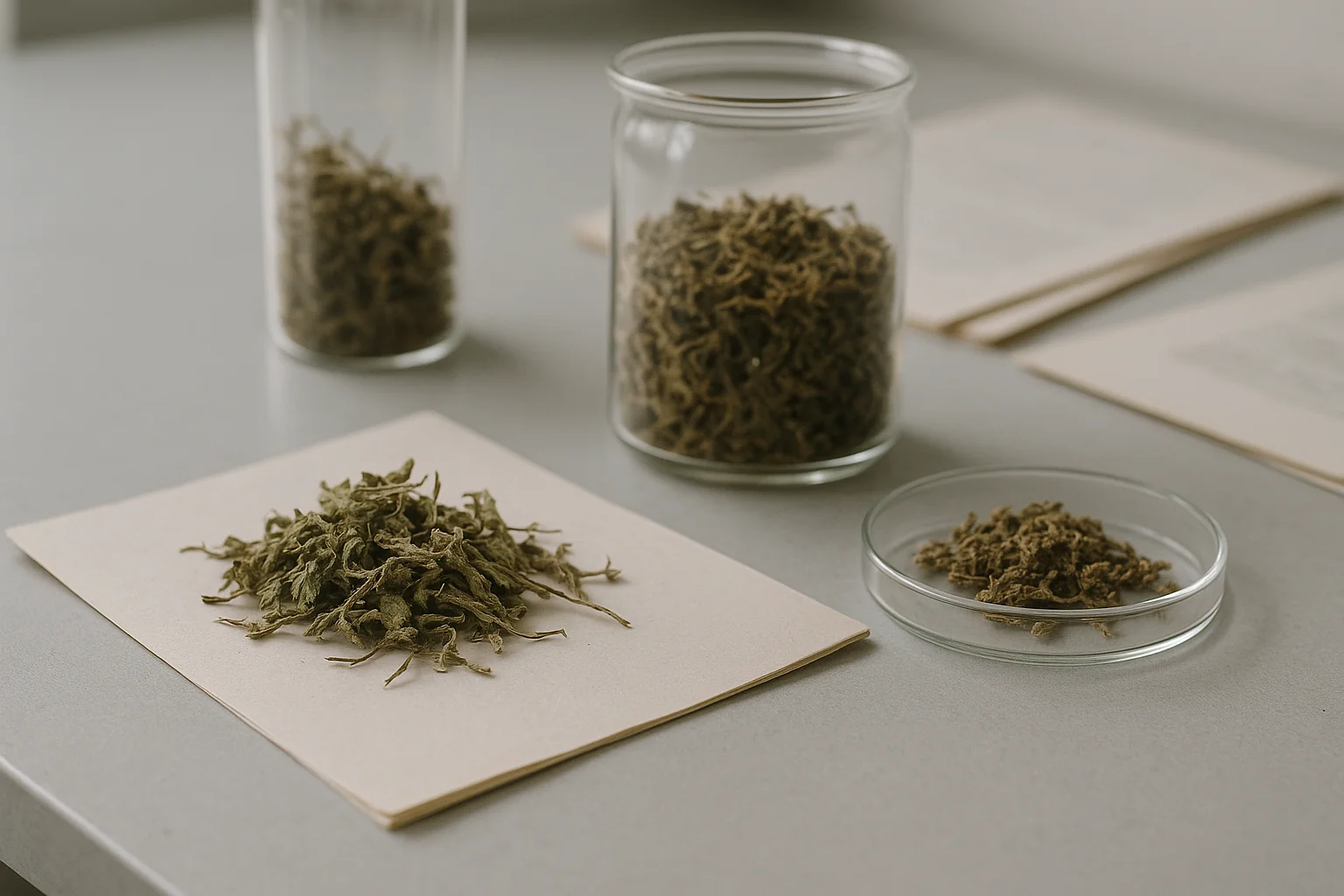

Animintz (Cannabis flos S-LAB): pedigree from two lines of Cookies and myrcene in the profile
Animintz is a hybrid with an indica dominance, supplied to Polish pharmacies by one producer. We have gathered what its pedigree, terpene profile, and state of evidence indicate from sources, along with what these sources do not say.
| Strain card | Animintz |
|---|---|
| Producers | S-LAB (1 pharmacy position) |
| Medical brand | the same as the producer |
| Alternative names | none |
| Category according to sources | hybrid with an indica dominance |
| Leading terpene | myrcene |
| Other terpenes | caryophyllene limonene linalool |
| Pedigree | established Animal Cookies × Sinmint Cookies |
| Source consistency | one source |
- Who supplies. Exclusively S-LAB, so there is nothing to compare versions with, and a break in supply means a lack of this strain, not another version of it.
- Profile. Myrcene leads, alongside caryophyllene, limonene, linalool. We do not provide percentage shares, as sources count them against different totals.
- Origin. The pedigree is established, the parents are Animal Cookies and Sinmint Cookies.
- What is missing. The profile describes one source, so there is nothing to compare it with.
Where does Animintz come from and what does its pedigree say?
Animintz was created by crossing Animal Cookies with SinMint Cookies, which are two lines that have grown from the same trunk. This is provided by one verified source, which also indicates the breeder, Seed Junky Genetics. The commercial description defines the plant as a hybrid with an indica dominance, and this information also comes from one place.
Both components of this cross lead to one family. Animal Cookies descends from the Girl Scout Cookies line, and SinMint Cookies is described in the same source as a combination of Girl Scout Cookies and Blue Power. Thus, the pedigree of Animintz converges on both sides to the same strain, which is not visible from the name alone.
We know the origin here from one entry that could be verified directly, and it should be read as information from a single place, not as a determination confirmed by several independent descriptions. In the cluster of which this text is a part, twenty-five cultivars out of eighty-five have no established parents, and we state directly that the pedigree remains unknown for them, rather than guessing at ancestors. Animintz does not belong to this group, but the difference between one source and the consistency of many sources remains, and it is worth keeping in mind when comparing descriptions.
Who supplies Animintz to Polish pharmacies?
One producer, S-LAB. There is no choice between versions from several manufacturers, and the comparison comes down to what this one description provides about the raw material. However, availability changes from batch to batch, so check the current state in the updated list of strains, not in the cultivar description.
| What the source provides | Value for Animintz |
|---|---|
| Producer supplying to Polish pharmacies | S-LAB |
| Genetics according to the commercial description | hybrid with an indica dominance |
| Number of sources describing the profile composition | one |
| THC content considering the producer’s tolerance | 19.8-24.2% |
| Dispensing mode | only by prescription, category Rpw |
The range instead of a single value comes from the fact that the producer’s declaration allows for a deviation of one-tenth in either direction. The number printed on the packaging is the midpoint of such a range, not the result of measuring the portion that the patient receives. When comparing two strains, a difference narrower than the width of both ranges does not resolve anything. The tolerance describes an allowable spread, not a weight error, so it also includes differences between packages from the same series. The table does not include price or current stock status, as both of these things change faster than the strain description, and we keep them only in the aggregate list.
A single supplier has one more consequence that strain descriptions usually remain silent about. When a batch runs out, there is no substitute from another producer under the same name, so a break in availability can be total and last until the next series is introduced. For the same reason, the strain name is not a guarantee of continuity of treatment, as it returns to circulation only when a specific series returns, not when the patient needs it. We have gathered the remaining positions of this producer in a separate discussion.
What does this herb smell and taste like?
- caryophyllene caryophyllene
- limonene limonene
- linalool linalool
- myrcene myrcene (leading in the pharmacy list)
There is no description of the smell that could be attributed to this cultivar based on documentation. Reports circulating in stores and forums are impressions of individual people, not measurements. However, it can be said what is usually associated with each of the four compounds mentioned in the only published profile of this strain.
Myrcene is often associated with a herbal and earthy note, which rarely comes to the forefront and more often acts as a background. Caryophyllene carries a peppery and spicy accent, limonene is citrusy, and linalool is floral, close to lavender. These are associations attributed to the compounds themselves, known from scent studies, and not a description of how a specific batch of herb smells.
It is not possible to draw a conclusion about which of these accents will prevail, as the source lists the presence of compounds, not their proportions. Additionally, the smell of the herb changes after opening the package and depends on how the plant was dried and how it was stored, so even two packages of the same strain may not smell the same. Commercial descriptions that provide one distinct aroma as a feature of the strain promise precision that the data does not have.
Another matter is that the smell does not predict anything. The compounds detectable by the nose constitute a small part of the plant’s content, and the olfactory impression depends on the detection threshold, which is different for each of them. A component present in trace amounts can dominate the scent, while one present in larger amounts may go unnoticed, so the order of notes in the description does not reflect the order of shares in the herb.
How quickly does this herb start to work and when does the effect wear off?
The answer depends not on the strain, but on how the raw material is administered. For Animintz, no one has published a separate measurement, and the gap between cultivars is smaller than the difference between inhaling vapor and swallowing. The description below therefore pertains to the route of administration and applies equally to the entire group of herbs.
The route of administration determines the course more than the strain itself, and the ranges below describe it, not this cultivar, as pharmacokinetic studies for a single cultivar have not been published.
| Vaporization | After swallowing | |
|---|---|---|
| First sensations | after a few minutes | from half an hour to two |
| Onset | another ten to thirty minutes | slow, over several hours |
| Total effect wears off | within two to four hours | after six, sometimes eight hours |
| Typical error | none | taking a dose after thirty minutes, which gives both doses at once |
For someone comparing strain descriptions, one conclusion arises. Declarations about faster or longer effects attributed to a single plant have no basis in measurement, as no such measurement has been made for any of these cultivars. The method of administration and the size of the dose are determined by the treating physician, not the description on the store’s website.
What has been shown in studies on myrcene, and what remains unestablished?
The action of myrcene itself has been demonstrated in rodents, in three studies with different routes of administration and divergent outcomes. However, the translation of these observations to humans inhaling vapor from the herb has not been demonstrated. Everything below pertains to a single compound administered to animals, not this strain administered to a patient.
| Study | Model and route of administration | What was shown |
|---|---|---|
| Rao VS et al., 1990 Journal of Pharmacy and Pharmacology PMID:1983154 |
rodent (mouse) | Myrcene (10-40 mg/kg) reduced pain responses in mice in hot plate and writhing tests induced by acetic acid; the effect was abolished by naloxone and yohimbine, indicating involvement of alpha2-adrenergic receptors and release of endogenous opioids. |
| do Vale TG et al., 2002 Phytomedicine PMID:12587690 |
rodent (mouse, intraperitoneal administration) | Myrcene administered intraperitoneally (100-200 mg/kg) reduced the locomotor activity of mice in an open field test, prolonged sleep induced by pentobarbital (by about 2.6 times at 200 mg/kg), and reduced the number of entries into the open arms of the elevated plus maze, which the authors described as a weak anxiogenic effect, not anxiolytic. |
| Wagner JK et al., 2024 NeuroSci PMID:39728677 |
rodent (mouse, inhaled vapor) | With short puffs mimicking inhalation in humans, beta-myrcene acted anxiolytically in the elevated plus maze in female mice, and in males only with a single puff. Unlike linalool, myrcene did not produce a synergistic effect with cannabidiol in either sex. |
In humans, it has not been shown that myrcene alone alleviates insomnia at doses typical for inhalation of herb. The direction of the effect in rodents depends on the route of administration and sex: after intraperitoneal injection in 2002, a slightly anxiogenic effect was described, while after inhalation in 2024, an anxiolytic effect was observed in females. These two results do not cancel each other out; they only show that the conclusion depends on conditions that no popular strain database provides.
Besides these studies, there are two types of content that should not be mixed with evidence. The first is the producer’s material: commercial description, declared genetics, and a list of compounds detected in the profile. The second is reports from individuals using the herb, describing single experiences without a comparative group and without blinding. Neither of these tells what this plant does in the body, so we keep them separate from research results in the text. The separation of these three layers rarely occurs in strain descriptions, and without it, a statement about mice and a statement from a commercial leaflet look equally serious on the page. We have gathered the studies on this terpene in a separate discussion.
What side effects have been reported for this strain?
Specifically for Animintz, none have been described. Reports are not collected under the strain name, so a compilation of symptoms attributed specifically to this plant does not exist and cannot arise from public data. It can only be honestly stated what pertains to cannabis herb as a group of raw materials.
Reports of adverse effects are collected for medicinal products with a batch number, not for the strain name, so the following pertains to cannabis herb as a group of raw materials. The most commonly reported are dry mouth, red eyes, and increased heart rate. Less frequently described are dizziness upon rapid standing, daytime drowsiness, and transient worsening of short-term memory, as well as anxiety that increases with dosage. A separate matter is medications taken concurrently, especially sedatives and those affecting coagulation: their assessment requires knowledge of the entire list of preparations, not just the description of the plant. We do not provide the frequency of these symptoms numerically, as public compilations for cannabis herb in Poland do not separate them by individual products.
This leads to a note about the strain descriptions themselves. Since the list of symptoms is common for the entire group, a page presenting it as a feature of one plant merely repeats general content under a different name. Differences between cultivars may exist, as the composition can vary, but no one has measured or published them in this form, and conjecture does not replace measurement.
At what temperature is this herb vaporized?
No one has established the proper temperature for this strain, so providing a single number would be fabrication. It makes more sense to point out three things that spoil most compilations circulating online, as they pertain not so much to the plant itself, but to the measurement method and what exactly was measured in such a measurement and to what the provided value refers.
First, tables of evaporation temperatures for individual compounds differ from each other, and to such an extent that choosing one compilation over another changes the recommendation. Where these discrepancies come from and what values from such tables actually pertain to, we analyze separately.
Second, the number on the device display describes the heating element or the air before the chamber, not the plant. The herb heats unevenly and with a delay, so the same setting gives a different result depending on the equipment, the packing of the chamber, and the pace of inhalation.
Third, the published profile of this strain lists four compounds, not one. Setting the equipment for the one indicated as leading is therefore a choice, not an optimization: what favors one component does not necessarily favor the others, and how much of each of them was in the herb, the source does not provide.
For these three reasons, the ranges entered into commercial descriptions should be read as a customary practice in the industry, not as a setting calculated for this plant. No public source provides a measurement made on this cultivar, so any number given here as proper would be copied from another strain or from nothing.
Which strains share a common ancestor with Animintz?
| Strain | Common parent | Leading terpene | Producers |
|---|---|---|---|
| Animal Rntz | Animal Cookies | caryophyllene | S-LAB |
| Zookies | Animal Cookies | caryophyllene | Medalchemy |
Two, both through Animal Cookies: Animal Rntz and Zookies. The kinship arises from the pedigree graph, not from name similarity. Besides this one common parent, both differ from Animintz in their second parent, producer, and the terpene indicated in their profiles as leading.
| Strain | Second parent | Producer | Terpene indicated as leading |
|---|---|---|---|
| Animal Rntz | Runtz | S-LAB | caryophyllene |
| Zookies | Gorilla Glue #4 | Medalchemy | caryophyllene |
The comparison immediately shows how little a common parent predicts. Both of these strains have a different leading compound in their profile description than Animintz, and one of them comes from a different producer, so it enters the pharmacy in a completely separate series. Sibling in this graph means that two strains have a documented common ancestor, and nothing more: it does not predict similar composition or similar effects. Separate discussions of both can be found with the strain Animal Rntz and with the strain Zookies.
Similarity of names does not resolve anything here, in either direction. The kush component carries ten cultivars in this cluster, and half of them have no established parents at all, so a common word can be a commercial decision, not a record of origin. Conversely, for some strains, the sibling list is empty despite a known pedigree, because the parent is a landrace or a broad family style, meaning a category, not a single established plant. For such strains, we do not add connections by intuition, as fabricated kinship spreads through the graph further than its absence.
Frequently asked questions about the Animintz strain
Is Animintz an indica or sativa strain?
The commercial description states a hybrid with an indica dominance and comes from one source. The division into indica and sativa does not predict the course of effects, as it describes the plant’s growth habit and naming tradition, not the measured response of the body.
How much THC does Animintz have?
The source provides one value, and the producer’s declaration allows for a deviation of one-tenth in either direction, so an honest record is the range of 19.8-24.2%. The number from the packaging represents the midpoint of this range, not the result of measuring a given portion.
Who supplies Animintz to Polish pharmacies?
One producer, S-LAB. Availability can be interrupted, as it depends on subsequent batches introduced to circulation, so it is worth checking the current state in the updated list of strains, not in the cultivar description.
What terpenes does the Animintz profile mention?
One source mentions caryophyllene, limonene, linalool, and myrcene, with myrcene indicated as the leading one. We do not provide shares, as sources do not disclose what total they count them against, and sums gathered from different databases for the same items do not add up to one hundred.
Does Animintz help with sleep?
This has not been demonstrated. Studies on myrcene were conducted on rodents and yielded divergent directions of results depending on the route of administration, and it has not been verified in humans that this compound alone works at amounts found in herb. Treatment is determined by the treating physician.
Which strains are related to Animintz?
Animal Rntz and Zookies, both through the common parent Animal Cookies. Kinship arises from the pedigree graph, not from name similarity, and does not predict similar composition: in both profiles, a different leading terpene is indicated than in Animintz.
Can Animintz be purchased without a prescription?
No. Cannabis herb is a pharmaceutical raw material dispensed only by prescription, in category Rpw, and the pharmacy fulfills a prescription issued for a specific raw material and a specified amount.
This material is for informational purposes only and does not replace medical advice. Cannabis herb is a pharmaceutical raw material dispensed by prescription in category Rpw. Editorial: ubucha.pl.