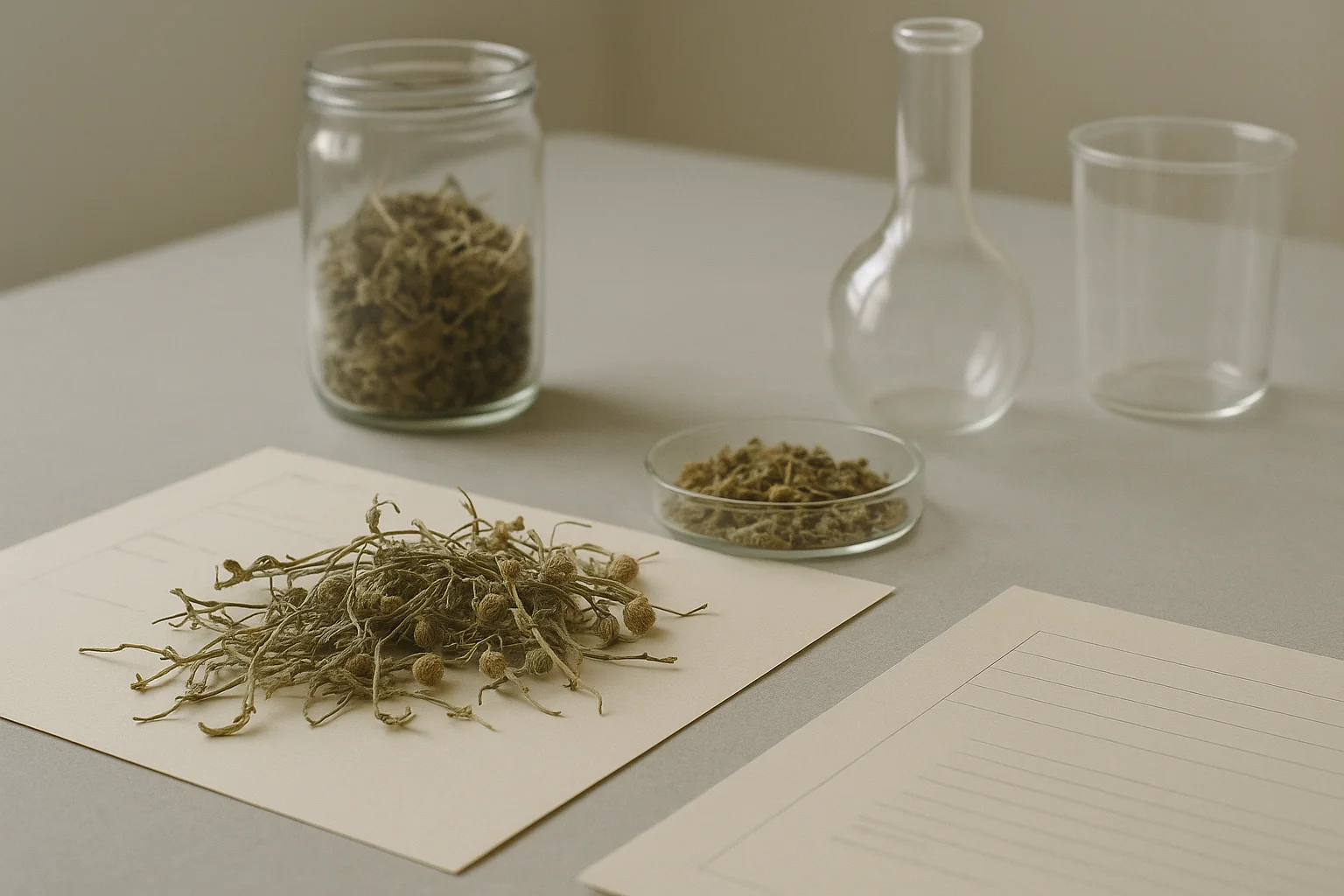

Master Kush (S-LAB, Synoptis Pharma, Tilray): earthy-peppery aroma with a hint of camphor
Indica strain with a profile led by caryophyllene, supplied to Polish pharmacies by three producers. The lineage remains unknown, and the composition is described by one source.
| Strain Card | Master Kush |
|---|---|
| Producers | S-LAB, Synoptis Pharma, Tilray (4 pharmacy positions) |
| Medical Brand | same as producer |
| Alternative Names | none |
| Category by Sources | indica |
| Leading Terpene | caryophyllene |
| Other Terpenes | bisabolol humulene limonene linalool myrcene nerolidol pinene |
| Lineage | unknown |
| Source Consistency | one source |
- Who supplies it. 3 producers (S-LAB, Synoptis Pharma, Tilray) in 4 positions, which may differ in declaration and origin of the raw material.
- Profile. It leads with caryophyllene, alongside bisabolol, humulene, limonene, linalool, myrcene, nerolidol, pinene. We do not provide percentage shares because sources count them against different totals.
- Origin. Lineage is unknown. This is a result, not a gap to fill: we do not add parents based on name similarity.
- What is missing. The profile describes one source, so there is nothing to compare it with.
What is Master Kush and where does this strain come from?
The lineage of Master Kush is unknown. None of the available sources provide the parents of this cultivar, so in the pedigree graph of the project, it stands with the value “unknown”. However, it is known that Polish pharmacies issue it as indica flower, and the available registered positions come from three producers.
The name is not evidence of kinship. In this cluster, the term “kush” is used for ten cultivars, half of which have established parents, and half do not have any. Adding Master Kush to any of these families solely based on the name would create a connection that no one has confirmed, and that connection would begin to live its own life in subsequent studies.
What can be said without guessing: available descriptions consistently classify this flower as indica. The declared THC content ranges from 16.2-24.2% because there are registered positions in circulation with different nominal values, and for each nominal value, the producer adds a tolerance of about ten percent of the value. Providing a single number would be a measurement that the pharmacy does not perform.
Availability can be unstable. Some registered positions disappear from circulation and return after months, depending on imports and whether the producer maintains a given potency in the offer. The current state of the shelves is shown in a summary of strains available in Polish pharmacies, maintained separately from this description.
Which producers supply Master Kush to Polish pharmacies?
Three: S-LAB, Synoptis Pharma, and Tilray. Each introduces its own registered position, and S-LAB has two with different nominal values. The versions are not interchangeable, as the source describing their composition provides a completely different arrangement of terpenes for Synoptis Pharma than for the other two.
| Producer | Registered Positions | How this version differs |
|---|---|---|
| S-LAB | two, with different nominal values | profile led by caryophyllene and nerolidol right behind it; aromatic note with camphor |
| Synoptis Pharma | one | in the same source, profile led by myrcene, shorter list of compounds mentioned |
| Tilray | one | composition record identical to the S-LAB version, same aromatic note |
The difference between versions is not cosmetic. The same base describes the Synoptis Pharma position as flower, where myrcene leads, and caryophyllene is far behind, while the S-LAB and Tilray positions have the opposite record. The trade name sounds the same, although the composition record does not. Until someone publishes results from the same laboratory for all three producers, this discrepancy should be read as a difference in record in the database, not as a measured difference between the flowers.
The composition of the version is one thing, availability is another. Registered positions enter and exit circulation independently of each other, so the list of producers valid today may not be valid in a quarter. For this reason, we maintain the current assortment in one place, not on eighty-five pages about individual strains. Separate descriptions are also provided by the producers themselves: S-LAB, Synoptis Pharma, and Tilray.
What does Master Kush smell and taste like?
- bisabolol bisabolol
- humulene humulene
- caryophyllene caryophyllene (leading in the pharmacy list)
- limonene limonene
- linalool linalool
- myrcene myrcene
- nerolidol nerolidol
- pinene pinene
Earthy and peppery, with a cool note of camphor that can easily be mistaken for the smell of incense. The citrus layer is present but thin and only appears after grinding. It is a spicy profile, not sweet: nothing here resembles fruits or vanilla. This is how the base describes it, from which the profile of this strain originates.
This aromatic profile is the main reason why Master Kush does not replace Purps, although both positions have the same leading terpene, the same unknown lineage, and the same three producers. Purps is described by its appearance and sweetness: purple buds, grape-berry aroma. Master Kush goes in the opposite direction, towards dry pepper and cool wood. Those looking for a fruity flavor will not find it here.
The description of effects should be read more cautiously than the description of smell. The base assigns this strain one keyword, relaxing, and nothing beyond that. In descriptive materials, Master Kush comes out as a balanced and alert relaxation, lighter than the sedation attributed to Purps. However, this is a commercial characteristic, not a measurement, and there is no study comparing these two strains behind it. The smell can be described in words and checked upon opening the package, but the character of the effects cannot be verified in the same way, and it is not worth blurring that boundary.
How long does it take for the strain to take effect and how long does the effect last?
No one has measured this for Master Kush itself. The numbers that can be provided describe the behavior of THC administered by inhalation or orally and come from pharmacokinetic studies concerning the raw material, not this strain. The difference between routes of administration is greater than the difference between individual cultivars.
With vaporization, the onset of effects is counted in minutes. Pharmacokinetic literature regarding inhaled THC describes the first sensations a few minutes after inhalation, peak concentration in the blood around the first quarter of an hour, and noticeable effects lasting approximately two to four hours. The reason is the route: the substance passes from the lung alveoli directly into the bloodstream, bypassing the digestive tract.
After oral administration, the same raw material behaves differently. The onset can be delayed by half an hour to two hours, the peak occurs later and is blurred, and the whole effect usually stretches over six to eight hours. This is due to the passage through the liver before entering the general circulation, which alters the speed and scale of the response.
None of these numbers are properties of Master Kush and should not be read as such. These are ranges for the route of administration, with a large individual variability, dependent on inhalation technique, equipment settings, and the meal preceding intake. The vaporizer setting is not the same as the temperature of the flower, which is discussed in a separate text about measuring temperature in the chamber.
What is known and what is not known about the effects of this strain?
It is known which terpene leads in the profile and what has been shown for this terpene in animal models. However, nothing is known about the strain itself: there is not a single clinical study in which Master Kush was administered to patients and the outcome measured. This boundary runs through the entire description below.
The profile composition is described by one source, a Polish database collecting pharmacy position cards. It lists bisabolol, humulene, caryophyllene, limonene, linalool, myrcene, nerolidol, and pinene for this strain. In the records concerning the S-LAB and Tilray versions, caryophyllene leads, with nerolidol right behind it; in the record of the Synoptis Pharma version, myrcene is at the forefront, and caryophyllene drops far down. The second source, which we use for other cultivars, does not describe this strain at all, so there is nothing to compare it with.
We do not provide percentage shares next to the names, and this is not an oversight. The measured sums of these shares, calculated for the same positions from Polish databases, amount to 46%, 73%, and 83%. The denominator is therefore unknown and different in each comparison, and the number placed next to the name of the compound would appear to be a measurement, which it is not.
Separately stands what has been shown for caryophyllene.
| Study | Model and Route of Administration | What was shown |
|---|---|---|
| Gertsch J et al., 2008 Proceedings of the National Academy of Sciences (PNAS) PMID:18574142 |
mouse (in vivo) and test tube (receptor binding, human cells) | (E)-caryophyllene selectively bound to the CB2 receptor (Ki = 155 nM) and inhibited carrageenan-induced paw swelling in wild-type mice, but not in CB2 receptor-deficient mice (Cnr2-/-), indicating a CB2-dependent mechanism; the study did not include any anxiety tests. |
| Klauke AL et al., 2014 European Neuropsychopharmacology PMID:24210682 |
rodent (mouse) | Oral caryophyllene reduced late inflammatory pain in mice in the formalin test in a CB2 receptor-dependent manner, with no effect on the early phase; in a neuropathic pain model, it alleviated thermal hyperalgesia and mechanical allodynia without developing tolerance with chronic administration. |
The boundary of these studies must be stated clearly. In neither of the two studies was caryophyllene tested on humans or in inhaled form from flower; both studies concern oral or systemic administration in mice in pain and inflammation models, not sleep or mood. Everything else said about the effects of Master Kush comes from commercial descriptions and reports from individuals consuming this flower, not from measurement.
What side effects have been reported after this strain?
There are no separate data for Master Kush. No one has kept a registry of adverse events broken down by cultivars, so frequencies for this position simply do not exist. Only numbers for hemp flower as a whole are available, and these do not automatically transfer to a single strain.
Symptoms mentioned with inhaled hemp flower include primarily dry mouth, dizziness, drowsiness, and increased heart rate, or tachycardia. With higher active substance content, anxiety and impaired coordination also occur. None of these positions have been counted for Master Kush separately.
The lack of data is not a formality here. A strain with a high active substance content and a profile described by one database may be presented as if its tolerance were known, but it is not. The decision on the selection of positions is made by the attending physician, and information about contraindications and interactions is carried by the leaflet of the specific package, not the strain description.
Reports go to the monitoring system for adverse drug reactions, but they are registered there under the product name, not under the cultivar name. Until this level of detail changes, the statement “after Master Kush, symptom X was reported with frequency Y” will be a fabrication, even if it sounds credible.
At what temperature should Master Kush be vaporized?
There is no single correct value, and the tables circulating online confuse two different things. The boiling temperature of a pure compound in the laboratory is not the temperature at which the same compound leaves the flower in the vaporizer chamber, and the difference can be measured in dozens of degrees.
This is evident with the leading compound of this strain. For caryophyllene, chemical bases report boiling under atmospheric pressure around 257 degrees Celsius, but the same compound has also been measured at reduced pressure, where it transitions to vapor at around 130 degrees. The flower is not a pure reagent, and the vaporizer chamber is not a distillation flask, so none of these numbers can be directly translated to settings.
The other compounds in the profile boil significantly lower: pinene around 156 degrees, myrcene about 167, limonene close to 178, linalool at 196. The practical consequence is simple: at lower settings, the vapor carries primarily the lighter part of the aroma, and at higher settings, the heavier, spicy note comes through, which is backed by the leading compound of this strain.
The discrepancies between temperature tables and why they cannot be reconciled are described in a separate text about the comparability of these listings. Caryophyllene itself, its studies, and their boundaries are discussed in a section dedicated to this compound.
Which strains are related to Master Kush?
- Comparisons with this strain. Two comparisons of this cluster place it alongside other positions from the list: Galaxy Walker OG, Gorilla Glue. The comparison analyzes composition and availability, and does not determine which strain is for whom.
None can be said based on the data. The pedigree graph in this project connects strains only through confirmed parents, and Master Kush has none, so it does not yield a single edge of kinship. An empty list is a result here, not a gap.
It is tempting to add everything that has the same component in its name. In the cluster, there are ten such positions, and the common word does not say anything about kinship in either direction: Blood Orange Kush has documented parents, Afghan Kush has none, yet both names appear to be sister strains. Adding edges by intuition creates a false connection that is then difficult to retract.
Instead of kinship, a comparison by characteristics remains, and there Master Kush appears three times. Separate texts place it alongside Gorilla Glue and alongside Galaxy Walker OG, each time for a different reason: once by profile, once by lineage. However, the closest in terms of data is Purps, which has the same leading compound and equally unknown origin.
If the breeder ever reveals the parents or if two independent sources provide a consistent lineage, this section will change. Until then, an honest answer remains a lack of answer, not a genealogy tree built from a trade name.
Frequently Asked Questions about Master Kush
Is Master Kush an indica strain?
Yes. Available descriptions of pharmacy positions consistently classify this flower as indica, and there are no discrepancies between sources, unlike the terpene profile itself.
Who brings Master Kush to Polish pharmacies?
Three producers: S-LAB, Synoptis Pharma, and Tilray. S-LAB has two registered positions with different nominal values, while the others have one each. The shelf composition changes over time, so the current state must be checked in the summary of strains available in pharmacies.
Why do you not provide percentage shares next to the names of compounds in the profile?
Because the published profiles lack a denominator. The sums of shares that Polish databases provide for the same positions always end up elsewhere and do not reach one hundred, so the number placed next to the name of the compound would appear to be a measurement, which it is not.
Does Master Kush have established parents?
No. The lineage of this strain is listed as unknown because the breeder has not revealed the parents or the available sources contradict each other. The common component of the name with other positions does not resolve anything here.
How does Master Kush differ from Purps?
By aroma and the character of relaxation. Purps is described by the sweetness of grape-berry and heavy sedation, while Master Kush is characterized by pepper, earth, and cool camphor, and by lighter relaxation that allows for alertness.
Can this flower be purchased without a prescription?
No. Hemp flower is a pharmaceutical raw material issued by a doctor’s prescription in the Rpw category, and this description is for informational purposes and does not replace the advice of a doctor or pharmacist.
Editorial text from ubucha.pl. Author: Redakcja ubucha.