Electronic scales are precise measuring instruments that allow you to measure herbs, flowers, and other substances with an accuracy of 0.01 g. In this category, you will find scales for herbs designed for everyday use — from compact pocket models to jewelry devices used for weighing precious metals. Did you know that choosing the right resolution can determine whether the weighing result is truly useful? Below, you will learn how to choose a scale tailored to your needs, what to pay attention to during calibration, and which parameters really matter in everyday use.
A good precision scale is not a luxury — it is a tool that prevents waste and allows you to control exact doses. Research on the precision of electronic scales shows that cheap models without certification can generate an error of up to 5–15%, which quickly accumulates in real losses with regular use. Before you reach for a scale, check the criteria below.
Reading accuracy (resolution)
The most important parameter of every electronic scale. To measure herbs and hemp flowers in small portions, you need a resolution of 0.01 g — this is the value at which the difference between 0.5 g and 0.6 g is immediately visible on the display. Jewelry scales offer higher precision of around 0.001 g, but in everyday use with herbs, this accuracy is rarely required. Kitchen models with a resolution of 1 g or 0.1 g are not suitable for precise measurement of small portions of herbs or flowers.
Maximum capacity
Capacity and resolution are inversely related. A scale with a resolution of 0.01 g typically supports up to 200–500 g, which is more than enough for everyday use. If you weigh larger batches, choose a model with a capacity of 500 g or 1000 g — but make sure that the resolution has not dropped to 0.1 g, as precision then increases along with capacity.
Type of sensor and certification
Scales with a strain gauge sensor provide repeatable results without temperature drift. Look for models with a CE certification and — if you care about compliance with trade regulations — with GUM legal certification. For home use, a CE certificate is completely sufficient and much easier to obtain.
Tare and additional functions
The tare function allows you to zero the reading with a container or paper, so you only weigh what you are interested in. Every good scale should have this function available at the push of a button. Useful extras include: a backlit LCD display, a windscreen to protect against false readings, automatic shut-off, and the ability to be powered by both batteries and USB.
Material and durability
A stainless steel bowl is easier to clean than plastic and does not absorb odors. The ABS plastic housing should be rigid enough not to deform during transport. Also, check if the manufacturer provides the protection class — IP44 indicates splash resistance, which can be useful for kitchen or herbal applications.
Common mistakes when buying
The first is confusing resolution with accuracy: a scale may display 0.01 g, but its actual error may be ±0.05 g. The second is buying a kitchen scale for measuring herbs — kitchen scales are designed for weighing from 100 g and up, so their readings are unreliable for small masses. Do not skimp on equipment that is the foundation of the precision of your process.
A precision scale is perfect for those who regularly measure portions of herbs, produce tinctures, grow plants, or engage in crafts that require repeatability. It is not needed if you only use ready-made products in fixed unit portions.
Most popular products in the category
The offer at Bucha in the scales category includes precise models aimed at users who value accuracy, compact sizes, and affordability. Below we describe the available assortment.
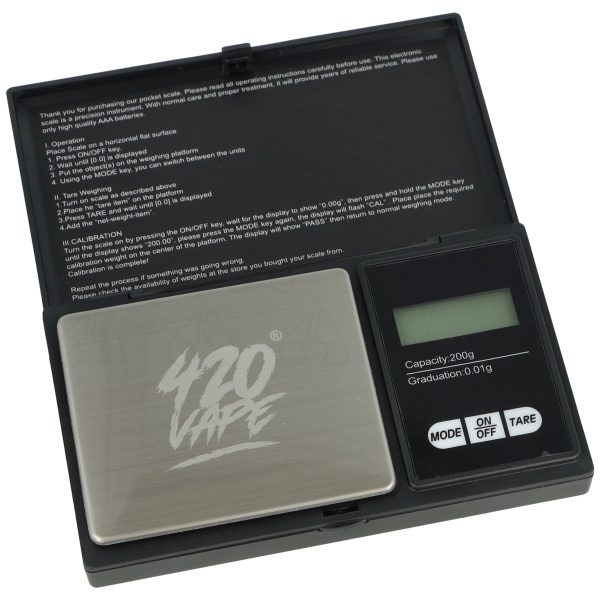
The 420VAPE electronic scale is a compact and reliable device with a resolution of 0.01 g and a maximum capacity of 200 g. These parameters are sufficient for daily measuring of hemp flowers, herbs, and other substances with small masses. The metal bowl ensures durability and easy cleaning, while the intuitive panel with a backlit display makes operation immediate even in low light. It fits in your hand — you can take it anywhere. The price of 45 PLN makes it one of the most affordable in this accuracy segment. If you want to know how many grams of herbs you need for a specific application, read the article What is CBD flower — you will find practical information about dosing there.
This model also works well as a jewelry scale for weighing silver or gold. Its range and accuracy meet the standard requirements of a home herbal medicine cabinet and a craft workspace. It is a proposal for those looking for a precise tool without unnecessary complications.
How to store and care for the scale
A precision scale is a measuring instrument — like any instrument, it requires proper storage. A few simple habits will significantly extend the life of your device and ensure consistent repeatability of readings.
After each use, clean the bowl of any residue from herbs or flowers with a dry or slightly damp cloth. Do not use aggressive detergents or immerse the scale in water — most models are not fully waterproof. Store the device in a horizontal position, away from strong magnets, vibrations, and heat sources. The storage temperature should be within the range of 5–40°C — outside this range, the strain gauge sensor may show drifting readings.
If the scale has been unused for a long time, before the first weighing, wait 5 minutes after turning it on — this is how long the sensor needs for thermal stabilization. Remove the batteries during long storage to avoid corrosion of the contacts. Also, check if the bowl is deformed — even a slight bending of the plate can distort readings by several tenths of a gram. Familiarize yourself with our guide on choosing papers for CBD flower to complete your accessories for precise dosing.
Who are scales for herbs and jewelry scales for?
Precision electronic scales are accessories aimed at very different users. They are united by one need: the need for certainty about the measured quantity. Below are a few typical profiles.
Users of CBD flower and herbs — people who want to control their doses and not waste product. A precision scale allows you to measure portions with an accuracy of up to hundredths of a gram, which is important for strongly aromatic varieties. It is worth taking a look at the article about vaporizers for CBD flower — a precision scale and a vaporizer are a duo that minimizes material losses.
Tincture and extract makers — working with solutions requires strict mass ratios. An error of 1 g on a 10-gram portion is a deviation of 10%, which directly changes the concentration of the final product. A scale with a resolution of 0.01 g eliminates this problem.
Hobbyists weighing — jewelry lovers, philatelists, modelers, and craftsmen will appreciate the same parameters as the herb enthusiast: high resolution, metal bowl, and reasonable price.
Who a precision scale is NOT for — if you only weigh ready-made products packaged in fixed unit portions (capsules, tablets), a scale is unnecessary. Similarly, if you need to weigh kilogram batches — then the capacity range of a typical herb scale will be insufficient.
Herb scales vs jewelry and kitchen scales — what are the differences?
The market today offers three basic classes of electronic scales that differ in range, resolution, and application. Knowing what each of them is makes it easier to choose the right one without overpaying for unnecessary features.
Jewelry scales
Jewelry scales are distinguished by a resolution of around 0.001 g (1 mg) and relatively low capacity — most often 50–200 g. They are intended for weighing gemstones, precious metals, and ingredients used in laboratories or for precise formulation of supplements. They are more expensive and more sensitive to vibrations than typical herb scales. If your portions are above 0.1 g, a jewelry scale in this precision class is usually unnecessary.
Pocket scales for herbs
This is the most popular category among users of herbs and hemp flowers. A resolution of 0.01 g and a capacity of 100–500 g provide a golden mean between precision and practicality. Prices start from several dozen PLN, and the operational requirements are minimal. Models like 420VAPE fall into this class — handy, precise, and resistant to everyday use.
Kitchen scales
Kitchen scales are designed for weighing food products in the range of from 100 g to several kilograms. Their resolution usually ranges from 0.1–1 g. In culinary applications, this is sufficient, but for measuring herbs, flowers, or jewelry, such accuracy is completely inadequate. An error of 0.5 g when measuring portions of herbs is a lot — it can sometimes constitute half of the entire portion.
So how to choose? If you mainly weigh herbs and flowers, opt for a pocket scale with a resolution of 0.01 g. If you conduct precise extractions or work with precious metals, consider a jewelry scale with an accuracy of 0.001 g — but remember that it is more expensive and more sensitive to shocks. Leave the kitchen scale for the kitchen — do not try to transfer it to a role for which it was not designed. Good equipment is an investment that pays off with every weighing.
How to use and calibrate an electronic scale for herbs?
- Step one — place the scale on a stable, level surface. Place the device on a hard, flat surface. Vibrations and unevenness of the countertop directly affect the reading. If the scale has adjustable leveling feet, use the included level or a leveling app on your smartphone.
- Step two — turn on the scale and wait for the display to stabilize. Press the power button and wait until the display shows a value of 0.00 without flickering. In new models, this takes 2–5 seconds, in older models or after a significant temperature change — even up to 30 seconds.
- Step three — check the tare before weighing. Place a container or paper on the bowl and press the TARA button. The display will return to a value of 0.00 — from this moment on, you are weighing only the contents, not the container. Tare is a required function in every scale intended for use with containers.
- Step four — calibrate the scale with a calibration weight. Every few weeks or after each transport, enter calibration mode. The manufacturer provides the standard weight in the instructions — for scales with a capacity of 200 g, it is usually a 100 g or 200 g weight. Place the weight and confirm — the scale will automatically update the calibration coefficient.
- Step five — measure the herbs and read the result. Pour or place the material on the bowl after performing the tare. Wait 1–3 seconds for the reading to stabilize and read the result. For portions below 1 g, it is especially important not to touch the countertop during weighing.
- Step six — clean the bowl after each use. Gently remove any herb residue with a soft brush or dry cloth. The cleanliness of the bowl is a condition for precise readings — contaminants affect the tare and the scale reading with each subsequent weighing.
Frequently asked questions
What accuracy is needed for weighing CBD flower?
For daily weighing of CBD flower, a scale with a resolution of 0.01 g is sufficient. It allows you to distinguish portions differing by one hundredth of a gram — precision sufficient for the vast majority of applications. Jewelry scales with an accuracy of 0.001 g are mainly needed for laboratory extractions or premium jewelry.
Can herb scales also be used as jewelry scales?
Yes. A compact electronic scale with a resolution of 0.01 g and a metal bowl meets the basic requirements of a jewelry scale for home use. Dedicated jewelry scales usually have higher precision (0.001 g) and lower capacity — up to 50 or 100 g.
How often should the herb scale be calibrated?
Manufacturers recommend calibration before first use and after each transport. With regular use, calibration is sufficient once every 2–4 weeks. If the scale has been in a place with variable temperature or humidity, calibrate it immediately after moving.
Are pocket scales accurate?
Good pocket scales with a strain gauge sensor and CE certification achieve reading repeatability of ±0.02–0.05 g under normal conditions. Errors increase with strong wind, vibrations, and extreme temperatures — this is a normal limitation of any portable scale.
What is the difference between a herb scale and a kitchen scale?
A kitchen scale is designed for ranges 1–5 kg with an accuracy of 0.1–1 g. A herb scale offers much higher resolution (0.01 g) with lower maximum capacity. For portions below 5 g, a kitchen scale is practically useless — its absolute error exceeds the measured mass.
Which power supply is better — batteries or USB?
Batteries provide full mobility — the scale works anywhere, without a socket. USB is suitable for a fixed workstation. The best models support both power modes — in economical models, one battery power lasts for several hundred weighings.
How to clean the herb scale?
Clean the metal bowl with a dry or slightly damp cloth after each use. Do not use aerosol alcohol or corrosive agents — they can damage the sensor coating. Remove herb residues with a soft brush. Wipe the inside of the housing rarely and only with a dry cloth, never spray directly.
Are herb scales legal in Poland?
Yes. The possession and use of precision electronic scales are fully legal in Poland — they are standard measuring instruments used in laboratories, pharmacies, and jewelry. GUM legalization is only required for trading goods, not for private use.
This page is informational and educational. It contains links to products available in the Bucha store. Prices and specifications may change — check the current data on the product page before purchasing.