
What is CBN? Cannabinol - Properties, Effects, Research 2026
CBN (cannabinol) is formed from the oxidation of THC. We check what research says about sleep, appetite, and receptors, and what the legal status is in Poland.
Cannabinol is the only cannabinoid that the plant does not produce intentionally. CBN is formed when THC oxidizes under the influence of oxygen, light, and time, so its content increases in stored material rather than in the flowering plant. Marketing has turned this chemistry into a slogan about a natural sleep aid, and in 2026 it is worth comparing this slogan with what has actually been researched. This text does exactly that: it reviews studies on sleep, appetite, bacteria, and receptors, marking whether humans, rats, or cells were studied, and indicates places where the popular statement about CBN diverges from the research results. Finally, it organizes the legal status of cannabinol in Poland.
KEY INFORMATION
- CBN is formed from the oxidation of THC, not from a separate biosynthetic pathway; its precursor is ultimately the same cannabigerolic acid as for CBD and CBG (Walsh et al., Frontiers in Pharmacology, 2021).
- A 2021 review closes the topic of sleep with one sentence: published evidence is insufficient to justify manufacturers’ claims (Corroon, Cannabis and Cannabinoid Research, 2021).
- The first objective measurement of sleep after CBN was conducted in rats in 2025: sleep was prolonged, but both NREM and REM phases increased (Arnold et al., Neuropsychopharmacology, 2025).
- Part of the action is likely due to the metabolite 11-hydroxy-CBN, active at the CB1 receptor with a strength comparable to THC.
- In rats, CBN increased food intake, while CBD acted oppositely (Farrimond et al., Psychopharmacology, 2012).
What is CBN and how is it formed in the cannabis plant?
CBN, or cannabinol, is a cannabinoid that is secondarily formed from tetrahydrocannabinol under the influence of oxidation. It does not have its own syntase in the plant: it appears where THC comes into contact with oxygen, light, and heat for an extended period. Therefore, its presence increases in stored material rather than in fresh flowers.
The primary source is, however, common for the entire family. Cannabis produces over 120 cannabinoids, all derived from cannabigerolic acid; CBN belongs to a group referred to as minor cannabinoids, present in small amounts and less studied than THC and CBD (Walsh et al., Frontiers in Pharmacology, 2021). The chain looks like this: cannabigerolic acid, then tetrahydrocannabinolic acid, then THC, and only then CBN.
This order has one practical consequence that is rarely written about. Since cannabinol is formed from THC, the amount of THC in the material sets the upper limit on the amount of CBN that can ever be formed from it. In industrial hemp, the sum of delta-9-THC and tetrahydrocannabinolic acid does not exceed 0.3 percent of dry mass by definition, so the pool from which cannabinol would arise is inherently small. We discuss the previous link in this chain separately in the text about what THCA is and how it differs from THC.
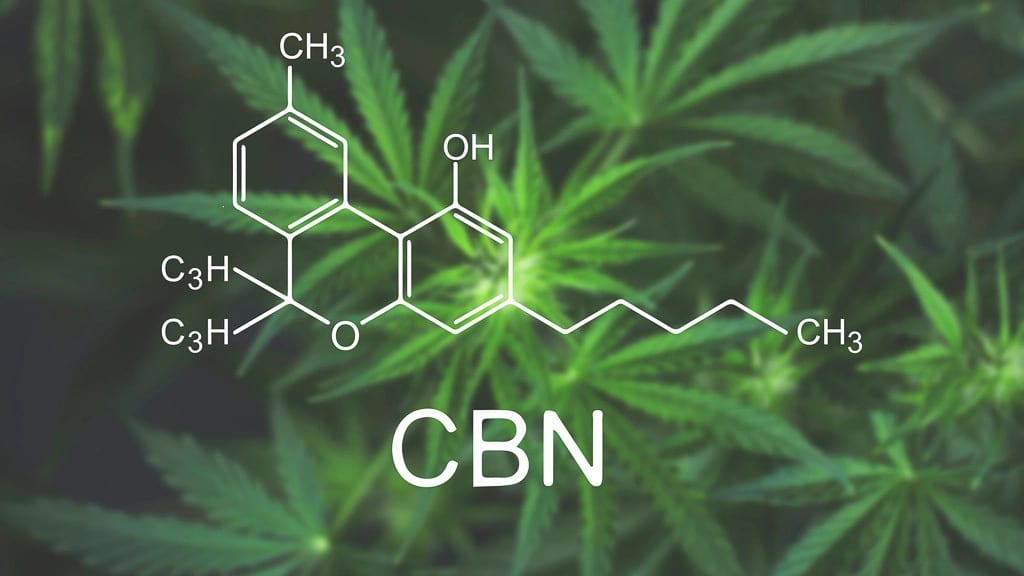
The molecular formula of cannabinol is C21H26O2. Oxidation converts the cyclohexene ring of the THC molecule into an aromatic ring, and this change affects the affinity for receptors. The previous version of this article stated how much percent of THC converts to CBN over a year; the numbers could not be confirmed in any peer-reviewed work and were removed.
How does CBN act on receptors and why does it not intoxicate?
The most recent and specific measurement comes from a study on sleep in rats, which also examined receptor pharmacology. The result is surprising: it was not cannabinol itself that proved active at the CB1 receptor, but its metabolite. The compound 11-hydroxy-CBN, formed from CBN, acted on CB1 with a potency and efficacy comparable to delta-9-THC, while CBN itself exhibited significantly lower activity (Arnold et al., Neuropsychopharmacology, 2025).
Moreover, this metabolite reached concentrations in the brains of the studied animals comparable to the parent compound. The authors describe this as a surprise and directly suggest that the active metabolite may account for part of the sedative effect. This changes how one should read the label: the profile of “pure CBN” does not have to be the profile of what ultimately circulates in the body.
A broader context is provided by a review of the pharmacology of minor cannabinoids. Compounds from this group act as agonists and antagonists on many targets simultaneously: CB1 and CB2 receptors, TRP channels, PPAR receptors, and the serotonin receptor 5-HT1a. This same review begins with the caveat that knowledge of the pharmacology of this group is incomplete (Walsh et al., Frontiers in Pharmacology, 2021). If you want to understand what these receptors are, we have a separate guide on where CB1 and CB2 receptors are located and what they are responsible for.
And psychoactivity? A review dedicated to cannabinol states that evidence for CBN producing effects similar to cannabis in humans is ambiguous, and most available data show a lack of such effect (Corroon, Cannabis and Cannabinoid Research, 2021). The previous version of this text stated that CBN’s affinity for CB1 is ten times weaker than THC, citing a study that did not address this issue at all; the number has been removed.
Does CBN really help with sleep?
The answer that manufacturers do not put on the packaging is: published evidence in humans does not confirm this. A review dedicated solely to this question searched databases for human studies, filtered 99 abstracts, and qualified eight full texts for detailed analysis (Corroon, Cannabis and Cannabinoid Research, 2021).
The picture that emerged is unequivocal. Studies on cannabinol are old and few, most human studies date back to the 1970s and 1980s, the trials were small and not diverse. Works directly measuring drowsiness or fatigue are rare. The author did not identify a single published clinical study in which sleep after CBN was assessed using polysomnography or even a validated sleep questionnaire.
The conclusion is straightforward: published evidence is insufficient to support claims of sedative effects, and individuals seeking a cannabis-derived sleep aid should approach manufacturers’ claims with skepticism. The author adds one more practical note. Future studies should use doses significantly higher than those in currently available products, where the content of cannabinol usually does not exceed 5 mg.
A newer review of the entire category reaches the same conclusion more broadly. The authors reviewed twenty-one new studies on cannabinoids in insomnia, sleep apnea, REM behavior disorder, and restless legs syndrome, and summarized that the evidence base does not correspond to the scale at which these preparations are used (Lavender et al., Current Psychiatry Reports, 2024).
What did the first sleep study with objective measurement show?
In 2025, a study was published that for the first time measured the impact of cannabinol on sleep architecture using an objective method, namely polysomnography. Rats were studied. CBN prolonged total sleep time, but the effect was biphasic: first, sleep was suppressed, and only then was there a clear increase (Arnold et al., Neuropsychopharmacology, 2025).
The most important detail concerns which phases of sleep increased. Cannabinol increased both slow-wave NREM sleep and REM sleep. The strength of the effect on NREM was comparable to zolpidem, a classic sleep medication, with the difference that zolpidem did not affect the REM phase at all. The previous version of this article claimed that CBN prolongs NREM and shortens REM; this is the opposite of the result and has been corrected.
The study adds a metabolic thread, which we have already mentioned. After the administration of cannabinol, its metabolite 11-hydroxy-CBN reached comparably high concentrations in the brain and also changed sleep architecture, although somewhat differently than the parent compound. The authors suggest that the active metabolite contributes to the sedative effect.
How to read this? As the first solid evidence that CBN actually measurably affects sleep, and at the same time as evidence obtained in rodents. The study itself begins by stating that cannabinol is sometimes sold in the form of isolates with the promise of effects comparable to sleep medications, and no study had previously objectively checked its impact on sleep architecture.
Is there a study on CBN in humans with insomnia?
Yes, and it is a single study with a small sample size. An Australian team designed a randomized trial, with a double-blind placebo-controlled design, in a crossover arrangement with a single dose, for twenty individuals with insomnia diagnosed by a clinician and a score of at least 15 points on the insomnia severity scale (Lavender et al., BMJ Open, 2023).
The scheme looks like this: each participant receives a single oral dose of 30 mg of cannabinol, a single dose of 300 mg, and a matched placebo, on three nights separated by two-week breaks. Sleep is measured using polysomnography in the laboratory, and the next day neurobehavioral function tests are performed, including a driving simulator. The primary endpoint is the number of minutes awake after falling asleep.
The clinical trial registry confirms that the trial has been completed. Under the number NCT05344170, there is a study titled corresponding to the protocol description, indicating “insomnia disorder” and three arms: 30 mg of cannabinol, 300 mg of cannabinol, and placebo. We checked this entry at the source on August 10, 2026.
Three things need to be added. First, we did not find results in the form of a published paper: a description of the method and the registry entry are available, so it is not yet known what this trial showed. Second, this is a preliminary study, on twenty individuals and with a single dose, so its task is to prepare the ground for larger trials, not to resolve the matter. Third, the doses it tests are many times higher than the content of cannabinol in products sold as sleep support. This is exactly the discrepancy that the 2021 review pointed out.
Does CBN stimulate appetite?
In rats, yes, and this is the only action of cannabinol for which we found a clear experimental result. In a study comparing three cannabinoids administered orally to already fed animals, CBN shortened the time to start eating and increased the size and length of the first meal, as well as the total amount of food consumed (Farrimond et al., Psychopharmacology, 2012).
The effect was dependent on the CB1 receptor, which the authors demonstrated by administering cannabinol together with an antagonist of this receptor. This is important because it links the behavioral observation to a specific mechanism, rather than leaving it as a bare observation.
This same study provides two comparative results that are worth holding next to each other. Cannabidiol acted oppositely: it significantly reduced the total amount of food consumed during the test. Cannabigerol did not change feeding behaviors in any direction. The authors summarize that for the first time, cannabinol’s ability to increase food intake has been demonstrated.
What cannot be inferred from this? A conclusion about humans. The study was conducted on adult male rats, and transferring the rodent eating pattern to a patient with diminished appetite is a hypothesis, not a result. The previous version of this article stated that the increase was about 16 percent; such a number is not present in this study and has been removed.
Does CBN have antibacterial properties?
The study that the entire internet refers to in this matter concerns cannabinoids as a group but describes the mechanism for another compound. It has been shown that cannabinoids inhibit the growth of methicillin-resistant Staphylococcus aureus, block biofilm formation, and destroy already formed biofilm and cells in the stationary phase surviving contact with antibiotics (Farha et al., ACS Infectious Diseases, 2020).
A detailed description of the mechanism, a study on the cell membrane of Gram-positive bacteria, and demonstrating efficacy in a mouse model of systemic infection, however, concern cannabigerol, not cannabinol. The abstract of this study does not provide a separate minimum inhibitory concentration value for CBN nor compare it with vancomycin.
The previous version of this article attributed a specific inhibitory concentration value to cannabinol and a comparison with an antibiotic, as well as listing seven strains and six tested cannabinoids. None of these things are in the abstract of the study, so all were removed, not rewritten.
So what can be said? That cannabinoids as a class exhibit antibacterial activity against methicillin-resistant Staphylococcus aureus and that this is a promising direction for research, in which the best-described compound remains cannabigerol for now. None of these studies have involved humans.
How does CBN differ from CBD, CBG, and THC?
Four compounds, one plant, and four completely different profiles. The following comparison is based solely on the works we checked individually during the editing of this text, so it does not include positions for which we could not identify a source.
| Compound | How it is formed | What results from verified works |
|---|---|---|
| CBN | oxidation of THC in stored material | increased sleep in rats, increased food intake; itself weakly active on CB1, its metabolite very (Arnold 2025, Farrimond 2012) |
| THC | from CBGA through THCA syntase | reference point for strong activity on CB1, hence the psychoactive effect (Arnold 2025) |
| CBD | from CBGA through CBDA syntase | in rats reduced the amount of food consumed, i.e., opposite to CBN; the only one of this quartet with EFSA safety assessment (Farrimond 2012, EFSA 2026) |
| CBG | decarboxylation of CBGA | did not affect feeding behaviors at all; partial agonist of CB2 (Farrimond 2012, Navarro 2018) |
One thing from this table is particularly useful when reading labels. Cannabinoids from one plant do not create a scale from weaker to stronger, but rather a set of separate profiles that sometimes act oppositely. The same feeding experiment yielded three different results for three compounds, and yet all three come from the same precursor. We discuss another compound from this same branch separately in the text about what CBC is and how cannabichromene works.
Is aged dry material a better source of CBN?
The direction of change is indisputable, the scale is not. Since cannabinol is formed from the oxidation of tetrahydrocannabinol, material stored longer in contact with air and light will contain more of it than fresh material. This follows from the chemistry of the process itself, not from measurements in a specific warehouse.
The problem is that the same process also affects the rest of the profile. Terpenes, which are responsible for the aroma and the hypothetical entourage effect, are volatile and degrade simultaneously. The gain in cannabinol comes at the cost of loss in other components, rather than adding to them.
Additionally, there is a limitation we mentioned regarding biosynthesis that determines the matter in Polish conditions. If the material is industrial hemp, in which the sum of delta-9-THC and tetrahydrocannabinolic acid does not exceed 0.3 percent of dry mass by definition, then even complete oxidation of this resource will not yield a high content of cannabinol. Claims of several percent CBN in legal hemp material are therefore difficult to reconcile with the statutory threshold for the material.
The previous version of this article provided specific percentages of cannabinol content in fresh, two-year-old, and archival dry material, as well as the recommended humidity range during maturation in jars. None of these numbers could be confirmed in peer-reviewed work, so they were removed. The principle remains: cool, dark, airtight, if you want to preserve the profile, and conversely, if you want to break it down.
How much CBN to use and what is known about safety?
There is no study that establishes a safe or effective dose of cannabinol for humans, so this article does not provide one. However, it is possible to describe what amounts appear in the literature and on the market, as these are two different scales. A clinical study on insomnia tests single doses of 30 mg and 300 mg, while a 2021 review notes that products sold as sleep support usually contain no more than 5 mg.
The reference point for safety remains the assessment regarding cannabidiol, as there is no such assessment for cannabinol at all. The European Food Safety Authority established a provisional safe dose in 2026 of 0.0275 mg per kilogram of body weight per day, or about 2 mg daily for a person weighing 70 kilograms, with an uncertainty factor of 400 (EFSA, EFSA Journal, 2026).
This same assessment states directly that safety cannot be established in individuals under 25 years of age, in pregnant and breastfeeding women, and in individuals taking medications simultaneously. Animal studies have shown consistent liver toxicity, and in humans, the hepatotoxic signal intensified precisely when pharmacological treatment was concurrent. If you are taking medications regularly, discussing cannabinoids belongs to a doctor, not a seller.
The issue of absorption remains, around which a lot of unsupported numbers have accumulated. A systematic review of the pharmacokinetics of cannabidiol in humans established absolute bioavailability only for the inhalation route, at 31 percent; no study has measured it for the oral and sublingual routes (Millar et al., Frontiers in Pharmacology, 2018). Percentage values given in descriptions of drops, capsules, and gummies have no basis in this work and have been removed from this article.
How to read the label and certificate of analysis for a CBN product?
The certificate of analysis, abbreviated as COA, is a report from the examination of a specific batch of material conducted by an external laboratory. For cannabinol, it has particular significance because this compound is formed uncontrollably, through oxidation, rather than through intentional selection of a strain. Without measurement, no one knows how much is in a given batch.
The first thing to check is trivial but often overlooked: whether cannabinol is even present in the results table. Many cannabinoid profiles list only cannabidiol and tetrahydrocannabinol, omitting the rest. If a product is sold with a claim of CBN content, then that position should stand in the document with a number, not in the store description with an adjective.
- Batch number and date of testing. A certificate from two years ago describes a different material than that in the package, and with cannabinol, time is a variable that changes the result.
- Acidic forms alongside neutral ones and the sum of delta-9-THC and THCA, which is exactly the value that the law ties to the threshold for industrial hemp.
- Heavy metals, pesticide residues, and solvents used in extraction.
- Method of determination and limit of quantification, because a result described as “below threshold” means as much as the method is sensitive.
It is worth being able to do the arithmetic of the label yourself, as it can be a source of misunderstandings. The percentage notation refers to the mass of the cannabinoid in the entire content of the package, so a ten-milliliter oil described as five percent contains 500 mg of that compound in the bottle, not per serving. This is a calculation for the content of the package, not a guideline for intake.
What the certificate will not tell you? Nothing about efficacy. It is a document about the composition and purity of the batch, not proof of action. A manufacturer who presents it as confirmation of a health effect is overinterpreting their own laboratory study.
Can CBN affect the result of a drug test?
We did not find a study measuring the cross-reactivity of cannabinol in screening tests, so neither a positive nor negative answer can be based on a source. The previous version of this article claimed that the risk exists and referred to the address of the publication database without citing a specific study; that statement has been removed.
What can be said with certainty concerns not cannabinol, but the material. Full-spectrum products contain trace amounts of tetrahydrocannabinol that fall within the statutory threshold for industrial hemp, and it is THC and its metabolite that are what screening tests look for. The risk therefore arises from the presence of THC in the preparation, not from the presence of CBN.
It is also worth knowing the distinction that is often confused in texts about cannabis. The value of 1 ng/ml, which appears during a roadside check, is the limit of quantification of the method specified in the executive regulation from 2014 (Dz.U. 2014 poz. 948), not a threshold of liability. For urine, the same act states 20 ng/ml, and the threshold for saliva is not known at all. The basis for testing a driver for substances acting similarly to alcohol is Article 129j of the Road Traffic Law, not the provision on alcohol.
The practical conclusion for a person undergoing professional control is simple and does not depend on whether the preparation contains cannabinol. If the test result has professional consequences for you, choose products without tetrahydrocannabinol and request a certificate of analysis in which that position is measured, not declared.
Is CBN legal in Poland in 2026?
The name cannabinol does not appear in the list of psychotropic substances, narcotics, and new psychoactive substances. We checked this in the consolidated text of the regulation of the Minister of Health (Dz.U. 2024 poz. 1139); later changes, announced as Dz.U. 2025 poz. 598 and Dz.U. 2026 poz. 934, concerned hexahydrocannabinol and the list of isomers of tetrahydrocannabinols, not cannabinol.
The status of the product is determined by the origin of the material. Industrial hemp refers to Cannabis sativa L. plants, in which the sum of delta-9-THC and tetrahydrocannabinolic acid in the flowering or fruiting tops, from which resin has not been removed, does not exceed 0.3 percent when calculated on dry mass, rounded to one decimal place. The basis is Article 4 point 5 of the Act of July 29, 2005 on Counteracting Drug Addiction (t.j. Dz.U. 2023 poz. 1939), as amended by the Act of March 24, 2022 (Dz.U. 2022 poz. 763), effective from May 7, 2022.
Two distinctions that are often confused in texts about CBN change the result of laboratory testing. The threshold is counted as the sum of THC and THCA, not just delta-9-THC. It refers to the plant, not the finished product. Previously, until May 6, 2022, it was 0.20 percent.
EU law has the same numerical value but is a separate regulation: from January 1, 2023, varieties eligible for support under the Common Agricultural Policy may contain up to 0.3 percent THC based on Article 4 paragraph 4 of Regulation (EU) 2021/2115. The national threshold corresponds to the EU one, but does not derive from it. Cannabinoids remain in the EU novel food procedure, so products are marketed outside the dietary supplement category, and the manufacturer is not allowed to attribute unauthorized health claims to them. The amendment to the Act on Counteracting Drug Addiction coming into force on August 27, 2026, does not change the THC threshold, classification of substances, or retail sales principles.
Which claims about CBN are not supported by research?
We have gathered them together because each circulates in product descriptions and guide texts, and each either lacks a source or has a source that says otherwise. Some come from the previous version of this very article.
- “CBN is the strongest natural sleep aid.” A review dedicated to this question found no published clinical study with polysomnography or a validated sleep questionnaire (Corroon, 2021).
- “CBN shortens the REM phase, making sleep deeper.” The only objective measurement shows an increase in both NREM and REM (Arnold et al., 2025).
- “CBN gets you high because it comes from THC.” Evidence for CBN producing effects similar to cannabis in humans is ambiguous, and most data show a lack of such effect (Corroon, 2021).
- “CBN outperformed MRSA better than vancomycin.” The abstract of the cited study does not provide either the inhibitory concentration value for cannabinol or a comparison with the antibiotic (Farha et al., 2020).
- “CBN increases appetite by several percent.” The increase in food intake was demonstrated in rats, but without such a number (Farrimond et al., 2012).
- “Cannabinoids are safe up to 1500 mg per day according to WHO.” The source address of this statement does not work, and the latest European assessment provides a value three orders of magnitude lower (EFSA, 2026).
There is, however, a result that is spoken of less often, but which is solid. In a model of amyotrophic lateral sclerosis in transgenic SOD1 mice, cannabinol administered subcutaneously via an osmotic pump at a dose of 5 mg per kilogram per day for up to twelve weeks delayed the onset of symptoms by more than two weeks, but did not affect survival (Weydt et al., Amyotrophic Lateral Sclerosis, 2005). The second part of this statement is already in the title of the paper and usually disappears when cited.
Frequently Asked Questions
What is CBN and how is it formed?
CBN, or cannabinol, is formed from the oxidation of tetrahydrocannabinol under the influence of oxygen, light, and time. It does not have its own syntase in the plant, so its presence increases in stored material rather than in fresh flowers. The common precursor for the entire family remains cannabigerolic acid (Walsh et al., Frontiers in Pharmacology, 2021).
Does CBN affect sleep?
A review from 2021 found no published clinical study measuring sleep after CBN using polysomnography or a validated questionnaire and deemed the evidence insufficient (Corroon, Cannabis and Cannabinoid Research, 2021). Objective measurement has so far only been conducted in rats.
Does CBN shorten REM phase?
No. In the first study with polysomnography, cannabinol increased total sleep time and both NREM and REM phases, with the effect on NREM comparable to zolpidem (Arnold et al., Neuropsychopharmacology, 2025). Zolpidem, unlike CBN, did not change REM phases.
Is CBN psychoactive like THC?
Evidence for cannabinol producing effects similar to cannabis in humans is ambiguous, and most available data show a lack of such effect (Corroon, Cannabis and Cannabinoid Research, 2021). CBN itself exhibits low activity at the CB1 receptor.
Does CBN stimulate appetite?
In rats, yes. Cannabinol shortened the time to start eating, increased the size of the first meal, and the total amount of food consumed, with the effect depending on the CB1 receptor (Farrimond et al., Psychopharmacology, 2012). There are no studies in humans on this matter.
What dose of CBN should be taken?
It has not been established for humans, so it cannot be provided here. For comparison scales: a clinical study on insomnia tests single doses of 30 mg and 300 mg, while market products usually contain no more than 5 mg. Discuss use for sleep disorders with a doctor.
Is CBN legal in Poland in 2026?
The name cannabinol does not appear in the list of controlled substances (t.j. Dz.U. 2024 poz. 1139). The status of the product is determined by whether it comes from industrial hemp, i.e., plants in which the sum of delta-9-THC and THCA does not exceed 0.3 percent of dry mass (art. 4 pkt 5 of the act, t.j. Dz.U. 2023 poz. 1939).
What is worth remembering about cannabinol?
CBN is a product of aging material, not a separate creation of the plant. It is formed from THC under the influence of oxygen and light, so the amount of tetrahydrocannabinol in the material sets the upper limit on how much cannabinol can ever be formed from it. In industrial hemp, this limit is legally low.
The reputation of a sleep aid precedes the data. A review dedicated directly to this question found no clinical study with objective sleep measurement, and the first such measurement was only conducted in 2025 on rats and yielded a result partially opposite to the popular description, as REM phase also increased. The only study in humans with insomnia involved twenty individuals and tested a single dose.
What remains as solid? Increased food intake in rats, opposite to the action of cannabidiol in the same experiment, and delayed symptoms in a mouse model of amyotrophic lateral sclerosis without affecting survival. Additionally, the role of the metabolite 11-hydroxy-CBN, which acts more strongly at the CB1 receptor than the parent compound.
Cannabinol is not sold as a separate product here, and trace amounts are carried by full-spectrum material; if you are looking for it, you will find it in the category of hemp flower. Before purchasing, request a certificate of analysis and check the measured cannabinoid profile in it.
This article is for informational and educational purposes only and does not constitute medical advice. Before starting to use cannabis or CBD for therapeutic purposes, consult a doctor, especially if you are taking other medications, are pregnant, or breastfeeding.
Author: Michał Waluk · Published: 2026-04-27 · Updated: 2026-08-10