
Humulene: present in 48 strain profiles, absent from the pharmacy list
Humulene is mentioned by the budcare.pl database in 48 strains from Polish pharmacies, medweed.pl in five, and the pharmacy list does not indicate it as leading in any. We gather two studies on rodents and show where what can be read ends.
| Terpene card | humulene |
|---|---|
| Strains with this leading terpene | 0 out of 85, does not lead in any on the pharmacy list |
| Present in profiles | 48 out of 85 |
| Works in the evidence base | 2 |
| Research model | rodent |
| Boiling point | 99.5 °C |
| Measurement condition | reduced pressure, 3.0 mmHg this is NOT the boiling point at atmospheric pressure |
- On the pharmacy list. Does not lead in any of the 85 strains, although profile databases mention it in 48 of them. This is the content of this page, not a gap.
- Evidence. 2 works from 2007 to 2008, all on animals or in cell culture, none on patients taking the herb.
- Temperature. 99.5 °C, with the measurement condition determining whether the number means anything.
- What we do not provide. Percentage share in the profile, because the denominator in the sources is different and the numbers are not comparable between strains.
What is humulene and where is it found outside of cannabis?
Humulene is a sesquiterpene with the formula C15H24, consisting of a single eleven-membered ring with three double bonds. PubChem lists it under number 5281520 and the name alpha-humulene, with the synonym alpha-caryophyllene. The name comes from common hop, Humulus lupulus, in whose essential oil this compound is described as one of the main sesquiterpenes.
The same molecular formula and the same molecular weight of 204.35 link it to beta-caryophyllene, but the structure is different: caryophyllene has two connected rings, including a strained four-membered one, while humulene has only one large one. Hence the old name alpha-caryophyllene, misleading for a reader who expects a caryophyllene strain from it. In our data, both compounds go hand in hand: the budcare.pl database lists them together in 88 out of 93 records containing humulene, and when reduced to cultivars in 45 out of 48.
Outside of cannabis and hops, sesquiterpenes of this group are a common component of essential oils of plants, and in brewing, oxidation products of humulene are responsible for part of the hop aroma. For the reader of the pharmacy list, something else matters: the presence of the compound in the plant is a chemical feature, not information about the dose that the patient will take. This difference returns in every subsequent section of this text, as it determines what can be written about the position from the pharmacy list and what remains a description of the molecule.
How long does it take for humulene to reach the body and how long does it stay?
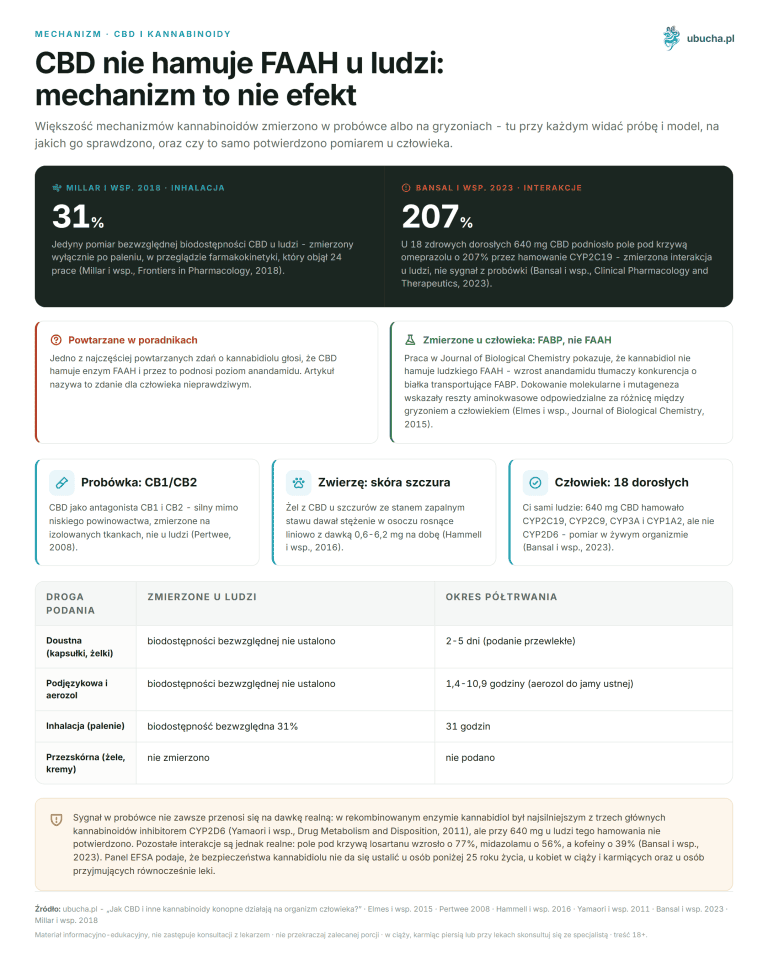
It is unknown, as it has not been measured in humans. The only measurement in the evidence base of this cluster concerns mice after oral administration and speaks of minutes, not hours. For the inhalation route, there is not a single value, and our data do not even provide the boiling point under room conditions.
| Study | Model and route of administration | What was shown |
|---|---|---|
| Fernandes ES et al., 2007 European Journal of Pharmacology PMID:17559833 |
rodent (mouse and rat) | Oral alpha-humulene reduced paw swelling in mice and rats induced by platelet-activating factor, bradykinin, ovalbumin, and carrageenan, and as the only one of two studied compounds also reduced swelling after histamine; systemic administration inhibited the formation of tumor necrosis factor alpha and interleukin 1 beta in rats. |
| Chaves JS et al., 2008 Planta Medica PMID:18951339 |
rodent (mouse) | After oral administration of 150 mg/kg, the concentration of alpha-humulene in mouse plasma peaked after 15 minutes, and its bioavailability was 18%; the half-life was 16.8 minutes after oral administration, and the compound was practically undetectable two hours after intravenous administration. |
The boiling point describes the pure compound in a flask, not the setup of the equipment or the amount that passes into vapor. Our collection of temperatures has only one source record for alpha-humulene, 99-100 °C at a pressure of 3 mmHg, attributed to the HMDB database at PubChem record 5281520. Atmospheric pressure is about 760 mmHg, so this number cannot be compared with measurements under room conditions. The scale of divergence is visible in caryophyllene, for which we have both types of records.
| Compound | Source record | Measurement pressure | After conversion |
|---|---|---|---|
| alpha-humulene | 99.00 to 100.00 °C | 3 mmHg | 99.5 °C, measurement under reduced pressure |
| beta-caryophyllene | 256.00 to 259.00 °C | 760 mmHg | 257.5 °C, room conditions |
| beta-caryophyllene | 264 to 266 °F (NTP, 1992) | 14 mmHg | 130 °C, measurement under reduced pressure |
The same substance is recorded once at 257.5 °C, once at 130 °C, and the difference is solely due to pressure. How much humulene remains in the herb after heating is unknown, so we do not provide any device settings.
The route of administration determines the course more than the strain itself. After vaporization, the substance passes from the lungs to the blood almost immediately, so the first sensations appear after a few minutes, intensity increases for another ten to thirty minutes, and the whole experience fades within two to four hours. After swallowing, the material first passes through the intestine and liver, so the first sensations are waited for from half an hour to two, and the episode lasts six, sometimes eight hours. Hence the most common mistake in oral administration: who thinks after thirty minutes that nothing is happening and takes another dose will receive both doses at once. The above ranges describe the route of administration, not this strain; pharmacokinetic studies for a single cultivar have not been published.
What have studies shown about the effects of humulene?
Two studies, both on rodents. The first describes the reduction of paw swelling and inhibition of two cytokines in mice and rats, the second measures the fate of the compound in the body of mice. None included humans and none was a test-tube study, so the conclusion about the effect on patients has no basis here.
The model determines what can be written. Experimentally induced paw swelling is a measure of the inflammatory response in the animal, not a symptom that a patient presents to a doctor. The doses given to rodents are measured in milligrams per kilogram of body weight and are not converted to a dose of herb. Therefore, this text will not contain a sentence about what humulene does to humans.
What has not been shown about humulene?
Nothing has been shown in humans. There is a lack of measurement of blood concentration after inhalation, measurement of bioavailability from the herb, and data on the dose at which anything happens. The following sentence from the evidence base of this cluster describes this gap more accurately than any commercial description of a strain.
In humans, neither the bioavailability of humulene from the herb nor its concentration after inhalation has been measured. Measurement in mice gives an availability of 18% and a half-life of less than twenty minutes after oral administration, so the percentage share in the strain profile says nothing about how much of the compound reaches the blood.
Let’s break this down. Eighteen percent was measured after administering a dose of 150 mg/kg to mice, thus via a route that the pharmacy material is not taken, and in a species whose liver works differently than that of humans. A half-life of less than twenty minutes means that in mice the compound disappeared from plasma faster than one vaporization session lasts. Neither of these two numbers can be transferred to humans.
What else is missing. There is no measurement of how much of the compound passes from the herb to vapor upon heating, so it cannot be said what part of the profile record actually leaves the plant material. There is no dose-response relationship in humans, no threshold at which anything starts to happen, and no data on interactions with medications. The sentence “strain rich in humulene” thus describes the label of the profile, not the dose that anyone receives.
This section weighs more than a list of presumed properties. Descriptions of strains circulating online attribute the actions of terpenes as if they resulted from measurements on patients. In our evidence base, there is no such measurement for humulene, and we state this directly instead of burying the gap in generalities.
What adverse effects have been reported after humulene?
None, because no one collects them under the name of the terpene. The record includes a finished drug from a specific batch, so there are no entries in public compilations that could be attributed to the compound itself. Below is the state of knowledge about the raw material, of which humulene is one of many molecules.
Reports of adverse effects are collected for a medicinal product with a batch number, not for the name of the strain, so the following concerns cannabis herb as a group of raw materials. The most commonly reported are dry mouth, red eyes, and increased heart rate. Less frequently described are dizziness upon rapid standing, daytime drowsiness, and temporary worsening of short-term memory, as well as anxiety increasing with the dose. A separate issue is medications taken concurrently, especially sedatives and those affecting coagulation: their assessment requires knowledge of the entire list of preparations, not just the description of the plant. We do not provide the frequency of these symptoms numerically, as public compilations for cannabis herb in Poland do not separate them by individual products.
A separate property of the entire group stands: concentrated terpenes can irritate the respiratory tract and skin, which applies more to working with oils and concentrates than to content in the herb. We do not have a measurement that would link such a reaction with humulene inhaled with vapor, and we do not replace it with assumptions.
The conclusion is modest. Symptoms described after the herb are attributed to the raw material as a whole, so the choice of strain based on the profile record does not shift anything here. A report of an adverse effect is directed to a doctor or to the monitoring system, and that is the proper route, and the description of the strain is not a tool for that.
Which strains from Polish pharmacies have humulene as a leading terpene?
None. In our pharmacy data, no entry has this compound indicated as leading, although it appears in the composition of 48 out of 85 described cultivars. The list assigns one leading terpene to each entry and uses only six names, and humulene is not among them.
The numbers look like this. Pharmacy data cover 141 commercial entries broken down into 85 cultivars, and the field for leading terpene accepts six values: caryophyllene in 30 cultivars, myrcene in 20, limonene in 16, terpinolene in 7, nerolidol in 6, and pinene in 6. The total closes at 85, so it is not about gaps in filling the field, but about a closed dictionary.
An empty list is therefore not a statement about the plant, but about the source. The pharmacy list indicates one compound per entry, while profile databases list several, and it is they that show humulene. If indicating the leading terpene were to mean “the most,” a quantitative measurement with a known denominator would be needed, and such measurements are not published by Polish pharmacy sources.
We maintain a complete list of positions available in pharmacies in the strain hub. The store catalog has a separate herb category, which is not a pharmacy list and does not include positions issued by a doctor’s prescription, as such are not issued outside pharmacies.
Which profile databases mention humulene in the strain composition?
Practically one. Budcare.pl mentions this compound in 48 cultivars from our list, medweed.pl in five, and there is not a single strain that would be indicated exclusively by medweed. The discrepancy is not a detail: in 43 out of 48 names, the entire record of the presence of humulene is based on one source.
In raw numbers, the budcare.pl database has 146 registration records and humulene is listed in 93 of them, the medweed.pl database has 65 records and humulene is listed in 5. When reduced to cultivars, there are 48 names out of 85 described in this cluster.
More interesting is what happens where both databases describe the same strain. We have 19 such positions with humulene: both sources consistently mention it in 5, and in 14 it is mentioned exclusively by budcare.pl. The direction is one-sided and never happens the other way around. Additionally, all three strains for which both databases provide identical composition have humulene on the list.
For the reader, this means one thing: the record of content can be a feature of the database, not the strain. The table below shows for each name which source mentions this compound and whether the composition descriptions agree at all.
| Strain | Who mentions humulene | Composition description agreement |
|---|---|---|
| Afghan Kush | both sources | both sources provide the same composition |
| Animal Rntz | budcare.pl | composition described by one source |
| Balasa (Gorilla Girl) | budcare.pl | sources differ in composition |
| Beach Crasher | both sources | sources differ in composition |
| Big Purple Dragon | budcare.pl | composition described by one source |
| Biscuit Runtz | both sources | both sources provide the same composition |
| Black Jelly | budcare.pl | sources differ in composition |
| Black R | budcare.pl | composition described by one source |
| Blueberry | budcare.pl | composition described by one source |
| Cataract Kush | budcare.pl | composition described by one source |
| Chemango Kush | budcare.pl | sources differ in composition |
| Desert Flame | budcare.pl | composition described by one source |
| Facade | budcare.pl | composition described by one source |
| Farm Gas | budcare.pl | sources differ in composition |
| Frosted Cherry Cookies | both sources | both sources provide the same composition |
| Frosted Lemon Angel | budcare.pl | composition described by one source |
| Galaxy Walker OG | budcare.pl | sources differ in composition |
| Girl Scout Cookies | budcare.pl | composition described by one source |
| GMO | budcare.pl | composition described by one source |
| Gorilla Glue | budcare.pl | sources differ in composition |
| Headband | budcare.pl | composition described by one source |
| Inzane in the Membrane | budcare.pl | composition described by one source |
| Island Sweet Skunk | budcare.pl | sources differ in composition |
| Krypton | budcare.pl | sources differ in composition |
| Lemon Haze Gelato | budcare.pl | composition described by one source |
| Lemon Skunk | budcare.pl | composition described by one source |
| Lilac Diesel | budcare.pl | sources differ in composition |
| Mac Monkey (Blue Monkey) | budcare.pl | composition described by one source |
| Master Kush | budcare.pl | composition described by one source |
| Northern Berry | budcare.pl | sources differ in composition |
| Orange Cream Pop | budcare.pl | sources differ in composition |
| Original Gangster Deluxe | budcare.pl | sources differ in composition |
| Pink Certz | budcare.pl | composition described by one source |
| Pink Kush | both sources | sources differ in composition |
| Purple Octane | budcare.pl | composition described by one source |
| Purps | budcare.pl | sources differ in composition |
| Rockstar | budcare.pl | composition described by one source |
| Sherbert Scotti | budcare.pl | composition described by one source |
| Sirius | budcare.pl | composition described by one source |
| Sour Diesel | budcare.pl | composition described by one source |
| Spiced Latte | budcare.pl | composition described by one source |
| Strawberry OG | budcare.pl | composition described by one source |
| Sweet Berry Kush | budcare.pl | composition described by one source |
| Tilray Sirius | budcare.pl | composition described by one source |
| Triangle Mints | budcare.pl | composition described by one source |
| Wappa | budcare.pl | composition described by one source |
| Wedding Pie | budcare.pl | sources differ in composition |
| White Widow | budcare.pl | composition described by one source |
What does the humulene share provided by profile databases mean?
Less than it seems. Shares provided by the profile database do not sum to one hundred: in 93 records with this compound, they give 35 different sums, from 14 to 116, with a median of 84. The denominator is therefore unknown and different in each record, which is why we provide the composition as composition, without numbers next to the names.
The spread is easy to check. Four records close exactly at one hundred, three exceed one hundred, and the poorest collects only fourteen. The number of listed components also varies, from four to nine per record. With such material, the value placed next to the name looks like a measurement, but it is a share in a set whose boundaries no one provides.
The order speaks for itself. In 93 records, budcare.pl has this component in the highest share only twice, and it most often lands in the fourth, fifth, or sixth place on the list. Medweed.pl provides only the order, without numbers, and in its five records places it once in the second, twice in the third, and twice in the fifth place. Not a single record from this database places it first.
Hence the principle of this cluster: next to the name of the terpene, we do not place a number. A share without a denominator in a text about a drug issued on prescription looks like a measurement, but it is not, and it is this apparent precision that is often the reason why a patient chooses a position from the pharmacy based on one value from the description.
Frequently asked questions about humulene
Is humulene the same as alpha-caryophyllene?
Yes. Alpha-caryophyllene is an older name for the same compound with the formula C15H24, listed in PubChem under number 5281520. Beta-caryophyllene is a separate substance with the same molecular formula but a different ring structure.
Does humulene from the herb reach the blood after vaporization?
It is unknown. In humans, neither the concentration after inhalation nor how much of the compound passes from the herb to vapor has been measured. The only measurement of bioavailability in the evidence base of this cluster concerns mice after oral administration.
At what temperature does humulene boil?
Our data carry one record: 99-100 °C at a pressure of 3 mmHg, thus a measurement under reduced pressure. This is not a value comparable to temperatures measured at 760 mmHg and is not a setting of any device.
How many strains from Polish pharmacies have humulene as a leading terpene?
Not one. The pharmacy list in our data uses only six names of leading terpenes and does not include humulene among them, although it is mentioned in the composition of 48 out of 85 described cultivars.
Why do you not provide how much humulene is in the strain?
Because the denominator is unknown. Shares from the profile database give in 93 records 35 different sums, from 14 to 116, so the value placed next to the name would look like a measurement, but it is not.
Do the results of studies on mice say anything about the effects of humulene on patients?
No. Both works on this compound in the evidence base of the cluster were conducted on rodents, and the doses given to mice are measured in milligrams per kilogram of body weight. Transferring such a result to humans has no basis in the data.
Cannabis herb is a pharmaceutical raw material issued by a doctor’s prescription in the Rpw category. The material is informational in nature, describes the state of evidence, and does not replace medical advice. The editorial text was prepared by the editorial team of ubucha.pl.