
Legality of CBD Purchases in Poland: Safe Online Shopping 2026
Is purchasing CBD online legal? The 0.3% THC threshold, the status of novel food, consumer rights after the 2023 changes, and how to verify a store.
Purchasing products from industrial hemp online is legal in Poland, and doubts arise not from the law itself, but from the category in which the seller places the product. Cannabidiol is not listed in the register of controlled substances, the trade in hemp plants and products is allowed, but the food status of CBD extracts remains unresolved in the European Union. This article clarifies three things at once: how the 0.3% threshold is calculated and where it comes from, why CBD extracts are considered novel food and what that means for labeling, and what rights consumers have when the shipment does not match the description. Some regulations regarding complaints changed in 2023 and are still sometimes described in the old way.
KEY INFORMATION
• Cannabidiol is not listed in the register of controlled substances, and products from industrial hemp can be sold, including by mail.
• The 0.3% threshold is calculated as the sum of delta-9-THC and THCA on a dry weight basis, rounded to one decimal place (Article 4 point 5 of the Act on Counteracting Drug Addiction).
• The basis for the threshold is Journal of Laws 2022 item 763, effective from May 7, 2022; the national threshold corresponds to the EU one, but does not derive from it.
• CBD extracts are treated as novel food in the EU without authorization; sanitary notification does not replace authorization.
• Since January 1, 2023, consumer complaints are handled according to the regulations on non-compliance with the contract, not according to the warranty from the Civil Code.
What is the legal status of CBD in Poland in 2026?
Cannabidiol is legal in Poland because it is not mentioned in any of the lists of controlled substances. The trade in products from industrial hemp, i.e., Cannabis sativa L. varieties that meet the statutory THC content threshold, is also legal. Mail order sales of such products to adults do not require a separate permit.
The basis is the Act of July 29, 2005 on Counteracting Drug Addiction (consolidated text: Journal of Laws 2023 item 1939). The definition of industrial hemp in Article 4 point 5 of this Act was amended by the Act of March 24, 2022 (Journal of Laws 2022 item 763), effective from May 7, 2022. This act raised the threshold from 0.20% to 0.3%, not the law published on the same day with item number 764, which concerns registers and cultivation purposes.
The distinction is not a mere editorial formality. Both acts come from March 24, 2022, both were published on April 6, and both came into force on May 7, so they are often confused, and referring to the wrong one leads the reader to a provision where the threshold is not mentioned at all. It is also worth using the service eli.gov.pl instead of the older ISAP portal, as the latter is subject to an anti-bot barrier and does not show the content of the act.
What does this mean for the buyer? Cosmetics with cannabidiol, hemp flower, vaporization products, and oils sold outside the food category have a clear legal basis. The area that remains unresolved includes dietary supplements and food with CBD extract, which formally require authorization as novel food. Products exceeding the threshold and those assigned therapeutic effects without registration as medicinal products are illegal.
The legality of cannabidiol does not extend to all substances sold in hemp shops. Hexahydrocannabinol, abbreviated as HHC, is a controlled substance in Poland, and its trade remains prohibited, regardless of how the product is named on the product card. An offer containing such an item is a signal that the seller does not track changes in the lists, which undermines the credibility of the entire assortment. The distinctions between individual cannabinoids are organized in a summary of what is legal among HHC, HHC-O, and THCP.
What does the 0.3% THC threshold mean exactly?
The 0.3% threshold refers to the sum of two compounds, not one. The law speaks of the sum of the content of delta-9-tetrahydrocannabinol and tetrahydrocannabinolic acid (THCA) in the flowering or fruiting tops of the plants from which the resin has not been removed, calculated on a dry weight basis. The sum is subject to rounding to one decimal place.
This distinction changes the result of laboratory testing. THCA is the acidic precursor form that converts to delta-9-THC under heat, and in fresh plant material, it usually constitutes the majority of the pool. Therefore, measuring only delta-9-THC would show a value significantly lower than what the control body tests. A certificate that only provides delta-9-THC does not answer the question of compliance with the threshold.
The national threshold corresponds to the EU threshold, but does not derive from it. The Regulation of the European Parliament and Council (EU) 2021/2115 allows for cannabis varieties with THC content up to 0.3% as of January 1, 2023, under the Common Agricultural Policy. The previous regulation 1307/2013 established 0.2% and has been repealed. These are two separate regulations with the same numerical value, and the Polish law does not cite the EU regulation as its basis. The history of the limit itself is detailed in a separate text about where the 0.3% THC limit came from.
The method of measurement directly follows from this definition. Laboratories measure cannabinoids using liquid chromatography, which allows separating the acidic form from the decarboxylated one and counting both separately, or gas chromatography, where the high temperature of the injector converts THCA to delta-9-THC before measurement. The method thus changes what is visible in the result table, and therefore the certificate should state the technique used alongside the numbers.
It is also worth knowing what the threshold does not cover. It refers to plant material, not to the finished product, and does not replace separate limits for food from hemp seeds. For the latter, the Commission Regulation (EU) 2023/915 sets weight values: 3.0 mg/kg for seeds and processed products and 7.5 mg/kg for hemp seed oil.
Why is CBD considered novel food and what does it mean in 2026?
The European Commission updated the novel food catalog in January 2019 and included hemp extracts containing cannabidiol. The consequence is clear: before such an extract can be marketed as food or a dietary supplement ingredient, it requires EU authorization. Without it, it remains outside the legal food circulation, although it does not cease to be legal in other categories.
The scientific assessment is the responsibility of the European Food Safety Authority. In 2022, EFSA stated that based on available data, it could not complete the safety assessment of cannabidiol as novel food and pointed out gaps regarding the liver, gastrointestinal tract, nervous system, hormonal system, and reproductive and genotoxicity issues. At the time of issuing the position, 19 applications were being considered (EFSA, 2022).
The most common misunderstanding concerns the role of sanitary inspection. Notification of placing a food product on the market submitted to the Chief Sanitary Inspectorate is a report, not a permit. It does not determine the status of the ingredient, does not replace the authorization of novel food, and does not protect against later questioning of the product. Therefore, the statement “product reported to GIS” on the product card does not mean what it suggests.
Hence the terminology, which at first glance seems evasive. Descriptions like “collector’s item”, “aromatic extract”, or “oil for external use” are not marketing tricks, but a consequence of the food category remaining closed until authorization. A seller who still calls an extract a dietary supplement takes on the risk of a dispute with the control body, along with the risk of recalling the batch from sale.
For the buyer, the conclusion is practical. A product described as hemp oil, external use extract, or cosmetic has a simpler legal status than the same composition labeled as a dietary supplement. This does not change the contents of the bottle, but it does change the risk that the batch will be recalled from the market. This topic is further developed in the text about the regulation issues of CBD products.
What to check before purchasing CBD online?
Before purchasing, it is worth checking four things: the seller’s registration data, the terms and conditions, the product description, and the batch analysis certificate. All are public and available without contacting customer service, and their absence is as valuable information as their content.
The registration data come first because they determine whether there will be someone to write to. A legally operating store provides the company name, registered office address, tax identification number, and REGON number in the footer, and a company additionally provides a number in the National Court Register. You can check the data of a natural person running a business in CEIDG, a company in the KRS search engine, and the taxpayer status in the list maintained by the Ministry of Finance. Fabricated data will not survive a minute of such verification.
The terms and conditions come second and should be read selectively, not in full. Look for provisions on withdrawal from the contract within 14 days, the complaint procedure, the costs of returning the goods, and the processing of personal data. A general or copied terms and conditions from another store, with someone else’s name left in the content, says more about the seller than assurances on the homepage.
The product description should provide concentration, type of extract, capacity, carrier oil, and source of raw material. The analysis certificate should be available with the product card, not “upon request after purchase”. Reversing this order is convenient only for the seller: a document you receive after payment is no longer useful for making a decision.
Also check how the store describes the product’s effects. Claims about treating specific diseases are prohibited without registering the preparation as a medicinal product, and their presence indicates the seller’s willingness to circumvent regulations in other areas as well. A reliable description talks about the composition and method of use, indicates limitations of scientific data, and does not promise therapeutic results.
The last thing is age verification and delivery rules. A store selling products intended for adults should have this written in the terms and conditions, not just as a message upon entering the site. In the delivery rules, look for the declared shipping time, list of carriers, and information on what happens to the order when the product is temporarily unavailable.
How to read the CBD product analysis certificate?
The analysis certificate is useful in four areas. The header should include the name of the laboratory along with the accreditation number according to ISO/IEC 17025 standards. Accreditation ensures the repeatability of results and the reproducibility of measurement standards. A document without this number is a report that has not been verified by anyone outside.
The second section is the identification of the sample: product name, batch number, production date, and testing date. The batch number must match the marking on the packaging you hold. A general certificate “for the product”, the same regardless of the series, does not correspond to how quality control works, as the composition of plant material changes between harvests.
The third section provides the cannabinoid profile in milligrams per gram or as a percentage. Compare the cannabidiol content with the declaration on the label and check the THC position. For purified extracts, you will see a result described as not detected or given below the limit of quantification, which is important for those undergoing testing for psychoactive substances.
The fourth section includes contaminants: heavy metals, pesticide residues, residual solvents from extraction, and microbiological testing. Hemp absorbs metals from the soil exceptionally effectively, so this part is not an addition. A certificate that only provides the percentage of cannabidiol, without testing for contaminants, describes less than half of what is worth knowing about the batch.
The way the document is made available also says something. The best solution is a link to the file directly with the product card or a graphic code on the packaging leading to the current test result of that series. Providing the certificate only after contacting customer service is not a violation of regulations, but it takes away the document’s function, as it ceases to be a tool for comparing offers before purchase.
It also happens that the certificate is genuine but does not pertain to what you are buying. The document may come from the raw material producer, not the manufacturer of the finished product, and then describe the extract before dilution in carrier oil. The result will then be many times higher than the declaration on the bottle, which can be mistakenly interpreted as proof of exceptional quality. Check whether the tested sample is the final product.
What rights does a consumer have when purchasing remotely?
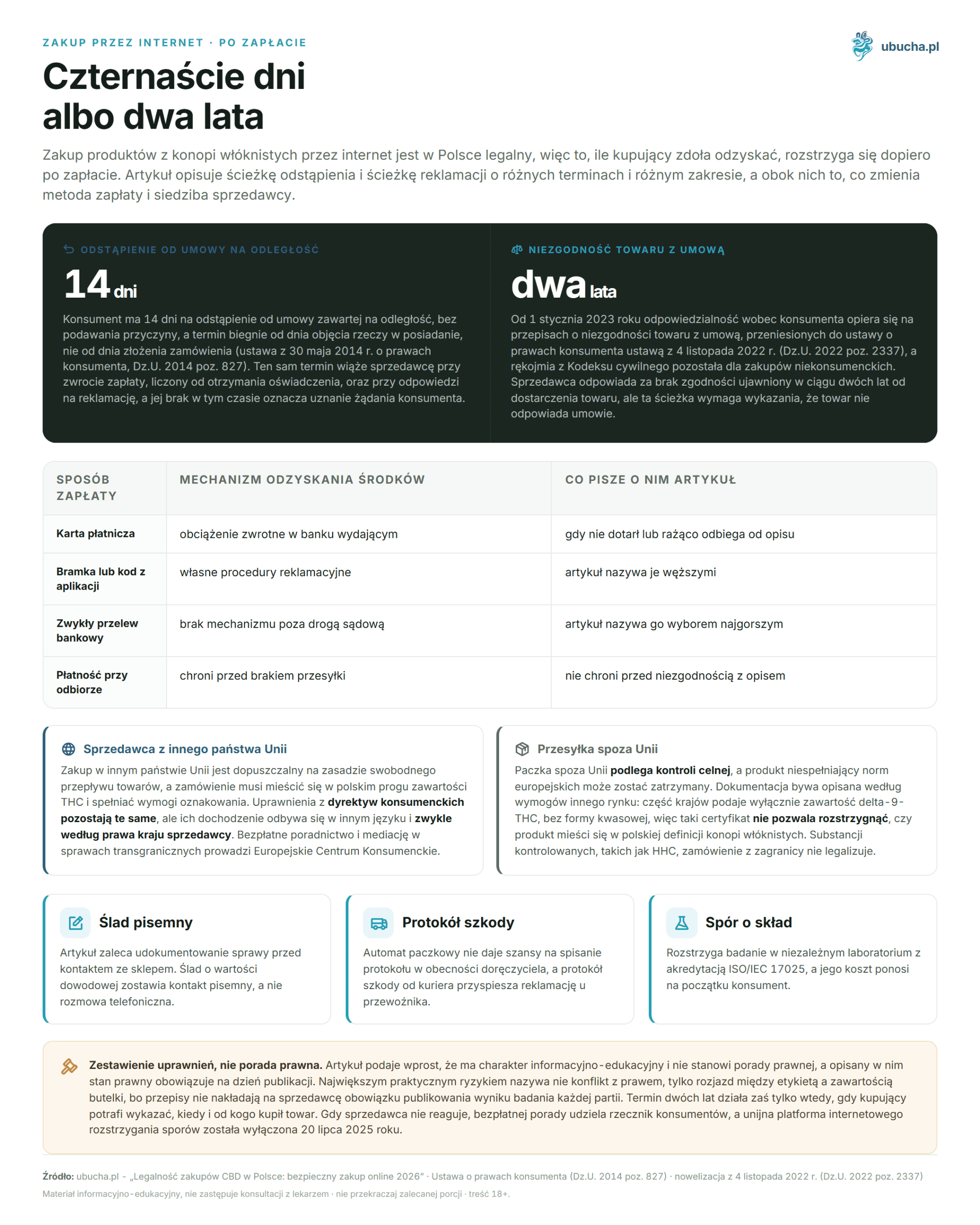
A consumer has 14 days to withdraw from a contract concluded remotely, without giving a reason. The deadline runs from the day of taking possession of the item, not from the day of placing the order. The seller has 14 days to refund the payment, counted from the receipt of the withdrawal statement. The basis is the Act of May 30, 2014 on Consumer Rights (Journal of Laws 2014 item 827).
Withdrawal has exceptions listed in the law. They concern, among other things, items delivered in sealed packaging, which cannot be returned after opening for health or hygiene protection reasons. An unopened oil falls within the right to withdraw without discussion; with an unsealed package, the seller may invoke this exception, although many stores accept returns nonetheless.
The second path is a complaint, and here many guides describe an outdated state. Since January 1, 2023, liability towards the consumer is based on the regulations on non-compliance with the contract, transferred to the Consumer Rights Act by the Act of November 4, 2022 (Journal of Laws 2022 item 2337). The warranty from the Civil Code remains for non-consumer purchases. The seller is responsible for non-compliance revealed within two years from the delivery of the goods.
The practical difference between these paths is simple. Withdrawal does not require justification, but is within 14 days and concerns unused goods. A complaint regarding non-compliance operates for two years and includes opened products, but requires demonstrating that the goods do not comply with the contract, for example, the declared concentration. When questioning the composition, it is this second path that is appropriate.
How to recognize an unfair CBD store?
An unfair store usually reveals itself in four areas at once: in the company data, in the offer, in communication, and in documentation. A single signal may be a coincidence, but the convergence of two or three is sufficient reason not to provide credit card details.
The first area is the website and data. Lack of a tax identification number, lack of a registered office address, a domain registered a few weeks earlier, descriptions with visible syntactic errors, and product images taken from stock photo banks without producer markings. You can check the age of the domain in the internet archive, and the company data in public registers.
The second area is the offer. A price significantly lower than the rest of the market, time pressure such as a message about the last pieces, and promises of treating specific diseases. Attributing therapeutic properties to a product without registration as a medicinal product is prohibited, and a seller willing to write this will not hesitate to omit batch testing.
Verification tools are worth knowing in advance, not at the moment you encounter a suspicious offer. You can check the data of the person running the business in CEIDG, a company in the National Court Register search engine, and the taxpayer status in the Ministry of Finance list. The history of the domain will show the internet archive, and you can gather opinions in services independent of the store. The entire procedure takes a few minutes and is done once for the seller, not with each order.
The third area is the method of contact and payment. Lack of a phone number, lack of response to messages, requests for prepayment via a regular transfer to a personal account instead of a company account. The fourth area is documentation: certificates copied from another company, without laboratory data and without an accreditation number, in a file that looks edited. The Office of Competition and Consumer Protection maintains a public list of warnings, which is worth checking before the first order in an unknown store.
What payment and shipping methods are safe?
The most protection is provided by a payment card, as only with it does the chargeback procedure operated by the issuing bank work. It allows recovering funds when the goods do not arrive or significantly deviate from the description, and the seller refuses to refund. The complaint is filed with your bank, not with the seller, and that is its greatest advantage.
Payments through certified payment gateways and systems based on codes from banking applications are convenient and quick, but have their own, narrower complaint procedures. A regular transfer to a bank account does not provide any mechanism for recovering funds outside of legal action, so with an unknown seller, it is the worst choice. Payment on delivery protects against the absence of the shipment but not against the inconsistency of its contents with the description.
Regardless of the method, check whether the site operates under a secure protocol. An address starting with “https://” and a padlock symbol in the browser’s address bar is the minimum requirement for any site accepting payments. A store that does not meet this requirement transmits card data in a readable form for network intermediaries.
When the shipment does not arrive within the declared time, the order of actions is established. First, check the status with the carrier, then write to the store and set an additional reasonable deadline for them to fulfill the obligation. Only after this deadline has passed without success can you withdraw from the contract due to non-fulfillment of the obligation and demand a refund. The written form of this request is important, as it is from it that the set deadline is counted.
When receiving the shipment, one thing matters: the ability to check the contents. A parcel machine is convenient but does not allow for writing a damage report in the presence of the deliverer. In case of visible damage to the packaging, request a damage report from the courier, as this document later significantly speeds up the complaint process with the carrier and the seller.
Is purchasing CBD from abroad legal?
Purchasing in another EU country is permissible based on the free movement of goods. This was confirmed by the Court of Justice of the European Union in its judgment of November 19, 2020, in case C-663/18, known as Kanavape (CJEU, C-663/18).
The Court ruled that cannabidiol produced legally in one member state is not a narcotic under the Single Convention on Narcotic Drugs of 1961, as classifying it there would contradict the purpose of the convention, which is to protect health. A national ban on the sale of such a product consequently violates the free movement of goods under Article 34 of the Treaty on the Functioning of the European Union.
However, the ruling does not abolish the competencies of member states entirely. The Court allowed restrictions justified by public health protection, provided they are based on a reliable scientific assessment of actual risk, not on hypothetical fear, and remain proportional to the goal. This ruling sets the boundaries of recognition, not full discretion in trade.
In practice, an order from another EU country must meet the Polish THC content threshold and labeling requirements. For shipments from outside the EU, the situation is different: the package is subject to customs control, and a product that does not meet European standards may be detained. A separate issue is controlled substances, such as HHC, whose orders from abroad do not legalize.
When purchasing cross-border, the consumer’s position in a dispute also changes. Against a seller from another EU country, you have the same rights arising from consumer directives, but enforcing them takes place in a different language and usually according to the law of the seller’s country. The European Consumer Centre provides free advice and mediation in cross-border matters within the EU.
The practical difference also concerns documentation. A product imported from outside the EU may be described according to the requirements of another market, making it difficult to compare declarations with the Polish threshold: some countries only provide the content of delta-9-THC, without the acidic form. A certificate that does not separate these two values does not allow determining whether the product fits within the Polish definition of industrial hemp.
What to do if the CBD product does not match the description?
Start by documenting the case before contacting the seller. Take photos of the packaging, label, and batch number, keep the proof of purchase, and describe the non-compliance in an email. Written contact leaves a trace that has evidential value; a phone conversation does not.
Next, choose a path. Within 14 days of receipt, with an unopened product, the simplest is to withdraw from the contract without giving a reason. If the deadline has passed or the packaging is opened, the appropriate route is a complaint regarding non-compliance with the contract, which operates for two years from the delivery of the item. In it, you can demand repair or replacement, and if that is impossible or excessively burdensome, a price reduction or withdrawal from the contract.
In disputes over composition, laboratory testing resolves the matter. An independent laboratory with ISO/IEC 17025 accreditation will analyze the cannabinoid content, and a result deviating from the declaration on the label is strong evidence of non-compliance. The consumer initially bears the cost of such testing, so it makes sense for larger orders or in disputes that have already escalated.
It is also worth knowing the deadlines on the seller’s side. They should respond to a complaint within 14 days; failure to respond within this time means acceptance of the consumer’s request. The same deadline applies to the refund after withdrawal from the contract, counted from the receipt of the statement. Record the dates of sending messages, as these are the dates from which both deadlines run, not from the day the seller decides to read them.
If the seller does not respond, help is free. The district or municipal consumer ombudsman provides legal advice, can approach the entrepreneur, and assist in mediation. The case can also be directed to the provincial inspectorate of the Trade Inspection in an amicable manner and reported to the Office of Competition and Consumer Protection. The EU online dispute resolution platform, to which older regulations referred, was deactivated on July 20, 2025, and references to it are now outdated.
Summary: how to safely buy CBD in Poland?
The legality of purchase is based on three pillars. The first is the 0.3% threshold calculated as the sum of delta-9-THC and THCA, introduced by the Act of March 24, 2022. The second is the EU status of novel food for extracts, which is still awaiting resolution and primarily affects the category in which the seller places the product. The third is consumer rights in contracts concluded remotely, restructured since 2023.
The greatest practical risk today is not a conflict with the law, but a discrepancy between the label and the contents of the bottle. Regulations do not impose an obligation on the seller to publish the test result of each batch, so documentation remains their voluntary decision, and differences between stores arise precisely from this. The choice of seller is, in this arrangement, the only control tool available to the buyer.
A practical checklist has five items. Check the company data in public registers. Read the terms and conditions regarding withdrawal and complaints. Find the analysis certificate for a specific batch and check for contaminants, not just the percentage of cannabidiol. Pay attention to therapeutic claims, as their presence disqualifies the seller. Pay by card if the store is new to you.
If you are comparing several stores before your first order, it will facilitate comparing sales channels in the text about where to best buy CBD oil. Also, keep the purchase documentation until you are sure that the product matches the description. The two-year deadline for reporting non-compliance only works if you can prove when and from whom you purchased the goods.
Frequently Asked Questions
Is CBD legal in Poland in 2026?
Yes. Cannabidiol is not listed in the register of controlled substances, and products from industrial hemp can be sold if the total delta-9-THC and THCA does not exceed 0.3% calculated on a dry weight basis. The basis is Article 4 point 5 of the Act on Counteracting Drug Addiction as amended by the Act of March 24, 2022.
Can I legally order CBD oils online?
Yes. Mail order sales of industrial hemp products to adults are allowed and do not require a separate permit. The store must operate a registered business, offer products that meet the THC content threshold, and comply with distance selling regulations, including the right to withdraw within 14 days.
How is the 0.3% THC threshold calculated?
As the sum of delta-9-THC and tetrahydrocannabinolic acid in the flowering or fruiting tops of the plants from which the resin has not been removed, calculated on a dry weight basis and rounded to one decimal place. Measuring only delta-9-THC gives a lower value and does not answer the question of compliance with the threshold.
Is CBD a novel food in the European Union?
Yes. The European Commission included CBD extracts in the novel food catalog in January 2019, which means authorization is required before being placed on the market as food or a dietary supplement. EFSA stated in 2022 that it could not complete the safety assessment and pointed out gaps in toxicological data.
Does notification to GIS mean product approval?
No. Notification of placing a food product on the market is a report, not a permit. It does not replace the authorization of novel food, does not change the status of the ingredient, and does not protect against later questioning of the product. Therefore, the information about the notification on the product card is not a confirmation of its approval.
How long do I have to return CBD purchased online?
Fourteen calendar days from taking possession of the item, without giving a reason. The seller has 14 days to refund the payment from the receipt of the withdrawal statement. An exception applies to items in sealed packaging, which cannot be returned after opening for health or hygiene protection reasons.
What is the difference between a complaint and withdrawal from the contract?
Withdrawal does not require justification, but covers 14 days and unused goods. A complaint regarding non-compliance with the contract operates for two years from the delivery of the item, includes opened products, but requires demonstrating that the goods do not comply with the contract. Since 2023, it has replaced warranty in consumer transactions.
Is purchasing CBD from abroad legal?
Within the European Union, yes, based on the free movement of goods confirmed by the Court of Justice in case C-663/18 of November 19, 2020. The product must meet the Polish THC content threshold and labeling requirements. For shipments from outside the EU, the risk of package detention by customs increases.
If you want to compare available concentrations and types of extract before ordering, check the category hemp oils.
This article is for informational and educational purposes and does not constitute legal advice. The legal status described in the article is valid as of the publication date: regulations regarding hemp may change. Before making a decision, consult a lawyer or current legal acts.
Author: Michał Waluk · Published: 2026-05-11 · Updated: 2026-08-10