
THC and THCV: What They Are and How They Differ? Comparison 2026
THC and THCV differ only by side chain length but act oppositely: one stimulates appetite, the other suppresses it. Doses, law, and hemp flower prices in Poland.
Two carbon atoms. That’s the difference between THC and THCV, and the effect is opposite: the first awakens a ravenous appetite, the second suppresses it. In 2024, about 62% of European medical marijuana patients used THC as the main therapy component (EMCDDA, 2024), while THCV is only entering phase three clinical trials. This data asymmetry leads to many marketing simplifications around the younger cannabinoid. We compare both molecules based on studies from Diabetes Care, Pharmacological Reviews, and Frontiers in Plant Science. You will learn how the C5 versus C3 chain shifts the CB1 receptor, why THCV is sometimes called the dietary cannabinoid, the legal status of both compounds in Poland in 2026, and what you can realistically buy in the Polish store.
KEY INFORMATION
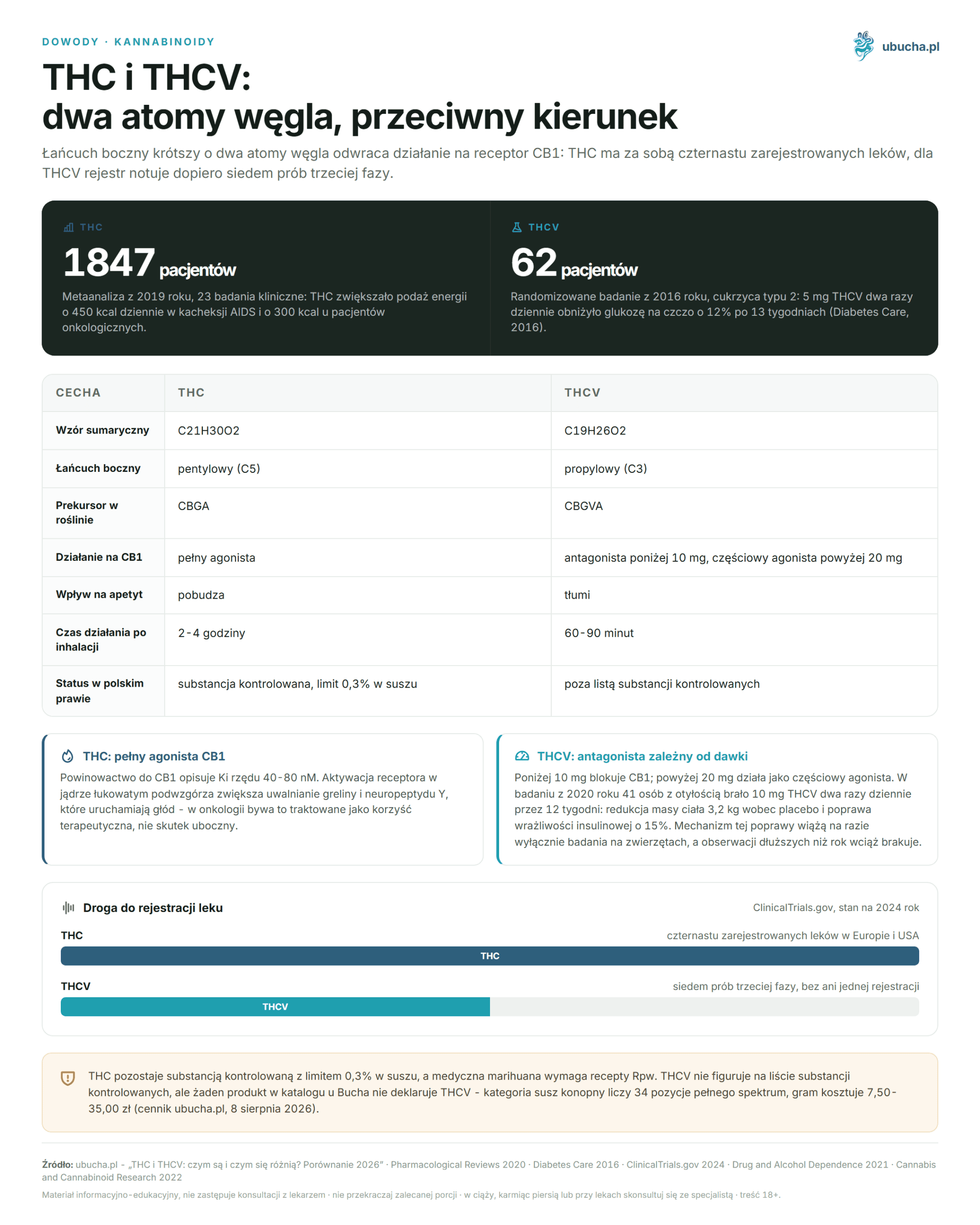
• THC has a C5 chain, THCV a shorter C3, which shifts CB1 receptor activity from agonist to antagonist (Pharmacological Reviews, 2020).
• THC stimulates appetite, THCV suppresses it: 5 mg twice daily lowered fasting glucose by 12% (Diabetes Care, 2016).
• In Poland, the THC limit in dried flower is 0.3%, and medical marijuana requires an Rpw prescription.
• No product in u Bucha’s catalog declares THCV.
• Gram of dried flower costs 7.50-35.00 zł (ubucha.pl price list, 2026-08-08).
What is the molecular difference between THC and THCV?
THC and THCV differ by two carbon atoms in the side chain. THC, delta-9-tetrahydrocannabinol, has a pentyl chain (C5), while THCV, tetrahydrocannabivarin, has a propyl chain (C3). This subtle change reverses how the molecule behaves at the CB1 receptor, affecting the entire pharmacological profile (Pharmacological Reviews, 2020).
Both compounds share the same dibenzopyran skeleton with hydroxyl groups and an aliphatic chain. The only difference is the chain length: five carbons in THC, three in THCV. Chemists call THCV a lower homolog. Their molecular formulas also differ: C21H30O2 for THC versus C19H26O2 for THCV.
Why do two carbons change so much? The side chain fits into the CB1 receptor binding pocket and determines binding strength. The longer C5 chain stabilizes binding and shifts the receptor to an active state. The shorter C3 chain fits more shallowly, so at low concentrations it mostly occupies the site without activating the receptor.
For comparison: CBD and CBG have identical molecular formulas and differ only in molecular geometry. We detailed differences among CBD, THC, and CBG separately in the CBD, THC and CBG comparison. THC and THCV differ in atomic composition. This is a rare case where shortening the chain produces an opposite biological effect rather than weakening the same effect.
| Feature | THC | THCV |
|---|---|---|
| Molecular formula | C21H30O2 | C19H26O2 |
| Side chain | pentyl (C5) | propyl (C3) |
| Plant precursor | CBGA | CBGVA |
| Effect on CB1 | full agonist | antagonist below 10 mg, partial agonist above 20 mg |
| Appetite effect | stimulates | suppresses |
| Duration after inhalation | 2-4 hours | 60-90 minutes |
| Legal status in Poland | controlled substance, 0.3% limit in dried flower | not on controlled substances list |
| Content in fiber hemp | below 0.3% | below 0.1% |
How is THCV produced in the cannabis plant?
THCV is produced from a different precursor than THC. The plant synthesizes THC from cannabigerolic acid (CBGA), and THCV from cannabigerovarinic acid (CBGVA). The divergence starts earlier because the first pathway uses olivetolic acid, and the second uses divarinic acid. This results in the shortened side chain.
The THCA synthase enzyme processes both pathways. It converts CBGA to THCA and CBGVA to THCVA. Active forms appear only after decarboxylation, i.e., exposure to heat and time. Fresh dried flower mainly contains acidic forms, which do not bind CB1 receptors like THC.
How much THCV is in the plant? Typical European Cannabis sativa L. strains contain less than 0.1%. African lines reach 0.5-3% (Frontiers in Plant Science, 2021). Selective breeding can raise this to 5-8%, but such strains are produced only for research and legal marijuana markets.
This arithmetic has practical consequences. To consume 10 mg of THCV from flower containing 1% THCV, about one gram of material is needed. For a 5% strain, only 200 mg is required. That’s why breeders work on THCV-dominant lines, although the market remains niche.
Harvest timing also affects content. Varin cannabinoids appear earlier in the profile than their longer counterparts, so material harvested before full flower maturity usually has a better THCV to THC ratio. Producers aiming for potency harvest later to increase THC content. These goals conflict and are decided by the farmer, not the genetics.
How do THC and THCV act on the CB1 receptor?
THC is a full CB1 receptor agonist, while THCV’s role depends on dose. Below 10 mg, it blocks the receptor without activating it. Above 20 mg, it becomes a partial agonist producing mild psychoactive effects (Drug and Alcohol Dependence, 2021). This two-step profile is unusual among natural cannabinoids. The rest of the family’s behavior is detailed in our cannabinoids and endocannabinoid system guide.
THC activation of CB1 triggers a G-protein cascade that reduces neurotransmitter release in the central nervous system. This causes sedation, altered time perception, and euphoria. THC’s affinity for CB1 is described by a Ki value around 40-80 nM, placing it among strong ligands.
At low doses, THCV acts as a neutral antagonist. It occupies the binding pocket but does not shift the receptor to an active state. The net effect is that THCV presence weakens THC’s action at the same site. At higher concentrations, THCV partially activates the receptor, but more weakly and briefly.
We noticed this biphasic effect is the main source of misunderstandings with customers. The question is usually “does THCV cause a high?” and the correct answer starts with “at what dose?” Without this qualifier, both yes and no answers are half false.
Practically, a patient seeking THC’s pain relief without ravenous appetite and tachycardia has reason to choose a strain with higher THCV content. Such material reduces side effects without eliminating the high. This explains Durban Poison’s position in medical programs.
How do THC and THCV affect appetite?
THC stimulates appetite, THCV suppresses it, and this is a difference in direction, not degree. A 2016 study on 62 type 2 diabetes patients showed 5 mg THCV twice daily lowered fasting glucose by 12% after 13 weeks (Diabetes Care, 2016). THC under the same conditions has the opposite effect.
THC’s mechanism is well described. CB1 activation in the arcuate nucleus of the hypothalamus increases ghrelin and neuropeptide Y release, triggering hunger. The so-called munchies effect is sometimes therapeutically beneficial in oncology, not just a side effect.
THCV blocks this point. By limiting CB1 signaling in the hypothalamus, it suppresses the appetite cascade and also acts on CB2 and several TRP receptors. Preclinical studies link this to improved insulin sensitivity, though long-term observations over a year are lacking.
What happens when both cannabinoids are in one plant? The net effect depends on their ratio. Durban Poison has about 1.5% THCV with 17-20% THC, so appetite still increases but less intensely than with THC alone. Users describe this as no binge, not no hunger.
The dietary cannabinoid nickname given to THCV by industry media in 2020 is half true. Appetite suppression is real and measured, but the effect scale is a few kilograms over several weeks, not a breakthrough obesity treatment.
What have clinical studies shown about THCV?
Clinical data on THCV is limited but consistent. A 2016 randomized study included 62 type 2 diabetes patients comparing placebo, THCV alone, CBD alone, and their combination. The strongest hypoglycemic effect came from 5 mg THCV twice daily (Diabetes Care, 2016).
A second study in 2020 involved 41 obese individuals with BMI over 30. A 10 mg twice daily dose of THCV for 12 weeks resulted in an average 3.2 kg weight loss versus placebo and about 15% improved insulin sensitivity. All participants completed the protocol.
Tolerability is notable. Obesity drug trials typically see 20-30% dropout due to side effects. In the cited study, no psychoactive effects were reported and dropout was zero. For a new molecule, this result is as important as efficacy.
THC has a vastly larger evidence base. A 2019 meta-analysis covered 23 clinical trials with 1847 patients. THC increased energy intake by about 450 kcal daily in AIDS-related cachexia and 300 kcal in oncology patients, with effects starting 30-60 minutes after administration.
The 2024 registry recorded seven phase three trials involving THCV (ClinicalTrials.gov, 2024). No THCV product is yet registered, while THC is an ingredient in fourteen approved drugs in Europe and the US.
Does THCV cause psychoactive effects like THC?
Not at typical doses, and that’s the key difference. Comparative studies show subjective high intensity from THCV reaches 30-40% of that from an equivalent THC dose (Cannabis and Cannabinoid Research, 2022). This is due to partial agonism: THCV shifts the receptor only halfway.
THC binds CB1 throughout the brain, with each area contributing to the experience. The limbic system causes euphoria, the prefrontal cortex alters time perception, the hippocampus impairs short-term memory. The cerebellum adds poor motor coordination. Together, this profile lasts 2-4 hours after inhalation.
THCV has three thresholds. Below 10 mg, most studies find no measurable psychoactive effects. The 15-25 mg range produces mild euphoria and mood improvement without coordination impairment. Above 50 mg, the profile approaches THC, but duration remains 60-90 minutes (Drug and Alcohol Dependence, 2021).
Clinical descriptions often mention a clear high. Users report no drowsiness, no hunger attack, and no confusion. That’s why THCV-rich strains are used medically during the day when patients must remain functional.
The marketing shortcut “THCV is THC without the high” is true only for doses below 10 mg. Above that, the description no longer matches reality. Producers using this claim without dose clarification provide incomplete information, and buyers pay with surprise.
What side effects do THC and THCV have?
THC’s profile is well documented; THCV’s is still preliminary. THC commonly causes dry mouth in 88% of users, red eyes in 72%, and tachycardia in 54% (Cannabis and Cannabinoid Research, 2019). Most effects fade after 4-6 hours.
Also reported are short-term memory impairment in 41%, reduced coordination in 38%, and anxiety or paranoia at high doses in 23%. The last two account for most unpleasant experiences in new users who take too high a dose initially.
THCV appears milder but data is limited. Reported effects include mild dry mouth, transient appetite reduction, and rarely anxiety at high doses. No significant tachycardia or typical memory issues were noted. Lack of long-term studies means this picture is preliminary.
Drug interactions are a separate issue. Both cannabinoids are metabolized by cytochrome P450 enzymes, mainly CYP2C9 and CYP3A4. Many anticoagulants, antiepileptics, and antidiabetics share these pathways, so combining requires medical consultation, not self-calculation.
WHO’s 2018 report did not list THCV as a controlled substance, while THC remains in Schedule I of the Psychotropic Substances Convention. This formal status difference does not affect practice, as THCV products almost always contain THC.
There is also a less discussed issue. Most reported adverse effects from hemp products stem not from cannabinoids themselves but from dosing errors or contamination. Pesticide residues and heavy metals appear in batches outside controlled supply chains. A certificate of analysis covering these parameters says more about product safety than declared cannabinoid content.
What is the legal status of THC and THCV in Poland in 2026?
THC is a controlled substance in Poland, with a 0.3% limit in hemp flower (Dz.U. 2005 Nr 179 poz. 1485 with later amendments). THCV is not on the controlled substances list. Practically, however, every product with detectable THCV also contains THC and is subject to the same regulations.
The Anti-Narcotics Act lists THC and its synthetic derivatives. Natural cannabinoids from fiber hemp, including CBD, CBG, and THCV, are exempt from narcotic control provided THC content does not exceed the threshold. Above it, the product is classified as a narcotic.
Medical marijuana operates under separate rules. Since 2017, doctors can issue Rpw prescriptions for products with THC above the threshold. In 2024, about 115,000 patients were covered, with annual growth around 40% (Fakty Konopne, 2024). The number of pharmacies filling such prescriptions is also increasing.
Species distinction matters legally. Fiber hemp listed in the European variety registry can be freely cultivated. Plants with THC above the threshold require separate permits. u Bucha store sells only fiber hemp products compliant with the Polish limit, which you can verify in the hemp flower category.
Outside Poland, the picture varies. Switzerland allows 1% THC in flower, Germany 0.2%, and since 2024 permits adults to possess certain amounts of high-THC material. THCV itself is not controlled in any of these countries.
How to calculate the 0.3% THC limit in finished products?
The limit refers to the product’s dry mass, not the declared cannabinoid potency. For dried flower, the calculation is simple: one gram of material may contain up to 3 mg THC. For oils, the calculation must consider the entire bottle’s mass, not just the CBD percentage on the label.
Example: a 10 ml bottle with 1000 mg CBD is labeled as 10% oil. THC percentage is calculated from the total mass, not CBD mass. Broad-spectrum formulas have THC removed to zero, while full-spectrum formulas usually contain a few milligrams per bottle.
This interpretation was disputed. A 2022 Supreme Court ruling confirmed the threshold applies to total THC content in the final product. Attempts to break down the result by isomers or sum it with other cannabinoids do not change the legal classification.
The practical takeaway for buyers: a certificate of analysis (COA) weighs more than the packaging description. The document lists cannabinoid content in milligrams per gram or as a mass percentage. Without it, the producer’s declaration remains unverified.
There is also a layer of food regulation. EFSA treats most hemp cannabinoids as novel foods requiring authorization, and the procedure is ongoing. Therefore, hemp products are sold in Poland as collectibles or cosmetics. This solution is tolerated but not final.
Buyers pay for this ambiguity in one specific way. Since the product is not formally food, the producer is not required to provide usage instructions or daily dose. Packaging descriptions are often minimal, and cannabinoid content information is relegated to a separate document. Stores maintaining full batch documentation stand out more than price alone would suggest.
In which cannabis strains is THCV found?
THCV appears mainly in African and South Asian lines, typically in the 0.5-3% range. Durban Poison, a classic sativa from South Africa, contains 1.0-1.5% THCV with 17-20% THC. Selectively bred strains reach 5-8% (Frontiers in Plant Science, 2021).
The geographic distribution is not accidental. Lines adapted to hot, dry climates produce more varin cannabinoids with the short C3 chain. European fiber hemp, bred for fiber and seeds over centuries, contains only trace THCV.
Among THCV-rich strains, Durban Poison, Pineapple Purps, and Doug’s Varin are most often mentioned. Doug’s Varin, bred in California in 2008, was the first commercial line with over 4% THCV. Analyses show 5-7% THCV with 6-8% THC, reversing the usual ratio.
Pineapple Purps resulted from crossing Doug’s Varin with Pineapple. It typically contains 3-5% THCV, 8-12% THC, and a distinct terpene profile with limonene and pinene. Availability in Europe is limited to select markets, and it is not registered in Poland’s medical program.
Polish fiber hemp varieties like Finola, Felina 32, or Białobrzeskie contain only trace THCV. For consumers, this means you cannot buy material with declared THCV legally; what you get is a natural minor cannabinoid admixture in full-spectrum flower.
Strain names on labels should also be read cautiously. The same commercial name may be used by different breeders for material with different cannabinoid profiles, as the fiber hemp variety registry describes genetics, not the cannabinoid profile of a batch. Laboratory testing of each delivery is decisive. If the seller provides only a name and one cannabinoid percentage, the rest of the profile remains unknown.
How long do THC and THCV last?
THCV lasts noticeably shorter. After inhalation, effects appear within 5-15 minutes and fade after 60-90 minutes, while THC lasts 2-4 hours (Cannabis and Cannabinoid Research, 2022). Oral administration prolongs both, but the ratio remains the same.
The difference is pharmacokinetic. THCV is metabolized faster by CYP2C9 and CYP3A4 enzymes, with a half-life of 3-4 hours. THC metabolites remain in plasma for 20-30 hours. Active THCV derivatives disappear faster and do not accumulate in fat tissue to the same extent.
After inhalation, THC peaks in blood within 5-10 minutes with 10-35% bioavailability, depending on technique and device. Vaporization performs better than combustion. Orally, bioavailability drops to 4-12% as the liver converts THC to 11-hydroxy-THC, a more psychoactive compound.
THCV peaks in 3-8 minutes after inhalation with 15-30% bioavailability. Orally, it ranges 6-18%, peaking at 1.5-2.5 hours. The entire action cycle is about half the time of THC, which can be decisive when planning the day.
Drug tests do not distinguish the two compounds. THC-COOH metabolite is detectable in urine for 3-30 days depending on use frequency; THCV is shorter, typically 2-7 days. Screening antibodies cross-react with structurally similar derivatives, so a positive result does not clarify the source.
What are the therapeutic uses of THC and THCV?
THC has forty years of clinical use; THCV is entering phase three trials. In 2024, THC was an ingredient in fourteen registered drugs in Europe and the US, while THCV had seven phase three trials with no registrations (ClinicalTrials.gov, 2024).
Clinically confirmed THC indications include chronic pain, spasticity in multiple sclerosis, and chemotherapy-induced nausea and vomiting. Also cachexia, Tourette’s syndrome, and some drug-resistant epilepsies. Sativex, with equal THC and CBD, has been registered in Poland since 2012.
Neuropathic pain shows the best data. A 2021 meta-analysis covered 18 randomized trials with 2283 patients, noting a 30-40% average pain reduction versus placebo. The effect was stronger in peripheral than central pain, with effective doses between 2.5-10 mg daily.
THCV is studied for obesity, type 2 diabetes, and metabolic syndrome, as well as Parkinson’s disease and psychosis. CB1 antagonism provides a theoretical basis for antipsychotic effects, confirmed so far only in animal models.
The psychiatric direction requires caution on both sides. A 2019 meta-analysis confirmed a link between regular use of high-potency THC material and increased schizophrenia risk in individuals with family history. This warning is not mitigated by THCV presence in the same plant.
What is the entourage effect involving THC and THCV?
The entourage effect is the mutual modulation of cannabinoids and terpenes, described by Russo and Mechoulam in the British Journal of Pharmacology in 2011 (PMC, British Journal of Pharmacology, 2011). In the THC-THCV pair, it acts bidirectionally: THC enhances some THCV effects, and THCV reduces some THC side effects.
Animal studies showed a 3:1 mixture of both cannabinoids produced stronger analgesia than THC alone, with less tachycardia and sedation. The mechanism is that THCV’s partial agonism wins receptor competition in some brain structures.
Patients realized this before literature. Durban Poison gained a reputation as a work strain because it combines moderate THC with high THCV. Pain relief remains without the typical couch-lock effect at higher doses.
Terpenes add another layer. Myrcene deepens sedation, limonene improves mood, and beta-caryophyllene activates CB2 and is anti-inflammatory. Pinene is linked to better concentration, and alpha-humulene suppresses appetite, aligning with THCV’s direction. We describe these molecules in detail in the cannabis terpenes guide.
This explains interest in strains with three strong components simultaneously. North American breeders select lines combining THC, THCV, and CBD in one profile, aiming for therapeutic effects with minimal side effects. This is a direction for the next decade, not today.
How to dose products with THC and THCV?
Both substances require titration following the start low, go slow principle (Project CBD, 2023). THC starting doses range 2.5-5 mg sublingually or inhaled. THCV starting point is 5-10 mg. In medical marijuana programs, dosing is set by a doctor, not the patient.
First THC experiences can be stronger than expected. A 5 mg dose in a novice may correspond to 20 mg in a tolerant user. Tolerance builds over 2-4 weeks of regular use, and a 7-14 day break largely resets it.
THCV behaves more predictably. Dose-effect is roughly linear up to a plateau around 30-40 mg. Higher doses do not increase effect strength, only duration. Metabolic studies typically used 10 mg daily split into two doses.
Administration route shifts the scale. Inhalation requires the least, sublingual intermediate, and oral two to three times more due to first-pass metabolism. Edibles add up to two hours delay, which can cause accidental overdose from impatience.
In the Polish medical program, typical start is 0.1 g dried flower daily divided into two or three doses, increasing by 0.1 g weekly until effect. Ready-made products are dosed more precisely: one Sativex spray contains 2.7 mg THC and 2.5 mg CBD, with typical daily doses of 4-12 sprays.
What myths surround THC and THCV?
There are many misunderstandings, more with THCV than THC. A 2023 consumer survey found about 51% of respondents had incorrect beliefs about THC, and 72% about THCV (EMCDDA, 2023). The reason is simple: less data, more marketing.
The first myth claims THCV causes weight loss without diet or exercise. Clinical studies show 1.9-3.2 kg loss over 12-16 weeks. This is comparable to moderate lifestyle changes, not incretin drugs that achieve 10-15% body weight loss annually.
The second myth says THC is completely illegal in Poland. Not true: products below 0.3% THC are legal, and medical marijuana with higher THC is available by Rpw prescription. Cultivation, possession, and sale outside this system remain illegal.
The third myth concerns replacing medications. THCV lowered fasting glucose by 12% in 13 weeks, while metformin reduces it by 20-30%. Stopping antidiabetic treatment in favor of cannabinoids is risky, especially as both share liver enzyme pathways.
The fourth myth claims THCV strains are non-psychoactive. Durban Poison has 17-20% THC alongside 1-1.5% THCV, and Doug’s Varin 6-8% THC with 5-7% THCV. In both, THC sets the tone. Pure THCV isolates, practically non-psychoactive at low doses, remain rare in research.
The fifth myth involves drug tests. Some believe THCV-dominant material won’t cause positive roadside or workplace tests. Screening tests detect THC-COOH metabolite and cross-react with similar derivatives. Legal flower below THC threshold can also yield positive results with frequent use.
What can you realistically buy in the Polish store?
You cannot buy products with declared THCV. Searching u Bucha’s catalog returns no items with this cannabinoid in the description, and THCV-dominant strains are not registered in Poland’s medical program. What you get is full-spectrum flower with trace THCV.
The hemp flower category currently has 34 items. Below are eight selected to show format and price range. Prices are from the store as of August 8, 2026, and may change between publication and your purchase.
| Product | Format | Highlight | Price | Cost per 1 g |
|---|---|---|---|---|
| SZAŁ MIAŁ CBD Babcia Marysia MIX Trim | 10 g | trim from mixed strains, lowest cost in category | 75 zł | 7.50 zł |
| Specjały Babci Marysi Hemp Flower Northwest | 10 g | single strain in large package | 140 zł | 14.00 zł |
| Specjały Babci Marysi Hemp Flower Northwest | 5 g | same material in smaller pack | 75 zł | 15.00 zł |
| Rollmops Hemp Flower Specjał Mopsa (CBD Heaven) | 5 g | single brand selection, whole flower buds | 99 zł | 19.80 zł |
| Cannabis Spot CBD Flower Gorilla Glue | 5 g | strain with distinct terpene profile | 100 zł | 20.00 zł |
| Babcia Marysia CBD Northwest | 2 g | trial pack of the same strain | 45 zł | 22.50 zł |
| Babcia Marysia CBG Santhica | 2 g | profile based on CBG instead of CBD | 45 zł | 22.50 zł |
| Babcia Marysia CBD Northwest | 1 g | smallest pack, for testing only | 35 zł | 35.00 zł |
The conclusion is simple: price per gram depends on package size, not strain. The same Northwest costs 35.00 zł per gram in a 1 g pack and 14.00 zł in a 10 g pack. The 2.5-fold difference has nothing to do with cannabinoid profile.
How much does a gram of hemp flower cost?
The range is wider than shelf prices suggest. In the eight items above, cost per gram ranges from 7.50 zł to 35.00 zł, nearly fivefold difference. Package size explains almost all of this range.
The cheapest rate is for trim, i.e., smaller flower fragments. At 75 zł for 10 grams, that’s 7.50 zł per gram. The most expensive is the 1 g pack: 35 zł per gram, nearly five times more for material with the same cannabinoid profile.
Mid-range prices are in 5 g packs, from 15.00 zł to 20.00 zł per gram. Here, differences arise from strain and selection method, not package size. Above 20 zł per gram, you mainly pay for a small portion.
From our observations, 1 g and 2 g packs serve as samples. Customers buy them to test a strain, then switch to 5 or 10 g packs for repeat orders. In this scenario, overpaying initially is a conscious test cost, not a purchase mistake.
If you calculate usage cost rather than one-time purchase, cost per gram is the right measure. At 0.1 g daily, a 10 g pack for 140 zł lasts 100 days, costing 1.40 zł daily. The same calculation for a 1 g pack yields 3.50 zł daily.
When to choose THC and when THCV?
The choice depends on the goal and legal availability. For chronic pain, spasticity in multiple sclerosis, and chemotherapy nausea, THC is indicated and available in Poland by Rpw prescription. For appetite control and daytime concentration, THCV performs better.
The pain scenario has an established standard. A 1:1 THC to CBD combination, as in Sativex, yields 30-40% pain reduction in randomized trials at 5-15 mg THC daily. THCV is not part of this therapy, though it does not interfere in strains containing both cannabinoids.
The metabolic scenario is reversed. THC increases appetite, counteracting weight control. THCV at 10 mg daily split into two doses shows effects after 4-8 weeks but only combined with diet and activity changes.
The daytime scenario, i.e., work and focus, favors high-THCV strains. The problem is that such strains are not legally available in Poland. The realistic alternative is low-THC full-spectrum flower that does not impair work ability.
For most Polish consumers, the practical answer is full-spectrum flower with legal THC content and a full minor cannabinoid profile. For serious therapeutic indications, the path leads through a doctor’s office and Rpw prescription, not self-supplementation.
Frequently Asked Questions
What is the chemical difference between THC and THCV?
THC has a pentyl side chain (C5), while THCV has a propyl side chain (C3). This two-carbon difference changes affinity for the CB1 receptor. THC is a full agonist, and THCV is an antagonist at low doses and a partial agonist at high doses (Pharmacological Reviews, 2020). Their molecular formulas also differ.
Does THCV have psychoactive effects like THC?
Not at typical doses. Below 10 mg, THCV blocks CB1 and does not cause a high. Above 20 mg, it becomes a partial agonist and may produce mild, shorter psychoactive effects (Drug and Alcohol Dependence, 2021). THCV effects last 60-90 minutes compared to 2-4 hours for THC.
Are THC and THCV legal in Poland in 2026?
THC is a controlled substance with a 0.3% limit in dried flower (Dz.U. 2005 Nr 179 poz. 1485 with later amendments). THCV is not on the controlled substances list, but almost every product with THCV also contains THC. Medical marijuana requires an Rpw prescription.
How do THC and THCV affect appetite?
THC stimulates appetite by activating CB1 receptors in the hypothalamus, increasing ghrelin and neuropeptide Y release. THCV acts oppositely and blocks the same pathway. A 2016 study showed 5 mg twice daily lowered fasting glucose by 12% and reduced body weight (Diabetes Care, 2016).
In which cannabis strains is THCV found?
Mainly in African and Asian lines. Durban Poison, Doug’s Varin, and Pineapple Purps contain 0.5-3% THCV. European fiber hemp usually has below 0.1% (Frontiers in Plant Science, 2021). Selectively bred strains can reach 5-8% but are not available in the Polish market.
Does THCV help with weight loss?
Studies show a weight reduction of 1.9-3.2 kg over 12-16 weeks at doses of 5-10 mg twice daily (Diabetes Care, 2016). This effect is comparable to moderate dietary changes. THCV is not a registered obesity medication and does not replace diet or physical activity.
How long does THCV last compared to THC?
Shorter. After inhalation, THCV effects start within 3-8 minutes and fade after 60-90 minutes, while THC lasts 2-4 hours (Cannabis and Cannabinoid Research, 2022). The difference is due to faster metabolism of THCV by CYP2C9 and CYP3A4 enzymes and a shorter half-life.
Can you buy a product with THCV at u Bucha store?
There are no products with declared THCV. Searching the catalog returns no results for this cannabinoid. The hemp flower category has 34 full-spectrum products where THCV is present only in trace amounts, priced from 7.50 zł to 35.00 zł per gram.
Summary: THC or THCV, which to choose?
THC and THCV are sister molecules with opposite profiles. THC is a full CB1 receptor agonist. It acts strongly and long, causes psychoactive effects, and stimulates appetite. THCV with a shorter C3 chain blocks the same receptor at low doses, does not cause a high, suppresses appetite, and lasts 60-90 minutes.
For Polish consumers, the realistic option is full-spectrum flower with trace minor cannabinoids, within the 0.3% THC limit. For serious therapeutic indications, the path leads through an Rpw prescription, not self-supplementation.
THCV remains a cannabinoid of the future, but a dated future. Phase three studies for obesity, diabetes, and schizophrenia are ongoing, with first registrations expected between 2027-2030. Until then, the only access is natural admixture in hemp flower.
A good decision starts with understanding the difference between these molecules and ends with checking the certificate of analysis for a specific product. The rest - dose and frequency - requires a doctor’s consultation wherever chronic illness or ongoing medications are involved.
If you want to check what is realistically available, visit the hemp flower or hemp oils categories.
This article is for informational and educational purposes and does not constitute medical advice. Before starting cannabis or CBD for therapeutic purposes, consult a doctor, especially if you take other medications, are pregnant, or breastfeeding.
Author: Michał Waluk · Published: 2026-04-27 · Updated: 2026-08-08