
Instead of tobacco: what really changes when you quit smoking (comparison)
Herbal cigarettes, vaporization mixtures, and NRT compared based on data. Check what is produced when burning herbs and what warning the law mandates.
What to smoke instead of tobacco? When it comes to quitting nicotine, the answer is: smoke nothing, as only nicotine replacement therapy is effective. If it’s about maintaining the ritual itself, herbal cigarettes and mixtures for vaporizers remain, but none of these paths is safe. The question about a cigarette substitute usually arises in one of two situations: someone wants to quit nicotine or wants to maintain the ritual itself. These are two different goals and lead to two different answers. This text compares three paths that you most often ask about: herbal cigarettes without tobacco, herbal mixtures for vaporizers, and nicotine replacement therapy. For each, we provide what has really been measured, what has not been measured, and what obligations Polish law imposes on the manufacturer. One resolution is worth knowing in advance: the absence of tobacco in a cigarette removes nicotine, but does not remove smoke. The rest of the text explains why this distinction determines everything else and shows where the circulating numbers about the reduction of harmful compounds diverge from the studies they refer to. Separately, we describe what the law requires from the packaging of such a product.
KEY INFORMATION
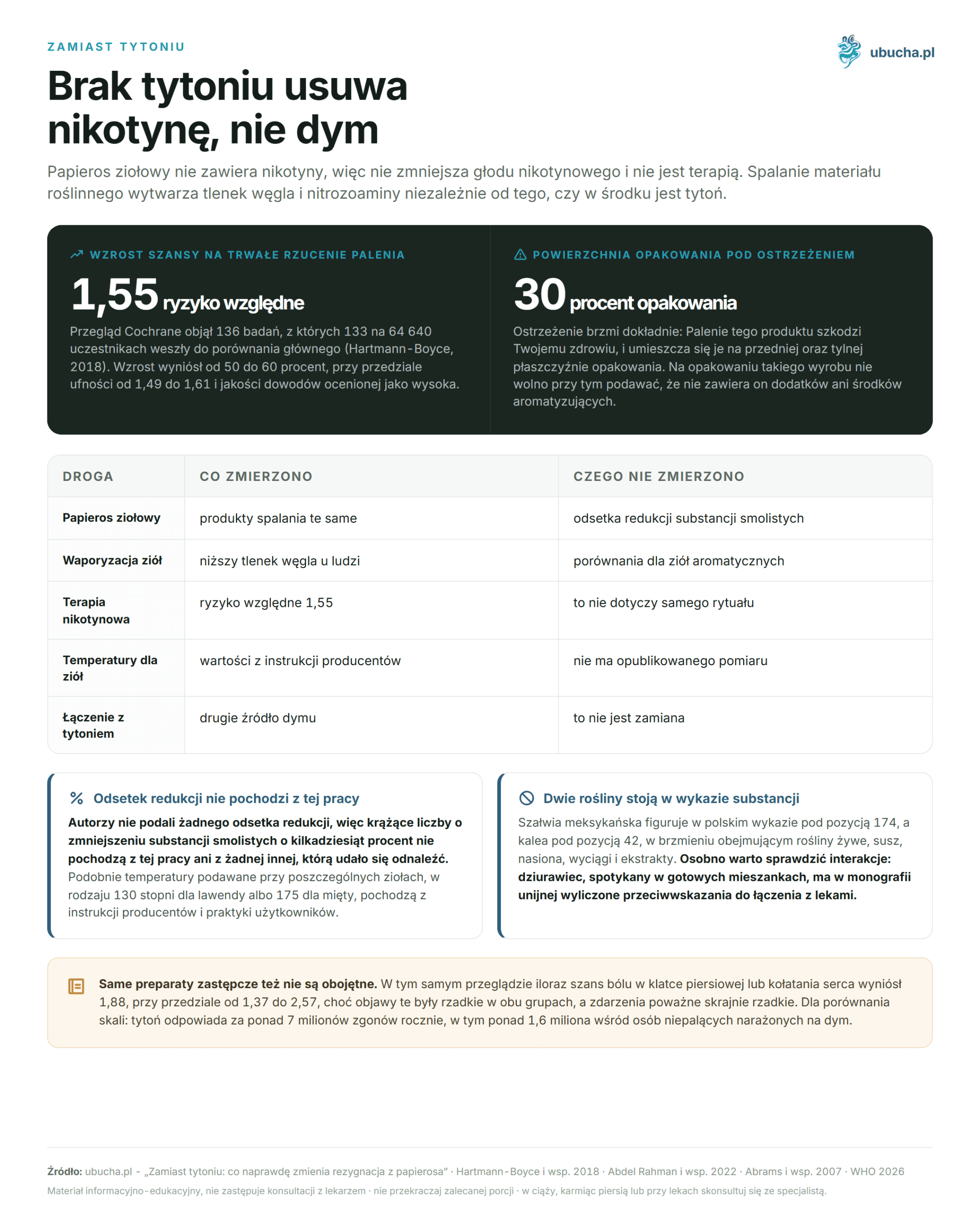
• Burning plant material produces carbon monoxide, polycyclic aromatic hydrocarbons, and nitrosamines regardless of whether the plant contains nicotine (Abdel Rahman et al., ACS Omega, 2022).
• A herbal smoking product has a statutory definition in Poland and must carry the warning \”Smoking this product harms your health\” on 30 percent of the packaging surface (art. 9e of the Act, Journal of Laws 2024 item 1162).
• The packaging of such a product must not inform that it contains no additives or flavoring agents.
• Nicotine replacement therapy increases the chances of quitting smoking permanently by 50 to 60 percent, relative risk 1.55 (95% CI 1.49-1.61) in 133 studies on 64,640 people (Hartmann-Boyce et al., Cochrane, 2018).
• Tobacco is responsible for over 7 million deaths annually, including over 1.6 million among non-smokers exposed to smoke (WHO, as of June 26, 2026).
What happens to the plant when you set it on fire?
It ceases to be that plant. The glowing end of the joint thermally decomposes organic matter, and from this decomposition, hundreds of compounds are formed that were not present in the dry leaf. A review paper directly addressing herbal cigarettes describes this mechanism in one sentence: burning plant substances can harm the body through toxic compounds, including carbon monoxide, polycyclic aromatic hydrocarbons, nicotine, and nitrosamines (Abdel Rahman et al., ACS Omega, 2022). The authors also compare the chemical composition of popular mixtures and note that some herbal smokes are associated with metabolic disorders.
It is worth remembering where nicotine stands in this chain. It is responsible for addiction and part of the effect on the circulatory system, but not for carbon monoxide or tar. Removing it from a cigarette removes one component from the list, not the entire list. The lungs do not distinguish between smoke from rosemary and smoke from tobacco in terms of carbon monoxide, as it is produced from the same process in both cases.
This is illustrated by measurements from clove cigarettes, which contain tobacco, yet were sold for years as milder. In standard machine smoking, they delivered more nicotine, carbon monoxide, and tar than regular cigarettes, and ten smokers smoked them longer and deeper: 549 seconds and 15.1 puffs compared to 314 seconds and 9.4 puffs with their own brand (Malson et al., Pharmacol Biochem Behav, 2003). Changing the content of a cigarette can change the way it is smoked, and along with it, the entire exposure.
Is a herbal cigarette without nicotine safer?
It does not cause nicotine addiction, and that is its only measured advantage. All other accusations against smoking transfer unchanged, as they come from burning, not from tobacco. The cellulose filter retains some particulate matter and does not retain gases, so carbon monoxide passes through it freely. We have formulated these conclusions more broadly in the post about whether herbal cigarettes are safe.
Separate attention is required for the composition. Cheaper mixtures may be based on nettle, mint, mullein, or raspberry leaves, while more expensive ones use rarer plants, and this begins a problem that the manufacturer does not have to signal. Mexican sage (Salvia divinorum) is listed in the Polish register under item 174, covering live plants, dried herbs, seeds, extracts, and extracts; kalea (Calea zacatechichi) is listed under item 42 (regulation of the Minister of Health, consolidated text Journal of Laws 2024 item 1139). These are controlled substances, not exotic additives to a joint, and their mere presence in the product description is a warning signal.
The second thing to check concerns completely legal plants. St. John’s wort, mentioned in ready-made smoking and vaporizing mixtures, has contraindications for its use with medications listed in the EU monograph. If you are taking anything by prescription, check the list of which herbs should not be combined.
What does the law say about herbal smoking products?
That they are a separate category of products with their own obligations, not just ordinary herbal goods. The law defines a herbal smoking product as a product based on plants, herbs, or fruits that does not contain tobacco and can be consumed through the process of burning, and classifies it among tobacco-related products (art. 2 point 50 and point 21 of the Act on the Protection of Health Against the Consequences of Tobacco Use, consolidated text Journal of Laws 2024 item 1162). The same structure exists in EU law, in art. 2 point 15 and art. 21 of Directive 2014/40/EU.
From the definition arise three specific obligations. The packaging must carry the warning \”Smoking this product harms your health\”, placed on the front and back surfaces and occupying 30 percent of the surface (art. 9e sec. 1 and sec. 4). The packaging must not provide information that the product contains no additives or flavoring agents, nor include elements suggesting reduced harm (art. 9e sec. 5). The manufacturer or importer must provide the authority with a complete list of ingredients with their quantities at least six months before the product is placed on the market, and this information goes to the public bulletin (art. 11h).
The practical conclusion for the buyer is simple. Packaging boasting naturalness or lack of additives, without a statutory warning, indicates that the seller does not treat the product as a herbal smoking product. The legislator anticipated exactly this scenario, where the absence of tobacco is sold as the absence of risk.
Which options can be compared and how do they differ?
The following comparison organizes five paths according to one criterion: whether burning is involved. Everything that requires ignition shares the same problem with thermal decomposition products, regardless of what is inside.
| Option | Nicotine | Burning | What has been measured |
|---|---|---|---|
| Herbal cigarette without tobacco | Declared absence | Yes | Review indicates carbon monoxide, polycyclic aromatic hydrocarbons, and nitrosamines in plant smoke; no studies on long-term effects |
| Herbal cigarette with filter | Declared absence | Yes | Filter retains some particulate matter; does not work on gases, including carbon monoxide |
| Herbal mixture for vaporizer | None | No | For aromatic herbs, no comparison with smoking has been conducted in humans; data comes from cannabis studies |
| Nicotine replacement therapy | Yes, measured dose | No | 133 studies on 64,640 people: chance of quitting higher by 50 to 60 percent, RR 1.55 (95% CI 1.49-1.61) |
| Quitting smoking | None | No | Counseling combined with medication more than doubles the chance of success compared to trying unsupported |
What is the difference between vaporization and what has not been measured about it?
A vaporizer keeps the material below the ignition point, so volatile compounds evaporate instead of decomposing in flames. The best-documented comparison of both paths comes from a hospital study of eighteen volunteers, where the same material was administered once through a vaporizer and once in the form of a cigarette. The peak concentration of the active substance in plasma and the area under the curve over six hours were comparable, the level of carbon monoxide in exhaled air after vaporization was lower, and no adverse effects were recorded (Abrams et al., Clin Pharmacol Ther, 2007).
Two things need to be stated directly, as product descriptions usually do not mention them. First, the study concerned cannabis, not aromatic herbs; no analogous comparison has been conducted in humans for mint, lavender, or lemon balm. Second, the authors did not provide any percentage of reduction, so circulating numbers about the reduction of tar substances by several dozen percent do not come from this work or any other that we have been able to find.
Similarly, one should read the temperatures given for individual herbs with caution. Values like 130 degrees for lavender or 175 for mint come from manufacturer instructions and user practice, not from published measurements, and differ between sources. We have outlined them together with this caveat in the text about vaporizing herbs and selecting temperatures. In the store, ready-made compositions for vaporizers are sold under the names Harmony Blends Clear Focus and Vital Flow.
If you are looking for a mixture for a joint with cannabis material, rather than a cigarette substitute, it leads to a separate text about the composition of the mixture.
When is swapping one smoke for another not enough?
When the problem is addiction, not just the habit. A herbal cigarette does not contain nicotine, so it does not reduce nicotine cravings and is not a therapy. Nicotine replacement therapy works exactly the opposite: it provides a measured dose of nicotine without smoke. A Cochrane review included 136 studies, of which 133 on 64,640 participants entered the main comparison, and showed an increase in the chances of abstinence by 50 to 60 percent, relative risk 1.55 (95% CI 1.49-1.61), with the quality of evidence rated as high (Hartmann-Boyce et al., Cochrane, 2018).
The products themselves are not neutral either. In the same review, the odds ratio for chest pain or palpitations was 1.88 (95% CI 1.37-2.57), although these symptoms were rare in both groups, and serious events were extremely rare. It is also worth remembering that combining tobacco with plant material is not a swap, but an addition of a second source of smoke, which we described in the post about why combining cannabis and tobacco is a bad idea.
If the goal is health, the order is therefore the opposite of intuitive. First, the question is whether it is about quitting nicotine, and only then the choice of the object to hold in hand. Counseling combined with pharmacological treatment more than doubles the chance of success, which makes a real difference when trying on your own (WHO, as of June 26, 2026).
Frequently Asked Questions
Are herbal cigarettes without nicotine safe?
No. The absence of nicotine removes addiction, but does not remove smoke. Burning plant material produces carbon monoxide, polycyclic aromatic hydrocarbons, and nitrosamines regardless of whether tobacco is present (Abdel Rahman et al., 2022). The cellulose filter retains some particulate matter but does not retain gases.
What warning must the packaging of a herbal smoking product carry?
Exactly this: \”Smoking this product harms your health.\” The warning must be placed on the front and back of the packaging and occupy 30 percent of the surface. The packaging must not state that the product contains no additives or flavoring agents (art. 9e of the Act, Journal of Laws 2024 item 1162).
Is it legal to smoke or vaporize any herb?
No. Mexican sage is listed in the Polish register under item 174, and kalea under item 42, covering live plants, dried herbs, seeds, extracts, and extracts (Journal of Laws 2024 item 1139). It is also worth checking interactions: St. John’s wort, found in ready-made mixtures, has contraindications for combining with medications.
By how much does vaporization reduce exposure to combustion products?
There is no number that can be honestly provided. In a study of eighteen volunteers, the level of carbon monoxide in exhaled air after vaporization was lower than after smoking at comparable concentrations of active substance, but the authors did not provide a percentage (Abrams et al., 2007). For aromatic herbs, such a comparison has not been conducted at all.
Does nicotine replacement therapy work better than herbal cigarettes?
Yes, for nicotine addiction. A Cochrane review involving 133 studies on 64,640 people showed an increase in the chances of quitting smoking permanently by 50 to 60 percent, relative risk 1.55 (95% CI 1,49-1,61). Herbal cigarettes do not contain nicotine, so they do not reduce nicotine cravings and are not a treatment for addiction.
How much does a vaporizer for plant material cost?
At the ubucha.pl store, devices in this category cost from 374 to 499 PLN, as of August 8, 2026. The price mainly depends on the heating method and the range of temperature regulation. Additionally, there is the cost of the plant material itself, and ready-made herbal mixtures are sold at similar prices.
You can find ready-made mixtures in the herbs category, and the devices themselves in the vaporizers category.
This article is for informational and educational purposes and does not replace consultation with a doctor. If you are pregnant, breastfeeding, taking medications, or have chronic conditions, consult the use of supplements or herbs with a specialist.
Author: Michał Waluk · Published: 2026-08-09 · Updated: 2026-08-24