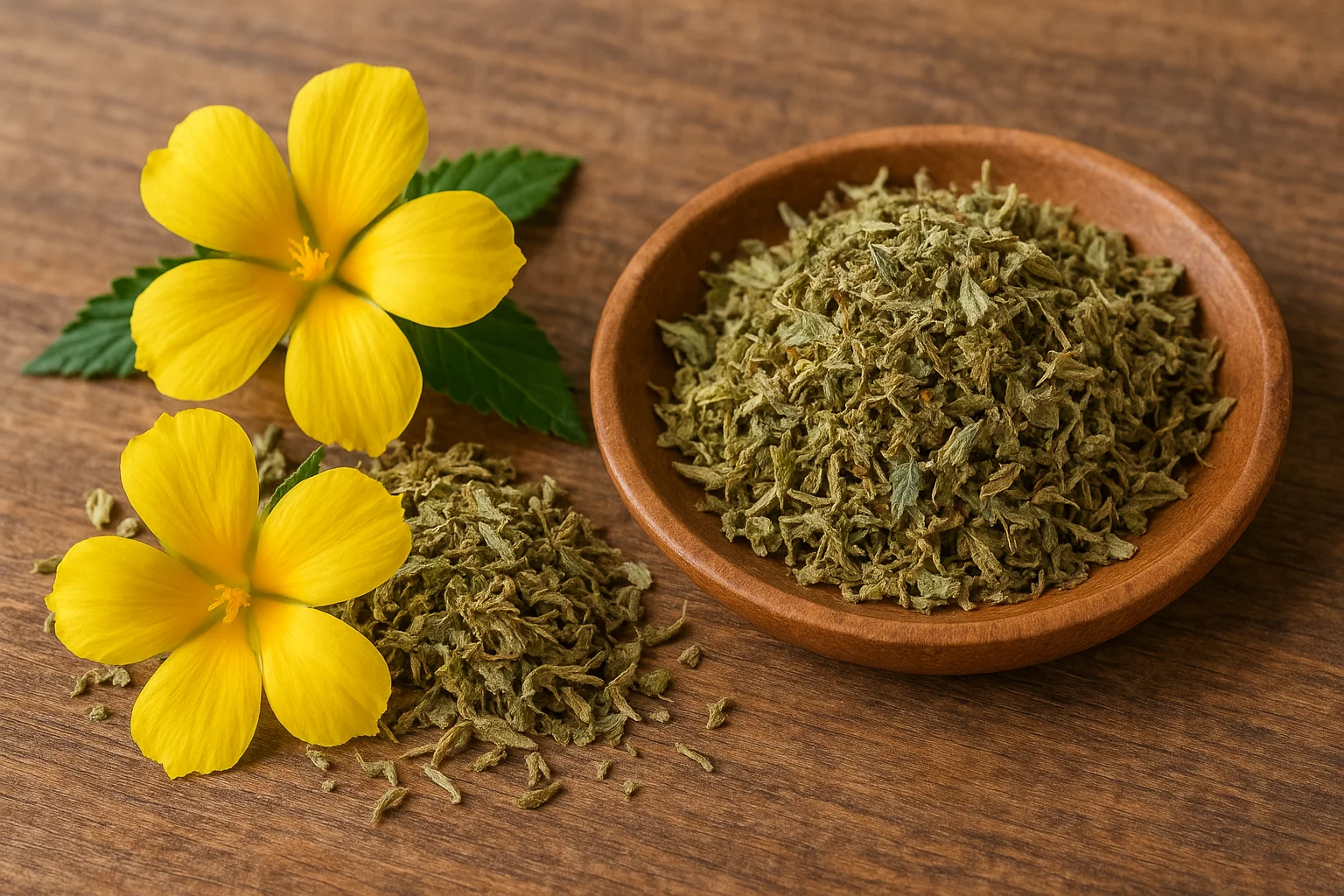

Damiana properties: herbal aphrodisiac, stress and concentration, what science says
Damiana (Turnera diffusa): what studies have really shown about its effects on libido and anxiety, what ingredients it has, and when to exercise caution with it.
Damiana is regarded as one of the most valued herbal aphrodisiacs in the world and simultaneously has one of the thinnest research backgrounds among popular herbs. These two things can only be reconciled by stating directly what has been measured, on whom, and what is still unknown. Reviews of this plant describe results almost exclusively from test tubes and animal models, and the few data from humans come from multi-ingredient preparations in which damiana was one of several herbs. This article navigates this distinction: it shows the composition of the plant, summarizes two studies that actually measured its effects, and separates documented mechanisms from those that circulate on the internet without support.
KEY INFORMATION
• In a study on sexually exhausted male rats, the aqueous extract of Turnera diffusa increased the percentage of animals completing a copulatory series and shortened the break after ejaculation (Estrada-Reyes et al., Journal of Ethnopharmacology, 2009).
• HPLC analysis of the same extract showed caffeine, arbutin, and flavonoids as the main components, so damiana is not a caffeine-free herb.
• An anxiolytic effect was noted in a separate work of this team, with an extract of 10 mg/kg in rats, without affecting the animals’ mobility (Estrada-Reyes et al., 2013).
• A review of the Turnera genus states that most described properties have been studied exclusively in chemical, cellular tests, or on animals (Szewczyk and Zidorn, Journal of Ethnopharmacology, 2014).
What is damiana and what does it contain?
Damiana, botanically Turnera diffusa, is a shrub from the Passifloraceae family that grows in Mexico, Central America, and northern South America. The Turnera genus currently includes 135 recognized species, of which about six are used in traditional medicine, and Turnera diffusa is the most highly valued herbal aphrodisiac among them (Szewczyk and Zidorn, Journal of Ethnopharmacology, 2014). The raw material is the leaves.
The chemical composition of the genus is described in more detail than its effects. The same review lists 22 different flavonoids, seven cyanogenic glycosides, maltol glycoside, phenolic compounds, monoterpenoids, sesquiterpenoids, triterpenoids, polyprenol ficaprenol-11, fatty acids, and caffeine. The last item is often omitted in commercial descriptions, yet it is significant: HPLC-ESI-MS analysis of the active aqueous extract from the leaves indicated caffeine, arbutin, and flavonoids as the main compounds present (Estrada-Reyes et al., Journal of Ethnopharmacology, 2009).
Popular descriptions provide exact percentage contents of apigenin or essential oils for damiana. We did not find a study from which these numbers originate, and the review of the Turnera genus does not include them, so they are not present in this text. However, the authors of the review note that, with a few exceptions, most traditional uses and experimentally confirmed properties have not yet been attributed to a specific compound or class of compounds.
Does damiana really work as an aphrodisiac?
In animals yes, in humans it has not been demonstrated. Estrada-Reyes’s team administered an aqueous extract of Turnera diffusa in doses of 20-80 mg/kg to sexually exhausted male rats, with yohimbine 2 mg/kg as a comparison. At 80 mg/kg, the extract significantly increased the percentage of males that completed one ejaculatory series and began another, and shortened the break after ejaculation. The authors emphasize that this occurred without an increase in the animals’ activity (Estrada-Reyes et al., 2009).
Four years later, the same team checked how this works. An extract of 10 mg/kg and sildenafil 10 mg/kg were given to rats with low sexual activity. Both primarily shortened the time to ejaculation, and administration of a nitric oxide synthase inhibitor abolished this effect in both groups. The authors conclude that the prosexual effect of damiana occurs via the nitric oxide pathway, mainly at the central level (Estrada-Reyes et al., Journal of Ethnopharmacology, 2013).
However, it must be clearly stated where this foundation ends. The review of the Turnera genus notes that the effect on sexual functions has been studied in humans, but in a preparation containing other potentially active ingredients alongside Turnera diffusa, so the result cannot be attributed solely to damiana. The same note applies to the only human study on anti-obesity effects. In other words: the animal model is consistent, and a clinical trial with damiana alone has not been published. Separately, we described what studies say about intimate life regarding CBD and sex.
| Study | On whom | What was measured | Result |
|---|---|---|---|
| Estrada-Reyes et al., 2009 | sexually exhausted male rats, extract 20-80 mg/kg | copulatory behaviors, break after ejaculation | improvement at 80 mg/kg, without increased mobility or anxiety behaviors |
| Estrada-Reyes et al., 2013 | male rats with low sexual activity, extract 10 mg/kg | time to ejaculation, involvement of the nitric oxide pathway, level of anxiety | shortening of time to ejaculation abolished by NO inhibitor, anxiolytic effect without affecting mobility |
| Szewczyk and Zidorn, 2014 | review of the entire Turnera genus | ethnobotany, composition, experimentally confirmed properties | data from humans only for multi-ingredient preparations; apigenin described as an analgesic component |
Where does the attributed anxiolytic effect of damiana come from?
From two sources, which are worth separating. The first is direct measurement: in a 2013 study, an extract of damiana at a dose of 10 mg/kg produced an anxiolytic effect in rats in the burying test and in an open field, without changing the animals’ mobility. The authors considered this an advantage for sexual use, as anxiety itself worsens results in these tests.
The second source is indirect and concerns apigenin, a flavonoid present in damiana. Apigenin was isolated from chamomile flowers and shown to bind to the central benzodiazepine receptor, competitively inhibiting the binding of flunitrazepam. In the elevated plus-maze test in mice, it produced a clear anxiolytic effect without sedation and without muscle relaxation at doses similar to those used for benzodiazepines, and no anticonvulsant effects were observed; only a tenfold increase in dose produced mild sedation (Viola et al., Planta Medica, 1995).
However, caution is useful here, which popular descriptions ignore. Viola’s work concerns apigenin isolated from chamomile, not an extract from damiana, and the review of the Turnera genus attributes apigenin in this plant a role as an analgesic component, established in experiments on animals. The statement about partial agonism at benzodiazepine receptors, repeated in descriptions of damiana, is therefore an addition of one finding to another plant. If you are looking for an herb for stress with its own separately studied background, we described it in the context of tulsi as an adaptogen for stress.
Does damiana improve concentration and add energy?
Tradition claims so, but there are no studies on concentration in humans. However, there is one chemical finding that explains part of the reports of stimulation, which is usually not mentioned in commercial descriptions of damiana: caffeine was detected in the active aqueous extract from the leaves, and a review of the Turnera genus confirms its presence in this group of plants. Therefore, damiana is not a neutral herb for the nervous system in the evening.
It is also worth rejecting an explanation that circulates in texts about damiana. It is repeated that arbutin, after breaking down to hydroquinone, stimulates the central nervous system. We did not find a study that demonstrated this, and arbutin is described in the literature in a completely different context. Since caffeine was found in the same extract, a simpler explanation is at hand and does not require inventing a new mechanism.
There remains an indirect path that can be described honestly without referring to a non-existent study. Anxiety and tension distract attention, so anything that reduces them improves the subjective sense of focus. However, the anxiolytic effect of damiana was measured in rats, not in humans with cognitive tasks, so this is a hypothesis, not a finding. Plants with studies directly on memory and attention are a different category; we described it in the text about bacopa monnieri for memory and concentration.
We noticed while checking this text something that changes its tone. The most frequently repeated statement about damiana says that it reduces anxiety in mice comparably to a low dose of diazepam, and it is supported by Estrada-Reyes’s work from 2009. We reached for that work: it studied rats, not mice, the comparison was yohimbine, and the authors only noted that the observed effects were not associated with increased activity or anxiety behaviors. This work does not report any reduction in anxiety at all. The anxiolytic effect exists, but it comes from another work of the same team, from 2013, and was measured with different tests. With herbs that have a thin basis, such a shift by one publication can turn a cautious conclusion into a promise that no one made.
How has damiana been traditionally used?
The tradition of damiana is wide, and it is this, not research, that has built its current position. An ethnobotanical review of the Turnera genus mentions medicinal uses for anemia, bronchitis, cough, diabetes, fever, fungal diseases, gastrointestinal disorders, pain, lung and respiratory diseases, skin conditions, and women’s health issues. Plants from this genus have also been used as abortifacients, expectorants, and laxatives (Szewczyk and Zidorn, 2014).
Turnera diffusa stands out in this context as the most highly valued species in the role of a herbal aphrodisiac. It reached Europe in the 19th century, like many raw materials from the New World, and entered the pharmaceutical circulation as a remedy for ailments described in a language that is no longer used today. In Polish herbal trade, it appears as dried herb and as an extract, outside the pharmacopoeial circulation, which means there is no uniform quality standard among producers. Checking whether the species name Turnera diffusa is on the packaging is therefore the basic thing that can be done when purchasing. Herbs with a turbulent pharmaceutical history are, by the way, a separate topic, described in the context of wormwood and absinthe.
In what forms is damiana found?
Three forms are most common in sales and differ primarily in how much of the raw material actually passes into the finished preparation. An infusion of dried leaves is the form closest to traditional and the most variable: some volatile compounds are lost during brewing, and the taste is distinctly bitter, with a camphor note. A dry extract in capsules is more consistent between batches, provided the manufacturer specifies the degree of concentration. An alcohol tincture extracts different fractions than water and for this reason is not simply a stronger tea.
We do not provide milligrams or daily portion numbers here. The reason is simple: there is no clinical trial for damiana in humans from which such a number could be derived. All doses mentioned in this text are animal doses converted to kilograms of body weight and cannot be directly translated to humans by simple multiplication. If you are considering regular use of damiana, talking to a doctor or pharmacist is the right place to determine the amount, especially with ongoing pharmacotherapy.
A separate note concerns smoking damiana leaves, which is present in Mexican tradition and is returning today as a trend. The products of combustion are produced regardless of how valuable the plant itself is, so the benefits of the herb do not outweigh the method of administration. An infusion or extract is incomparably safer in this regard.
When to exercise caution with damiana?
Three situations arise directly from the composition and described properties of the genus, not from a cautionary template. The first concerns diabetes: among the experimentally confirmed properties of the Turnera genus, antidiabetic effects are mentioned, so combining damiana with glucose-lowering medications requires a conversation with a doctor and attention to hypoglycemia symptoms.
The second is related to the presence of seven different cyanogenic glycosides in the genus. This is a group of compounds where the amount of raw material matters, and consuming large portions of infusion without consultation is not a good idea. The third concerns pregnancy and breastfeeding: plants from this genus have traditionally been used as abortifacients, and there is simply no safety data on damiana during these periods, so discontinuation is the only reasonable decision.
It is also worth noting what we did not find in the literature, although it is repeated in texts about damiana. The warning that arbutin enhances the effect of warfarin and requires INR monitoring has no source to refer to. This does not mean that the interaction does not occur. It means that no one has demonstrated it, and with ongoing anticoagulant treatment, any new herb should still be discussed with the attending physician.
Frequently asked questions
What is damiana and where does it come from?
Damiana, or Turnera diffusa, is a shrub from the Passifloraceae family that grows in Mexico and Central America. The Turnera genus includes 135 recognized species, of which about six are used in traditional medicine, and damiana is the most highly valued herbal aphrodisiac among them (Szewczyk and Zidorn, 2014). The herbal raw material is the leaves.
Does damiana really work as an aphrodisiac?
In rats yes, in humans it has not been demonstrated. An aqueous extract given to sexually exhausted males increased the percentage of animals completing a copulatory series and shortened the break after ejaculation (Estrada-Reyes et al., 2009). Data from humans come exclusively from multi-ingredient preparations in which damiana was one of several herbs.
Does damiana help with stress and anxiety?
An anxiolytic effect was measured in rats with an extract of 10 mg/kg, in the burying test and in an open field, without affecting the animals’ mobility (Estrada-Reyes et al., 2013). The earlier work of the same team from 2009, which most descriptions refer to, does not report any reduction in anxiety. There are no studies in humans.
Does damiana contain caffeine?
Yes. HPLC-ESI-MS analysis of the active aqueous extract from the leaves indicated caffeine, arbutin, and flavonoids as the main compounds present (Estrada-Reyes et al., 2009), and a review of the Turnera genus confirms the presence of caffeine in this group of plants. This is worth considering when planning the time of day.
Does damiana affect concentration and energy?
There are no studies on concentration in humans. The repeated explanation that arbutin, after breaking down to hydroquinone, stimulates the central nervous system has no source to refer to. The presence of caffeine in the extract explains reports of stimulation more simply and without assuming a new mechanism.
Is damiana safe and what should it not be combined with?
Caution is advised with diabetes, as the Turnera genus is attributed with antidiabetic effects, so there may be an overlap with glucose-lowering medications. Damiana is not used during pregnancy and breastfeeding, as plants from this genus have been used as abortifacients, and there is no safety data available.
In the herbs category, you will find, among others, ginseng dried herb and guarana extract, which are raw materials from the same shelf of traditional tonifying herbs. Damiana is not included in this assortment.
This article is for informational and educational purposes only and does not constitute medical advice. Before starting supplementation, consult a doctor, especially if you are taking medications regularly, are pregnant or breastfeeding, or have chronic illnesses.
Author: Michał Waluk · Published: 2026-05-29 · Updated: 2026-08-16