
Herb Vaporization: Which Herbs, What Temperatures, and How to Start Safely
Herb vaporization and material: what temperatures to use, how much substance gets into the vapor, what is really known about lemon balm, and which common numbers have no source.
Vaporization involves heating dried plant material so that volatile compounds evaporate without igniting the material. It sounds simple, and around this practice has grown a layer of numbers that look like research results but are not. A reduction of harmful compounds by over 95 percent, bioavailability of 30 to 60 percent, temperature to the exact degree for each herb. We checked them against the works to which these descriptions refer. Some turned out to be attributed to the wrong publication, some have no source at all, and what was actually measured is more interesting than the common version. Below you will find verified data on substance recovery from the vaporizer, honestly described temperature ranges, a separate section on lemon balm, and practical tips for the first sessions.
KEY INFORMATION
• Four temperature-controlled vaporizers delivered between 51.4 to 70.0 percent of total CBD and 54.6 to 82.7 percent of total THC to the vapor (Lanz et al., PLoS ONE, 2016).
• In 18 people, vaporization resulted in plasma THC levels comparable to smoking, with lower carbon monoxide levels in exhaled air (Abrams et al., 2007).
• The only measured absolute bioavailability of CBD in humans is 31 percent after smoking; no other route has been established (Millar et al., 2018).
• The temperatures given for individual herbs are manufacturer practices, not results of published measurements.
What is the difference between vaporization and smoking?
Temperature and what is produced along the way. A vaporizer keeps the material below the ignition point, so volatile compounds evaporate instead of breaking down in flames. When smoking, the glowing material reaches much higher temperatures, and alongside active substances, pyrolysis products are formed: carbon monoxide, aldehydes, and solid particles.
The best-documented comparison of both methods comes from a hospital study on 18 healthy volunteers. Participants received cannabis of one of three strengths for six days, once through the Volcano vaporizer, once in the form of a cigarette. Peak plasma THC levels and area under the curve over six hours were comparable, carbon monoxide levels in exhaled air after vaporization were lower, and no adverse effects were recorded (Abrams et al., Clinical Pharmacology and Therapeutics, 2007).
It is worth knowing what is not in this work because the internet attributes two things to it at once. The authors did not provide the percentage by which carbon monoxide decreased, and they did not measure benzopyrene. The number “over 95 percent” that is repeated everywhere and the statement about eliminating benzopyrenes do not come from this study. The direction of the conclusion remains unchanged: less carbon monoxide with the same concentration of active substance in plasma.
No such comparison has been conducted for aromatic herbs. It is reasonable to assume that the mechanism works the same way because it concerns the same physics of evaporation and combustion, but this is a conclusion by analogy, not a measured result.
Which herbs are suitable for vaporization?
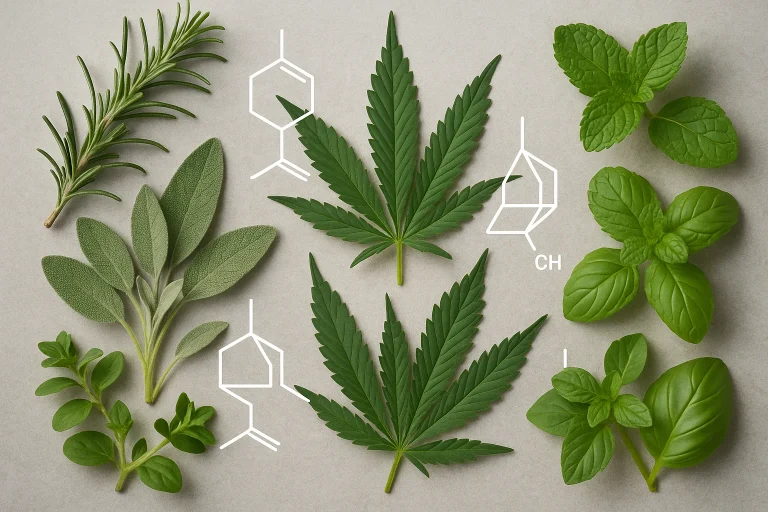
Those that contain volatile essential oils and can be dried well enough to evenly release vapor. In practice, the vaporizer community uses a dozen plants, and below we describe the six most common. The temperature ranges come from device instructions and user practice, not from published measurements for individual herbs.
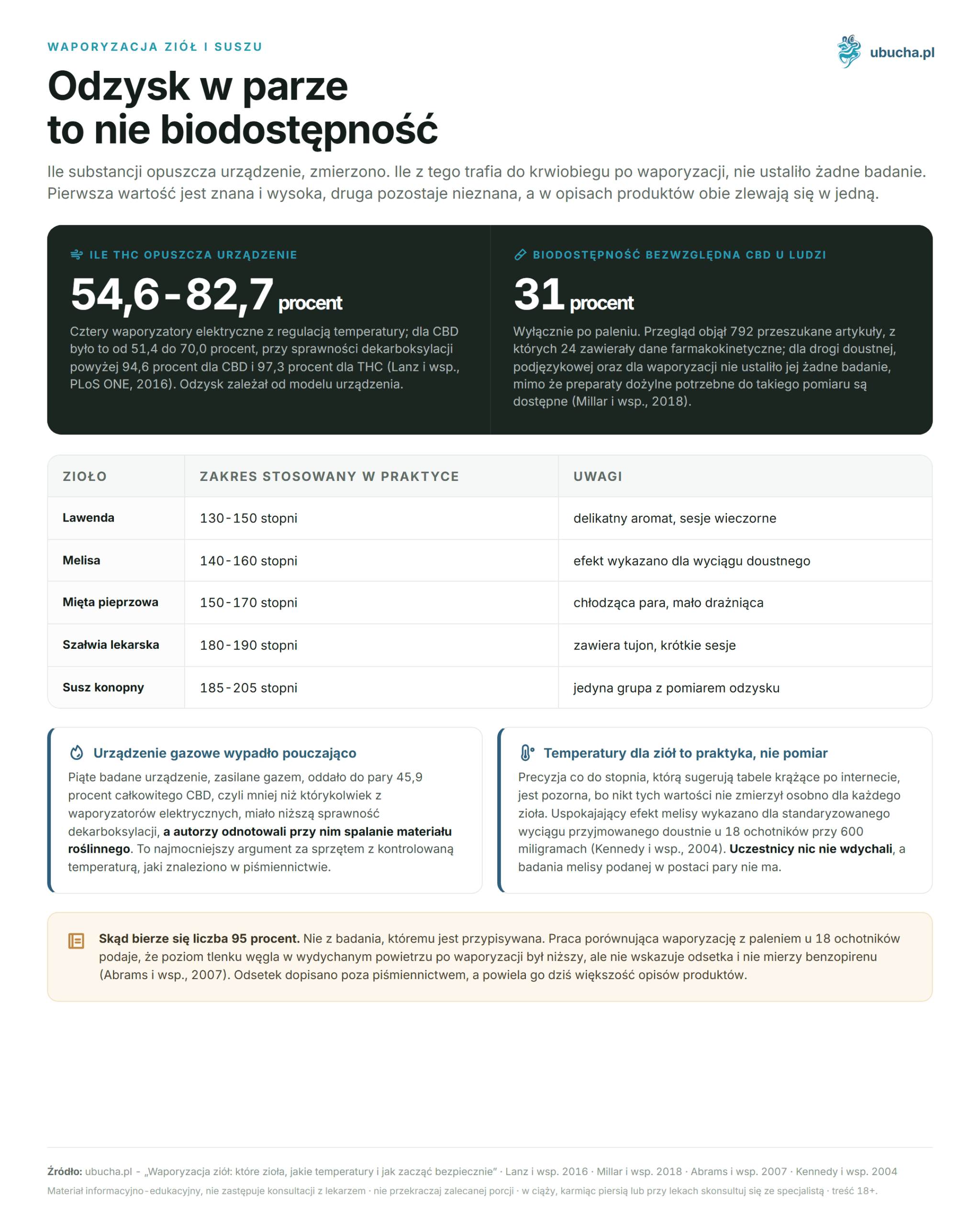
| Herb | Practiced Range | Notes |
|---|---|---|
| Lavender | 130-150 degrees | Delicate aroma, popular for evening sessions |
| Lemon Balm | 140-160 degrees | Calming effect confirmed for oral extract, not for vapor |
| Chamomile | 125-150 degrees | Mild taste, pairs well with lavender |
| Peppermint | 150-170 degrees | Clearly cooling vapor, minimally irritating |
| Sage | 180-190 degrees | Contains thujone, toxic in larger amounts; short sessions, not during pregnancy |
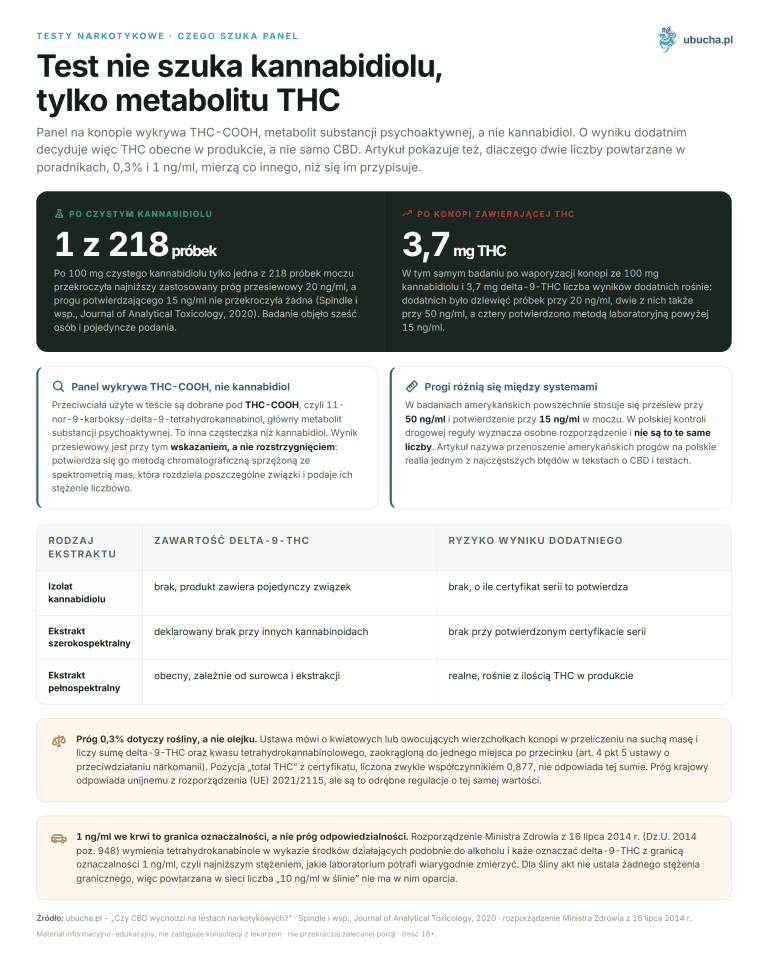
| Hemp Material | 185-205 degrees | The only group with published measurement of substance recovery |
Lemon balm deserves a separate mention because its effects are inaccurately described in product descriptions. The calming effect has been confirmed for standardized extract taken orally: in a double-blind, placebo-controlled study, 18 volunteers received either 300 or 600 milligrams of extract or placebo. The 600-milligram dose alleviated mood deterioration after a laboratory stressor, increasing self-rated calmness and decreasing self-rated alertness, while after 300 milligrams, counting was faster (Kennedy et al., Psychosomatic Medicine, 2004). Participants inhaled nothing. We found no study that tested lemon balm administered as vapor.
Ready-made vaporization blends can be found in the herbs category. When composing your own, it is worth remembering one thing: there are no published studies on herbal blends administered by inhalation, so promises of synergy remain the manufacturer’s promises.
How to vaporize lemon balm and what effects does it have?
Set 140 to 160 degrees, grind the dry leaf not too finely, fill the chamber loosely, and inhale slowly. That’s the practical part. Regarding effects, the honest answer is different: calming has been shown for the extract taken orally, and for lemon balm administered as vapor, there is no published measurement, so the promises in product descriptions are conclusions by analogy.
The range of 140 to 160 degrees comes from device instructions and user practice, just like the other values in the table above. Start at the lower limit and increase by a few degrees between sessions, observing the vapor: it should be visible and cool. A burnt smell or throat irritation means that the setting is too high, not that the material is weak.
Grinding is more important here than with hemp material. The herb leaf should be crushed finely, but too fine material restricts airflow and can clog the screen, so grind it coarser and check the screen after the first session. Fill the chamber loosely, about two-thirds full, and do not pack the material tightly.
The calming effect we mentioned above was measured after swallowing 600 milligrams of standardized extract (Kennedy et al., 2004). Vaporization does not reproduce either that dose or that route of administration: volatile components of the oil pass into the vapor, not a measured portion of the extract. What remains from the session can therefore be described without referring to the study, namely a lemony aroma and mild vapor at low settings. Those looking for documented effects of lemon balm will reach for an infusion or extract, not a vaporizer.
What temperature should I set on the vaporizer?
Start at the lower limit of the range and gradually increase between sessions. The vapor should be visible but cool and non-irritating; smoke or a burnt smell means the temperature is too high. The precision to the degree suggested by tables circulating on the internet is illusory because no one has measured these values separately for each herb.
This is different for hemp material, where measurements exist. In a laboratory study, five commercially available devices were tested, measuring cannabinoid content in the vapor using gas chromatography. Four electric vaporizers with temperature control delivered between 51.4 to 70.0 percent of total CBD and 54.6 to 82.7 percent of total THC to the vapor, with decarboxylation efficiency exceeding 94.6 percent for CBD and 97.3 percent for THC (Lanz et al., PLoS ONE, 2016).
The fifth device, powered by gas, performed in a revealing way. It delivered 45.9 percent of total CBD to the vapor, which is less than any of the electric vaporizers, had lower decarboxylation efficiency, and the authors noted burning of the plant material. This is the strongest argument for temperature-controlled equipment we found in the literature, and better than repeated warnings about cheap uncertified devices that no one has tested. More about choosing values is described in the text about choosing temperature during vaporization.
Convection or conduction: which vaporizer to choose?
For starters, conduction, for longer use, convection. The difference concerns the way heat is transferred and translates into the uniformity of extraction and flavor of the vapor. Neither of these designs is inherently safer; both work well if they maintain the set temperature.
In a conduction device, the material touches a heated surface. Heating is quick, the price is lower, and devices can be pocket-sized. The downside is unevenness: the material near the wall overheats before the center of the chamber, so it needs to be stirred during the session.
In a convection device, hot air flows through the material, and nothing touches it directly. Extraction is more even, the flavor is cleaner, the price is higher, and heating usually takes longer. It is worth knowing what the cited study does not resolve. It compared specific models, not heating principles: the highest recovery was achieved by the Arizer Solo (82.7 percent total THC and 70.0 percent total CBD), and the lowest for THC was recorded for DaVinci (54.6 percent), while Volcano Medic fell in the middle. Differences between models are documented, but the advantage of one design over another is not. A detailed comparison of both designs can be found in the text about convection and conduction vaporizers, and the equipment itself in the vaporizers category.
How to start herb vaporization step by step?
The whole procedure boils down to five actions: grind, fill, heat, inhale slowly, clean after the session. The first session should be short and at a low temperature because comfort is more determined by the way of inhalation than the device setting.
Prepare the herbs dry and evenly ground. Too fine grinding restricts airflow and can clog the screen, while too coarse reduces the surface area in contact with hot air. Moist material vaporizes poorly because some energy goes into evaporating water.
Fill the chamber loosely, about two-thirds full, and level the surface without packing. Tightly packed material blocks airflow and reduces vapor quality. Then turn on the device and wait for the readiness signal; inhaling before reaching the set temperature only gives cool air.
Inhale slowly and evenly for a few seconds. A sudden pull cools the air flowing through the chamber and reduces extraction, and at higher settings, it additionally irritates the throat. Burning or coughing means it is worth lowering the temperature.
After the session, empty the chamber while the device is warm, as residues come off more easily then. Clean metal and glass parts with high-concentration isopropyl alcohol, and the mouthpiece with warm soapy water. Regular cleaning improves taste and extends the life of screens.
How much CBD from the vaporizer reaches the blood?
No one has measured this. A systematic review of the pharmacokinetics of cannabidiol in humans included 792 searched articles, of which 24 contained pharmacokinetic data. Absolute bioavailability was provided only for one route: 31 percent after smoking. For oral, sublingual, and vaporization routes, none has been established, even though intravenous preparations needed for such measurement are available (Millar et al., Frontiers in Pharmacology, 2018).
The table circulating in product descriptions with values of 30 to 60 percent for vaporization, 6 to 15 percent for infusion, and 20 to 30 percent for sublingual administration has no basis in this work or any other we could find. This does not mean that vaporization is ineffective. It means that the numbers comparing routes of administration were created outside the literature.
Two things can easily be confused here, as they are different quantities. Recovery in vapor, measured by Lanz’s team, indicates how much substance leaves the device. Bioavailability indicates how much of that enters the bloodstream. The first value is known and high, while the second for vaporizers remains unknown. The review notes, however, that with the inhalation route, peak concentration appears faster than with oral administration, which aligns with what users describe as a quick onset of action.
Finally, a question that is often confused even more. Legally sold material comes from industrial hemp, meaning plants in which the sum of delta-9-THC and tetrahydrocannabinolic acid does not exceed 0.3 percent when calculated on a dry weight basis, rounded to one decimal place. The threshold applies to the plant, not the product, and is counted as the sum of both compounds, not just delta-9-THC (art. 4 point 5 of the Act on Counteracting Drug Addiction, consolidated text Journal of Laws 2023, item 1939, as amended by the Act of March 24, 2022, Journal of Laws 2022, item 763). More about the raw material itself is discussed in the text about what CBD material is.
When not to vaporize?
With respiratory diseases, during pregnancy and breastfeeding, and with ongoing pharmacotherapy without consulting a doctor. Vapor without combustion products is still a hot aerosol reaching the lungs, and there are simply no studies on chronic inhalation of herbal vapors.
Asthma, chronic obstructive pulmonary disease, and active bronchitis are situations where the decision should be made by a pulmonologist. Irritation of the airways is less common with vaporization than with smoking, but it does not disappear, especially at higher temperature settings.
During pregnancy and breastfeeding, the answer is simpler because there is a lack of data. It is unknown in what amounts terpenes inhaled from vapor cross the placenta or into milk, so there is no basis to consider such exposure safe.
If you are taking medication regularly, consult vaporization with a doctor or pharmacist. This applies to both hemp material and herbs, as the components of essential oils may be substrates for the same liver enzymes that metabolize drugs. Separately, it is worth looking at the text about whether herbal cigarettes are safe, as smoking products can be confused with vaporization material.
Frequently Asked Questions
Is vaporization healthier than smoking?
In terms of exposure to combustion products, yes. In 18 volunteers, vaporization resulted in plasma THC levels comparable to smoking, with lower carbon monoxide levels in exhaled air and no adverse effects (Abrams et al., 2007). However, this does not mean that inhaling hot vapor is harmless to the lungs.
Where does the 95 percent reduction in harmful compounds come from?
Not from the Abrams study to which it is attributed. This work states that carbon monoxide levels after vaporization were lower, but does not indicate a percentage and does not measure benzopyrene. The percentage was added outside the literature and is repeated today by most product descriptions.
How much active substance gets from the herb to the vapor?
In a study of five devices, four electric vaporizers with temperature control delivered between 51.4 to 70.0 percent of total CBD and 54.6 to 82.7 percent of total THC to the vapor, with decarboxylation efficiency above 94.6 percent (Lanz et al., 2016). Recovery depended on the model of the device.
What temperature should I set to start?
The lower limit of the range for the given material and increasing by a few degrees between sessions. For aromatic herbs, practice starts around 130 degrees, for hemp material around 185 degrees. These values come from manufacturer instructions and user experience, not from published measurements.
Do lemon balm and lavender in a vaporizer have a calming effect?
Studies confirm such an effect for lemon balm taken orally: 600 milligrams of standardized extract increased self-rated calmness in 18 volunteers after a laboratory stressor (Kennedy et al., 2004). For the same herbs administered as vapor, we found no studies.
How often should I clean the vaporizer?
Empty the chamber after each session while the device is warm. With hemp material, which leaves more resin, thorough cleaning with high-concentration isopropyl alcohol is worth doing every few sessions. Regularity improves taste and extends the life of screens and seals.
This article is for informational and educational purposes and does not replace consultation with a doctor. If you are pregnant, breastfeeding, taking medications, or have chronic conditions, consult the use of supplements or herbs with a specialist.
Author: Michał Waluk · Published: 2026-06-22 · Updated: 2026-08-24