Herb and Cannabis Vaporization - What Temperatures to Use and Why It Matters?
What temperatures to use when vaporizing herbs and cannabis? Data from studies on vaporizers, real thermal degradation thresholds, and practical setting choices.
The temperature in the vaporizer determines how much active substance reaches the vapor and how much remains in the chamber. However, more tables than studies have accumulated around this one parameter. The lists of boiling points for individual cannabinoids circulating online look precise, providing values to the degree and repeating in dozens of guides, but almost never indicate the work from which they originate. Checking a few of the most frequently cited sources shows that these values simply do not exist in them. This guide therefore reverses the order: it starts from what has actually been measured in studies on vaporizers and builds recommendations on that. You will learn how much active substance different devices actually recover, from what temperature thermal degradation products really begin to form, and why the lowest setting does not necessarily have to be the cleanest.
KEY INFORMATION
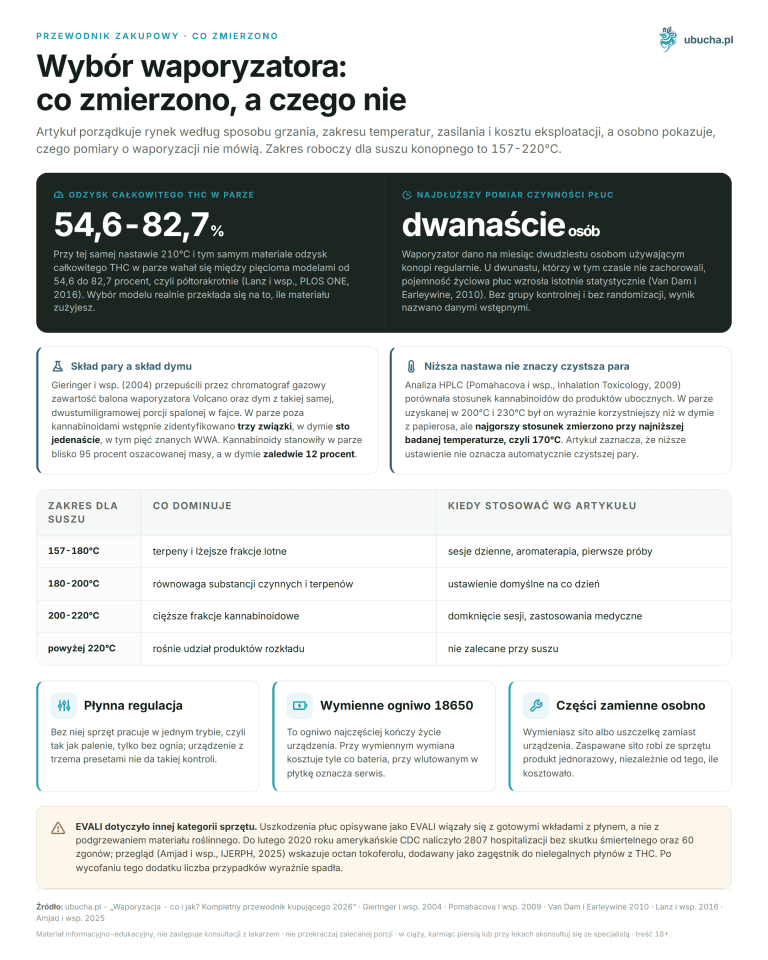
• The Volcano Medic vaporizer at 210°C transfers 58.4% of total THC and 51.4% of total CBD to the vapor, while the best of the tested models achieves 82.7% and 70.0% (Lanz et al., PLOS ONE 2016).
• The ratio of cannabinoids to by-products was worst at 170°C, while at 200°C and 230°C it was clearly better than in the smoke of a cannabis cigarette (Pomahacova et al., Inhalation Toxicology 2009).
• Benzene from terpene degradation appears only at temperatures around 500°C, far beyond the operating range of a dry herb vaporizer (Meehan-Atrash et al., ACS Omega 2017).
• The boiling points of cannabinoids and terpenes circulating in guides do not come from the works they are attributed to. You will not find them in this text.
• The threshold of 0.3% in Polish law counts as the sum of delta-9-THC and THCA, not just delta-9-THC.
What is the best vaporization temperature for cannabis herb?
Studies on dry herb vaporizers focus around 200-230°C, and this range has the strongest coverage in measurements. Lanz et al. (PLOS ONE, 2016) studied five devices, setting all electric models to 210°C, while Pomahacova et al. (Inhalation Toxicology, 2009) compared vapor at 170°C, 200°C, and 230°C.
Below this range begins an area where manufacturers and users operate more on habit than on measurement results. This does not mean that 180°C is a bad setting. It only means that no one has properly measured it, so promises made for lower temperatures should be treated more cautiously than guides declare.
The practical conclusion is simpler than elaborate tables suggest. Start from around 190°C, as this is the default setting in most devices, and change it by 5-10°C between chamber fillings. Note what changes in flavor and sensations. Your own notes from one specific herb and one specific device will tell you more than an averaged table, as variability between batches of raw material is large.
It is worth immediately parting with one assumption. There is no temperature that extracts everything at once, nor one that destroys nothing. Each setting is a choice between the amount of material transferred and what happens to the lighter aromatic components.
Why does temperature determine the composition of vapor?
Vaporization involves heating the raw material to the point where vapor of active substances is produced, but below the combustion threshold, where smoke and its accompanying toxins are formed. This is how Hazekamp et al. (Journal of Pharmaceutical Sciences, 2006) define it, who tested various settings of the Volcano device specifically to maximize THC transfer without creating its degradation products.
This second condition is less obvious than the first. At too high a setting, THC does not so much disappear as change into something else: into cannabinol or delta-8-THC. Hazekamp’s work directly points to these two compounds as degradation products that optimization aimed to avoid. The vapor is still dense, the device still works, and yet the content is already different than you assumed.
A separate layer is terpenes. Russo (British Journal of Pharmacology, 2011) describes them as co-authors of the effect, not just aromatic additives: they act on behavior even at serum concentrations of single nanograms per milliliter. Booth and Bohlmann (Plant Science, 2019) add, however, a caveat that guides remain silent about: knowledge of what drives the variability of these compounds in the plant is still basic.
What is decarboxylation and why does nothing work without it?
This is the transformation that makes the raw material active, occurring in the vaporizer chamber while heating. In fresh, dried plant material, cannabinoids primarily exist in their acidic form, namely as THCA and CBDA. Only heating detaches the carboxyl group from the molecule and converts them into neutral forms that act on the body.
The efficiency of this transformation is one of the few things in this field that is consistently repeatable. Lanz et al. (PLOS ONE, 2016) measured that in electric devices with temperature control, it reaches at least 97.3% for THC and 94.6% for CBD. In the gas model studied, lacking temperature control, it dropped to about 87.7%.
This difference explains why regulation is more important than just choosing a value. A device that does not maintain the setting not only transfers less material but also performs the transformation worse, so part of the loaded raw material remains in the chamber in a form that does nothing.
It is worth remembering this when reading laboratory results. The certificate of analysis usually provides the acidic and neutral forms separately, and the Polish regulation on the 0.3% threshold refers precisely to the sum of delta-9-THC and THCA. It does so because THCA in the raw material is potential THC: it just needs to be heated to become so. Without this distinction, the same material comes out legal or not, depending on which number from the certificate someone writes down.
How much active substance actually reaches the vapor?
Less than the density of the cloud suggests, and very differently depending on the device. Lanz et al. (PLOS ONE, 2016) tested five vaporizers under the same conditions, setting all electric models to 210°C. The spread of results reached twenty-eight percentage points between the best and the weakest device.
| Device (210°C) | Total THC in vapor | Total CBD in vapor |
|---|---|---|
| Arizer Solo | 82.7% | 70.0% |
| Plenty | 66.8% | 56.1% |
| Volcano Medic | 58.4% | 51.4% |
| Vape-or-Smoke (gas, no regulation) | 55.9% | 45.9% |
| DaVinci | 54.6% | 56.7% |
The gas model stands out separately. It was the only device without temperature control and the only one in which researchers observed combustion of the raw material. This is a good illustration that regulation is not a convenience, but a condition to even talk about vaporization.
Additionally, there is loss that guides do not mention. Hazekamp et al. (Journal of Pharmaceutical Sciences, 2006) established that the Volcano transfers on average about 54% of loaded THC to the balloon, but during clinical administration, on average 35% of inhaled THC is exhaled again. The number on the device label and the number that reaches the body are two different quantities.
Is low temperature safer than high temperature?
Not necessarily, and this is the most commonly repeated mistake in texts about vaporization. Pomahacova et al. (Inhalation Toxicology, 2009) measured the ratio of cannabinoids to by-products at three settings of the Volcano device. The worst result was from the sample vaporized at 170°C, not from the highest setting.
The mechanism is understandable when looking at what is actually measured. At a low setting, little active material passes into the vapor, while volatile non-cannabinoid compounds still evaporate. The ratio of what you want to inhale to what you are not interested in is therefore weakest. The cloud is thin, but that does not make it cleaner.
At 200°C and 230°C, the same ratio was clearly better than in the smoke from a cannabis cigarette. In other words, the advantage of vaporization over smoking in this study revealed itself in the middle and upper part of the range, not in the lower. This reverses the recommendation that is repeated as an obviousness in Polish guides.
This does not mean that low settings are useless. It means that their advantage is flavor and gentleness of the session, not vapor purity. If someone promises you both at once, citing studies, ask for a name and year. More of such repeated claims are dismantled in the text about myths surrounding herb vaporization.
At what temperature do toxins really begin to form?
Much higher than most guides state. Meehan-Atrash et al. (ACS Omega, 2017) studied the thermal degradation of myrcene and other terpenes under conditions mimicking real evaporation of extracts. Methacrolein appeared only at a median of 403°C, and benzene only in the highest tested range, with a median of 526°C.
At the lowest of the tested ranges, with a median of 322°C, methacrolein was not detected at all. This is over one hundred degrees above the entire working range of a dry herb vaporizer. The popular saying that exceeding 225°C or 230°C triggers the production of benzene and toluene has no support in this work or any other that could be found while editing this text.
However, two caveats should be added to avoid replacing one simplification with another. The study concerned the evaporation of extracts, not dry herb, and the starting material was terpenes themselves, not the whole plant. The conclusion that follows is therefore limited: it is terpenes that are the component that degrades into harmful compounds, and this occurs at temperatures around several hundred degrees.
Practically, this changes one thing. The upper limit of the working range of a dry herb vaporizer is not a toxicity boundary, but a boundary of sense: above it, you lose aroma and start to burn the raw material before you even approach the thresholds at which the compounds described in this work are formed.
How does temperature change the sensations from the session?
It changes the proportions of what reaches the vapor, not the strength of the session itself. Russo (British Journal of Pharmacology, 2011) describes the entourage effect, where terpenes modify the action of cannabinoids. He points to alpha-pinene as a compound that may counteract short-term memory impairment caused by THC.
This is an important distinction because popular descriptions attribute things to temperature that are actually the responsibility of the raw material. Lewis et al. (Planta Medica, 2018) show that the market is dominated by chemotypes rich in THC and myrcene, but cultivation can maintain stable terpene ratios with very different cannabinoid content. The character of the session is therefore mainly recorded in the chemotype, and the vaporizer setting only shifts the accents.
There is also an effect that is rarely mentioned in the context of a “stronger” session. Kowal et al. (Psychopharmacology, 2015) administered vaporized cannabis in two doses and tested divergent thinking. The group with the high dose of 22 mg THC performed significantly worse than the group with the dose of 5.5 mg and the placebo, which did not differ from each other.
The conclusion for setting choices is uncomfortable for device marketing. Stronger extraction does not mean a better session, and in tasks requiring fluid thinking, it can work directly against you. If you care about conceptual work, a higher temperature setting works against you.
Does the strain name suggest the right temperature?
No, and this is better documented than would be convenient for sellers of herb. Smith et al. (PLOS ONE, 2022) studied the composition of cannabinoids and terpenes in commercial samples from six US states. The isolated chemotypes turned out to be repeatable, but the commercial labels affixed to products did not consistently correspond to them.
The same caveat appears in the review by Booth and Bohlmann (Plant Science, 2019), where the lack of consistency in terpene and cannabinoid composition between commercial strains was directly cited as a cause for concern. The strain name is therefore not a technical specification, but a marketing designation with uncertain coverage in the chemistry of the raw material.
The consequence for setting choices is direct. Since two portions under the same name can have different compositions, the temperature prescribed from the guide “for this strain” is based on an assumption that no one has verified. Lewis et al. (Planta Medica, 2018) show that cultivation can maintain similar terpene ratios with very different levels of cannabinoids, so even well-conducted selection does not make the name a carrier of information about composition.
There are two sources you can rely on. The first is the result of a laboratory test attached to a specific batch, if the seller provides it. The second is your own notes from the same raw material at different settings. Both refer to the material you actually have, not to an averaged description of the strain.
What is the difference between a convection vaporizer and a conduction vaporizer?
It is the method of heat transfer, and in practice, the repeatability of the setting. In conduction devices, the raw material comes into direct contact with the hot surface of the chamber, while in convection devices, a stream of heated air flows through it. The difference between the declared and actual temperature in the chamber is harder to control in the first construction.
Convection heats the bed evenly, without a contact point with the heating element, where the material burns faster than the rest. The cost is longer heating and a higher price. Conduction starts almost immediately, but the grains at the walls work at a different temperature than those in the middle of the chamber, so the raw material requires mixing between draws. Hybrid constructions combine a short conduction pulse with subsequent air flow. A detailed comparison of both solutions can be found in a separate comparison of convection and conduction vaporizers.
Additionally, there is a factor that disrupts settings regardless of the construction. The screen separating the chamber from the mouthpiece channel gradually becomes clogged with residue, airflow decreases, and the heating element works longer to maintain the set value. The display then shows one thing, while the bed operates under different conditions.
Therefore, cleaning is not a matter of aesthetics, but a condition for the numbers in this article to even apply to your device. Mechanically removing residues after each session and periodically rinsing the screen with isopropyl alcohol maintain consistency between the setting and reality.
How does vaporization compare to smoking?
Clearly better in terms of the composition of the inhaled mixture, though not as spectacularly as the round numbers circulating online suggest. Lanz et al. (PLOS ONE, 2016) refer to earlier measurements in which only three non-cannabinoid compounds were identified in vapor from a vaporizer, while in smoke from burned cannabis about one hundred fifty.
This same work directly indicates what vaporization allows you to avoid: tar, polycyclic aromatic hydrocarbons, carbon monoxide, and other carcinogenic compounds produced during combustion. However, it does not provide any percentage reduction rate, although many guides attribute such a rate to it.
On the side of effects felt by users, the best available evidence remains the work of Earleywine and Barnwell (Harm Reduction Journal, 2007). In a large internet sample, using a vaporizer was associated with fewer reported respiratory symptoms, even after accounting for age, sex, smoking cigarettes, and the amount of cannabis used. The effect was greater the more raw material the participant declared.
However, it is worth knowing what power this evidence has. This is a self-reported survey study, not a clinical observation with measured lung function, so it speaks about symptoms reported by people, not about the measured state of the airways. Vaporization reduces exposure to combustion products, and that is all that can be responsibly stated today.
What temperatures to use for herbs other than cannabis?
There is currently no reliable numerical answer to this question, and it is more honest to say it outright. Tables assigning specific values in degrees to chamomile, lavender, or lemon balm have been circulating online for years, but they do not indicate the work in which someone measured those values for vaporization. The studies discussed above concern only cannabis.
The reason why transferring settings is risky is chemical. The active substances of aromatic herbs are mostly essential oils, which are mixtures more volatile than cannabinoids, with a completely different degradation profile. A setting chosen for cannabis herb has no reason to be appropriate for a raw material with a different characteristic.
Additionally, there is a difference that tables completely ignore. In the case of cannabis, the entire procedure makes sense because heating transforms cannabinoids from their acidic form into active ones. Aromatic herbs do not require any such transformation, so raising the temperature buys nothing but faster evaporation and faster degradation of the oil.
Practically, this means one thing: with herbs, start from the bottom of the device’s range and raise it cautiously, guided by aroma. A burnt smell is a signal that you have exceeded the useful threshold for that specific raw material, and it is a signal more reliable than a number from a table of unknown origin. More practical notes have been gathered in the text about herb vaporization and safe starting.
What is the legal status of vaporization in Poland?
The technique itself is not subject to regulation; the raw material determines it. The boundary is defined by the definition of industrial hemp in Article 4 point 5 of the Act of July 29, 2005 on Counteracting Drug Addiction (t.j. Dz.U. 2023 poz. 1939), as amended by the Act of March 24, 2022 (Dz.U. 2022 poz. 763), effective from May 7, 2022.
The method of calculating the threshold is sometimes stated incorrectly, and this has real consequences when reading laboratory results. The regulation speaks of the sum of delta-9-THC and tetrahydrocannabinolic acid, i.e., THCA, in flowering or fruiting tops from which resin has not been removed. The sum must not exceed 0.3% when calculated on a dry mass basis and is subject to rounding to one decimal place. The threshold does not therefore refer to delta-9-THC alone.
A separate inaccuracy concerns the origin of this value. EU law allows from January 1, 2023, a content of up to 0.3% for varieties covered by the Common Agricultural Policy support, based on Regulation 2021/2115; previously, the limit was 0.2%. However, these are two separate regulations with the same numerical value. The national threshold corresponds to the EU one, but it does not derive from it.
Outside of this range, a simple rule applies: HHC remains a controlled substance in Poland, and cannabis with a higher THC content is subject to narcotic regulations and requires a prescription for medical use. The amendment to the law coming into effect on August 27, 2026, does not change either the threshold, the classification of substances, or the rules of retail sale.
Frequently Asked Questions
At what temperature should I start vaporizing the herb?
From around 190°C, as this is the typical default setting, and studies on vaporizers focus around 200-230°C. Change the value by 5-10°C between chamber fillings and note the effect. Your own observations with a specific herb are more reliable than averaged tables.
Does low temperature produce cleaner vapor?
No. Pomahacova et al. (Inhalation Toxicology, 2009) measured the worst ratio of cannabinoids to by-products precisely at 170°C. At 200°C and 230°C, the ratio was clearly better than in the smoke of a cannabis cigarette. The advantage of low settings is flavor, not vapor purity.
Above what temperature does benzene form?
Meehan-Atrash et al. (ACS Omega, 2017) detected benzene only in the highest tested range with a median of 526°C, and methacrolein from 403°C. At 322°C, neither was detected. These temperatures are several hundred degrees higher than the operating range of a dry herb vaporizer.
How much active substance actually reaches the vapor?
It depends on the device. Lanz et al. (PLOS ONE, 2016) measured at 210°C from 54.6% to 82.7% of total THC and from 45.9% to 70.0% of total CBD in five models. Hazekamp et al. add that about 35% of inhaled THC is exhaled again.
Is vaporization healthier than smoking?
It reduces exposure to combustion products. Three non-cannabinoid compounds were identified in vapor compared to about one hundred fifty in smoke. Earleywine and Barnwell (Harm Reduction Journal, 2007) reported fewer respiratory symptoms in vaporizing individuals, but it was a self-reported survey study.
Why don’t you provide boiling points of cannabinoids?
Because the tables circulating in guides do not indicate the work from which they originate, and the works most often attributed to them do not contain such values. The Russo review from 2011, most frequently cited in this context, does not include a table of boiling points for terpenes or cannabinoids.
Do aromatic herbs require different temperatures?
Most likely yes, because essential oils are more volatile than cannabinoids, but there are no comparable studies on herb vaporization. Circulating tables do not indicate the source of measurement. Start from the lower range of the device and follow the aroma, not the number from an unknown list.
Is cannabis herb for vaporization legal in Poland?
Yes, if the sum of delta-9-THC and THCA does not exceed 0.3% in dry mass, rounded to one decimal place. The basis is Article 4 point 5 of the Act on Counteracting Drug Addiction as amended in 2022. The threshold refers to the sum, not just delta-9-THC.
Summary
Temperature is a real parameter of the session, but it operates under different laws than common knowledge suggests. Measured data concern the range of 200-230°C and show two things: the differences between devices are greater than the differences between adjacent settings of the same device, and the lowest setting performs worst in terms of the ratio of active substances to by-products.
The thresholds that guides warn about lie outside the range of dry herb equipment. Benzene from terpene degradation requires temperatures around 500°C, so the upper limit of the vaporizer is a boundary of flavor and sense, not a boundary of toxicity. At the same time, caution regarding high doses has foundations independent of the chemistry of the vapor, as shown by the study on divergent thinking.
The most useful thing you can do is keep your own notes and treat every table without a name and year as material to verify, not to apply.
Devices with temperature control and accessories for them can be found in the vaporizers category in the u Bucha store.
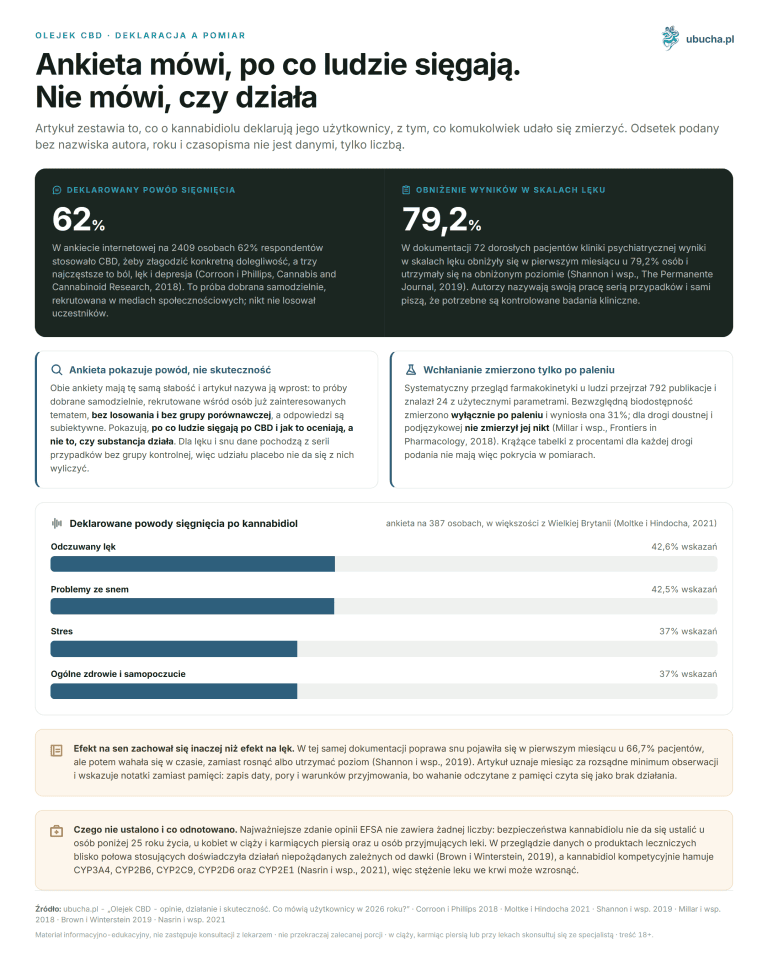
This article is for informational and educational purposes and does not constitute medical advice. Before starting to use cannabis or CBD for therapeutic purposes, consult a doctor, especially if you are taking other medications, are pregnant, or breastfeeding.
Author: Michał Waluk · Published: 2026-05-11 · Updated: 2026-08-10