
Vaporization of Lemon Balm: Temperature from Instructions, Not Measurements
Vaporization and smoking of lemon balm: where the range of 140-160 degrees from device instructions comes from, what the leaf contains, what we did not find in studies, and who EMA does not recommend it for.
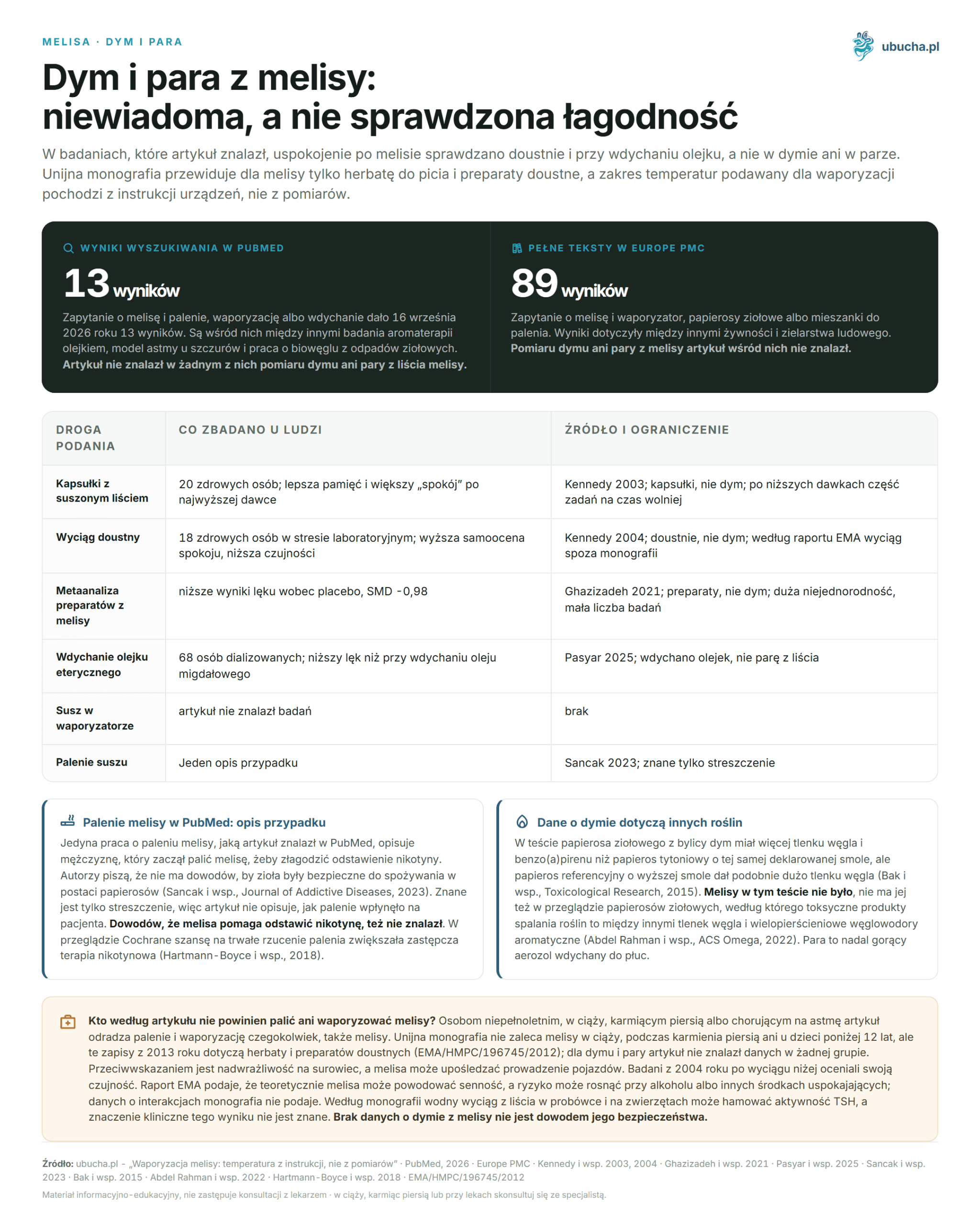
For vaporizing lemon balm, we found no temperature confirmed by measurement or study of vapor composition. The range of 140-160 degrees comes from device instructions. The situation is similar with studies on smoke: a query in PubMed about lemon balm and smoking, vaporization, or inhalation yielded 13 results on September 16, 2026, and none contained a measurement of smoke or vapor from the leaf. The EU monograph provides for lemon balm only as a drinkable tea and oral preparations (EMA/HMPC/196745/2012). From this text, you will learn what the leaf contains and where the temperature range comes from. You will also check what is known about smoke from herbs, where the opinion about the calming effect of lemon balm comes from, and who should avoid it.
KEY INFORMATION
• In 13 search results about lemon balm and smoke or vapor, we found no measurement of their composition (PubMed, 2026).
• The range of 140-160 degrees comes from device instructions, not measurements.
• EMA describes lemon balm only orally.
• A herbal cigarette made from mugwort produced twice as much carbon monoxide as a tobacco one with the same declared tar (Bak et al., 2015).
Can you smoke lemon balm?
The leaf of lemon balm can be ignited, but we found no measurement of what enters the lungs in that case. The only work on smoking lemon balm that we found in PubMed is a case report from a university in Istanbul. It concerns a man who started smoking lemon balm to alleviate nicotine withdrawal. The authors state that there is no evidence that herbs are safe to consume in the form of cigarettes (Sancak et al., Journal of Addictive Diseases, 2023). We only know the abstract of this work, so we do not describe how smoking affected the patient.
We found it through a query that connected lemon balm with smoking, cigarettes, vaporization, pyrolysis, burning, or inhalation. It yielded 13 results. Besides this description, among them are studies on aromatherapy with oil, an asthma model in rats, and a paper on biochar from herbal waste. In none did we find a measurement of smoke or vapor from lemon balm leaves.
In full texts, a query about lemon balm and vaporizer, herbal cigarettes, or smoking mixtures yielded 89 results. They concerned, among other things, food and folk herbalism. We found no measurement of smoke or vapor from lemon balm among them. Therefore, smoke from this plant is an unknown, not a verified mildness.
What does the lemon balm leaf contain and which of its components are volatile?
The main volatile component is essential oil, which constitutes only 0.06-0.8% of the leaf. Its main components are aldehydes: citral (including neral) and citronellal. Beta-caryophyllene and germacrene D each make up about 10% of the oil. This is how the raw material is described in the report of the European Medicines Agency (EMA/HMPC/196746/2012).
Besides the oil, the leaf contains, among other things, rosmarinic acid, up to 6%. The European Pharmacopoeia requires it to be at least 1% in the dried herb. Does this acid pass into the vapor? It is unknown, as we found no such measurement.
For pure compounds, boiling temperatures are known. Citral boils according to data collected in PubChem at 226-229 degrees (PubChem, citral), and citronellal at 205-207 degrees (PubChem, citronellal).
These numbers do not indicate at what temperature the leaf releases citral or how much it releases. They pertain to the pure substance, not the dried herb, in which the entire oil is a fraction of a percent of the mass. Citral does not always dominate either. In the lemon balm oil studied by a Japanese team, caryophyllene had the largest share, 25% (Hirai et al., Journal of Natural Medicines, 2022). This is the result of one study.
What is the vaporization temperature of lemon balm?
Device instructions indicate 140-160 degrees for lemon balm, and we gathered this range in the guide to herb vaporization. These values come from device instructions and practice, not measurements. We found no study that checked what passes from the lemon balm leaf to the vapor in this range and what remains in the chamber.
Comparisons of vaporization with smoking in humans that we found concern cannabis. In a survey of 6,883 people, vaporizer users had a respiratory symptom odds ratio of 0.40 compared to smokers, although only 152 people indicated the vaporizer as their main method (Earleywine and Barnwell, Harm Reduction Journal, 2007). The data is self-reported, and the survey was distributed by organizations advocating for drug law reform. In 18 volunteers, carbon monoxide in exhaled air was lower after vaporization than after smoking (Abrams et al., 2007).
Devices with temperature control can be found in the vaporizers category, and accessories for grinding the leaf before placing it in the chamber in the grinders category. However, vapor is still a hot aerosol inhaled into the lungs.
Does lemon balm instead of tobacco in a joint reduce harm?
Only partially. Removing tobacco eliminates nicotine from the joint but does not remove smoke. In a test of a herbal cigarette made from mugwort, the smoke contained 12.3 mg of carbon monoxide per piece compared to 6.1 mg in a tobacco cigarette with the same declared tar. It also contained more benzo(a)pyrene (Bak et al., Toxicological Research, 2015). A reference cigarette with higher tar produced a similar amount of carbon monoxide in this test, 12.5 mg. Therefore, the twofold difference pertains to the comparison with a low-tar cigarette.
Lemon balm was not included in this test. It is also missing from the review of herbal cigarettes, which describes the burning of plants in general: its toxic products include carbon monoxide and polycyclic aromatic hydrocarbons (Abdel Rahman et al., ACS Omega, 2022). Would smoke from lemon balm itself yield different results in measurement? We found no such measurement.
We also found no evidence that lemon balm helps quit nicotine. The patient in the case report smoked it for this purpose, and the authors question the role of herbs in treating tobacco addiction. The effectiveness of nicotine replacement therapy is noted: in a Cochrane review of 133 studies, it increased the chance of permanent quitting, relative risk 1.55 (Hartmann-Boyce et al., 2018). More on this, what to smoke instead of tobacco and which herbs not to put in a joint, we discuss in a separate text.
The addition of herbs does not change the status of cannabis herb. Cannabis other than hemp, i.e., with a sum of delta-9-THC and THCA above 0.3%, is a narcotic in Poland. Possession of it in violation of the law carries a penalty of imprisonment for up to 3 years (art. 4 pkt 37 and art. 62 ust. 1, t.j. Dz.U. 2023 poz. 1939 with changes). Lemon balm itself is not listed in the lists issued under this law (regulation of the Minister of Health, t.j. Dz.U. 2024 poz. 1139), even after changes from Dz.U. 2025 poz. 598 and Dz.U. 2026 poz. 934.
The Act on Counteracting Drug Addiction also prohibits advertising and promoting narcotic substances (art. 20 ust. 1), which is why we do not write about how to enhance the effect of a joint or where to obtain the herb. A herbal mixture sold for smoking is subject to the tobacco law as a herbal product for smoking (art. 2 pkt 50, t.j. Dz.U. 2024 poz. 1162 with changes).
Does smoking or vaporizing lemon balm calm you down?
This is unknown. In the studies we found, calming effects of lemon balm were checked after oral administration and inhalation of oil, not in smoke or vapor. In a placebo study, 20 healthy individuals received single doses of 600, 1000, and 1600 mg of dried leaf in capsules at weekly intervals. Better memory and greater ‘calm’ were noted after the highest dose (Kennedy et al., Neuropsychopharmacology, 2003). At lower doses, some timed tasks were performed more slowly.
We compiled the routes of administration of lemon balm for which we searched for studies in humans. Each provides different exposure, so the result from one row does not transfer to another.
| Route of Administration | What was studied in humans | Source |
|---|---|---|
| Capsules with dried leaf | 20 healthy individuals; after 1600 mg better memory and greater ‘calm’ | Kennedy et al., 2003 |
| Oral extract | 18 healthy individuals in laboratory stress; after 600 mg higher self-assessment of calm and lower alertness | Kennedy et al., Psychosomatic Medicine, 2004 |
| Preparations of lemon balm, meta-analysis of randomized studies | Lower anxiety scores compared to placebo, SMD -0.98, with high heterogeneity of studies | Ghazizadeh et al., Phytotherapy Research, 2021 |
| Inhalation of essential oil | 68 dialysis patients; lower anxiety than with inhalation of almond oil | Pasyar et al., BMC Complementary Medicine and Therapies, 2025 |
| Dried herb in a vaporizer | No studies found | none |
| Smoking dried herb | One case report, we only know its abstract | Sancak et al., 2023 |
The authors of the meta-analysis urge caution due to the high heterogeneity of studies, and they consider their small number a limitation. According to the EMA report, the 2004 study used a methanol extract, which is not covered by the EU monograph. We compare infusions of lemon balm and other herbs in a post about teas for sleep.
Who should not smoke or vaporize lemon balm?
We advise against smoking and vaporizing anything, including lemon balm, for minors, pregnant women, breastfeeding women, or those suffering from asthma. The EU monograph does not recommend lemon balm during pregnancy and breastfeeding or for children under 12 years, but these records from 2013 concern tea and oral preparations (EMA/HMPC/196745/2012). Hypersensitivity to the raw material is a contraindication, and lemon balm may impair driving. We found no data on smoke and vapor in any group.
After 600 mg of extract, participants in the 2004 study rated their alertness lower. The EMA report states that theoretically, lemon balm may cause drowsiness, and the risk may increase with alcohol or other sedatives. The monograph does not provide data on interactions. We compiled which herbs poorly interact with medications in the table which herbs not to combine with each other.
The monograph also mentions that an aqueous extract from the leaf in studies in vitro and on animals may inhibit the activity of thyroid-stimulating hormone, TSH. The clinical significance of this result is unknown. The lack of data on smoke from lemon balm is not evidence of its safety.
Frequently Asked Questions
Can you smoke lemon balm?
Lemon balm can be ignited, but it is unknown what enters the lungs in that case. In PubMed, we found only a case report of a man who smoked it while quitting nicotine (Sancak et al., 2023). Burning plants produces carbon monoxide: a herbal cigarette made from mugwort produced 12.3 mg per piece (Bak et al., 2015).
What temperature for vaporizing lemon balm?
Device instructions indicate 140-160 degrees for lemon balm. This is not a measurement result: a query in PubMed about lemon balm and vaporization, smoking, or inhalation yielded 13 results on September 16, 2026, and none contained a measurement of vapor from lemon balm leaves. Therefore, it is unknown what passes from the leaf to the vapor in this range.
Does smoking lemon balm calm you down?
This is unknown. Calming effects of lemon balm were studied orally: 18 healthy individuals after 600 mg of extract were assessed as calmer and less alert in a laboratory stress test (Kennedy et al., 2004). We found no studies on smoke or vapor from lemon balm in this regard, so the oral result cannot be transferred to a joint.
Does lemon balm help quit smoking?
We found no evidence for this. In the only case report we found, a man smoked lemon balm while quitting nicotine, and the authors question the role of herbs in treating tobacco addiction (Sancak et al., 2023). The effectiveness of nicotine replacement therapy is noted: in a Cochrane review of 133 studies, the relative risk of permanent quitting was 1.55 (Hartmann-Boyce et al., 2018).
Is smoking lemon balm legal?
Lemon balm itself is not listed in the controlled substances under the regulation of the Minister of Health (t.j. Dz.U. 2024 poz. 1139 with changes from 2025 and 2026). However, a herbal mixture sold for smoking is a herbal product for smoking, and its packaging must carry the warning ‘Smoking this product is harmful to your health’ on 30% of the surface (art. 9e of the tobacco law).
This article is for informational and educational purposes and does not replace consultation with a doctor. If you are pregnant, breastfeeding, taking medications, or have chronic conditions, consult the use of supplements or herbs with a specialist.
Author: Michał Waluk · Published: 2026-09-17 · Updated: 2026-09-17