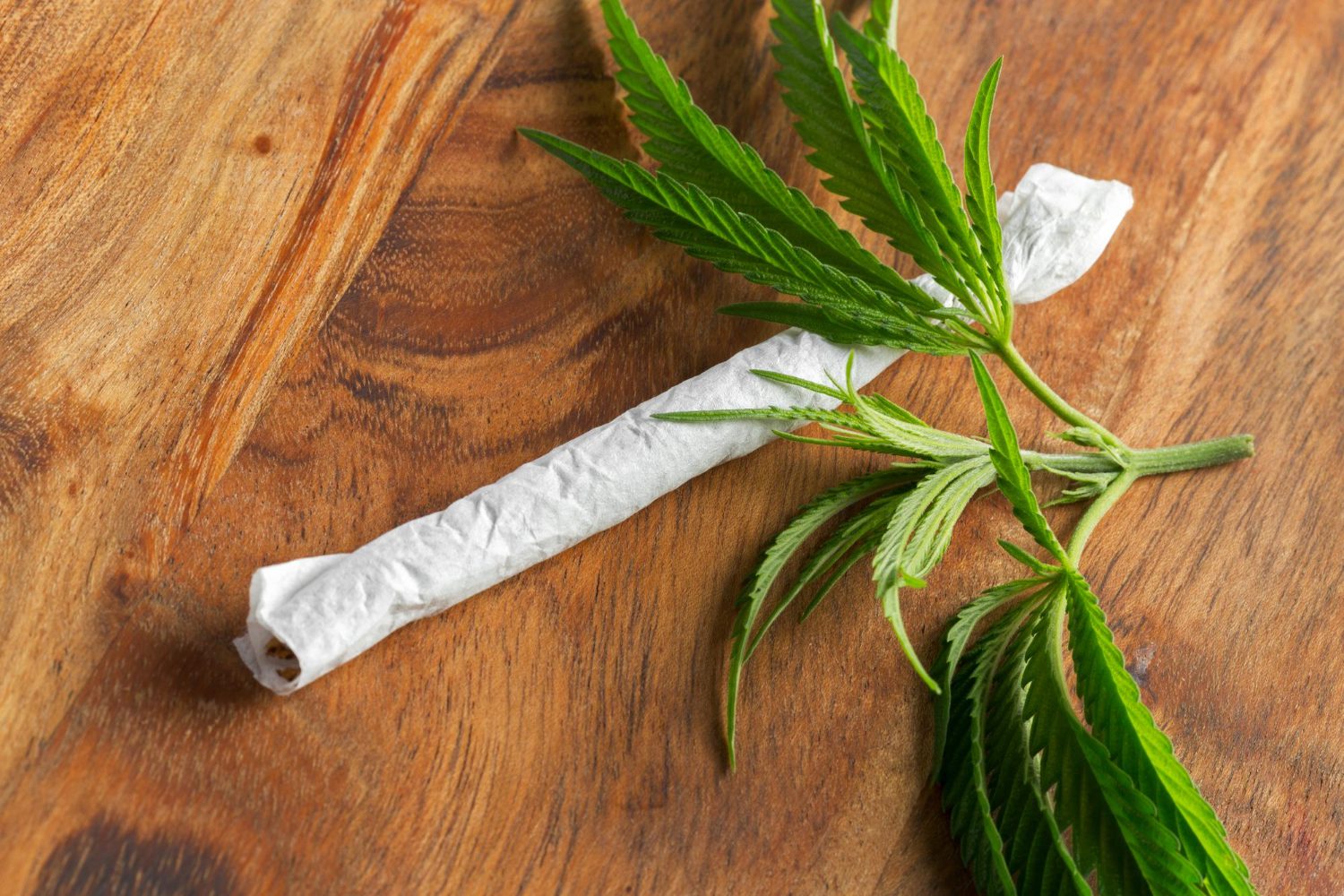

Best Rolling Papers 2026: Complete Guide to RAW, OCB, Elements and Hempire
Rolling papers without rankings and prices: materials, grammage, glue, sizes, what studies say about smoke, and how Polish law treats rolling papers and flower.
Rolling papers are usually discussed in the form of rankings: ten brands, star ratings, prices. This text is different because it starts with a question that rankings do not answer. What is actually known about how paper affects what you inhale? The answer is shorter than the tables in stores suggest: there is practically no research on the papers themselves, and those that exist concern smoking methods, not the sheet. Below you will find what can be verified: what rolling papers are made of, what the numbers on the packaging mean, what studies say about smoke, and how Polish law treats rolling papers and flower. There are no prices or rankings here, as both change faster than the text, and neither of those numbers tells you anything about what you actually inhale.
KEY INFORMATION
• Rolling papers are explicitly mentioned in the law as tobacco paraphernalia (art. 2 sec. 26, Dz.U. 2024 poz. 1162).
• There is practically no research on the impact of the paper itself on smoke composition.
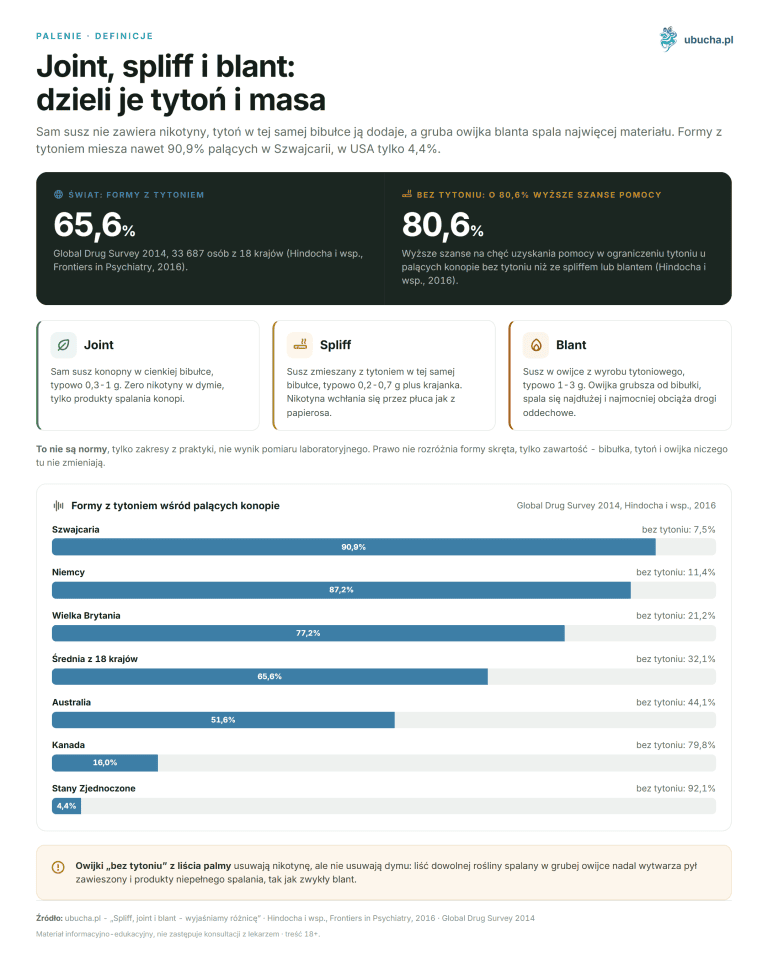
• 65.6% of respondents used routes involving tobacco, with rates in Europe ranging from 77.2% to 90.9% (Hindocha et al., 2016).
• Hemp plants are those with a total THC and THCA of up to 0.3% of dry mass.
What does paper do to a joint?
The paper serves three functions at once: it holds the shredded material in a compact form, determines the burning rate, and burns itself, adding its own decomposition products to the inhaled smoke. This last aspect is often overlooked in commercial descriptions, although it determines the difference between a thin and a thick sheet.
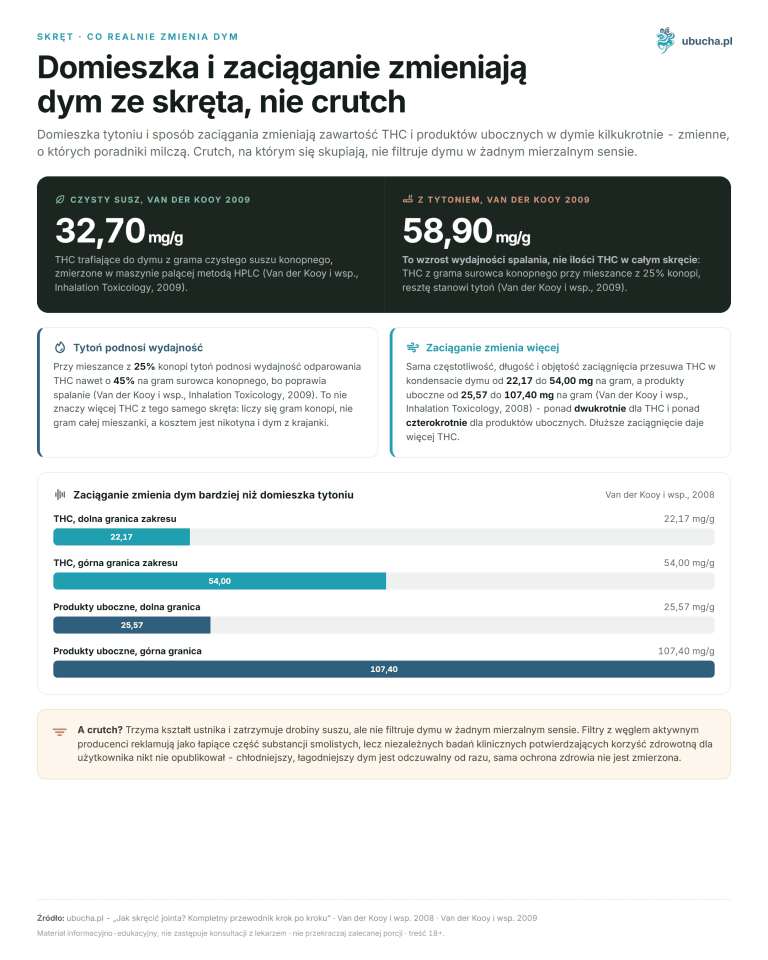
The smoke from burning plant material is a mixture in which harmful substances appear regardless of what you are smoking. In a comparison of the smoke composition from marijuana and tobacco cigarettes, prepared in the same way, ammonia was found in the mainstream stream at concentrations up to twenty times higher than in tobacco smoke, and hydrogen cyanide, nitrogen oxides, and some aromatic amines at concentrations three to five times higher (Moir et al., Chemical Research in Toxicology 2008).
Polycyclic aromatic hydrocarbons performed the opposite in this study: there were fewer in the mainstream stream than in tobacco smoke, and more in the sidestream. The authors concluded that the presence of known carcinogens was confirmed in both streams.
What does this mean for choosing a paper? It means that paper is part of the burned mass, not a neutral package. The less of it there is and the fewer additives it contains, the smaller its contribution to what reaches the lungs. This is reasoning, not a research result, and should be treated as such.
It is also worth remembering the conditions under which such data are produced. The comparative study was conducted on a smoking machine, with two established inhalation schemes, not on people. A real joint burns unevenly, with pauses and varying inhalation strength, so the numbers from the lab show the direction of differences, not the dose that a specific person takes.
Has anyone studied the papers themselves?
Practically not. Searching the Europe PMC database for papers on cigarette papers as a variable does not yield studies comparing materials, grammages, or types of glue in terms of smoke composition. The results concern completely different fields, as the English term for paper overlaps with names of processes in cell biology.
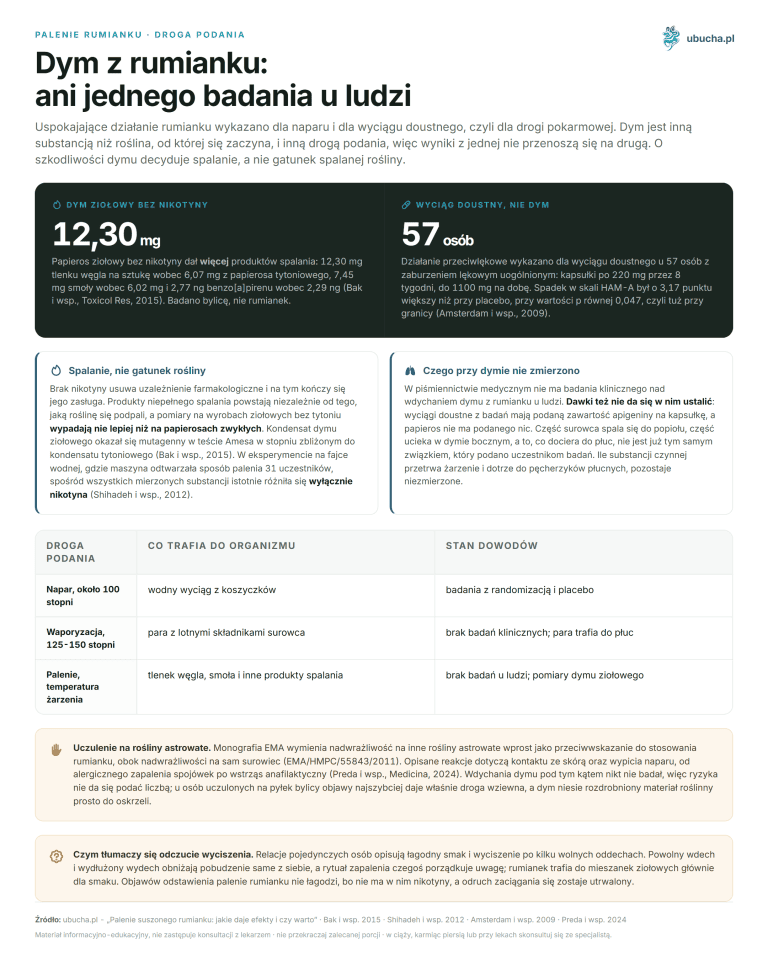
This is important information in itself. Statements like “this paper reduces the amount of tar substances by several dozen percent” have no basis in the scientific literature, although they sound precise. They come from manufacturer materials or tests conducted without controlled conditions.
The earlier version of this guide was based on a work attributed to a researcher dealing with cannabis, supposedly concerning the impact of papers on the delivery of active substances. The identifier for this work is not in Europe PMC, and this author’s works from this year concern something else. We removed this claim along with the reference.
So what remains? Research on smoking methods, smoke composition, and respiratory effects. These are the basis for the following sections, and everything concerning the sheet itself is described as a product property that you can check on the packaging, not as a proven health effect.
This gap has a simple explanation. Research on smoking is funded where the health effect is large and measurable, namely with tobacco and the plant material itself. Paper constitutes a fraction of the burned mass, so its contribution is difficult to isolate from the whole. The lack of research does not mean that the paper is insignificant. It means that no one has measured its significance, and marketing has filled this void with its own numbers.
What paper materials will you find on the shelf?
The market is divided into four main raw materials and one growing addition. Hemp paper is made from hemp fiber, rice paper from rice mass, classic paper from wood cellulose, and linen paper from long flax fiber. Additionally, there are bamboo sheets. The differences between them concern strength, ash quantity, and their own aftertaste.
Manufacturers describe these features on the packaging, and this is the only place where they can be verified before purchase. The rest, namely the burning rate and taste sensations, also depend on the moisture of the material, the tightness of the roll, and the airflow, so comparisons between brands are rarely repeatable.
Popular brands available in Poland are divided according to raw material, not quality. Some series are based on hemp fiber, others on rice mass, still others on unbleached wood cellulose, and larger manufacturers offer variants from several of these materials at once. Choosing a brand is therefore practically a choice of raw material and format, not a choice of a better or worse manufacturer.
| Material | Distinctive Feature | What to Watch Out For |
|---|---|---|
| Hemp | long fiber, good strength with a thin sheet | can be more expensive than wood |
| Rice | very thin, little ash | easily tears in damp fingers |
| Wood | classic, forgives mistakes | check if it is not bleached with chlorine |
| Linen | thin and strong at the same time | rarely available in Poland |
| Bamboo | fast-growing raw material | small number of size variants |
If you are just choosing paper for a specific type of flower, you will find more details in the text about which papers to choose for flower.
What is the difference between bleached and unbleached papers?
The color of the sheet indicates the production process, not quality. Unbleached paper retains the natural brownish color of the fiber. Bleached paper undergoes an additional chemical stage that increases brightness. Historically, chlorine compounds were used for this, but today manufacturers more often declare chlorine-free bleaching.
On the packaging, look for markings like “unbleached”, “chlorine free”, or “TCF”. These are manufacturer declarations that can be compared between brands, unlike the term “natural”, which means nothing specific.
The opposite is also true and worth stating outright: brown does not always mean cleaner. There are light papers made without chlorine and dark papers with additives that improve burning uniformity. The composition provided by the manufacturer decides, not the shade of the sheet.
A separate group consists of transparent sheets made from plant cellulose. They look impressive and leave little ash, but are more expensive and harder to roll, and their advantage is appearance, not health. If you want to limit what you burn, a smaller sheet or giving up burning altogether is a simpler route.
To the same group of declarations belong additives that improve the even burning of the paper. In factory-made cigarettes, such additives are sometimes used, but in rolling papers, they are less common. A manufacturer that does not use them usually emphasizes this, as it is a selling point. If there is no mention of this on the packaging, you simply do not have the information, and no photo of the sheet can replace it.
What size of paper should you choose?
The size determines how much material fits in the joint and how much paper burns along with it. Each manufacturer provides dimensions on the packaging, and the names of formats are the same across the industry, so comparison is particularly straightforward here.
The 1¼ format is a shorter sheet, about 76 mm, convenient for small portions and for learning to roll. King Size is about 110 mm long and allows for a larger joint, usually shared in company. King Size Slim retains the length but has a narrower sheet, so with the same portion of material, you burn less paper. Double Wide is a short and wide size, rarely found in Poland.
From the perspective of the amount of paper burned, the choice of format weighs more than the choice of material. Switching from a wide sheet to a narrower one with the same portion of material reduces the mass of paper in the joint, and that is the only change in this whole puzzle that you can check yourself: just compare the dimensions of the sheets provided on both packages.
| Format | Characteristics | For Whom |
|---|---|---|
| 1¼ | short sheet, small portion | people learning to roll |
| King Size | longer and wider sheet | joint shared in a group |
| King Size Slim | same length, narrower sheet | less paper in smoke |
| Double Wide | short and wide | unusual forms, niche |
If you are considering giving up sheets in favor of ready-made cones or wraps, you can find a comparison of these three solutions in the text about papers, wraps, and ready-made cones.
What does the grammage on the packaging mean?
Grammage is the mass of paper per square meter, given in grams. The lower the number, the thinner the sheet, less material in burning, and less ash. The higher the number, the easier it is to roll and the lower the risk of tearing in damp fingers.
Manufacturers divide their series into ultra-thin, standard, and thicker variants, but trade names are not standardized between brands. Comparison makes sense only when you match numbers from the packages, not slogans from labels.
Thinner paper has a practical price. It is harder to handle, worse withstands moisture, and requires a more even distribution of material. A person who has been rolling for a month will lose more sheets than they gain in smoke cleanliness, so starting with a standard variant is more sensible.
It is also worth remembering that grammage describes the paper itself, not the joint. How much you actually burn depends on the size of the sheet and how tightly you roll it. A thin King Size can contain more paper than a thicker sheet in the 1¼ format.
There is one more reason why it is not worth chasing the lowest number. Very thin sheets more easily allow moisture from the shredded material to pass through, causing the joint to lose stiffness and start to come apart halfway. With flower that is more humid than usual, a paper with higher grammage will be more comfortable, even if you theoretically burn more of it.
How to check this without the manufacturer’s tables? Take two sheets from different series and hold them up to the light. The thinner one clearly lets light through and you can see the outlines of your fingers, while the thicker one stops more. This is the same parameter that the manufacturer recorded with a number, just assessed by eye, and often the only available option when shopping in a physical store.
What glue do rolling papers use?
The glue strip is the only element of the paper that you touch with your tongue, so its composition is a justified question. Higher-end papers use gum arabic, a resin obtained from acacia, which is also used in the food industry. Cheaper sheets may be glued with synthetics.
Manufacturers declare the type of glue on the packaging, and this is the only information that can be checked before purchase. We did not find studies comparing emissions from burning different glues in papers, so any claim about the specific harmfulness of one of them should be treated as unverified.
There can also be mechanical differences. The strip can run along one edge or both, and some brands use perforation to facilitate adhesion. A wider strip holds more securely but adds material, while a narrower one does the opposite. This is a matter of convenience, not health.
If after gluing you feel a distinct chemical taste, the source may be the glue strip or additives that improve burning, not the paper itself. A simple test is to compare two sheets from different brands with the same material and the same rolling technique.
The glue also reacts to storage conditions. Moisture activates it prematurely and glues the sheets together, while high temperatures can dry the strip enough that it stops holding. A block carried for months in a pocket usually loses its properties faster than one lying in a drawer, and this has nothing to do with the quality of the paper itself.
Moistening the strip is also a matter of technique, not just composition. Excess moisture softens the paper and turns it into a blob when rolling, while too little causes the joint to come apart after a few puffs. Just drag the strip once, without stopping, and press it down with your finger along its entire length, instead of holding it in place.
Does adding tobacco to a joint matter?
It does, and more than the choice of paper. In a survey of 33,687 people who reached for cannabis in the past year, 65.6% of respondents used routes involving tobacco. In Europe, this percentage ranged from 77.2% to 90.9%, and in both Americas from 4.4% to 16.0% (Hindocha et al., Frontiers in Psychiatry 2016).
The authors also checked whether the route of administration is associated with a desire to reduce substance use. Those using routes without tobacco had a 10.7% higher chance of expressing a desire to reduce tobacco use, an 80.6% higher chance of stating that they would need help with this, and more than twice the likelihood of intending to seek such help.
The relationship with the desire to reduce cannabis use was already inconsistent. This distinction is important because it shows that the method of smoking is primarily related to the relationship with tobacco, not the amount of plant material used.
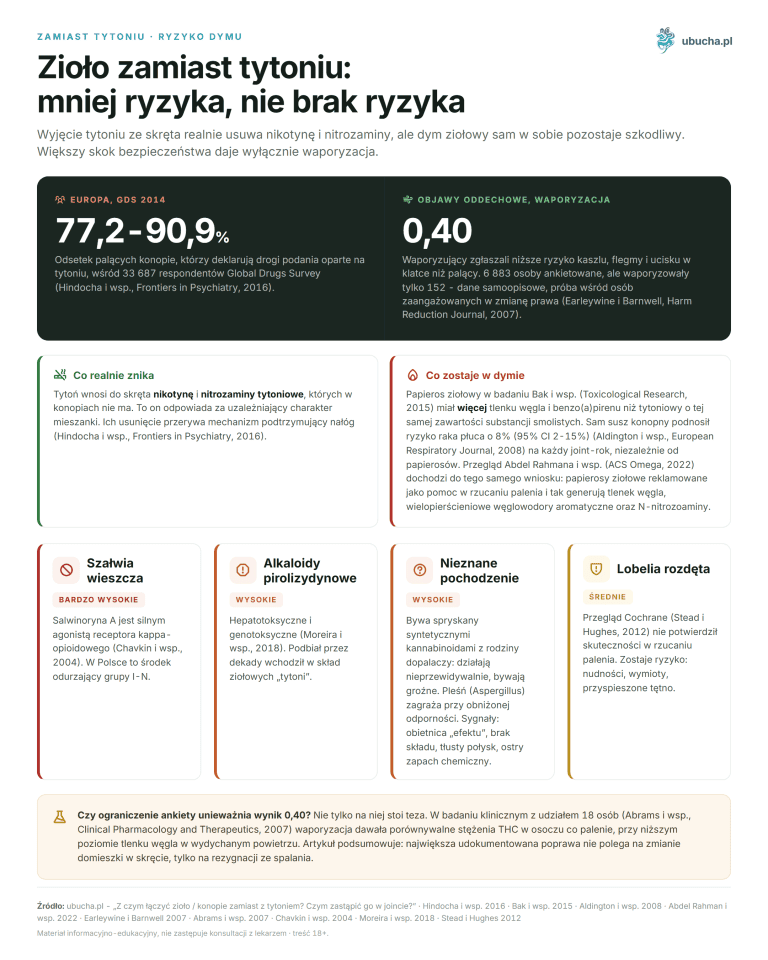
The practical conclusion is simple and does not require changing the brand of papers. If you want to limit exposure, the first decision is to give up tobacco in the joint, the second is to give up burning altogether. Choosing a sheet is only the third and least important of these three.
The authors emphasize the significant global variability of routes of administration. In Europe, mixing with tobacco is the norm, while in both Americas it is marginal. Since the same plant can be used completely differently on both sides of the ocean, the habit of mixing is difficult to derive from the properties of the material itself. The habit can be changed without giving up rolling altogether.
What does smoking do to the respiratory pathways?
Regular smoking of cannabis causes visible and microscopic damage to the large airways, consistently associated with symptoms of chronic bronchitis. These symptoms subside after quitting smoking (Tashkin, Annals of the American Thoracic Society 2013).
At the same time, smoking cannabis does not lead to significant abnormalities in lung function tests, except for a possible increase in lung volume and a slight increase in resistance in the airways of unclear clinical significance. A clear link to chronic obstructive pulmonary disease has not been demonstrated.
Cannabis smoke contains carcinogenic substances, but well-designed epidemiological studies do not indicate an increased risk of lung or upper respiratory tract cancer with light and moderate use. With heavy and long-term use, the evidence is ambiguous. The author summarizes that the pulmonary risk of even regular, intense cannabis smoking is much lower than that of tobacco.
This is not a consent to smoking, but an ordering of the scale. Bronchial symptoms are real and reversible, and the biggest difference is made by the decision of whether there is tobacco in the joint and whether burning occurs at all.
The review also lists effects for which the evidence is incomplete. Smoking leads to the loss of cilia in the bronchial epithelium and weakens the ability of alveolar macrophages to combat microorganisms, but the link with lower respiratory tract infections remains unclear. Isolated cases of pneumothorax and pulmonary bullae have also been described, to which epidemiological studies have not yet attributed a causal link.
Does vaporization perform better than a joint?
In the available data, yes. In a large internet sample, using a vaporizer was associated with fewer respiratory symptoms, even after accounting for age, gender, cigarette smoking, and the amount of cannabis used (Earleywine and Barnwell, Harm Reduction Journal 2007). The more material the respondent used, the greater the difference in favor of the vaporizer.
The authors state that people who regularly reach for joints, pipes, and water pipes can reduce respiratory symptoms by switching to a vaporizer. However, an important caveat is that this is a survey study with self-reported symptoms, not a trial with random assignment to groups.
Returning to the numbers from the previous section: the vaporizer was the most popular in that survey in Canada and the United States, where 13.2% and 11.2% of respondents used it, respectively. In Europe, where tobacco routes dominate, it is still a margin.
The vaporizer also has costs that are worth knowing before purchase. It requires charging and regular cleaning, and the material needs to be ground more finely than for a joint. With a neglected device, the taste deteriorates faster. However, for some people, what decides is something else: vaporization does not leave smoke in the room and does not require buying sheets, so after a while, it stops being more expensive.
If you want to compare individual methods with each other, you can find a comparison in the text about what is least harmful: bong, vaporizer, or joint.
What accessories are really useful?
The list is shorter than suggested by store sets. A cardboard filter, commonly known as a tip, stiffens the end, protects fingers, and prevents inhaling material particles. It is not a filter in the chemical sense and does not stop harmful substances, so do not buy it with that expectation.
The second sensible accessory is a grinder. Evenly shredding the material provides more even burning and reduces the risk of burns on one side, which has a greater impact on comfort than changing the brand of paper. If you are choosing your first one, check out the guide on which grinder to choose for flower.
The third is a tray, which is simply a flat surface with a rim. It does not improve anything in the joint itself, but it limits material loss and organizes work, especially with thin sheets that easily slide around.
What you do not need? A rolling machine if you want to learn to do it by hand, as it prolongs the learning process. The rest of the gadgets are a matter of convenience, not burning parameters.
It is also worth mentioning activated carbon filters, sold as inserts for tips. Manufacturers claim they capture some tar substances, but we have not found studies that measured this effect under controlled conditions. Until such measurements are made, it is wiser to treat them as a comfort element, not a health protection.
The same goes for ready-made cones. They save time and provide a repeatable shape, but usually contain more paper than a hand-rolled sheet, as they must maintain their shape on their own. Convenience therefore costs exactly where most guides promise savings.
How to store rolling papers so they do not lose their properties?
Rolling papers do not spoil in the food sense, but they lose usability faster than you might think. The enemies are three conditions: moisture, high temperature, and strong odors. Moisture weakens the glue strip and warps the sheets, heat dries the glue, and paper absorbs odors from the environment and releases them when burned.
The simplest way to store them is in the closed original packaging in a dry drawer, away from heaters, windows, and strongly scented cosmetics. An open block is best kept in a ziplock bag or a box, especially if you carry it with you.
Do not keep sheets together with moist plant material in the same container. This is the most common reason why a block starts to stick together, and at the same time the easiest to avoid. Flower and paper like different conditions, so they should have separate packaging.
The usability test is simple. If the sheet separates when unfolding or the glue strip does not hold after moistening, the block is suitable for disposal regardless of how long it has been lying around. If the paper retains its elasticity and the glue holds, the age of the packaging does not matter.
It is also worth paying attention to the packaging itself. Blocks with a cardboard cover and magnet protect the sheets better than a paper envelope, which can come apart in a backpack after a few weeks. Some manufacturers add a cardboard strip for filters to the block, which is convenient but takes up space and can transfer moisture to adjacent sheets in humid conditions.
How does Polish law treat rolling papers and flower?
Cigarette papers are explicitly mentioned in the law. Tobacco paraphernalia are articles and devices intended for using tobacco or tobacco products, excluding lighters and matches, such as cigarette cases, cigar boxes, cigarette papers, devices for rolling cigarettes, and pipes along with cleaning accessories (art. 2 sec. 26 of the act on health protection against the consequences of using tobacco and tobacco products, consolidated text: Dz.U. 2024 poz. 1162).
It is worth correcting the often-repeated statement about the age limit. The statutory prohibition on providing to persons under 18 includes tobacco products, electronic cigarettes, and refill containers (art. 6 sec. 1). This provision does not mention tobacco paraphernalia, although many stores apply the same age limit to them as part of their sales policy. The law prohibits advertising and promoting tobacco paraphernalia (art. 8 sec. 1).
On the side of plant material, the limit is different. Hemp plants are those in which the sum of delta-9-THC and tetrahydrocannabinolic acid does not exceed 0.3% of dry mass in the flowering tops, rounded to one decimal place (art. 4 sec. 5 of the act on counteracting drug addiction, consolidated text: Dz.U. 2023 poz. 1939). The sum of both compounds counts, not just delta-9-THC.
Possessing cannabis other than hemp in violation of the provisions of the act is punishable by imprisonment of up to 3 years, with significant amounts from 1 to 10 years, and in the case of lesser weight, a fine, restriction of liberty, or imprisonment of up to 1 year (art. 62). Pharmacy flower is a separate situation, based on art. 33a and a prescription.
The act also provides for the possibility of discontinuing proceedings when the subject of the act is a small amount intended for personal use, and a penalty would be pointless due to the circumstances of the act and the degree of its social harmfulness (art. 62a). The provision does not specify a limit in grams, so the circulating conversions online are simplifications, not the content of the act.
Frequently Asked Questions
Are there studies comparing rolling papers from different brands?
We did not find any studies in Europe PMC comparing materials, grammages, or types of glue in terms of smoke composition. Available studies concern smoking methods and respiratory effects, not the paper itself. Claims about a specific percentage reduction of harmful substances by a chosen paper have no basis in the literature.
Which paper material is the best?
There is no single answer, as the differences concern convenience, not health. Hemp paper combines a thin sheet with strength, rice paper leaves little ash but tears more easily, and wood paper forgives mistakes when rolling. Practice, not package declarations, decides here.
Are bleached papers harmful?
Bleaching with chlorine compounds can leave trace residues, which is why some manufacturers declare chlorine-free bleaching. There are no studies measuring the health effects of this difference. Look for markings like unbleached, chlorine free, or TCF on the packaging, as the color of the sheet does not determine anything.
Is the sale of rolling papers age-restricted?
The statutory prohibition on providing to persons under 18 includes tobacco products, electronic cigarettes, and refill containers (art. 6 sec. 1 of the act, Dz.U. 2024 poz. 1162). Rolling papers are mentioned as tobacco paraphernalia and are not included in this enumeration, although stores often apply the same age limit to them.
Does tobacco in a joint matter?
It does, and significantly. In a survey of 33,687 people, 65.6% of respondents used routes involving tobacco, with rates in Europe ranging from 77.2% to 90.9% (Hindocha et al., 2016). Those using routes without tobacco were more likely to express a desire to reduce tobacco smoking and seek help for it.
Does a vaporizer reduce respiratory symptoms?
In a large survey, using a vaporizer was associated with fewer respiratory symptoms than smoking, even after accounting for age, gender, and cigarette smoking (Earleywine and Barnwell, 2007). This study is based on self-reported symptoms, so it shows a correlation, not causation.
Do rolling papers have an expiration date?
Manufacturers do not provide an expiration date for sheets. A practical limitation is the glue, which loses its properties due to moisture, and the paper, which changes color when exposed to sunlight. Store the package closed, in a dry place, away from heat sources and odors.
How much THC can legal hemp flower contain?
Hemp plants are those in which the sum of delta-9-THC and tetrahydrocannabinolic acid does not exceed 0.3% of dry mass in the flowering tops (art. 4 sec. 5 of the act on counteracting drug addiction). The threshold is calculated as the sum of both compounds, and the result is rounded to one decimal place.
If you are looking for sheets, filters, and rolling accessories, you will find them in the rolling papers category in the u Bucha store.
This article is for informational and educational purposes and does not encourage smoking. Burning any plant material generates pyrolysis products harmful to the respiratory system. The legal status described in the article is valid as of the date of the update: regulations regarding cannabis may change, so check current legal acts before making a decision.
Author: Michał Waluk · Published: 2026-05-11 · Updated: 2026-08-10