
Mixing cannabis and tobacco is a bad idea - impact on lungs, anxiety, and depression
Why mixing herb with tobacco is worse than just a joint? WHO data, a study of 53,843 adults, and a practical plan to quit spliffs.
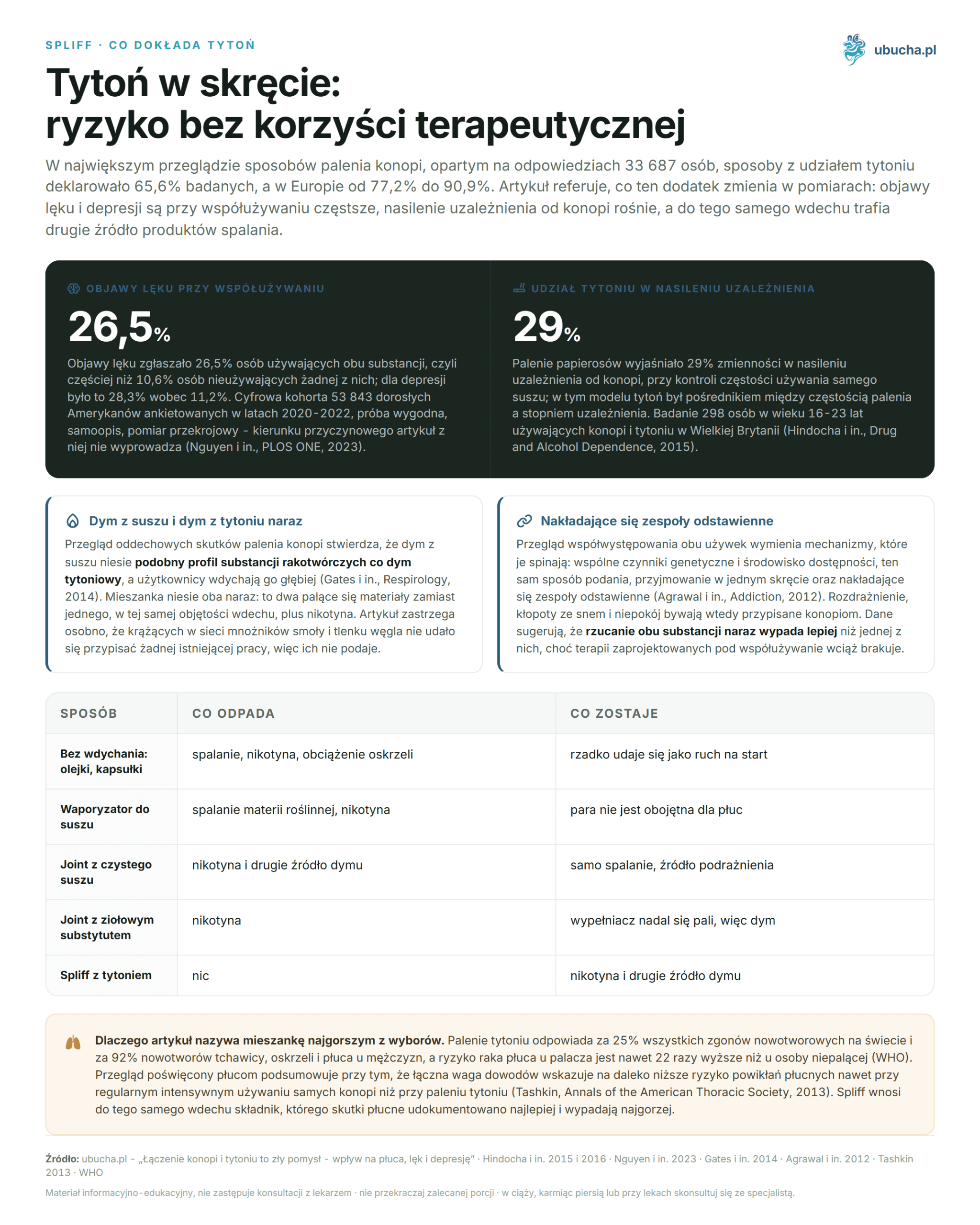
A spliff, or joint mixed with tobacco, is the norm in Europe, not the exception. In the largest review of cannabis smoking methods to date, based on responses from 33,687 people from dozens of countries, 65.6% of respondents reported using methods involving tobacco, with rates in Europe ranging from 77.2% to 90.9% depending on the country (Hindocha et al., Frontiers in Psychiatry, 2016). This habit did not arise from medicine, but from the price of the herb and the way subsequent generations of users learn to smoke. However, the consequences are borne by the respiratory system and mood. This text shows what tobacco adds to the smoke, how it affects anxiety and depressive symptoms, why it complicates breaking away from cannabis itself, and what the real path out of a spliff looks like. We verified every number at the source, and those that could not be attributed to existing work were removed from the text.
KEY INFORMATION
• Smoking tobacco accounts for 25% of all cancer deaths worldwide and 92% of trachea, bronchus, and lung cancers in men (WHO).
• Among 53,843 adult Americans, 26.5% of those using both substances reported anxiety symptoms compared to 10.6% of non-users (Nguyen et al., PLOS ONE, 2023).
• Smoking cigarettes explained 29% of the variability in the severity of cannabis addiction among young users, regardless of the frequency of herb use.
• Smoking methods without tobacco are associated with a significantly greater willingness to reduce tobacco use and seek help.
• Hierarchy of quitting: do not smoke, vaporizer, pure joint, joint with herbal substitute, and only then spliff.
Why is mixing cannabis with tobacco a bad idea?
Because you are adding a second source of carcinogens and nicotine to smoke that already contains carcinogenic substances. Smoking tobacco accounts for 25% of all cancer deaths worldwide, and in men, it is associated with 92% of trachea, bronchus, and lung cancers. A smoker has up to 22 times the risk of lung cancer compared to a non-smoker (WHO).
Cannabis smoke itself is not innocent. A review of the literature on the respiratory effects of cannabis smoking states that it contains a similar profile of carcinogenic substances as tobacco smoke, and users inhale it deeper (Gates et al., Respirology, 2014). However, the authors emphasize something that is easy to forget: knowledge about the respiratory effects of cannabis alone is still incomplete, partly because so many participants smoked tobacco simultaneously. Co-use blurs the picture.
The practical conclusion is simple. If you are already smoking herb, every gram of tobacco added to the joint increases the risk you do not need to take, and it does so without any therapeutic benefit. The reasons Europeans do this are economic and cultural: tobacco stretches the herb, makes it easier to burn moist material, and the rolling method is learned from friends. None of these are medical arguments. We explained the difference between a spliff, a joint, and a blunt in a separate text about joint terminology.
What does tobacco add to joint smoke?
It adds nicotine and a second dose of combustion products. Nicotine is an addictive substance, and it is responsible for wanting another spliff even when you no longer care about the effects of THC. The rest of the difference is simple arithmetic: two burning materials instead of one, in the same inhalation volume.
It is worth separating two things, as they often blend in conversations.
| Factor | Cannabis smoke | Tobacco smoke |
|---|---|---|
| Nicotine | none | present, responsible for addiction |
| Combustion products of plant material | present, profile similar to tobacco | present, best described of all |
| Inhalation method | deeper inhalation, longer retention | shallower inhalation, more frequent repetition |
| Evidence scale | incomplete, distorted by co-smoking tobacco | extensive, decades of research |
In the corpus of texts about spliffs, many impressive multipliers circulate: how many times more tar, how many percent more carbon monoxide. We checked them, and none could be attributed to existing work, so you won’t find them here. A reliable statement sounds less spectacular: cannabis smoke and tobacco smoke carry similar classes of carcinogenic substances, and the mixture carries both at once.
What happens to the bronchi when you smoke just herb?
Regular smoking of cannabis alone causes visible and microscopic damage to the large airways, consistently associated with a higher likelihood of chronic bronchitis symptoms. These symptoms subside after quitting smoking. This is summarized by a review dedicated to the impact of marijuana smoking on the lungs (Tashkin, Annals of the American Thoracic Society, 2013).
The rest of the picture is less alarming than intuition suggests. Habitual use of cannabis alone does not lead, in cross-sectional or observational studies, to significant abnormalities in lung function, aside from a possible increase in lung volume and a slight increase in airway resistance of unclear clinical significance. The relationship with chronic obstructive pulmonary disease has not been established. Cannabis smoke does contain carcinogenic and co-carcinogenic substances, but few well-designed epidemiological studies indicate an increased risk of lung cancer or upper respiratory tract with light and moderate use. With heavy and long-term use, the evidence is conflicting.
There are also changes worth knowing about, although their effects remain unclear. Regular smoking of cannabis leads to the loss of cilia in the bronchial epithelium and impairs the bactericidal function of alveolar macrophages, but data on the resulting risk of lower respiratory infections are ambiguous. The author’s conclusion is clear and worth remembering: the total weight of evidence indicates a far lower risk of pulmonary complications even with regular heavy use of cannabis than with smoking tobacco.
That is why the mixture is the worst possible choice. It introduces into the same inhalation a component whose pulmonary effects are best documented and come out the worst. Giving up tobacco does not make smoking healthy, but it removes exactly that part of the risk that is proven.
How often do Europeans mix herb with tobacco?
Very often, and the difference between continents is enormous. In the Global Drugs Survey filled out by 33,687 people who smoked cannabis in the past year, 65.6% of respondents reported using methods involving tobacco. In Europe, this percentage ranged from 77.2% to 90.9%, in Australasia from 20.7% to 51.6%, and in both Americas it dropped to the range of 4.4-16.0% (Hindocha et al., Frontiers in Psychiatry, 2016).
This same work provides the most interesting number of the entire set. A vaporizer as the main method of administration was indicated by 13.2% of respondents in Canada and 11.2% in the United States, where the tobacco tradition of smoking cannabis has never taken hold. The geography of smoking methods is therefore not a matter of biology or law. It is a matter of what the novice user is taught.
The authors also checked whether the method of smoking is associated with the desire to reduce substances. People smoking cannabis without tobacco had a 10.7% higher chance of declaring “I want to use less tobacco,” an 80.6% higher chance of “I would like to get help in reducing tobacco,” and a 103.9% higher chance of “I plan to seek that help.” The relationship with the tendency to limit cannabis itself was already ambiguous. In other words: giving up tobacco in a joint goes hand in hand with a willingness to part with nicotine altogether.
Does mixing tobacco with cannabis increase the risk of anxiety and depression?
Co-use is associated with the worst mental health profile among the patterns studied. In the COVID-19 Citizen Science Study digital cohort, which included 53,843 adult Americans surveyed between 2020-2022, 26.5% of those using both substances reported anxiety symptoms, and 28.3% reported depressive symptoms. In the group not using either, it was 10.6% and 11.2%, respectively (Nguyen et al., PLOS ONE, 2023).
After accounting for confounding variables, the odds ratio for co-use was 1.89 for anxiety and 1.77 for depression compared to non-users. Co-use performed worse than tobacco alone and worse than cannabis alone. Daily use of cigarettes, e-cigarettes, or cannabis was also associated with higher odds of both symptoms than less frequent use.
It should be noted what this study does not show. The sample was convenient, not random, data came from self-reporting, and the measurement of substances and symptoms was cross-sectional. It cannot be read whether substances exacerbate symptoms or whether people with symptoms are more likely to reach for substances. A separate study of a Canadian cohort of 662 teenagers tracked over a decade found that the frequency of cannabis use was associated with depressive symptoms at ages 16-19 and again after age 25, but not with anxiety symptoms (Leadbeater et al., Addiction, 2019). The picture is therefore more fragmented than headlines suggest.
Why does tobacco complicate breaking away from cannabis?
Because a spliff contains two habits at once, and usually only one is recognized. In a study of 298 people aged 16-23 using cannabis and tobacco, smoking cigarettes explained 29% of the variability in the severity of cannabis addiction, controlling for the frequency of using the herb alone. Tobacco turned out to be a mediator in this model between the frequency of cannabis smoking and the degree of addiction (Hindocha et al., Drug and Alcohol Dependence, 2015).
A review of the co-occurrence of both substances indicates several mechanisms that bind them: shared genetic factors, shared availability environment, the same method of administration, simultaneous intake in one joint, and overlapping withdrawal syndromes (Agrawal et al., Addiction, 2012). The last point explains most practical failures. Nicotine withdrawal symptoms and cannabis withdrawal symptoms look similar: irritability, sleep problems, anxiety. A person quitting herb attributes them to cannabis, even though some come from tobacco.
This same work signals something worth remembering before the first attempt. Data suggest that quitting both substances at once may be associated with better outcomes than quitting one of them, although therapies designed for co-use are still lacking. This is the opposite of the common advice “first one, then the other.”
What are the real alternatives to a spliff?
The safest option is not to inhale anything that is burned. However, if quitting smoking is not immediately feasible, it is worth keeping in mind the order in which subsequent steps reduce risk. The hierarchy below organizes choices from least to most burdensome on the respiratory tract.
| Level | Method | What is eliminated |
|---|---|---|
| 1 | Without inhalation: oils, capsules, edibles | combustion, nicotine, bronchial burden |
| 2 | Vaporizer for herb | combustion of plant material, nicotine |
| 3 | Joint of pure herb | nicotine and a second source of smoke |
| 4 | Joint with herbal tobacco substitute | nicotine |
| 5 | Spliff with tobacco | none |
Level two is often overlooked, although it is technically the simplest. A vaporizer heats the herb instead of burning it, so no smoke from burning plant material is produced. This does not mean that vapor is neutral for the lungs, and you will not find a percentage difference here, as there is simply no reliable number. We detailed the comparison of inhalation methods in the text about what harms the least.
Level four can be the most convenient first step, as it retains the ritual of rolling and the volume of the joint while removing nicotine. Herbs used as fillers are most often damiana, lemon verbena, peppermint, sage, and lavender, as well as non-psychoactive cannabis. We compared their profiles and mixing methods in a guide about what to smoke instead of tobacco. However, it must be said plainly: herbal filler is still burned, so it removes nicotine, not smoke.
How to transition from a spliff to a pure joint or vaporizer?
Gradually and with the assumption that you are parting with two things at once. A sudden change usually ends in a relapse, as nicotine withdrawal symptoms are attributed to cannabis. The following plan spreads the change over seven weeks. This is a practical proposal, not a protocol from a clinical trial, so adjust the pace to yourself.
| Week | Tobacco share in the mix | What you add |
|---|---|---|
| 1-2 | about 80% of the previous amount | damiana or mint as filler |
| 3-4 | about 50% | herbal substitute in the same proportion |
| 5 | about 25% | non-psychoactive cannabis |
| 6 | about 10% | carbon filter instead of cardboard tip |
| 7 | zero | pure herb or switch to a vaporizer |
Nicotine cravings are a pharmacological phenomenon, not a matter of character. Patches, gums, lozenges, and nicotine inhalers are available over the counter in Poland, and anti-nicotine clinics operate under public health insurance. A conversation with a family doctor is a sensible first step, especially if previous attempts ended in relapse.
If you are aiming for a vaporizer right away, be aware that the first days will taste different and you may feel a weaker effect. This is a matter of getting used to irritation from smoke, not evidence of weaker effectiveness. You can choose equipment in the category of vaporizers.
Does CBD help quit smoking tobacco?
The signal exists, but it is preliminary and smaller than headlines suggest. In a pilot double-blind study, 24 smokers wanting to quit received either a CBD inhaler or placebo for a week, with instructions to use it when craving a cigarette. In the placebo group, the number of cigarettes smoked did not change at all, while in the CBD group it decreased by about 40% (Morgan et al., Addictive Behaviors, 2013).
A subsequent study by the same research group clarified what CBD does not do. Thirty dependent smokers after overnight abstinence received a single dose of 800 mg of CBD or placebo. CBD diverted attention from cigarette cues and reduced their pleasure rating, but did not affect either nicotine cravings or withdrawal symptom severity (Hindocha et al., Addiction, 2018).
The comparison of both studies gives a cautious picture. CBD may weaken the attraction of smoking-related cues, which is that part of the habit that activates at the sight of a pack or ashtray. However, it does not replace nicotine replacement therapy and does not eliminate physiological cravings. Both trials were small, one lasted a week, the other one session, so neither speaks to long-term effectiveness. Treat CBD as a possible support, not as a cure for quitting smoking.
Is passive inhalation of spliff smoke harmful?
Yes, and this is one of the best-documented things in the entire topic. Passive inhalation of tobacco smoke causes serious heart and respiratory diseases, including coronary heart disease and lung cancer, and prematurely kills over 1.6 million people annually (WHO). A spliff is a source of tobacco smoke just like a cigarette.
In a room with children, the same rule applies as with cigarettes, not a milder one. There is also the issue of cannabinoids in sidestream smoke, about which much less is known, as studies involving children are not conducted for obvious reasons. The lack of data is not an argument for safety, but a reason for caution.
Pets are a separate problem, often underestimated. Dogs and cats stay low to the floor, where smoke accumulates, have less body mass, and cannot leave the room. Accidental cannabinoid poisonings in dogs are regularly reported in veterinary practice, with symptoms including balance disorders, vomiting, and drowsiness. However, the circulating percentage increases in the number of such poisonings do not have a source that can be pointed out, so we do not provide them here. The practical rule is simple: do not smoke where the animal cannot move away.
How to recognize that you have a problem with nicotine hidden in spliffs?
A signal is that you cannot smoke cannabis without tobacco, even though you do not care about the taste or the “body” of the joint. People who only smoke spliffs often do not consider themselves smokers because they have never bought a pack of cigarettes. However, nicotine does not ask what it is wrapped in.
The following list is not a diagnostic tool. It is a set of observations worth bringing to a conversation with a doctor if you recognize three or more in yourself.
- Need to smoke within half an hour of waking up.
- Irritability and trouble concentrating between one joint and the next.
- Smoking even when you do not want the effects of THC.
- Reluctance to a pure joint, justified by saying it “does not taste the same.”
- Continuing to smoke despite cough, shortness of breath, or asthma exacerbations.
- Unsuccessful attempts to reduce the amount of tobacco in the mix.
It is worth visiting an anti-nicotine clinic or a family doctor when self-attempts end in relapse. Nicotine replacement therapy, bupropion, and varenicline are medications with documented effectiveness in quitting smoking, and the decision on the choice is made by the doctor. If you care about the order of actions, remember the conclusion from the Agrawal review: data suggest that quitting both substances at once performs better than spreading it out over stages.
How long does it take for health to improve after quitting tobacco?
The first changes begin within fifteen minutes, and the most important ones spread over years. The timeline below comes from a World Health Organization report and concerns quitting tobacco regardless of whether it was smoked in a cigarette or a spliff (WHO).
| Time since quitting | What changes |
|---|---|
| 20 minutes | heart rate and blood pressure drop |
| 12 hours | carbon monoxide levels in the blood return to normal |
| 2-12 weeks | circulation improves and lung capacity increases |
| 1-9 months | cough and shortness of breath decrease |
| 1 year | risk of coronary heart disease is reduced to half that of a smoker |
| 10 years | risk of lung cancer is reduced to about half that of a smoker |
| 15 years | risk of coronary heart disease equals that of a non-smoker |
Note two positions that are often misrepresented in popular versions of this timeline. After one year, the heart risk does not equal that of a non-smoker, but drops to half that of a smoker; equality occurs after fifteen years. The risk of stroke equalizes in the range of five to fifteen years after quitting. The timeline is therefore kinder than the fear of quitting, but less immediate than brochures promise.
Frequently Asked Questions
Does a spliff cause more addiction than just the herb?
Data suggests that it does. In a study of 298 young people using cannabis and tobacco in the UK, smoking cigarettes explained 29% of the variability in the severity of cannabis addiction, regardless of how often participants used the herb (Hindocha et al., Drug and Alcohol Dependence, 2015). Tobacco was a mediator in this model between frequency of use and addiction.
Does hemp paper contain THC?
Hemp paper is made from the fiber of the stem, not from the flowers. The Polish threshold of 0.3% refers to the sum of delta-9-THC and THCA measured in flowering or fruiting tops of plants from which the resin has not been removed (Article 4 point 5 of the Act on Counteracting Drug Addiction, Journal of Laws 2022 item 763). Fiber is not a material to which this measurement applies.
Is a vaporizer safe for the lungs?
Vaporization bypasses combustion, so no tar or carbon monoxide from burning plant material is produced. This does not mean it is neutral for the respiratory tract. The literature on the impact of cannabis smoking on the respiratory system is still incomplete and does not allow for a reliable number describing the difference (Gates et al., Respirology, 2014).
How long does it take for health to improve after quitting tobacco?
According to WHO, heart rate and blood pressure drop after 20 minutes, carbon monoxide levels in the blood return to normal after 12 hours, cough and shortness of breath decrease between the first and ninth month, after one year the risk of coronary heart disease is halved compared to a smoker, and after 10 years the risk of lung cancer is halved.
Does CBD help quit smoking tobacco?
The signal is preliminary. In a pilot study involving 24 smokers, a CBD inhaler used as needed for a week was associated with a decrease in the number of cigarettes smoked by about 40%, which was not observed in the placebo group (Morgan et al., Addictive Behaviors, 2013). In another study, a single dose of 800 mg of CBD did not affect either nicotine cravings or withdrawal symptoms.
Are cannabis without tobacco safe for the lungs?
They are not neutral. Cannabis smoke contains a similar profile of carcinogenic substances as tobacco smoke, and it is inhaled deeper and retained longer (Gates et al., Respirology, 2014). Giving up tobacco removes nicotine and some toxins, but does not eliminate combustion, which remains a source of bronchial irritation.
What to do with this knowledge?
Three things, in this order. First, check what you are really dealing with. If you only smoke spliffs and cannot smoke a pure joint, the problem is most likely nicotine, not cannabis. A study of young users showed that tobacco drives the severity of cannabis addiction regardless of how often it is smoked.
Second, choose the next step down the hierarchy, not the last one right away. Switching tobacco for an herbal filler removes nicotine and is usually maintainable. Switching to a vaporizer additionally removes combustion. Giving up inhalation removes everything, but it rarely succeeds as the first move.
Third, treat the anti-nicotine clinic like a regular visit, not a last resort. Nicotine replacement therapy is available over the counter, prescription medications have documented effectiveness, and data suggest that quitting both substances at once performs better than spreading it out over stages. The WHO timeline provides a concrete reward: cough and shortness of breath decrease within the first months.
You can find non-tobacco cannabis and herbs used as joint fillers in the herbs category.
This article is for informational and educational purposes and does not constitute medical advice. Before starting to use cannabis or CBD for therapeutic purposes, consult a doctor, especially if you are taking other medications, are pregnant, or breastfeeding.
Author: Michał Waluk · Published: 2026-05-04 · Updated: 2026-08-10