
Spliff, joint and blant - explaining the difference
Joint, spliff and blant are three different rolls. Check how they differ in composition, how much nicotine tobacco adds, and what research and Polish law say about it.
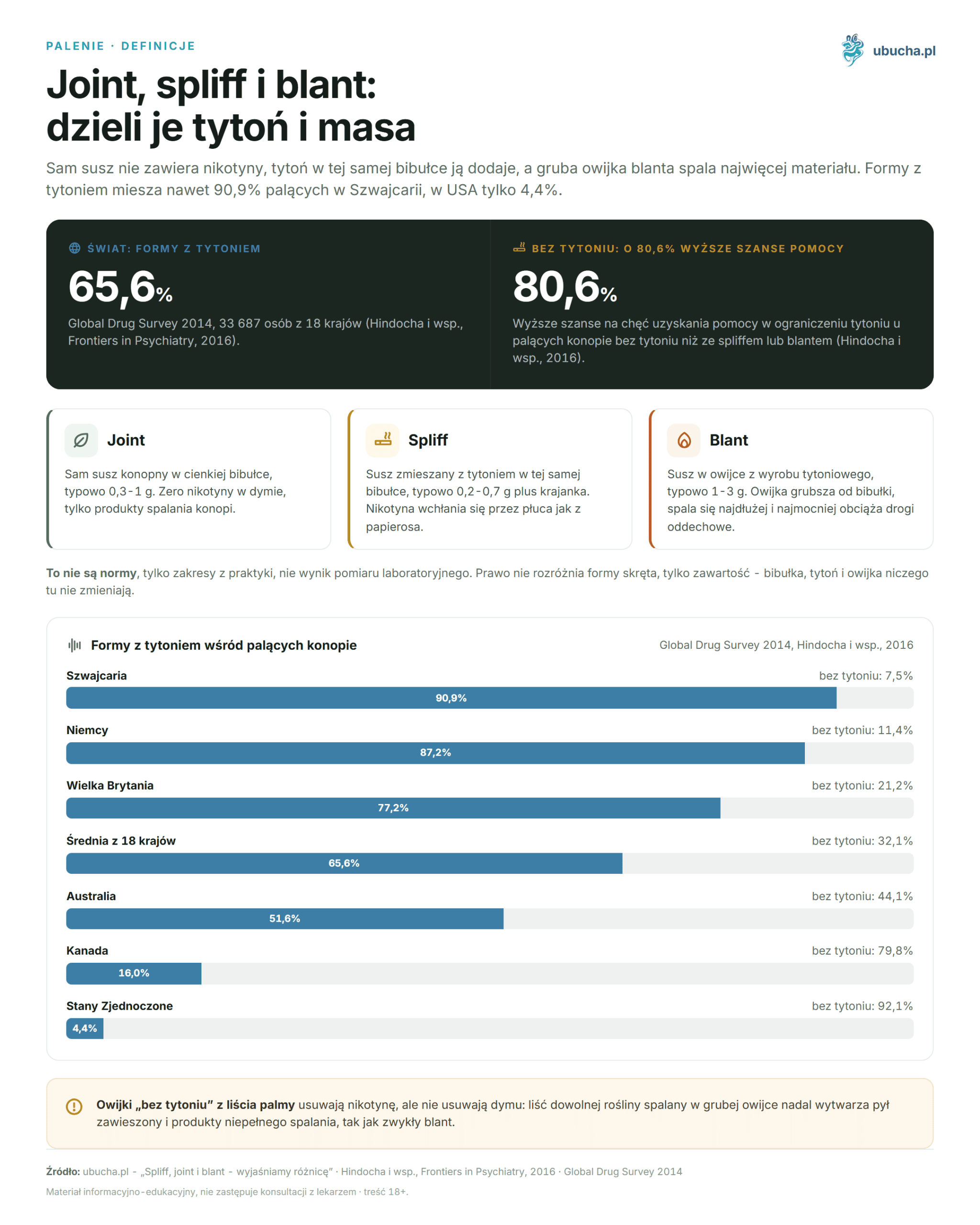
Joint, spliff and blant are used interchangeably in conversations, though they mean three different things. The difference is not just slang. It depends on how much nicotine you inhale, how long the session lasts, and how much plant material you burn in total. The largest survey on this topic, the Global Drug Survey with 33,687 participants from 18 countries, showed that tobacco forms of cannabis smoking account for 65.6% of users worldwide, but are extremely unevenly distributed: from 4.4% in the United States to 90.9% in Switzerland. This text organizes the three concepts, explains the origins of regional differences, compares them with what is known about smoke and lungs, and describes the Polish legal status. At the end, you will find a practical section about rolling papers, filters, and grinders.
KEY INFORMATION
• Tobacco forms of cannabis smoking are declared by 65.6% of users worldwide, from 4.4% in the USA to 90.9% in Switzerland (Hindocha et al., Frontiers in Psychiatry 2016).
• Joint is pure flower in rolling paper, spliff is flower mixed with tobacco, blant is flower in a tobacco wrap.
• Blant burns the most material and burdens the respiratory tract the longest.
• Nicotine from a spliff sustains addiction in people who do not consider themselves cigarette smokers.
• In Poland, the material counts, not the form of the roll: the 0.3% threshold is the sum of delta-9-THC and THCA measured in the plant (art. 4 point 5 of the Act on Counteracting Drug Addiction).
What is the difference between joint, spliff and blant?
The difference boils down to two things: what is inside and what it is wrapped in. A joint contains only cannabis flower in a thin rolling paper. A spliff mixes flower with tobacco in the same rolling paper. A blant, in English blunt, is flower wrapped in a tobacco product, i.e. a tobacco leaf or a split cigar wrap.
From the perspective of what you inhale, the consequences differ. A joint delivers thermal decomposition products only from cannabis material. A spliff adds nicotine and combustion products of cigarette tobacco. A blant burdens the respiratory tract the most because the wrap is thicker than paper, burns slower, and itself constitutes a significant part of the burned mass.
| Feature | Joint | Spliff | Blant (blunt) |
|---|---|---|---|
| Content | Pure cannabis flower | Flower with tobacco | Flower in tobacco wrap |
| Wrap | Rice, hemp, cellulose paper | Same paper as joint | Tobacco leaf, cigar wrap |
| Typical flower mass | 0.3-1 g | 0.2-0.7 g plus tobacco | 1-3 g |
| Relative burn time | Several minutes | Similar to joint | Several times longer |
| Region of origin | North America | Caribbean and Europe | New York |
| Nicotine in smoke | No | Yes, from shredded tobacco | Yes, from wrap |
The masses given in the table are typical sizes encountered in practice, not laboratory measurements. Burn time cannot be given in minutes with reasonable accuracy because it depends on packing density, material moisture, and how often someone inhales. What is certain is the order itself: blant lasts the longest because it burns the most mass.
Where did the joint come from and why do Americans smoke pure flower?
The joint in today’s sense, i.e. a roll of pure flower, became popular in the United States in the 1960s along with the hippie counterculture. Earlier, the word existed in American drug slang since the 1930s, and the custom of rolling cannabis in paper came from Mexico in the 19th century.
The reason pure flower won across the Atlantic is simple. Marijuana was relatively cheaper and more available in the US than in Europe, so stretching portions with tobacco made no economic sense. There was also a cultural factor: for part of the countercultural community, a roll without tobacco was a statement against the tobacco industry, not just a flavor choice.
A modern joint consists of three elements: flower, rolling paper, and a crutch, i.e. a paper filter rolled in a spiral. The crutch maintains the shape of the roll, stops small particles from entering the mouth, and allows finishing the roll without burning fingers. Without it, the roll falls apart faster and leaves a bigger butt.
The paper format also matters practically. In Europe, king size slim about 110 mm long dominates, while in North America shorter 1¼ papers about 78 mm are more common. Longer paper holds more material but requires more even packing to prevent the ember from running on one side. More about paper formats can be found in our rolling paper guide, and rolling technique is broken down in a separate rolling tutorial.
Why did the spliff dominate Europe and not America?
Because tobacco solves three problems at once in Europe: it lowers the cost per roll, makes rolling loose material easier, and evens out burning. The word comes from Jamaican patois, reached the UK with post-war Caribbean migration, and spread across the continent with reggae music.
The scale of this custom was measured by Hindocha et al. (Frontiers in Psychiatry, 2016) based on Global Drug Survey 2014 data. Among 33,687 people who smoked cannabis in the past year, 65.6% indicated tobacco as the route of administration. The variation between countries is greater than differences between generations or genders.
| Country | Forms with tobacco | Forms without tobacco |
|---|---|---|
| Switzerland | 90.9% | 7.5% |
| Netherlands | 87.6% | 10.1% |
| Germany | 87.2% | 11.4% |
| United Kingdom | 77.2% | 21.2% |
| Australia | 51.6% | 44.1% |
| Canada | 16.0% | 79.8% |
| United States | 4.4% | 92.1% |
| Average of 18 countries | 65.6% | 32.1% |
The distribution is not random. In countries where hashish was mainly used, tobacco served as a carrier because crushed hashish alone does not hold in paper. Where flower dominated, such a carrier was not needed. Also, simple household budget arithmetic applies: at high black market prices, stretching a portion with tobacco doubles the number of sessions from the same amount of flower. It is worth noting how narrow this dominance is: globally, 61.3% of all responses are one specific form, i.e. joint with tobacco, and other tobacco variants were chosen rarely.
Poland was not included in this comparison, so any number assigned to Polish smokers is an estimate, not a measurement. The proximity of Germany and Switzerland, where tobacco form reaches nearly 90%, only allows the assumption that spliff dominates here as well. Alternatives to tobacco in rolls are described separately in the post about what to replace tobacco with in a joint.
What is a blant and where does its Polish name come from?
A blant is flower wrapped in a tobacco product instead of paper. It originated in New York in the 1980s when smokers began cutting cheap Phillies Blunt cigars, emptying the cigar tobacco, and filling them with flower. The English name blunt comes directly from this brand, and the Polish blant is a phonetic spelling of it.
Today, blants rarely come from cut cigars. Accessory manufacturers sell ready-made wraps: sheets of homogenized tobacco leaf, whole tobacco leaves, and tobacco-free variants made from palm leaf or thicker hemp paper. The latter group is sometimes marketed as safer because it contains no nicotine.
This marketing argument should be read cautiously. The absence of tobacco indeed removes nicotine from the equation but does not remove smoke. Burning any plant leaf produces suspended dust and incomplete combustion products, and a tobacco-free wrap still weighs many times more than thin paper. Replacing tobacco with palm reduces one problem but does not eliminate the other.
In Poland, blant remains a niche form. The cultural message arrived here with delay, ready tobacco wraps are not typical goods in Polish accessory shops, and the market is dominated by king size slim papers. You are more likely to encounter the term blant in song lyrics than a real blant in circulation.
It is also worth distinguishing two concepts often confused in Polish slang. Blant is a specific technique of wrapping in a tobacco product, while preroll simply means a ready-made, factory-rolled joint sold in packaging. A preroll is usually a regular joint in paper and has nothing to do with a tobacco leaf wrap, although it is sometimes called that in ads.
How much flower fits in a joint, spliff and blant?
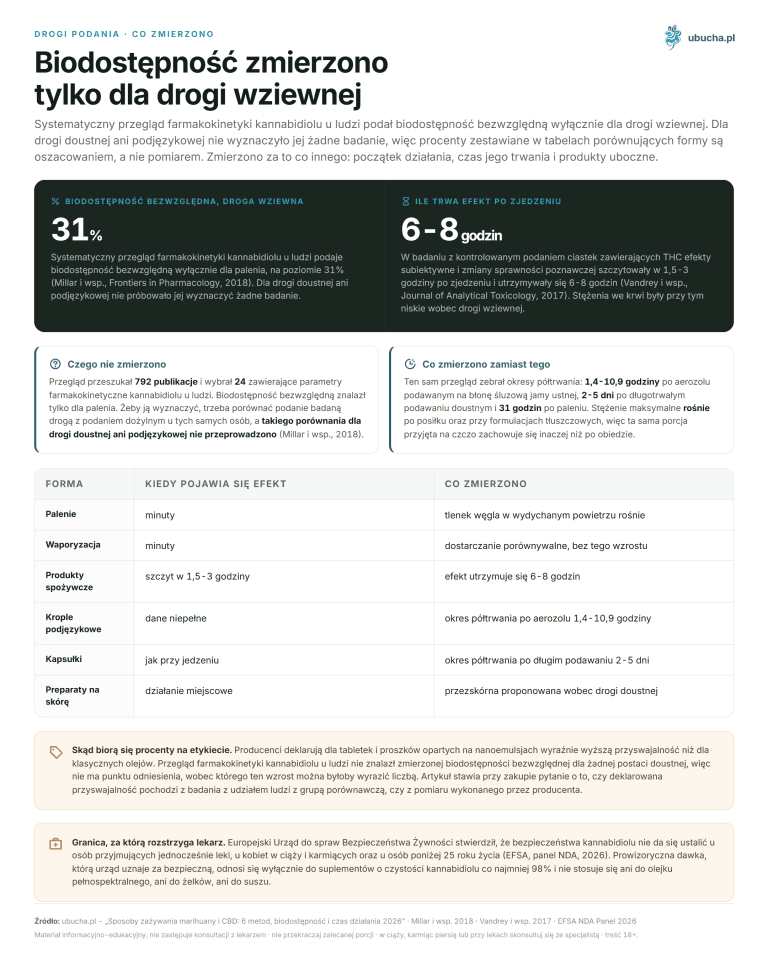
A joint typically holds 0.3-1 g of flower, a spliff 0.2-0.7 g plus shredded tobacco, and a blant from 1 to 3 g. These are not standards but ranges encountered in practice. The difference matters because the amount of THC in a roll increases directly proportionally to the mass of material and its potency.
The calculation is simple. Half a gram of flower with 18% THC contains about 90 mg of this substance, two grams of the same flower about 360 mg. Only part reaches the bloodstream because a significant amount decomposes in the ember or escapes as sidestream smoke, and proportions depend on inhalation technique and how long someone holds the smoke. None of these quantities is constant between individuals.
The course of effects after inhalation is well described. Grotenhermen (Clinical Pharmacokinetics, 2003) summarized that after inhalation, maximum plasma THC concentration appears within minutes, psychotropic effects start within seconds or minutes, peak after 15-30 minutes, and fade over 2-3 hours. Oral administration starts after 30-90 minutes and lasts 4-12 hours.
A practical conclusion especially concerns the blant. A roll with two grams of flower smoked alone by an occasional smoker is a dose far above the comfort threshold, and typical effects of overdose described by the same author include anxiety, panic attack, accelerated heartbeat, and blood pressure changes. Blants in the culture they come from were always a social form smoked in groups, and this is no coincidence.
How does burn rate affect what you inhale?
The longer the session and the more mass burned, the greater the total exposure of the respiratory tract to hot smoke. This is the simplest and most certain relationship in the whole topic. A blant with 1.5 g of flower and a thick wrap burns several times more material than a joint with 0.5 g in thin paper.
Popular online tables with exact minutes and milligrams of tar substances for each of the three forms have no basis in published measurements. No one has compared joint, spliff, and blant under controlled conditions regarding combustion products. What can be said honestly concerns the comparison of smoking with vaporization.
Here the data are concrete. Pomahacova et al. (Inhalation Toxicology, 2009) compared the Volcano vaporizer with smoke from a cannabis cigarette and measured by HPLC the ratio of cannabinoids to by-products. Vapor at 200 and 230 degrees Celsius had a significantly better ratio than smoke, and the worst result was vaporization at 170 degrees, below the effective evaporation threshold.
However, this study did not examine wraps or burn time, so no number can be derived about the blant itself. If you see an article online citing this study regarding tobacco wraps, it means the author of the quote did not open it. Practical conclusions about temperatures are collected in our vaporization guide.
What does cannabis smoking do to lungs?
Cannabis and tobacco smoke are qualitatively similar but differ in component proportions. A direct comparison of both smokes produced and collected the same way was conducted by Moir et al. (Chemical Research in Toxicology, 2008), which is the most reliable source on this topic.
Their results are nuanced. Ammonia occurred in the main stream of cannabis smoke at concentrations up to 20 times higher than in tobacco smoke. Hydrogen cyanide, nitrogen oxides, and some aromatic amines were 3-5 times higher. Selected polycyclic aromatic hydrocarbons, often linked to smoke carcinogenicity, were lower in cannabis smoke than tobacco smoke.
One sentence from this work is rarely quoted but reverses the conclusion for bystanders. For sidestream smoke, i.e. smoke rising from the ember between puffs, the relationship was opposite: polycyclic aromatic hydrocarbons were higher in cannabis smoke than tobacco smoke. Smoking in enclosed spaces burdens not only the smoker.
What this means for lungs was summarized by Tashkin (Annals of the American Thoracic Society, 2013). Regular cannabis smoking damages large airways and is associated with chronic bronchitis symptoms that resolve after quitting. No clear link with chronic obstructive pulmonary disease was found, and epidemiological data do not indicate increased lung cancer risk with light and moderate use. For heavy and long-term use, evidence remains inconclusive. The review ends with a sentence often lost in abstracts: accumulated evidence indicates that lung complication risk even with regular intensive cannabis smoking is much lower than with tobacco smoking.
The third piece of the puzzle was added by Earleywine and Barnwell (Harm Reduction Journal, 2007). Their data come from an online survey sent via mailing lists of drug law reform organizations; after filtering, 6883 responses remained. Vaporizer use was associated with fewer respiratory symptoms even after adjusting for age, sex, number of cigarettes smoked, and amount of cannabis, and the number of cigarettes interacted with cannabis amount to increase symptoms. This indirectly burdens spliffs and blants, as both add tobacco to the same session. Important caveat: cross-sectional study on a self-selected sample with self-reported symptoms shows association, not causation.
How much nicotine does a spliff deliver and does it cause addiction?
No exact nicotine dose per spliff has been established because it depends on how much tobacco is added. Values circulating online in milligrams are mere multiplication without measurement basis. What is certain is that nicotine from shredded tobacco is absorbed through the lungs just like from a cigarette.
The consequence is measurable behaviorally. In the analysis by Hindocha et al. (2016), people using non-tobacco forms had 10.7% higher odds of declaring a desire to reduce tobacco, 80.6% higher odds of wanting help to do so, and 103.9% higher odds of planning such help than those smoking cannabis with tobacco. The relationship thus works the other way: spliff quietly sustains the nicotine habit.
The same study’s authors found no consistent link between administration form and desire to reduce cannabis itself. This distinction is often lost in summaries: the study concerns motivation regarding tobacco, not cannabis.
The practical effect is known to anyone who tried to switch from spliffs to pure joints. Withdrawal symptoms, irritability, and increased appetite appear in people who never considered themselves cigarette smokers because they never bought a pack. Nicotine does not care what it was wrapped in. This is seen from the other side: even among those declaring non-tobacco forms, 16.3% never tried smoking tobacco independently of cannabis, meaning the other four-fifths did smoke it.
This mechanism has another rarely mentioned consequence. A person convinced they are quitting cannabis also quits nicotine but attributes all withdrawal symptoms to cannabis. The difficulty then seems greater than it is, and separating the two processes is often easier: first remove tobacco from the roll, then possibly take a break from cannabis itself.
Which rolling paper or wrap to choose?
The choice of wrap changes flavor, burn rate, draw strength, and how much foreign material you burn with the flower. The simplest rule is: the thinner the paper, the less you add to the smoke. A tobacco leaf wrap weighs many times more than paper and itself becomes a significant smoke source.
| Wrap type | Flavor and burn | What it adds to smoke |
|---|---|---|
| Rice paper | Neutral flavor, fast burn | Least of all |
| Hemp paper | Slightly nutty taste, slower burn | Little, plant fibers |
| Linen paper | Very thin, moisture resistant | Little |
| Transparent cellulose | No flavor, good for terpene evaluation | Little, synthetic material |
| Tobacco leaf wrap | Distinctive, very slow burn | Nicotine and smoke from wrap |
| Palm leaf wrap | Mild, slow burn | Smoke from wrap, no nicotine |
A separate issue is flavors. Flavored papers and wraps with vanilla or fruit taste have not been studied for safety of inhaling combustion products. However, it is known what some food flavorings lead to when inhaled: Allen et al. (Environmental Health Perspectives, 2016) detected diacetyl, 2,3-pentanedione, or acetoin in most of 51 tested e-cigarette liquids, and inhaling diacetyl is linked to bronchiolitis obliterans. This study concerned e-liquids, not papers, but shows flavor is not a neutral additive.
When choosing paper, its weight and behavior when rolling also matter. Thinner paper gives less own flavor but forgives fewer mistakes and breaks more easily if packed too tightly. Hemp and linen papers are more forgiving for beginners, and the difference in added smoke between them and the thinnest cellulose is small.
What tools do you need for an even burn?
Three things are enough. A grinder ensures uniform shredding, without which the ember runs on one side. Paper determines burn rate. The crutch holds shape and allows finishing the roll. Other accessories are convenience, not a requirement.
A four-chamber grinder with a screen also collects kief, i.e. trichome dust falling to the bottom. Models made of aerospace aluminum are lighter and keep teeth sharp longer than wooden ones. Two-piece plastic grinders work occasionally but shred unevenly, visible on the first roll.
Filters fall into several groups with different purposes:
- Cardboard crutch is a strip about 5 by 20 mm rolled in a spiral, cheapest and most used.
- Activated charcoal filters soften smoke sensation but also mute aroma.
- Ceramic and glass filters are reusable and do not change flavor but require cleaning and care.
We noticed in the store a pattern beginners ask about most: uneven burn almost always results from packing, not paper. A typical mistake is tight packing near the filter and loose end near the ember. The opposite ratio, i.e. even packing with slight looseness near the filter, solves the problem faster than changing paper brand. Grinders and filters are found in the cannabis accessories category.
How does flower storage affect how it burns?
Moisture mainly decides. Too dry flower crumbles into dust in the grinder, burns fast, irritates the throat, and burns unevenly. Too moist flower goes out after each puff and requires constant side relighting. The difference between the two is often a few days in the wrong container.
The biggest enemy is light and temperature, not air itself. Terpenes, volatile compounds responsible for smell and taste, evaporate faster the warmer and brighter the jar is. Material kept on a windowsill loses aroma within weeks, the same flower in a dark cabinet keeps it for months. The effect is noticeable on the first puff.
Practical rules boil down to four things. Airtight container instead of a zip bag, because foil electrifies and pulls trichomes off the walls. Dark place at room temperature, because a fridge causes humidity swings with each opening. Humidity regulator if you keep larger amounts for longer. And separate containers for different strains so aromas do not mix.
We noticed that people complaining about harsh smoke most often have a problem with overdried material, not too strong a strain. Restoring moisture with a humidity pack changes the sensation within a day. Containers and packs are collected in the cannabis storage category.
How did music spread the three smoking forms worldwide?
Each of the three forms has its own soundtrack, and this is no coincidence. The joint grew with the American 60s counterculture and rock scene. The spliff spread with reggae and the Caribbean diaspora in the UK. The blant was promoted by New York hip-hop of the late 80s and 90s.
In Rastafarian tradition, smoking ganja has a spiritual dimension, and a spliff smoked in a group during reasoning is a communal act, not entertainment. Bob Marley, whose album Catch a Fire was released in 1973, brought this image to mass culture outside Jamaica. He also transferred the habit of mixing with tobacco, as Caribbean spliffs were large and smoked slowly.
The blant was promoted by New York. Cypress Hill debuted in 1991, and two years later their album Black Sunday included the track Hits from the Bong, which became closely associated with this aesthetic. Method Man and Redman released the joint album Blackout! in 1999 and cemented the blant as an element of urban rap iconography. The message reached Europe with a delay of over a decade and did not change the dominance of rolling paper here.
Dutch coffeeshops operate under a tolerance policy initiated by the 1976 amendment to Dutch drug law, and they solidified the European spliff model. Hashish sold there is finely crushed and practically requires a carrier, usually tobacco.
What does Polish law say about joint, spliff and blant?
The law does not distinguish the form of the roll, only its content. Possession of cannabis herb other than industrial hemp remains a crime in Poland under the Act of July 29, 2005 on Counteracting Drug Addiction (consolidated text Dz.U. 2023 item 1939). Paper, tobacco, or wrap do not change this.
Article 62 paragraph 1 of this act provides for imprisonment up to 3 years. For a significant amount, paragraph 2 provides for imprisonment from 1 to 10 years, not simply “up to 10 years”, and this lower limit is important because it means no suspended sentence. For lesser amounts, paragraph 3 allows a fine, restriction of liberty, or imprisonment up to one year.
Article 62a allows discontinuation of proceedings if the amount is insignificant and intended for personal use, with the act stating discontinuation “also before issuing a decision to initiate investigation or inquiry.” The provision refers only to art. 62 paragraphs 1 or 3, so it does not apply at all for significant amounts. It is a discretionary decision, not a right of the detainee, and treating it as a guarantee of impunity is a mistake.
Where exactly is the 0.3% threshold and what is measured?
Industrial hemp is not subject to these provisions, but the definition is narrower than most guides state. Art. 4 point 5 of the act, as amended by the March 24, 2022 act (Dz.U. 2022 item 763, effective May 7, 2022), counts the sum of delta-9-THC and tetrahydrocannabinolic acid in flower or fruiting tops with unremoved resin, up to 0.3% dry weight, rounded to one decimal place. The threshold concerns the plant, not the finished product, and includes the acidic form, which some certificates list separately.
The same value applies in EU law for varieties qualifying for support under the Common Agricultural Policy, but these are two separate regulations with the same number, not one derived from the other. The Polish threshold has a national basis and only corresponds to the EU threshold.
Cannabidiol itself raises no concerns of international bodies. In the WHO Expert Committee on Drug Dependence 2018 critical review, it was stated that CBD shows no effects indicating abuse or dependence potential in humans and that use of pure cannabidiol has not been linked to any public health problems. The assessment concerns substances of known purity and does not determine the legal status of products available for sale.
For clarity, one practical caveat. Legality of industrial hemp flower does not mean possession will not attract attention during checks, as it looks and smells like THC material. Only laboratory testing resolves this, so buying flower with a content certificate and keeping original packaging is sensible. The law is on the buyer’s side, but proof rests on the material.
Frequently Asked Questions
Is a spliff stronger than a joint?
No, if you compare rolls of the same size. Tobacco takes up part of the volume, so there is less cannabis flower in a spliff. The subjective feeling of strength comes from nicotine, which gives a short stimulation and dizziness, not from a higher dose of THC.
Is a blant more harmful than a joint?
In terms of respiratory burden, yes. A blant contains several times more material, burns much longer, and the tobacco wrap adds nicotine. Earleywine and Barnwell (2007) noted in a survey of 6883 people that the number of cigarettes and amount of cannabis interact to increase respiratory symptoms.
Why do Europeans mix cannabis with tobacco, but Americans do not?
It is determined by price, availability, and local custom. The Global Drug Survey in the study by Hindocha et al. (2016) showed tobacco smoking forms in 77.2% of respondents in the UK and 87.2% in Germany versus 4.4% in the USA and 16.0% in Canada.
Can I legally roll a joint with CBD flower?
Yes, if the flower comes from industrial hemp, i.e. plants in which the sum of delta-9-THC and tetrahydrocannabinolic acid does not exceed 0.3% dry weight (art. 4 point 5 of the Act on Counteracting Drug Addiction). Such material is not subject to criminal provisions of this act, but burning any plant material burdens the respiratory tract.
Where does the Polish word ‘blant’ come from?
It is a Polonized pronunciation of the English word blunt. The English name comes from cheap Phillies Blunt cigars, which New York smokers emptied of cigar tobacco and filled with cannabis flower. In Polish slang, both spellings coexist and mean the same.
Does nicotine from a spliff cause addiction?
Yes, the dose enters the bloodstream just like from a cigarette. In the analysis by Hindocha et al. (2016), people using non-tobacco forms had an 80.6% higher chance of wanting help to reduce tobacco than those smoking cannabis with tobacco.
Is vaporization less harmful than smoking?
Data indicate so. Pomahacova et al. (2009) obtained a significantly better ratio of cannabinoids to by-products in vapor at 200 and 230 degrees Celsius than in smoke. Earleywine and Barnwell (2007) noted fewer respiratory symptoms in vaporizer users.
Are flavored rolling papers and wraps safe?
No one has studied this for rolling papers. However, it is known that food flavorings can carry diacetyl, which Allen et al. (2016) detected in most of 51 tested e-cigarette liquids. Inhaling diacetyl is associated with bronchiolitis obliterans.
Summary
Three names describe three different compromises. The joint gives the cleanest smoke profile among smoked forms because it burns only flower and thin paper. The spliff is cheaper per session and easier to roll but introduces nicotine, which most spliff smokers do not count in their balance. The blant burdens the respiratory tract the most because it adds smoke from a thick wrap to the flower smoke.
If you want to reduce risk, the order is quite clear. Vaporization performs better than smoking in every available comparison, and quitting tobacco in the roll removes the entire nicotine part of the problem. Oral routes, such as oils, bypass the lungs entirely.
There remains the legal issue, which is easy to forget when discussing rolling technique. In Poland, the roll form does not matter, the material counts. Legal routes remain flowers from industrial hemp, i.e. plants within the 0.3% sum of delta-9-THC and THCA threshold, available in the cannabis flower category, and oral preparations from the cannabis oils category.
This article is for informational and educational purposes and does not constitute legal advice. The legal status described is valid on the publication date, and cannabis regulations may change. Smoking any plant substance harms the respiratory tract.
Author: Michał Waluk · Published: 2026-05-10 · Updated: 2026-08-15