
Lavender for Sleep and Stress: How to Use Aromatherapeutically and What Research Says
Lavender for sleep and stress: what research has really shown about aromatherapy and the oral preparation Silexan, how to use the oil, and when to exercise caution.
The scent of lavender is associated with calmness, but intuition is not evidence. In this case, there is evidence, and it is stronger than usual in aromatherapy. In a sleep laboratory, exposure to lavender oil increased the percentage of deep sleep in healthy individuals, and an oral preparation of the same oil has undergone seven clinical trials in anxiety disorders. At the same time, some of the repeated numbers found online have no support in the cited works. The most famous of these, regarding shortening the time to fall asleep, is not supported by any of the studies it is usually based on. This article separates one from the other: it shows how to use lavender aromatherapeutically, what exactly studies on sleep and anxiety have shown, how the scent differs from the capsule, and in which situations caution is warranted.
KEY INFORMATION
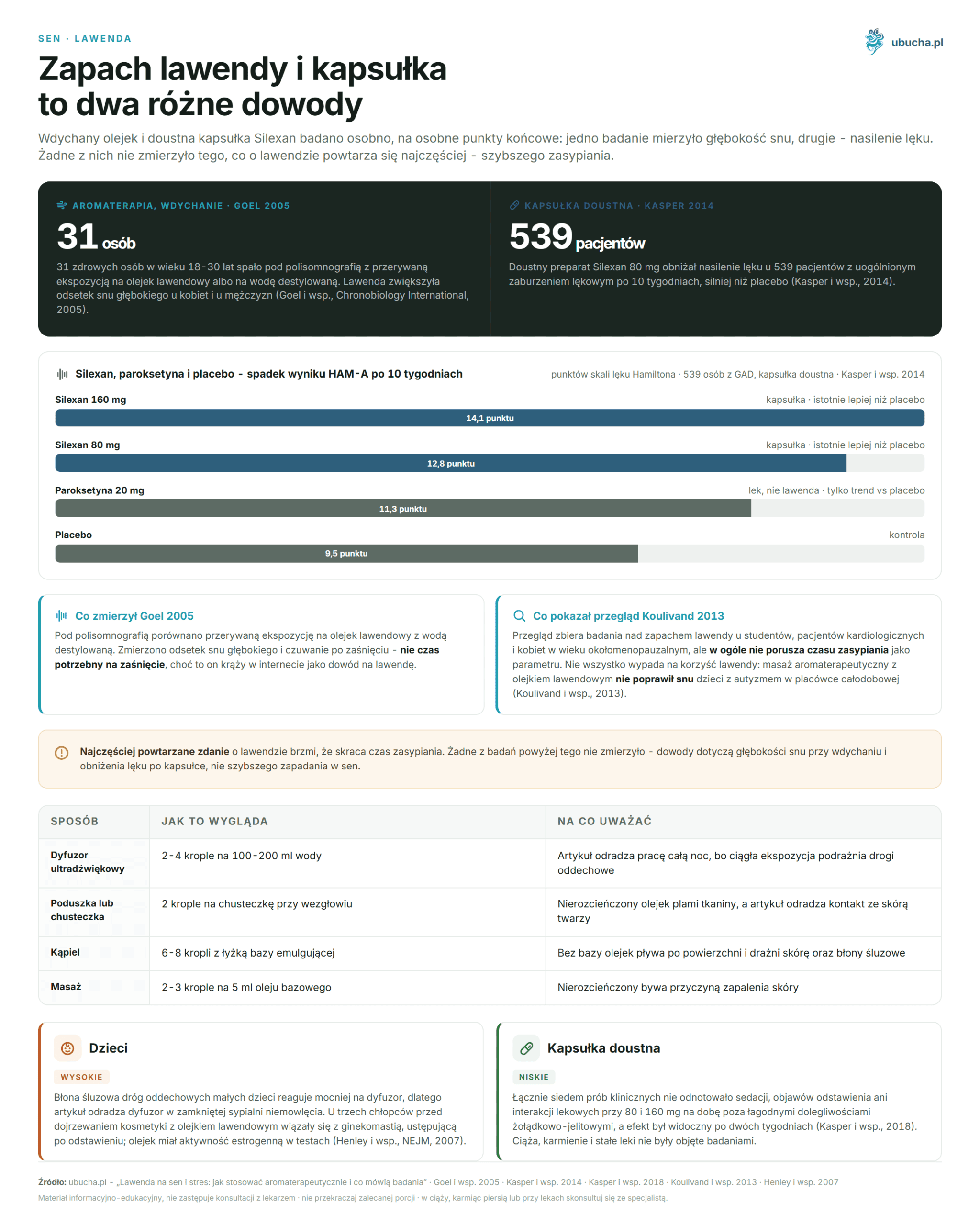
• In a sleep laboratory, 31 healthy individuals slept with exposure to lavender oil or distilled water. Lavender increased the percentage of deep sleep in both genders (Goel et al., Chronobiology International, 2005).
• The oral preparation Silexan 80 mg reduced anxiety severity in 539 patients with generalized anxiety disorder after 10 weeks, more than placebo (Kasper et al., 2014).
• A review of seven clinical trials noted no sedation, withdrawal symptoms, or drug interactions at doses of 80 and 160 mg per day (Kasper et al., 2018).
• Not everything is in favor of lavender: aromatherapy massage did not improve sleep in children with autism in a residential facility (Koulivand et al., 2013).
How does lavender differ from sedative medications?
The difference concerns side effects, not potency. A review of clinical data on the lavender oil preparation included seven trials and three preclinical publications. The authors noted a reduction in anxiety visible after two weeks, and at doses of 80 and 160 mg per day, they observed no sedation, withdrawal symptoms, or interactions with other medications. The only repeatable adverse effect is mild gastrointestinal discomfort (Kasper et al., World Journal of Biological Psychiatry, 2018).
This distinction has practical significance. Benzodiazepines act quickly, but with prolonged use, they lead to tolerance and dependence, leaving grogginess in the morning. The lavender preparation takes weeks to work, and in return, it does not impair functioning the next day. These are two different tools for two different situations, not substitutes.
It is worth stating clearly what we do not know. The molecular mechanism of lavender’s action is not resolved. Common descriptions repeat a detailed story about linalool blocking calcium channels and its similarity to buspirone, but there is no work that can be pointed to behind it. A review of data on lavender and the nervous system describes anxiolytic, calming, analgesic, and anticonvulsant properties as observations from studies on animals and humans, without resolving which receptor it acts through (Koulivand et al., Evidence-Based Complementary and Alternative Medicine, 2013). This article therefore sticks to what has been measured in clinical trials.
How to use lavender aromatherapeutically?
Lavender aromatherapy does not require a strong scent. It requires gentle exposure at the right time and dilution where the oil touches the skin. The table below summarizes four ways lavender can be incorporated into an evening ritual, along with what to watch out for with each.
| Method | What it looks like | What to watch out for |
|---|---|---|
| Ultrasonic diffuser | 2-4 drops of Lavandula angustifolia oil in 100-200 ml of water, turned on half an hour before sleep | Do not leave the device on all night. Continuous exposure irritates the respiratory tract |
| Pillow or tissue | 2 drops on a tissue placed at the head of the bed, without electricity and equipment | Undiluted oil stains fabrics. Do not place it directly on the skin of the face |
| Bath | 6-8 drops mixed with a tablespoon of emulsifying base, such as whole milk, before pouring into the tub | Without a base, the oil floats on the surface and irritates the skin and mucous membranes |
| Massage | 2-3 drops in 5 ml of base oil, rubbed into the neck and shoulders | Never undiluted. See the section on safety and children’s skin |
The label is more important here than the price. The clinical studies mentioned below were conducted on oil from narrow-leaved lavender, or Lavandula angustifolia. Lavandin, a hybrid of Lavandula x intermedia, can be a cheaper filler in blends and does not have the same research backing. If the manufacturer does not provide the species name in Latin, you do not know what you are buying.
What have studies shown about lavender and sleep?
The strongest single result comes from the sleep laboratory. Thirty-one healthy individuals aged 18-30, sixteen men and fifteen women, spent three consecutive nights under polysomnography. One night was adaptive, and the other two, in random order, involved intermittent exposure to lavender oil or distilled water. Lavender increased the percentage of deep sleep in women and men, and in the morning, all participants reported greater energy (Goel et al., Chronobiology International, 2005).
More interesting is what the study showed beyond that. Other changes varied by gender: in women, lavender prolonged the second stage of light sleep, shortened the REM phase, and shortened the time from falling asleep to the first awakening, while in men, it acted in the opposite direction. The authors describe lavender as a mild sedative with a gender-dependent effect. This is the exact opposite of the common version, in which lavender simply works the same for everyone.
A broader review collects smaller and less well-controlled studies. The scent of lavender improved average sleep quality ratings in fifteen students, in 64 patients with coronary artery disease, and in 34 perimenopausal women with insomnia. In a group of ten individuals with insomnia confirmed by the PSQI questionnaire, the score improved by 2.5 points, more strongly in women and younger individuals, and mild insomnia responded better than severe. The same review notes an opposing result: aromatherapy massage with lavender oil did not improve sleep in children with autism in a residential facility (Koulivand et al., 2013). If you are looking for a broader context, we have described it in the text about insomnia in adults and ways to sleep without sleeping pills.
What is Silexan and what did its studies show?
Silexan is a preparation of lavender oil in 80 mg capsules, intended for swallowing. The difference from aromatherapy is fundamental: the capsule goes to the digestive tract and acts systemically, so it was studied as a drug, with placebo and active comparison.
The largest trial involved 539 adults with generalized anxiety disorder diagnosed according to DSM-5, who took Silexan 160 mg, Silexan 80 mg, paroxetine 20 mg, or placebo for 10 weeks. The Hamilton anxiety scale score decreased on average by 14.1 points at 160 mg, by 12.8 points at 80 mg, by 11.3 points at paroxetine, and by 9.5 points at placebo. Both doses of Silexan performed significantly better than placebo, and paroxetine achieved only a trend in the main analysis (Kasper et al., International Journal of Neuropsychopharmacology, 2014).
The comparison with benzodiazepine comes from a separate trial. For six weeks, adults with generalized anxiety disorder received Silexan or lorazepam. The Hamilton scale score decreased by 11.3 points in the Silexan group and by 11.6 points in the lorazepam group, from a very similar baseline. The authors emphasize that lavender did not cause sedation (Woelk and Schläfke, Phytomedicine, 2010). A comparison of three trials states that lorazepam was given at a dose of 0.5 mg per day to 37 individuals, and Silexan 80 mg per day to 280 individuals (Kasper et al., Wiener Medizinische Wochenschrift, 2010).
Important caveat to all these numbers. They describe the course of specific clinical trials in individuals with diagnosed anxiety disorders and are not a guideline for how much you should take. The oral lavender preparation should be discussed with a doctor, especially if you are taking medications regularly.
Does lavender in tea work the same as the oil?
No, and it must be said frankly. All the clinical trials described above were conducted on essential oil: inhaled in the sleep laboratory or swallowed in a capsule. An infusion of dried flowers is a different preparation, with a different concentration of volatile fractions and a different route of administration. We did not find a clinical trial that measured the effect of lavender infusion on sleep, so transferring results obtained for the oil to tea would be an abuse.
This does not mean that tea is without value. An evening infusion can be the simplest possible signal of the end of the day, and a regular pre-sleep ritual in itself organizes the circadian rhythm. It is just worth knowing what to expect from it: a cup of infusion is an element of the evening routine, not a miniature of a preparation from a clinical trial. Lavender also most often appears in blends, alongside lemon balm or hops, where it is more responsible for flavor and aroma than for measurable effect. We have outlined these proportions in a comparison of sleep teas with lemon balm, lavender, and hops. If you are interested in the hop herb itself, we have separately described hops for sleep and nervousness.
Aromatherapy or capsule: what to choose for sleep issues?
This is determined by what is preventing you from falling asleep. A diffuser costs little, does not interact with medications, and is suitable for trying for a week without consulting anyone. An oral preparation is a different category of decision: it has been studied in individuals with diagnosed anxiety disorders, acts systemically, and requires a conversation with a doctor, especially with ongoing pharmacotherapy.
We noticed a discrepancy between what readers remember about lavender and what is stated in the cited works. The most frequently repeated statement is that lavender shortens the time to fall asleep. Meanwhile, Goel’s polysomnographic study measured the percentage of deep sleep and wakefulness after falling asleep, not the time it takes to fall asleep, and Koulivand’s review does not address this parameter at all. We checked the full text of both studies specifically in this regard. Lavender has evidence for sleep depth and for reducing anxiety, but not for faster onset of sleep. If your problem is that you lie awake for an hour with your eyes open, the promise tailored to that symptom likely comes from a repeated summary, not from a study.
When should caution be exercised with lavender?
Lavender aromatherapy is one of the milder applications of essential oils, but three situations require attention. The first concerns the skin: undiluted essential oil can cause contact dermatitis, so it should be diluted in a base before any application to the body. The second concerns small children, whose mucous membranes react more strongly, so a diffuser should not be placed in a closed room with an infant.
The third is more serious and is often downplayed on the internet. The New England Journal of Medicine described three prepubescent boys who developed gynecomastia while using cosmetics containing lavender oil and tea tree oil, which resolved after discontinuation. The authors then tested both oils in human cell lines and found estrogenic and anti-androgenic activity (Henley et al., New England Journal of Medicine, 2007). The common explanation that it was solely about multi-ingredient cosmetics, not the oil itself, contradicts the content of this paper: both oils were indeed tested. Therefore, regular application of lavender-containing products on the skin should be avoided in male children.
In the case of the oral preparation, the picture from clinical trials is calm: apart from mild gastrointestinal discomfort, no adverse effects, sedation, or withdrawal symptoms were noted (Kasper et al., 2018). However, pregnant and breastfeeding women and individuals taking medications regularly should discuss it with a doctor, as these groups were not included in the studies.
Frequently Asked Questions
How to use lavender aromatherapeutically for sleep?
The simplest way is through a diffuser: 2-4 drops of Lavandula angustifolia oil in 100-200 ml of water, turned on half an hour before sleep and turned off after falling asleep. Alternatively, 2 drops on a tissue placed at the head of the bed. For a bath, the oil should first be mixed with a tablespoon of emulsifying base, as without it, it floats on the surface and irritates the skin.
Does lavender really improve sleep quality?
In a sleep laboratory, 31 healthy individuals aged 18-30 slept with exposure to lavender oil and distilled water. Lavender increased the percentage of deep sleep in both genders, and in the morning participants reported more energy. Other changes varied by gender and acted in the opposite direction for women compared to men (Goel et al., 2005).
Does lavender shorten the time it takes to fall asleep?
We found no evidence for this in the studies typically cited here. Goel’s polysomnographic study measured the percentage of deep sleep and wakefulness after falling asleep, and Koulivand’s 2013 review does not discuss the time it takes to fall asleep at all. Evidence pertains to sleep depth and reduced anxiety, not faster onset of sleep.
What is Silexan and what did its studies show?
Silexan is a preparation of lavender oil in 80 mg capsules, studied orally. In a trial involving 539 adults with generalized anxiety disorder, after 10 weeks it reduced the Hamilton anxiety scale score by 12.8 points at a dose of 80 mg compared to 9.5 points with placebo (Kasper et al., 2014). Its use is determined by a doctor.
Does lavender help with anxiety and nervousness?
In anxiety disorders, an oral lavender preparation was studied, not the scent. A review of seven clinical trials describes a reduction in anxiety visible after two weeks, comparable to lorazepam or paroxetine, without sedation, withdrawal symptoms, or drug interactions at doses of 80 and 160 mg per day (Kasper et al., 2018).
Is lavender safe for children and pregnant women?
The oil should never be applied undiluted to a child’s skin, and cases of gynecomastia have been reported in prepubescent boys after using lavender-containing cosmetics, with confirmed estrogenic activity of the oil itself (Henley et al., 2007). The oral preparation has not been studied in pregnancy or breastfeeding, so the decision should be made with a doctor.
In the category of herbs, you will find, among others, dried hop cones and valerian extract, two raw materials that appear alongside lavender in evening blends.
This article is for informational and educational purposes and does not constitute medical advice. Before starting supplementation, consult a doctor, especially if you are taking medications regularly, are pregnant or breastfeeding, or have a chronic illness.
Author: Michał Waluk · Published: 2026-05-29 · Updated: 2026-08-16