
Smoking Dried Chamomile: What Effects Does It Have and Is It Worth It
Smoking chamomile: this has not been studied in humans, and nicotine-free herbal smoke produced more carbon monoxide than tobacco. Check what has been shown for infusions.
Smoking dried chamomile has no confirmed effects because no one has measured them in humans. The calming effect of this plant has been demonstrated for infusions and oral extracts, meaning for the digestive tract. Smoke is a different substance than the plant from which it starts, and a different route of administration, so results from one do not transfer to the other. Chamomile is included in smoking blends mainly for its mild flavor. What users describe as calmness is a description of the ritual and slow breathing, not a measured effect of apigenin. Below you will find what can be said about smoking chamomile based on measurements: what has been shown for infusions, what has not been shown for smoke, how many toxins have been measured in the smoke of a nicotine-free herbal cigarette, and what remains instead of fire.
KEY INFORMATION
• There is not a single clinical study on inhaling chamomile smoke in humans.
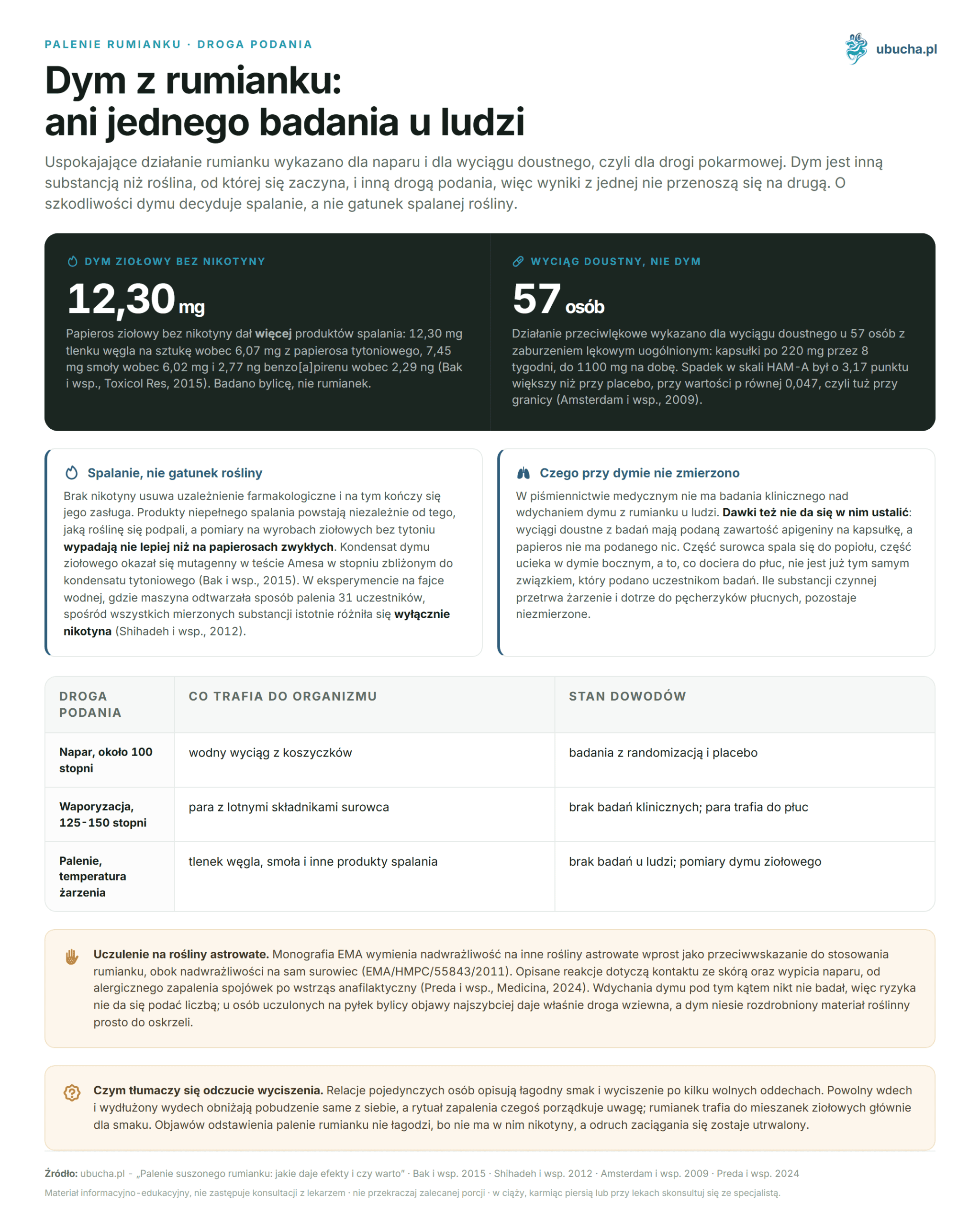
• A nicotine-free herbal cigarette produced 12.30 mg of carbon monoxide per piece compared to 6.07 mg from a tobacco cigarette (Bak et al., Toxicol Res, 2015).
• In the same measurement, tar was 7.45 mg compared to 6.02 mg, and benzo[a]pyrene was 2.77 ng compared to 2.29 ng per piece (Bak et al., 2015).
• The anxiolytic effect of chamomile has been demonstrated for oral extracts in 57 individuals with generalized anxiety disorder (Amsterdam et al., 2009).
• The EMA monograph lists hypersensitivity to other Asteraceae plants as a contraindication for the use of chamomile (EMA/HMPC/55843/2011).
• For vaporizing chamomile, we provide a range of 125-150 degrees, which is below the combustion threshold.
What effects does smoking dried chamomile have?
It is unknown because no one has measured it. In the medical literature, there is no clinical study that has examined what happens to a person inhaling smoke from chamomile flower heads. Everything circulating on this topic online are accounts from individuals describing a mild flavor and a feeling of calm after a few slow breaths.
This description likely has an explanation that does not require any plant. Slow inhalation and prolonged exhalation lower arousal by themselves, and the ritual of lighting something organizes attention. Chamomile adds flavor to this, and that is mainly why it is included in herbal blends, alongside peppermint and lavender.
What smoking chamomile definitely does not provide is well known. It does not alleviate withdrawal symptoms because it does not contain nicotine. It does not act psychoactively because it does not contain cannabinoids. It is also impossible to establish a dose: oral extracts from studies have the apigenin content stated per capsule, while a cigarette does not state anything. Part of the material burns to ash, part escapes in side smoke, and what reaches the lungs is no longer the same compound that was given to study participants.
The question about the effects of smoking chamomile comes up regularly, and an honest answer is shorter than the question. Effects have not been described because there was nothing to describe.
Does the calming effect of chamomile transfer from infusion to smoke?
There is no data on this, and both routes of administration must be separated. Everything known about the calming effect of chamomile comes from studies on oral administration, meaning capsules with extract or infusion. Neither of these concerned inhaling smoke.
The strongest single result comes from a randomized placebo-controlled study in which 57 individuals with generalized anxiety disorder took chamomile extract in capsules for 8 weeks at 220 mg, up to 1100 mg per day. The decrease on the HAM-A scale was 3.17 points greater than in the placebo group, with a confidence interval from 0.45 to 6.29 and a p-value of 0.047 (Amsterdam et al., J Clin Psychopharmacol, 2009). A statistically significant result, but just at the threshold.
In the case of insomnia, the picture is weaker. In a placebo study, 34 individuals with chronic primary insomnia took 270 mg of extract twice daily for 28 days and no significant differences were obtained in any parameter from the sleep diary (Zick et al., BMC Complement Altern Med, 2011). Where oral chamomile helps and where it does not, we have outlined in the post about chamomile for sleep and generalized anxiety.
To transfer these results to smoke, one would need to know how much apigenin survives the burning temperature and how much of it reaches the lung alveoli. No one has measured this, so every statement about calming chamomile smoke is an inference by analogy.
Does the absence of nicotine make chamomile smoke safer?
No, in what matters. The absence of nicotine removes pharmacological dependence, and that is where its merit ends. Incomplete combustion products are produced regardless of what plant you light, and measurements on nicotine-free herbal products do not fare any better than regular cigarettes.
In the analysis of the main smoke from a Korean nicotine-free herbal cigarette made from mugwort, 12.30 mg of carbon monoxide per piece was measured compared to 6.07 mg from a tobacco cigarette, 7.45 mg of tar compared to 6.02 mg, and 2.77 ng of benzo[a]pyrene compared to 2.29 ng. The condensate of herbal smoke turned out to be mutagenic in the Ames test to a degree similar to that of tobacco condensate (Bak et al., Toxicol Res, 2015). Mugwort was studied, not chamomile, but the mechanism does not depend on the species.
The same conclusion was reached in an experiment on a water pipe, where a machine replicated the smoking method of 31 participants, once with tobacco and once with its nicotine-free herbal equivalent. Among all measured substances, only nicotine differed significantly (Shihadeh et al., Food Chem Toxicol, 2012).
This issue has been resolved by the service in a separate text, and nothing in the new data changes that: the harm of smoke is determined by combustion, not by the species of the burned plant. We have gathered measurements and conclusions in a guide on whether herbal cigarettes are safe.
Who is at risk of an allergic reaction from smoking chamomile?
Individuals allergic to Asteraceae plants. Chamomile belongs to the same family as mugwort, ragweed, marigold, and daisy. The EMA monograph lists hypersensitivity to other Asteraceae plants as a contraindication, alongside hypersensitivity to the raw material itself (EMA/HMPC/55843/2011).
In the allergy literature, the mechanism is called the mugwort-chamomile association. The primary allergy concerns the pollen of common mugwort, and symptoms appear secondarily after contact with chamomile, ranging from allergic conjunctivitis to anaphylactic shock. The defensin Art v 1 is likely responsible for the cross-reaction. There are few well-documented cases of anaphylaxis after chamomile, but the authors of the review consider the scale of the phenomenon to be underestimated (Preda et al., Medicina, 2024).
Described reactions concern skin contact and drinking the infusion. No one has studied inhaling chamomile smoke in this regard, so the risk cannot be quantified. It is known, however, that in individuals allergic to mugwort pollen, the inhalation route gives symptoms the fastest, and smoke carries fragmented plant material straight to the bronchi. Asthma and chronic obstructive pulmonary disease are separate reasons to keep fire away from the respiratory tract.
What to replace smoking chamomile with?
With an infusion or vaporization, depending on why you reach for chamomile. The infusion has studies with randomization and stated doses. Vaporization does not lead the material to combustion, so it does not produce carbon monoxide or tar, although vapor also reaches the lungs and is not neutral.
| Route of Administration | Temperature | What Reaches the Body | State of Evidence |
|---|---|---|---|
| Infusion | about 100 degrees | water extract from flower heads | randomized and placebo studies (Amsterdam 2009, Zick 2011) |
| Vaporization | 125-150 degrees | vapor with volatile components of the material | no clinical studies on vaporizing chamomile |
| Smoking | combustion temperature, many times higher | incomplete combustion products, including carbon monoxide and tar | no studies in humans; measurements of herbal smoke (Bak 2015) |
The range of 125-150 degrees for chamomile was provided in the temperature guide for vaporizing herbs. If you are looking for material intended for a vaporizer, we have gathered dried herbs for this purpose in the dried herbs category. If you were looking for a cigarette substitute, we compared herbal blends in the text about what to smoke instead of tobacco.
Frequently Asked Questions
Does smoking chamomile have a calming effect?
This has not been demonstrated in humans. The anxiolytic effect of chamomile has been described for oral extracts, not for smoke. The feeling of calm after smoking the herb is more likely explained by slow breathing and the ritual itself than by any component of the plant.
Is chamomile smoke less harmful than tobacco smoke?
Not in terms of combustion products. In the smoke of a nicotine-free herbal cigarette, 12.30 mg of carbon monoxide per piece was measured compared to 6.07 mg from a tobacco cigarette, and the smoke condensate was mutagenic to a degree similar to that of tobacco (Bak et al., 2015).
Does smoking chamomile help quit smoking?
There is no evidence. Chamomile does not provide nicotine, so it does not alleviate withdrawal symptoms, and the inhalation reflex remains reinforced. Proven effective methods are nicotine replacement and medications prescribed by a doctor.
How much chamomile do you need to smoke to feel something?
No such dose has been established. Studies on chamomile operate with doses of oral extracts measured in milligrams per capsule. How much active substance survives burning and reaches the lung alveoli remains unmeasured.
Is chamomile from a tea bag suitable for smoking?
It is not intended for that. The material for brewing can be finely ground and contains dust that, when ignited, enters the respiratory tract. Lack of intended use for smoking also means no control over smoke parameters.
Can smoking chamomile cause an allergic reaction?
Yes, in individuals allergic to Asteraceae plants. Reactions to chamomile have been described after skin contact and after drinking the infusion, ranging from conjunctivitis to anaphylactic shock (Preda et al., 2024). Inhalation of smoke has not been studied in this regard.
Is vaporizing chamomile safer than smoking?
It is less burdensome because the material does not reach combustion, so carbon monoxide and tar are not produced. For chamomile, we provide a range of 125-150 degrees. The vapor still reaches the lungs, and there are no clinical studies on vaporizing chamomile.
Does smoking chamomile harm the lungs?
This has not been directly studied. The smoke from any burned plant carries reactive forms of oxygen and nitrogen, which trigger oxidative stress and an inflammatory response, and these drive each other (Caliri et al., 2021).
This article is for informational and educational purposes and does not replace consultation with a doctor. If you are pregnant, breastfeeding, taking medications, or have chronic conditions, consult the use of supplements or herbs with a specialist.
Author: Michał Waluk · Published: 2026-08-24 · Updated: 2026-08-24