
Can you smoke mint? What is known about the effects of smoking mint
Can you smoke mint? We found no studies on smoke from mint leaves in PubMed. We check what is known about menthol in smoke, who may be harmed by mint, and what the law says.
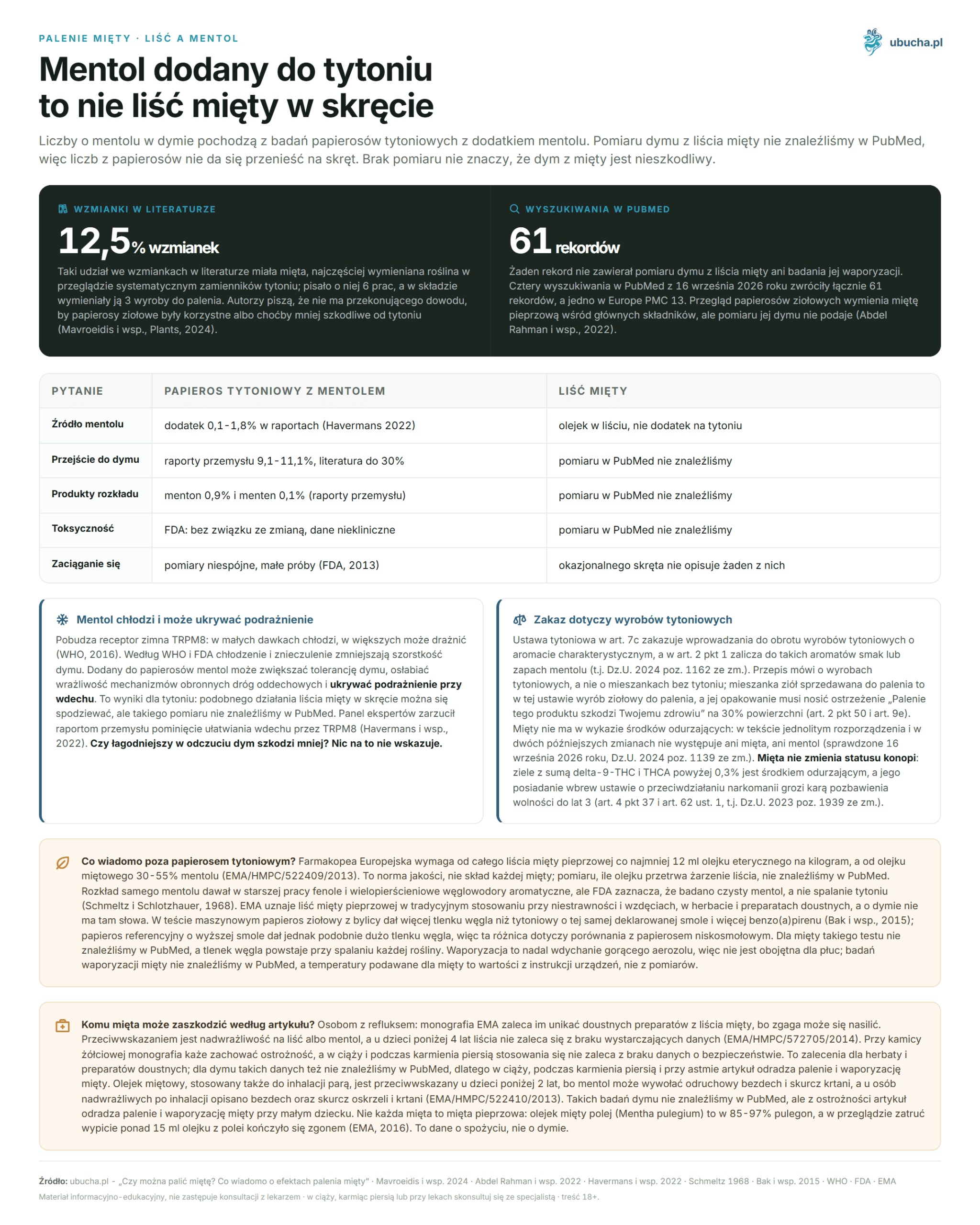
Can you smoke mint? Mint is not on the Polish list of narcotic substances, and the statutory ban on menthol flavor applies to tobacco products. Whether its smoke is safe has not been checked: we found no study measuring the composition of smoke from mint leaves. In a systematic review of tobacco substitutes, mint was the most frequently mentioned plant, with 12.5% mentions in the literature (Mavroeidis et al., Plants, 2024). Data on menthol in smoke comes from studies of mentholated tobacco cigarettes. From this text, you will learn what these studies show and where they end. We also describe who mint may harm, what changes a joint with mint instead of tobacco brings, and what the regulations say.
KEY INFORMATION
• Mint was the most frequently mentioned plant in the systematic review of tobacco substitutes, with 12.5% mentions (Mavroeidis et al., 2024).
• We found no measurement of smoke from mint leaves in PubMed.
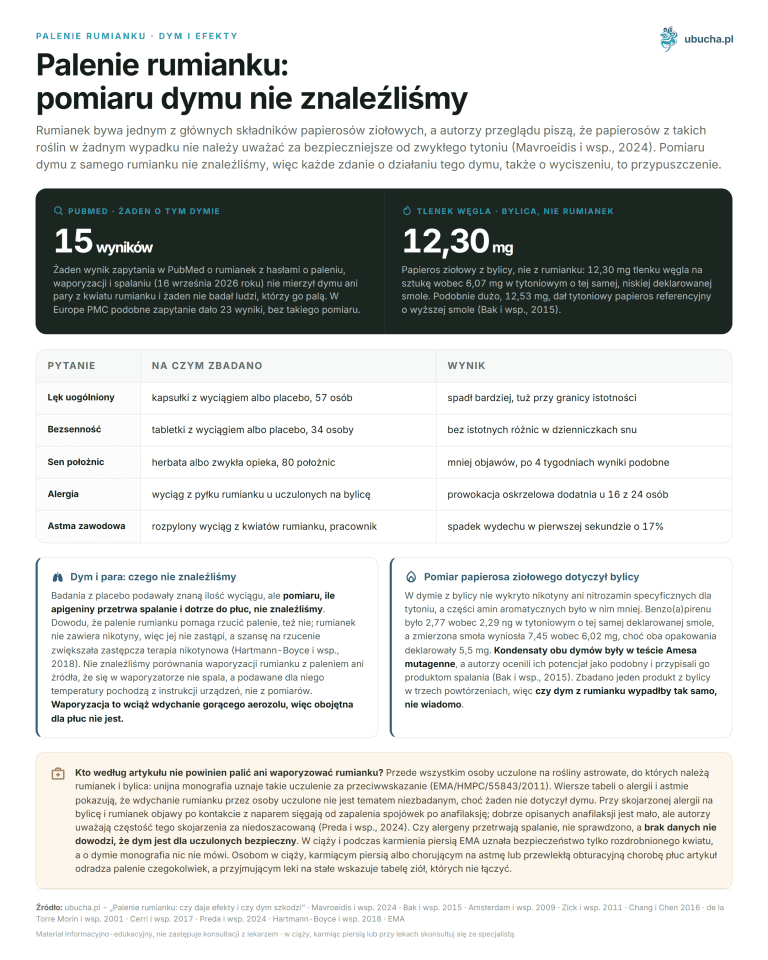
• A herbal cigarette produced 12.30 mg of carbon monoxide compared to 6.07 mg from a tobacco cigarette with the same declared tar (Bak et al., 2015).
• The statutory ban on menthol flavor applies to tobacco products.
Has anyone studied smoke from mint leaves?
We found no such study. A review of herbal cigarettes from 2022 mentions peppermint as one of the main ingredients of such products, but does not provide a measurement of smoke from mint itself (Abdel Rahman et al., ACS Omega, 2022).
We checked this on September 16, 2026. Four searches in PubMed returned a total of 61 records, and one in Europe PMC 13. No record contained a measurement of smoke from mint leaves or a study of its vaporization. Works on the distribution of menthol in smoke concerned tobacco, e-cigarettes, or the menthol additive itself.
In the review by Mavroeidis et al. on mint, 6 works mentioned it, and 3 products for smoking included it. However, the authors note that there is no convincing evidence that herbal cigarettes are beneficial or even less harmful than tobacco (Mavroeidis et al., 2024).
The lack of measurement does not mean that smoke from mint is harmless. It only means that we found no such measurement. What is known about herbal cigarettes in general is described in our text on whether herbal cigarettes are safe.
What effects does smoking mint have?
No one has measured this: we found no study on the effect of mint smoke on mood or well-being. It is known what menthol does. It stimulates the cold receptor TRPM8, so in small doses it cools and alleviates pain, while in larger doses it can irritate and hurt (WHO, advisory note TobReg on menthol, 2016).
According to WHO and the US FDA, cooling and numbing reduce the harshness of smoke. Added to cigarettes, menthol may increase smoke tolerance, weaken the sensitivity of the respiratory defense mechanisms, and mask irritation upon inhalation. These are results for tobacco. A similar effect of mint leaves in a joint can be expected, but we found no such measurement. Does a milder-feeling smoke harm less? There is no evidence for that.
As a medicine, mint leaves have one recognized use. The European Medicines Agency recognizes peppermint leaves for traditional use in digestive ailments, such as indigestion and bloating, in tea and oral preparations (EMA, summary EMA/60946/2020). There is no mention of smoke there, just as in the case of smoking dried chamomile.
Does menthol make you inhale deeper?
Measurements are inconsistent. In a 2013 FDA review, women smoking menthol cigarettes (49 people) took deeper puffs than those smoking regular cigarettes (46 people). In another study, on 18 and 18 people, menthol did not change the smoking method (FDA, menthol cigarette assessment, 2013).
The third study gave a result opposite to the first. There, 29 men smoking non-menthol cigarettes took 22% more puffs, with an average volume 13% larger than with menthol cigarettes. Puff volume is not the same as inhalation depth. The trials were small, so no result resolves the issue.
WHO, following the FDA advisory committee, states that menthol did not seem to increase smoke inhalation, and data from smokers are mixed. The assumption that menthol promotes deeper inhalation or longer retention of smoke in the lungs is described in the report as speculation.
The comparison of these works shows a greater gap than the dispute itself. All concern tobacco smokers. WHO also states that no studies have been found on the effect of menthol on inhalation methods in people who are just starting to smoke, smoke little, or smoke occasionally. No results describe an occasional joint with mint without tobacco.
How much menthol passes into smoke and what is produced from it?
For mint leaves, we found no such measurements. The data found concern tobacco cigarettes with added menthol. According to industry reports, 9.1-11.1% of menthol passed into smoke, and according to the literature, up to 30%. Reports from 12 manufacturers were evaluated by a panel of 10 independent experts (Havermans et al., Tob Prev Cessat, 2022).
According to the same reports, with the addition of 0.1-1.8% menthol to tobacco, the main degradation products were mentone (0.9%) and menthene (0.1%), and menthol itself mostly passed into smoke unchanged. The panel criticized the reports for omitting the facilitation of inhalation by the TRPM8 receptor.
The FDA concluded based on non-clinical studies that menthol in cigarettes is not associated with a change in smoke toxicity. The degradation of menthol itself produced phenols and polycyclic aromatic hydrocarbons, but the FDA notes that pure menthol was studied, not the combustion of tobacco (Schmeltz and Schlotzhauer, Nature, 1968).
The European Pharmacopoeia requires whole peppermint leaves (Mentha x piperita) to contain at least 12 ml of essential oil per kilogram, and peppermint oil to contain 30-55% menthol (EMA, report EMA/HMPC/522409/2013). This is a quality standard, not the composition of every mint. Menthol is not an additive in tobacco here, and we found no measurement of how much oil survives the burning of the leaf. Therefore, numbers from cigarettes cannot be transferred to a joint.
Who may be harmed by mint?
Primarily people with reflux. The EMA monograph advises them to avoid oral preparations with mint leaves, as heartburn may worsen. Contraindications include hypersensitivity to leaves or menthol, and for children under 4 years, leaves are not recommended due to insufficient data (EMA/HMPC/572705/2014).
These are recommendations for tea and oral preparations. The monograph also advises caution in cases of gallstones. Due to insufficient safety data during pregnancy and breastfeeding, use during this time is not recommended. We found no such data for smoke, so we advise against smoking and vaporizing mint during that time, as well as in cases of asthma.
Mint oil, also used for steam inhalation, is contraindicated in children under 2 years, as menthol can cause reflex apnea and laryngeal spasm. In sensitive individuals, apnea and bronchial and laryngeal spasms have been reported after inhalation (EMA/HMPC/522410/2013). We found no such studies on smoke, but out of caution, do not smoke or vaporize mint around small children.
Not every mint is peppermint. Pennyroyal mint oil (Mentha pulegium) is 85-97% pulegone, and in a review of poisonings, drinking more than 15 ml of pennyroyal oil ended in death (EMA, statement on pulegone and menthofuran, 2016). These are data on consumption, not on smoke.
Does mint in a joint instead of tobacco reduce harm?
Only partially: it removes nicotine, but not smoke. In a machine test, a herbal cigarette made from mugwort produced 12.30 mg of carbon monoxide compared to 6.07 mg from a tobacco cigarette with the same declared tar. It also had more benzo(a)pyrene (Bak et al., Toxicological Research, 2015). A reference cigarette with higher tar produced a similar amount of carbon monoxide, 12.53 mg, so the difference concerns the comparison with a low-tar cigarette. We found no such test for mint.
Carbon monoxide is produced when burning any plant. Does menthol make smoke less toxic? In tobacco cigarettes, according to the FDA, no. Which plants should not be put in a joint, we described in our text on what to smoke instead of tobacco in a joint.
Vaporization does not bring the raw material to combustion. Our guide to herb vaporization states for mint 150-170 degrees, but these are values from device instructions, not from measurements. We found no studies on mint vaporization. Devices with temperature control can be found in the vaporizer category, and accessories for grinding herbs before placing them in the chamber in the grinders category.
Vaporization is still inhaling hot aerosol, so it is not neutral for the lungs. A comparison of routes of administration can be found in the text bong, vaporizer or joint: which is least harmful.
What does Polish law say about smoking mint?
Mint is not on the list of narcotic substances and psychotropic substances. In the consolidated text of the regulation and in two later amendments, neither mint nor menthol appears. We checked this on September 16, 2026 (regulation of the Minister of Health, t.j. Dz.U. 2024 poz. 1139 ze zm.).
Article 7c of the Tobacco Act prohibits the marketing of tobacco products with characteristic flavors, and Article 2 point 1 includes menthol flavor or scent among such flavors (t.j. Dz.U. 2024 poz. 1162 ze zm.). The provision refers to tobacco products, not to mixtures without tobacco.
A herbal mixture sold for smoking is considered a herbal product for smoking under this law. Its packaging must carry the warning “Smoking this product harms your health” on 30% of the surface (Article 2 point 50 and Article 9e).
Mint does not change the status of cannabis. Cannabis with a total delta-9-THC and THCA content above 0.3% is a narcotic substance, and possession of it in violation of the Act on Counteracting Drug Addiction carries a penalty of imprisonment for up to 3 years (Article 4 point 37 and Article 62 paragraph 1, t.j. Dz.U. 2023 poz. 1939 ze zm.). Article 20 of this law prohibits advertising and promotion of narcotic substances, which is why we write about the risks, not the effects of a joint.
Frequently Asked Questions
Can you smoke mint?
Mint is not on the Polish list of narcotic substances (Dz.U. 2024 poz. 1139 ze zm.), and the ban on menthol flavor from Article 7c of the Tobacco Act applies to tobacco products. Health-wise, this is untested: in searches on PubMed from September 16, 2026, we found no measurement of smoke from mint leaves, and data on menthol in smoke comes from mentholated tobacco cigarettes.
What effects does smoking mint have?
We found no studies on these effects. It is only known what menthol does: it stimulates the cold receptor TRPM8, so in small doses it cools, and in larger doses it can irritate (WHO, 2016). The European Medicines Agency recognizes mint leaves for digestive ailments, such as indigestion and bloating, in the form of tea or oral preparations. Its documents on mint do not mention smoke.
Is smoking mint healthy?
There is no evidence for this. In a review of tobacco substitutes, mint had the most mentions in the literature, 12.5%, but the authors state that there is no convincing evidence of reduced harm from herbal cigarettes (Mavroeidis et al., 2024). In tobacco cigarettes, menthol may mask irritation, and according to the FDA, it is not associated with a change in the toxicity of their smoke.
Is a joint with mint less harmful than one with tobacco?
The absence of tobacco removes nicotine, but not smoke. In a machine test, a herbal cigarette without tobacco produced 12.30 mg of carbon monoxide per piece compared to 6.07 mg from a tobacco cigarette with the same declared tar (Bak et al., 2015). We found no studies on mint smoke in a joint, and menthol may mask its harshness.
At what temperature does mint vaporize?
Our guide to herb vaporization states for mint 150-170 degrees. These are values from device instructions, not from measurements. We found no studies on mint vaporization: a search in PubMed from September 16, 2026, yielded 2 results, none on this topic. The vapor still reaches the lungs.
This article is for informational and educational purposes and does not replace consultation with a doctor. If you are pregnant, breastfeeding, taking medications, or have chronic conditions, consult the use of supplements or herbs with a specialist.
Author: Michał Waluk · Published: 2026-09-17 · Updated: 2026-09-17