
How to make hemp chocolate? Step by step recipe with CBD dosing
How to make hemp chocolate with CBD at home: three methods, exact dosing in mg, decarboxylation of herb, and safe storage of the bar.
Hemp chocolate is experiencing a renaissance among Polish CBD enthusiasts. According to Grand View Research, the global CBD market is expected to reach USD 22.05 billion by 2030, growing at a rate of 15.8% annually, with edibles being one of the fastest-growing segments of this market. Chocolate is an almost ideal fat matrix for CBD, as cocoa butter melts close to body temperature and promotes intestinal absorption, significantly more effectively than dry herb or capsules. In this guide, we show three proven methods for making hemp chocolate at home, exact doses in milligrams, and what in this process really requires precision and what is a kitchen myth repeated without verification. You will also learn how long to realistically wait for the effect and how to safely store the finished bar.
KEY INFORMATION
• Three preparation methods: CBD oil mixed into melted chocolate (the simplest), infusion of cocoa butter with decarboxylated herb (full spectrum), crystalline CBD isolate (no herbal aftertaste).
• Oral bioavailability of CBD is only 4-12% on an empty stomach, and fat in the meal can increase it up to 4 times (Millar et al., 2018; Birnbaum et al., 2019).
• The effect begins after 30-90 minutes, peaks at 2-4 hours, and lasts 4-8 hours (Newmeyer et al., 2017).
• In Poland, CBD is legal with a total THC content of up to 0.3% (the Act on counteracting drug addiction). In the EU, CBD edibles remain in an uncertain Novel Food status (Regulation 2015/2283).
• This is not medical advice. Always label homemade products as “CBD” and keep out of reach of children.
How to make hemp chocolate at home? Three proven methods
Hemp chocolate can be prepared in three ways: by mixing CBD oil into melted dark chocolate, infusing cocoa butter with decarboxylated industrial herb, or adding crystalline CBD isolate to tempered chocolate. The quickest method takes 35 minutes, and the bioavailability of CBD consumed with a fat matrix reaches 4-12% (Millar et al., 2018).
Each variant has its strengths:
- CBD oil - choose if you want a repeatable dose and do not have a thermometer. The cannabinoids are already decarboxylated and dissolved in a fat carrier.
- Cocoa butter infusion - choose if you care about a full spectrum of cannabinoids and terpenes; the side effect is a hint of “herbiness” appreciated by connoisseurs.
- Crystalline isolate - choose for gifts or chocolate for those sensitive to herbal flavors; it does not change the flavor profile of the chocolate.
Each method scales from 100 g to 1 kg of chocolate without changing the proportions, so once you master the recipe, you can repeat it in any quantity. We recommend beginners start with CBD oil - the least variables to control and the lowest risk of wasting raw material on the first try.
Why is it worth making hemp chocolate yourself?
Homemade production gives full control over the dose of CBD in a single piece, the choice of cocoa beans, and the ingredient list without unnecessary additives. A homemade recipe usually consists of 4-6 ingredients, while industrial chocolates have many more, resulting in a cleaner sensory profile and a lower risk of allergic reactions.
Three main reasons to work independently are dose, quality, and cost. Commercial CBD chocolates in Poland cost 90-150 PLN for 100 g with a content of 100-300 mg of CBD (indicative state, market prices change quickly). Homemade production with 10% CBD oil reduces the cost of raw materials to about 35-45 PLN for a 100 g bar with 200 mg of CBD.
From our experience: when testing three CBD oils from different manufacturers on the same bar, a 70% MCT-based oil produced a smooth emulsion, hemp oil left a slightly grassy aftertaste, and isolate oil did not change the flavor profile at all. For white chocolate, isolate works better, while for dark chocolate, hemp oil is preferable.
Homemade production also allows for precise calculation of CBD content in each piece, as you only need to know the concentration of the oil and its volume. Commercial products often state the dose “per bar” rather than “per piece,” making microdosing more difficult.
What ingredients are needed for homemade hemp chocolate?
The basic list contains five items, described in the table below. Dark chocolate 70-85% guarantees a high cocoa butter content (about 35-42%), a natural carrier for lipophilic CBD. Milk chocolate 50% contains too little fat, and CBD precipitates as a layer on the surface.
| Ingredient | Amount | Function |
|---|---|---|
| Dark chocolate 70-85% | 200 g | Fat-sugar matrix, flavor carrier |
| CBD oil 5% or 10% | 1-3 g | Active CBD carrier |
| Decarboxylated industrial herb | 5-10 g (optional) | Alternative to oil, full spectrum |
| Flavors (salt, mint, chili, cardamom) | 0.5-1% of the weight of chocolate | Flavor modulation through TRPV1/TRPM8 receptors |
| Silicone mold | 12-24 cavities | Molding and cooling bars |
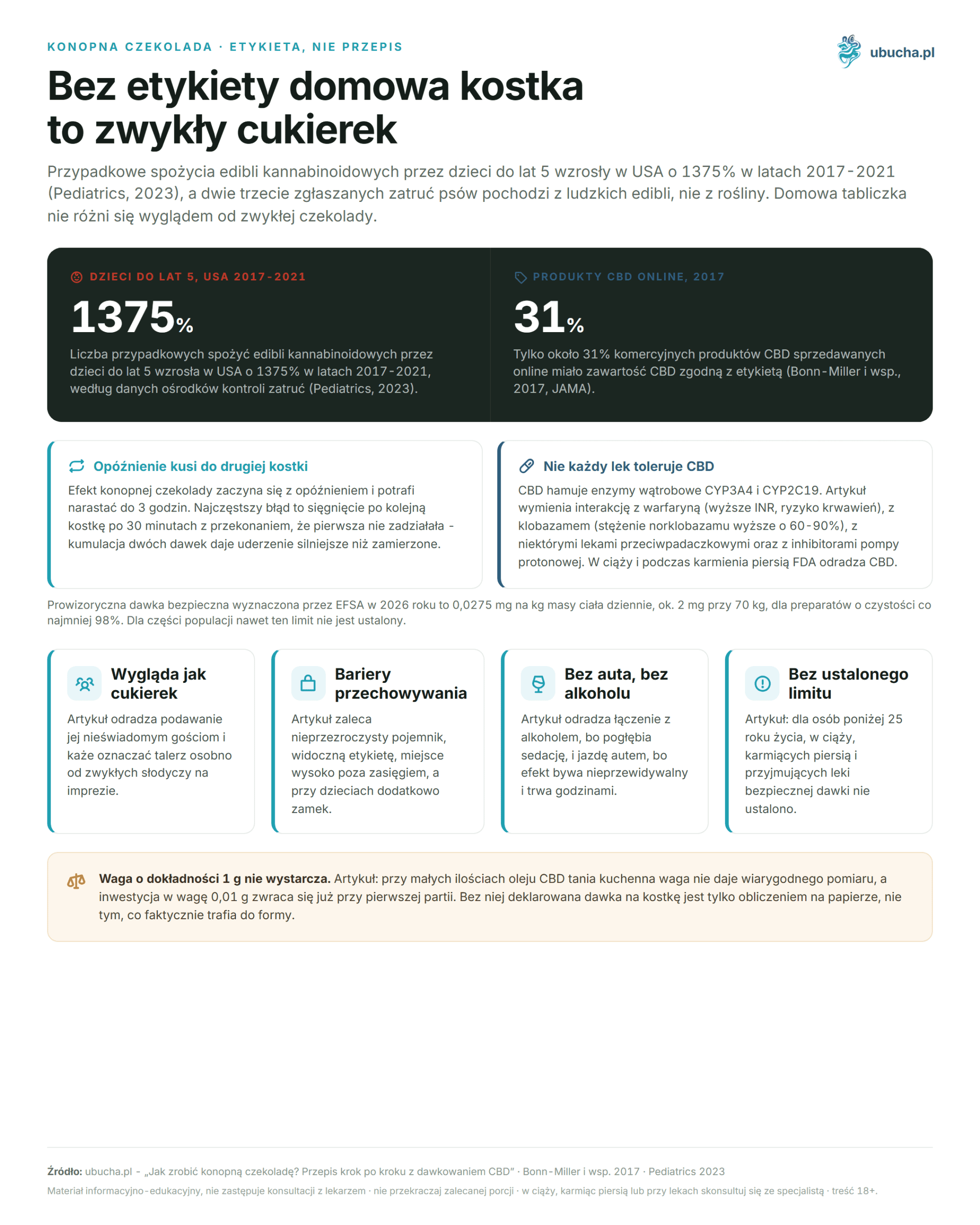
Advanced confectioners can also build chocolate from scratch with raw materials: 100 g of cocoa butter, 80 g of cocoa paste (or 60 g of natural cocoa and 20 g of butter), 40-60 g of powdered erythritol, and 1 g of sunflower lecithin. This version provides keto-friendly chocolate without sucrose, which can be important for people with insulin resistance. CBD oil 5% (50 mg/ml) or 10% (100 mg/ml) is the most convenient for dosing; crystalline CBD isolate (99% purity) requires dissolving in hot fat. Always check the manufacturer’s certificate of analysis (COA), as the Bonn-Miller et al. (2017, JAMA) study found that only about 31% of commercial CBD products sold online had content consistent with the label (Bonn-Miller et al., 2017).
Does hemp herb require decarboxylation before use in chocolate?
Yes, raw hemp herb contains cannabinoids in acidic form (CBDA, THCA), which require thermal activation to physiologically active forms (CBD, THC). This process is essential for herb but unnecessary for ready-made CBD oils or isolates, which are already decarboxylated.
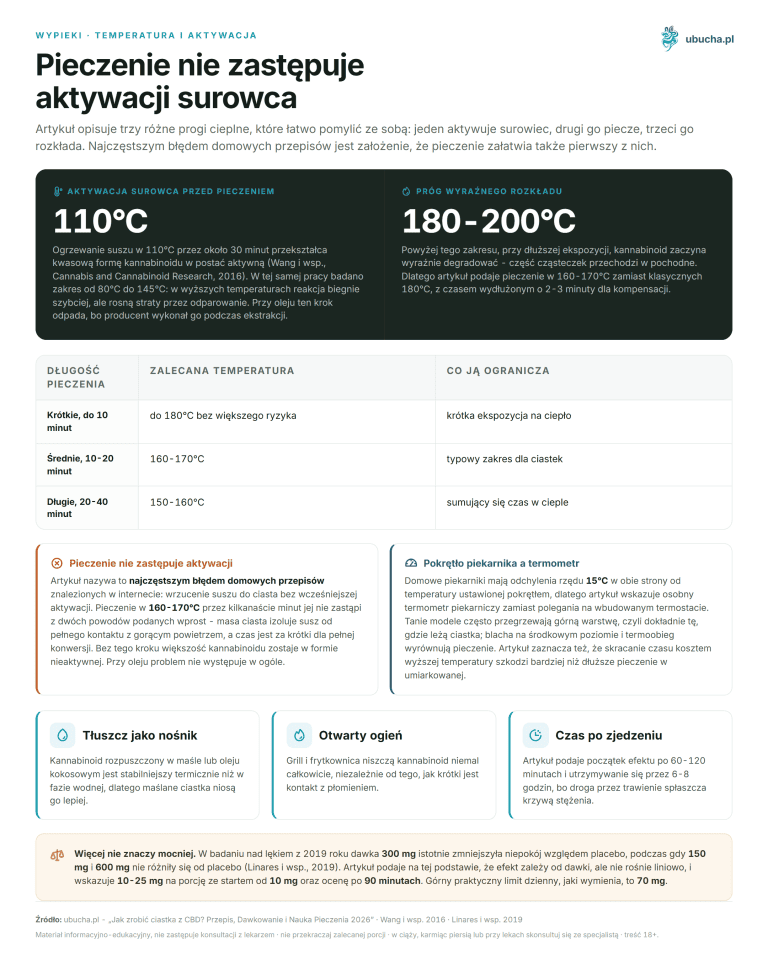
The study on decarboxylation kinetics by Wang et al. (2016) tested temperatures from 80°C to 145°C and showed that the process follows first-order kinetics: the higher the temperature, the faster it proceeds, and the acidic precursors of THC decompose about twice as fast as their CBD counterparts (Wang et al., 2016). In home practice, a range of 110-120°C for 30-45 minutes works well: undercooking leaves a large portion of cannabinoids in inactive form, while significant overheating destroys the terpenes responsible for the entourage effect. Decarboxylation should not be done “by eye” - a baking thermometer is needed.
From our experience: the first batch of herb was decarboxylated at 140°C for 60 minutes, following older English-language guides. The chocolate turned out bitter, poorly active, and smelled of burnt hay. After switching to 115°C for 40 minutes, the sensory profile was significantly better.
How to decarboxylate herb step by step?
- Grind the herb into pieces of 2-4 mm using a coffee grinder or scissors.
- Spread an even layer on parchment paper in a baking tray.
- Preheat the oven to 115°C, with the convection turned off, so as not to blow away the terpenes.
- Bake for 35-40 minutes, stirring with a spoon after 20 minutes.
- Check the color - the herb should take on a light brown hue.
- Cool under cover to retain the terpenes in the container.
Professionals use a sous vide circulator set to 95°C for 120 minutes instead of an oven: the herb is vacuum-packed, which limits terpene loss and provides repeatability close to laboratory standards. This method is the cleanest but requires equipment costing several hundred PLN, so it mainly makes sense for frequent recipe repetition. The same decarboxylation procedure can also be used when making hemp butter if you prefer a buttery base instead of cocoa. The smell in the kitchen during decarboxylation can be intense, so it is worth cracking a window or turning on the hood. If you are unsure whether the herb is ready, it is better to bake it for 5 more minutes than risk underactivated cannabinoids - overheating for a few minutes is less harmful than undercooking the entire batch.
How to melt chocolate to maintain good texture?
We melt chocolate using the bain-marie method, maintaining the mass temperature at 45-50°C. This choice is dictated by the quality of the chocolate itself, not the protection of CBD: cannabidiol is thermally stable far above kitchen temperatures, and significant degradation begins only around 160°C. The reason for temperature control is different: above 60-70°C, chocolate loses its shine and crispness (the so-called snap), and when in contact with a drop of water, the fat separates from the sugar, causing the mass to “seize” and become lumpy.
- Prepare the water bath - pour 3-4 cm of water into a saucepan, bring to a gentle simmer, without boiling.
- Set the glass bowl so that it does not touch the water.
- Add the chocolate broken into 1 cm pieces.
- Stir with a silicone spatula in an 8 shape for 5-7 minutes until the mass is liquid.
- Remove from heat when about 80% of the pieces have melted - the rest will melt by stirring off the heat.
The most common mistake is water from the bath getting into the mass: just 1-2 drops cause the chocolate to seize. The second is mixing cold CBD oil with hot chocolate, which causes thermal shock and breaks the emulsion - it is worth warming the CBD oil in a separate bowl to about 35°C beforehand.
How to mix CBD oil into melted chocolate?
Add CBD oil only when the mass cools to 40-42°C, and the oil itself is heated to about 35°C. Mix gently for 60-90 seconds until a uniform emulsion is obtained. Too vigorous and long mixing aerates the mass and worsens the appearance of the finished bar after it sets, while too short mixing leaves visible oil streaks after solidification.
CBD oil is lipophilic, so it dissolves well in cocoa butter. The problem lies in the difference in viscosity: oil is liquid, chocolate is thick, so they need to be combined with patient mixing. Mistakes here cost aesthetically: chocolate with an incomplete emulsion looks frosted after solidifying, even if the taste and CBD dose are correct. If you are making a larger batch, mix in portions of 200 g of chocolate - with larger amounts, it is harder to maintain an even temperature throughout the mass, which increases the risk of a failed emulsion. It is also worth preparing all ingredients and tools in advance, as the time window between the appropriate temperature of the chocolate and the oil is short and easy to miss while looking for the thermometer. The following basic recipe shows the entire sequence step by step, with exact ingredient amounts and times.
Basic recipe: chocolate with CBD oil (200 g, approx. 200 mg CBD)
- Prepare the equipment: saucepan, glass bowl, candy thermometer, silicone spatula, chocolate molds (12-24 cavities), scale accurate to 0.1 g, pipette or syringe for oil.
- Melt the chocolate: melt 200 g of dark chocolate 70-85% in a bain-marie to 45-50°C, stirring constantly in an 8 shape.
- Cool slightly: remove the bowl from the bath, allow the mass to cool to 40-42°C, check with a thermometer.
- Heat the oil: place 2 g (about 2 ml) of 10% CBD oil in the bain-marie for 30 seconds to reach 35°C.
- Mix: pour the oil into the chocolate mass, mix for 60-90 seconds in one direction until the mass is uniform and shiny.
- Portion: pour the mass into molds, using a dosing spoon for 8-10 g per cavity (12 pieces with 17 mg CBD each or 24 pieces with 8.5 mg CBD each).
- Cool: 30 minutes at room temperature, then 30 minutes in the refrigerator (4°C) until completely solidified.
- Package: remove from molds, transfer to a glass container, label “CBD 17 mg/piece” and the production date.
Do not use plastic measuring cups - full-spectrum CBD oil dissolves low-quality polypropylene over time. Do not cool rapidly in the freezer: this causes white blooms (fat bloom) without affecting efficacy, but it looks unsightly. The silicone mold does not require greasing.
How to infuse cocoa butter with decarboxylated herb?
Infusing cocoa butter with decarboxylated herb takes 45 minutes at 80°C and requires double straining through cheesecloth and a coffee filter. This method is for advanced users: you get a full-spectrum product with terpenes and minor cannabinoids (CBG, CBC), which Ethan Russo (2011, British Journal of Pharmacology) described as the “entourage effect” (Russo, 2011). The cost of error is higher than with oil: lost herb means throwing away 30-100 PLN.
- Decarboxylation: decarboxylate 5-10 g of herb (115°C/40 min, see procedure above).
- Melt the butter: melt 100 g of cocoa butter in a bain-marie, bringing it to 80°C, monitoring with a thermometer.
- Add the herb: add the decarboxylated herb to the butter, stirring every 5 minutes for 45 minutes, maintaining 78-82°C.
- Filter: pour the mixture through double cheesecloth moistened with water, then through a coffee filter into a glass jar, squeezing out the remnants in the cheesecloth.
- Cool and store: the infused butter solidifies at room temperature; it can be used immediately or stored for up to 6 months in the refrigerator.
- Mix with chocolate: mix 30 g of infused butter with 170 g of melted 70% chocolate (45-50°C), then proceed as in the basic recipe.
Insufficiently filtered infusion leaves plant particles in the chocolate that can be gritty and enhance bitterness. The two-step scheme (cheesecloth plus coffee filter) removes most impurities; professional pastry kitchens additionally use a 25-micron filter, but in home conditions, a coffee filter is sufficient. In a comparative test in the author’s home kitchen, infusing 5 g of 9% CBD herb in 100 g of cocoa butter produced a bar with a subjectively clearer relaxing effect than a comparably quantified chocolate with just CBD oil, likely due to a fuller terpene profile.
All this recipe stands on CBD oil, and this is not a coincidence. The THC version has a different legal status in Poland, and we delineate the boundary between the two in the text about whether chocolate with marijuana is legal.
How to calculate the CBD dose per piece of chocolate?
The dose is calculated from a simple formula: (volume of oil in ml) times (percentage concentration) times 10 = mg of CBD in the entire bar. Then divide by the number of pieces. Example: 2 ml of 10% oil equals 200 mg of CBD; a 200 g bar divided into 20 pieces gives 10 mg of CBD per piece. For comparison, the provisional safe dose set by EFSA in 2026 is 0.0275 mg per kilogram of body weight per day, which is about 2 mg for 70 kg, and applies only to preparations with a purity of at least 98%.
| Volume of oil | Concentration | CBD in 200 g bar | CBD/piece (20 pcs) | CBD/piece (10 pcs) |
|---|---|---|---|---|
| 1 ml | 5% | 50 mg | 2.5 mg | 5 mg |
| 2 ml | 5% | 100 mg | 5 mg | 10 mg |
| 1 ml | 10% | 100 mg | 5 mg | 10 mg |
| 2 ml | 10% | 200 mg | 10 mg | 20 mg |
| 3 ml | 10% | 300 mg | 15 mg | 30 mg |
| 2 ml | 15% | 300 mg | 15 mg | 30 mg |
Precision in dosing starts with precision in weighing - a cheap kitchen scale with an accuracy of 1 g is not sufficient for small amounts of oil. Investing in a scale with 0.01 g accuracy (60-90 PLN) pays off with the first batch. Beginners should aim for 5-10 mg of CBD per piece and try 1-2 pieces at a time. Experienced users use 15-25 mg per piece, and microdosing (2-4 mg) works well throughout the day without sedation. The principle of “start low, go slow” applies especially to edibles, where the effect builds over hours.
How long does hemp chocolate last and when will I feel the effect?
CBD edibles start to take effect 30-90 minutes after consumption, with peak blood concentration occurring between 2 and 4 hours, and the total duration of action is 4-8 hours (Newmeyer et al., 2017). A fatty meal before consumption prolongs the onset of effects but increases CBD bioavailability by up to four times compared to an empty stomach (Birnbaum et al., 2019). Chocolate, as a fat matrix, naturally enhances this effect.
The kinetics of edibles differ fundamentally from vaporization or sublingual oil: CBD passes through the stomach, small intestine, and then the liver, where first-pass effect occurs. Therefore, bioavailability drops to 4-12%, compared to 30-40% with sublingual application. On an empty stomach, the effect begins after 30-45 minutes, but is weaker; after a fatty meal, the onset extends to 60-90 minutes, but the peak can be two or three times higher.
The most common mistake is eating another piece after 30 minutes thinking the first one did not work. The effect of edibles can build up to 3 hours, and the accumulation of two doses makes the impact unexpectedly strong. Patience is the only protection against excess.
How to safely store hemp chocolate?
Store hemp chocolate in a glass container labeled “CBD” in the refrigerator at 4-8°C, away from children and pets, for a maximum of 2-3 weeks. The number of accidental cannabinoid edible ingestions by children under 5 increased by 1375% in the USA from 2017-2021, as shown by a study published in Pediatrics in 2023 based on poison control center data. Labeling and proper storage are mandatory here.
Edibles in a home kitchen look identical to regular sweets, so without clear labeling, they pose a real danger. Use the three barrier principle: an opaque container, visible labeling, and a place high out of reach. The same applies to pets: even two-thirds of reported cannabinoid poisonings in dogs come from eating human edibles, not plant material, and dogs are particularly at risk because the smell of chocolate attracts them just like regular sweets. If there are children in the house, consider an additional locked container or storage in a locked place, not just high up. More about storing herb and cannabis products can be found in a separate storage guide.
What to avoid when consuming hemp chocolate?
Do not combine CBD with alcohol: the combination deepens the sedative effect and affects motor coordination. Do not consume edibles before driving, as the effect can occur unexpectedly and last for several hours. Do not serve edibles to people who do not know what they are consuming - this is a matter of safety and informed consent, not just good taste. This also applies to serving at home parties: label the plate with hemp chocolate separately from regular sweets.
CBD is an inhibitor of cytochrome CYP3A4 and CYP2C19. Clinically significant interactions include warfarin (increased INR, risk of bleeding), clobazam (increased norklobazam concentration by 60-90%), some antiepileptic drugs, and proton pump inhibitors. Consultation with your attending physician is essential if you regularly take prescription medications.
A separate note concerns pregnancy and breastfeeding: despite the lack of randomized studies on humans in this area, the FDA advises against CBD during pregnancy and while breastfeeding due to the presence of CBD in breast milk and its transport across the placenta. This is a categorical “no” for homemade hemp chocolate in these groups.
What is the legal status of hemp chocolate in Poland and the EU?
In Poland, CBD products are legal if they come from industrial hemp listed in the register and contain a total of delta-9-THC and THCA not exceeding 0.3% when calculated on dry mass (art. 4 point 5 of the Act of July 29, 2005 on counteracting drug addiction, consolidated text Journal of Laws 2023 item 1939, as amended by the Act of March 24, 2022, Journal of Laws 2022 item 763). Until May 6, 2022, the threshold was 0.20%, from May 7, 2022, the threshold is 0.3% - the threshold counts as the sum of both compounds, not just delta-9-THC. Home production for personal use is not subject to the rigors of the EU Novel Food regulation (Regulation 2015/2283). Commercial sale requires EFSA authorization, the procedure of which takes several months, which is why the Polish professional market is mainly limited to oils and cosmetics, while edibles remain a niche.
THC remains a controlled substance in Poland, as does HHC (hexahydrocannabinol). Making edibles with THC or HHC is illegal and punishable in Poland. This guide concerns only legally sourced CBD, with a total THC content of up to 0.3%.
What flavor variants of hemp chocolate are worth trying?
The four variants below cover most tastes: classic bitter with salt, dessert milk, delicate white, and seasonal Ruby. The choice depends on the time of day: dark chocolate with CBD works well in the evening for calming, while milk chocolate with CBG (cannabigerol) is better suited for the morning.
| Variant | Ingredients for 200 g base | Note |
|---|---|---|
| 85% Dark with ancho chili | 1/2 teaspoon ancho chili, a pinch of sea salt, 1.5 ml of 10% CBD oil | Add chili together with the oil, mix for 90 seconds |
| Milk with caramel and nuts | 30 g of salted caramel, 50 g of roasted hazelnuts, 2 ml of 10% CBD oil | Melt to 42°C, lower threshold than dark |
| White with freeze-dried raspberry | 20 g of freeze-dried raspberry, 100 mg of CBD isolate in 1 g of cocoa butter | No cocoa, so isolate is better than full-spectrum oil |
| Ruby with pink pepper | 1 teaspoon of pink pepper, 2 ml of 5% CBG or CBD oil | Max. 42°C - Ruby is particularly sensitive to overheating |
Ruby is the fourth type of chocolate, introduced by Barry Callebaut in 2017, with a naturally pink color and a tart-berry flavor profile. If you are looking for alternative edible formats beyond chocolate, check out our recipe for CBD gummies.
Frequently Asked Questions
Is hemp chocolate legal in Poland?
Yes, if it contains CBD derived from industrial hemp, in which the total delta-9-THC and THCA does not exceed 0.3% (art. 4 point 5 of the Act of July 29, 2005 on counteracting drug addiction). Home production for personal use is legal. Commercial sale is subject to EU Novel Food regulations and requires EFSA authorization.
How many mg of CBD should one piece have for a beginner?
The optimal starting dose is 5-10 mg of CBD per piece. The provisional safe dose set by EFSA in 2026 is 0.0275 mg per kilogram of body weight per day, which is about 2 mg for 70 kg, and safety cannot be established for individuals under 25 years of age, pregnant and breastfeeding women, and those taking medications. Experienced users use 15-25 mg per piece, and microdoses of 2-4 mg work well throughout the day.
Why does temperature matter when melting CBD chocolate?
CBD itself is thermally stable far above the temperatures used in cooking: significant degradation begins only around 160°C. Controlling the temperature at 45-50°C during melting in a bain-marie benefits the chocolate, not the CBD: it protects against crystallization and loss of shine and prevents the separation of fat and sugar when even a drop of water gets into the mixture.
How long can homemade hemp chocolate be stored?
A maximum of 2-3 weeks in the refrigerator at 4-8°C, in a sealed and dark container. In the freezer for up to 2 months, although it loses some sensory profile. Versions with added fresh fruits last shorter, 7-10 days. Always label the container with the dose of CBD per piece and the production date.
Does hemp chocolate cause a ‘high’?
No, if it contains only CBD derived from industrial hemp. CBD has no psychoactive effects, as confirmed by the WHO ECDD critical review (2018). It provides a feeling of calm and tension reduction but does not alter perception or impair cognitive abilities at moderate doses.
Can I give hemp chocolate to a child?
No. CBD edibles are intended for adults. The exception is prescription CBD preparations for specific pediatric indications, such as Epidiolex for Dravet syndrome, only under medical supervision. The number of accidental cannabinoid edible poisonings in children under 5 in the USA increased by 1375% from 2017-2021 (Pediatrics, 2023). Labeling and storing out of reach of children is mandatory.
Does CBD interact with medications?
Yes, CBD is an inhibitor of cytochromes CYP3A4 and CYP2C19. Clinically significant interactions include warfarin (increased INR, risk of bleeding), clobazam (increased norklobazam concentration by 60-90%), some antiepileptic drugs, and proton pump inhibitors. Consult your doctor before adding CBD if you regularly take prescription medications.
What is the difference between hemp chocolate and chocolate with hemp seeds?
Hemp seed chocolate contains only ground or whole seeds, which provide protein and omega-3 and omega-6 fatty acids but do not contain cannabinoids - an example is our hemp seed pralines. Hemp chocolate in the edible sense contains physiologically active CBD, sometimes CBG. These are two completely different products despite the similar name.
Summary
Homemade hemp chocolate is a project that takes 1-2 hours, combining the joy of cooking with functional CBD dosing. Three proven methods, CBD oil, cocoa butter infusion, and crystalline isolate, cover the needs from beginners to connoisseurs. The key to success is a candy thermometer, a scale with 0.1 g accuracy, and patience while waiting for the effect, which comes after 30-90 minutes, not immediately.
Remember to label the container “CBD,” store it in the refrigerator, and keep it out of reach of children and pets. Experiment with flavors, keep a dosing journal, and consult your doctor if you regularly take medications. Enjoy.
The current assortment can be found in the hemp herb category, stock levels change continuously.
Disclaimer: This article is for informational and educational purposes only and does not replace medical consultation. CBD edibles remain in an uncertain Novel Food status in the EU. In Poland, CBD is legal if the total delta-9-THC and THCA does not exceed 0.3% (art. 4 point 5 of the Act of July 29, 2005 on counteracting drug addiction). Always label homemade products as “CBD” - the risk of accidental consumption by children is real. Consult your doctor regarding drug interactions (warfarin, clobazam, antiepileptic drugs) and during pregnancy and breastfeeding.
Author: Michał Waluk · Published: 2026-05-11 · Updated: 2026-08-24