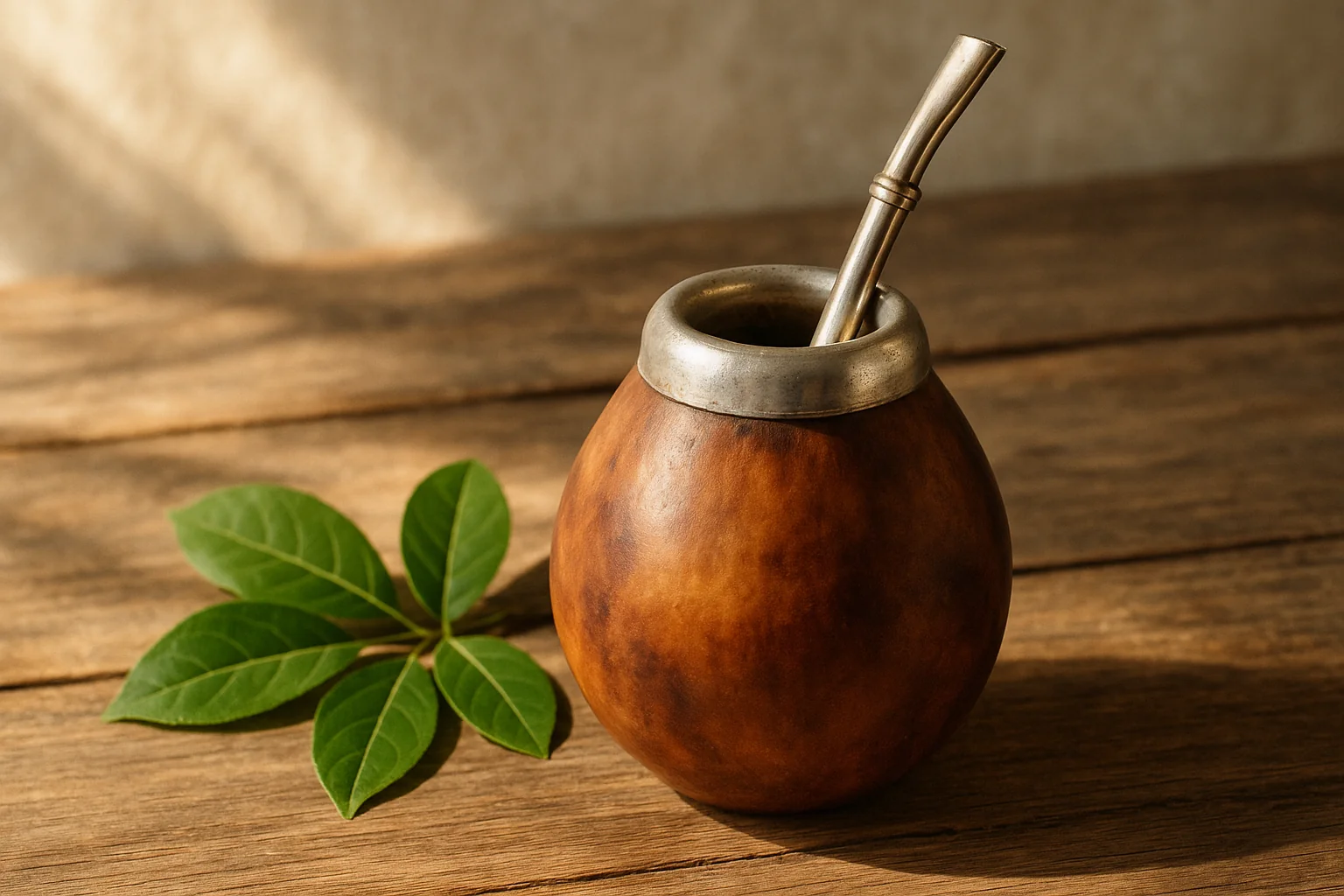

Yerba mate properties: caffeine without nervousness and why it is a better option than coffee
Yerba mate contains caffeine and theobromine, while L-theanine is present in trace amounts. What studies show about antioxidants, cholesterol, and brewing temperature.
Yerba mate has two reputations in Poland: a drink that stimulates more gently than coffee and a plant with an oncological warning. Both have arisen from real findings, but each has been twisted along the way. The popular explanation for the gentle stimulation points to L-theanine, and measurements published in 2024 show that it is present in the brew about a thousand times less than caffeine. The IARC warning from 2016 does not concern yerba as a plant, but rather the temperature at which any beverage is consumed. Below, we separate one from the other: what studies show about composition, cholesterol, and body mass, what they do not show, and how to brew mate to avoid the only documented risk.
KEY INFORMATION
• The brew contains L-theanine, but about a thousand times less than caffeine (Płatkiewicz et al., Antioxidants, 2024).
• IARC classified beverages above 65 °C as probably carcinogenic, not yerba itself.
• A meta-analysis of seven studies found no effect of mate on lipids (Masson et al., 2022).
• Cold brew has on average two times fewer active compounds than hot.
What is the plant and where does yerba mate come from?
Yerba mate is a brew made from the leaves of Ilex paraguariensis, a tree from the holly family that grows in the subtropical forests of South America, primarily in Paraguay and Argentina. The harvested leaves are blanched and dried, then ground. A granulate of varying thickness is produced: the finer it is, the stronger and more bitter the brew.
The custom of drinking mate originates from the Guarani people and spread across the continent during colonial times. It arrived in Europe late and still mainly functions here as an alternative to the third cup of coffee or energy drinks.
Heck and de Mejia (Journal of Food Science, 2007) gathered in a review what is known about this plant. Their summary is more cautious than commercial descriptions suggest: yerba mate stimulates the central nervous system, has high antioxidant capacity, and protects DNA from oxidation in laboratory conditions. However, in the same summary, the authors write that the brew has been associated with both preventing certain cancers and promoting their formation. This tension runs through the entire literature on mate and returns later in the text.
One thing organizes the rest of this article: most claims about yerba mate come from laboratory studies and population observations, not from clinical trials. Where clinical trials have been conducted, the results are often more modest than the promises.
Is mateine different from caffeine?
No. “Mateine” is a commercial name, not a separate chemical compound. The molecule is identical to caffeine and works through the same mechanism: it blocks adenosine receptors, which pushes away the feeling of drowsiness. No chemical analysis has isolated a substance in yerba that would be a “milder version” of caffeine.
So where does the impression of different stimulation come from? The most likely explanation is the second methylxanthine present in the brew, namely theobromine, the same one known from cocoa. In measurements Płatkiewicz and colleagues (Antioxidants, 2024) found its concentration in hot brews to be in the range of 4.3-51 µg/ml, and caffeine 10-31 µg/ml. The authors note that there was often more theobromine than caffeine, contrary to what they expected from earlier literature.
This has practical significance because theobromine acts more weakly and longer. A brew with a comparable amount of it provides a different course of stimulation than espresso, which practically has none. The second factor is the way of drinking: the calabash is consumed in small portions over an hour or two, while coffee is drunk in a few minutes. A spread-out dose gives a flat curve regardless of what exactly is in it.
Milligram comparisons circulating online vary several times and it makes no sense to repeat them. They depend on the ratio of dry leaves to water, the grind size, and the number of refills, and these three things everyone sets differently. Your tolerance to caffeine affects the perceived effect more than the difference between the beverages.
How much L-theanine is really in yerba mate brew?
Trace amounts. The Płatkiewicz team measured L-theanine in yerba mate brews using mass spectrometry and obtained 0.007-0.028 µg/ml in hot brews and 0.006-0.022 µg/ml in cold. This concentration is about a thousand times lower than caffeine in the same samples.
The difference in order of magnitude settles the matter. Studies on the combination of L-theanine with caffeine report portions measured in milligrams, while a liter of mate brew provides micrograms. The popular explanation that L-theanine from yerba smooths out the effect of caffeine like in green tea has no support in these measurements. The amino acid is present in the brew, just in an amount of no physiological significance.
| Compound | Hot brew (µg/ml) | Cold brew (µg/ml) |
|---|---|---|
| Caffeine | 10-31 | 1.7-13 |
| Theobromine | 4.3-51 | 1.3-27 |
| L-theanine | 0.007-0.028 | 0.006-0.022 |
We noticed in this editing that this number disappears from all popular descriptions of yerba, and without it, the whole story of “calm energy” hangs in the air. If you are looking for documented effects of L-theanine itself, we described its combination with caffeine in a separate post. The mate brew is not a way to achieve that effect.
Does yerba mate have more antioxidants than green tea?
Yerba mate has high antioxidant capacity, and that is certain, but point comparisons with green tea circulating online have no basis in the works they refer to. The review by Heck and de Mejia describes the protection of DNA from oxidation and the inhibition of lipoprotein peroxidation in laboratory conditions, but does not place yerba on a scale alongside other brews.
The dominant group of compounds in mate are chlorogenic acids and other derivatives of caffeic acid, not catechins, which prevail in Camellia sinensis. These are two different families of polyphenols with different absorption pathways, so comparing them with a single number is misleading regardless of what that number is.
What is decisive is something other than the content in the brew. Gómez-Juaristi and colleagues (Food Chemistry, 2018) traced the fate of mate polyphenols in humans and identified over 34 metabolites in bodily fluids. Of the entire portion of phenolic compounds taken, 13.2 percent appeared in urine, and 81 percent of the excreted metabolites had a microbiological origin, meaning they were produced only in the large intestine. Therefore, yerba polyphenols are partially bioavailable and deeply processed by the microbiota before they can do anything.
The practical conclusion is that mate and green tea provide different sets of compounds and do not replace each other. We described the metabolism of catechins from green tea separately because it proceeds differently.
Does yerba mate lower cholesterol and aid weight loss?
According to the latest meta-analysis, no. Masson and colleagues (Plant Foods for Human Nutrition, 2022) gathered thirteen studies, and seven of them, involving 378 people, underwent quantitative analysis. They found no difference in total cholesterol, LDL fraction, HDL fraction, or triglycerides between the mate-drinking groups and the control groups.
The authors state directly that the results of individual studies were conflicting and caution that they are based on small, inconclusive trials. This important caveat goes both ways: the meta-analysis does not prove that mate does not affect lipids; it proves that previous studies have not shown this. Claims of reducing LDL by a few percent, repeated in supplement descriptions, do not have support in the collective analysis today.
Weight loss is similar. Martinet, Hostettmann, and Schutz (Phytomedicine, 1999) administered twelve herbal preparations marketed as weight loss aids to non-obese individuals and measured their energy expenditure. They recorded no significant increase in energy expenditure for any of them. The only change was a decrease in the respiratory quotient after the mate extract, indicating a shift towards fat oxidation rather than an acceleration of metabolism.
This one measurement is sometimes cited as evidence of thermogenic action, although the work from which it originates states a lack of such action. This pattern repeats throughout the entire category of fat burners.
What did IARC really warn about hot beverages?
In 2016, the International Agency for Research on Cancer classified drinking very hot beverages, i.e., at temperatures above 65 °C, as probably carcinogenic to humans (group 2A), in relation to esophageal cancer. In the same assessment, coffee was moved to group 3, meaning unclassifiable in terms of carcinogenicity.
The resolution concerns temperature, not the beverage. The agency’s director summarized it by stating that temperature seems to be responsible, not the beverages themselves. The basis was studies from China, Iran, Turkey, and South America, in which the risk of esophageal cancer increased with drinking temperature. The assessment was described by Loomis and colleagues in Lancet Oncology (2016).
For the reader, the conclusion is simpler than the press headline suggests. Yerba mate did not make the list as a plant. It was the drinking of any beverage at temperatures above 65 °C that made it there, and the traditional way of serving mate particularly encourages such exposure: hot brew sipped through a straw in small sips, daily, for years. The same mechanism applies to tea and coffee consumed at such temperatures.
Classification 2A speaks to the credibility of the association, not its strength. It does not answer the question of how many such beverages need to be consumed for the risk to increase measurably, and the agency cautions against this. The practical conclusion is to wait a few minutes or pour the leaves with cooler water, as this removes the only documented risk from this list.
How to brew yerba mate and is tereré a better choice?
With water clearly below boiling. Pour the leaves in a calabash or any container with water at a temperature of around 70-75 °C, wait a few minutes, and refill multiple times until the brew lightens. Boiling water not only increases the risk described above but also extracts more bitterness from the leaves.
Tereré, the Paraguayan cold version of the brew, completely removes thermal risk, and that is its real advantage. However, it has a cost that commercial descriptions are silent about. In the cited measurements, cold brews contained on average two times fewer active compounds than hot, and the difference concerned both alkaloids and polyphenols. The authors observed that in the cold version, herbal and fruit additions raised antioxidant activity more clearly than in the hot version.
The choice is therefore a compromise, not a resolution between better and worse. Hot brew at a safe temperature provides a stronger extract, while cold provides a weaker one and zero thermal risk. Both paths are sensible if you know what you are choosing.
When trying for the first time, start with a smaller amount of leaves than tradition suggests, and do not drink on an empty stomach. The brew can then be perceived as nauseating, which discourages many people right at the first calabash. Do not stir with the bombilla after pouring, as it clogs the filter.
Who should be cautious with yerba mate?
Primarily those who already need to monitor caffeine. The brew provides a real portion of it, so the restrictions applicable to coffee also apply here. The following list gathers situations requiring caution or discussion with a doctor.
- Pregnancy - EFSA in its 2015 opinion stated that caffeine intake from all sources up to 200 mg per day does not raise concerns for fetal safety. Mate counts towards this total along with coffee, tea, and chocolate.
- Heart rhythm disorders - caffeine can trigger palpitations in predisposed individuals. In cases of atrial fibrillation, it is worth consulting a cardiologist about regular consumption.
- Ongoing pharmacotherapy - caffeine metabolism occurs through the CYP1A2 enzyme, so drugs affecting this pathway change its action. A pharmacist can check this based on your list of medications.
- Reflux and peptic ulcer disease - the brew stimulates gastric acid secretion similarly to coffee, so it is better to drink it after meals.
- Drinking very hot - this is the only risk specific to mate, described in the previous section, and the only one you can eliminate with a thermometer.
Frequently asked questions
Is mateine different from caffeine?
No. It is the same molecule, and the name is purely commercial. The perceived difference is rather due to theobromine, which is often present in higher amounts than caffeine in the brew, and the way it is consumed in small portions over a longer time. No analysis has isolated a separate, milder alkaloid in yerba.
How much L-theanine is in yerba mate brew?
About a thousand times less than caffeine. Płatkiewicz and colleagues (Antioxidants, 2024) measured 0.007-0.028 µg/ml in hot brews. Studies on L-theanine operate in milligram portions, so micrograms from the brew do not explain the calm focus effect attributed to yerba.
Does yerba mate lower cholesterol?
A collective analysis does not confirm this. Masson and colleagues (2022) gathered seven studies with 378 participants and found no difference in total cholesterol, LDL, HDL, or triglycerides. The authors caution that previous trials were small and yielded conflicting results.
Is yerba mate carcinogenic?
IARC classified drinking beverages above 65 °C as probably carcinogenic in 2016, regardless of what is being consumed. Coffee was then moved to the unclassifiable group. The risk is associated with temperature and long-term repetition, not with the plant itself.
Is tereré healthier than hot brew?
It is thermally safer and chemically weaker. In the cited measurements, cold brews contained on average two times fewer active compounds than hot. The cold version thus removes the only documented risk but provides fewer alkaloids and polyphenols in the same volume.
Who should not drink yerba mate?
The restrictions are similar to those for coffee and stem from caffeine content. They concern pregnancy, heart rhythm disorders, reflux, and ongoing pharmacotherapy affecting the CYP1A2 enzyme. EFSA sets a threshold of 200 mg of caffeine per day from all sources combined for pregnant women.
Extracts from yerba mate and other plant extracts in liquid form can be found in the plant extracts category.
This article is for informational and educational purposes and does not replace consultation with a doctor. If you are pregnant, breastfeeding, taking medications, or have chronic conditions, consult the use of supplements or herbs with a specialist.
Author: Michał Waluk · Published: 2026-06-22 · Updated: 2026-08-16