
Supplements for Stress and Cortisol: What Really Lowers Cortisol and When to Take It
Ashwagandha, phosphatidylserine, rhodiola, magnesium, and vitamin C compared with studies measuring cortisol. What was shown, how many people participated, and how long it lasted.
Cortisol is not the enemy. Without it, you won't get up in the morning or react to threats. The problem begins when chronic stress disrupts its daily rhythm for weeks and months: sleep deteriorates, fat accumulates in the abdomen, immunity declines, and memory and mood drop. The market responds with dozens of products "for stress and cortisol," of which only some have randomized studies where cortisol was actually measured. Below we show these studies: who conducted them, how many participants there were, how long they lasted, and what the results were. We also indicate where evidence is lacking, as it is equally important to know what has not been studied as what has been studied regarding cortisol.
KEY INFORMATION
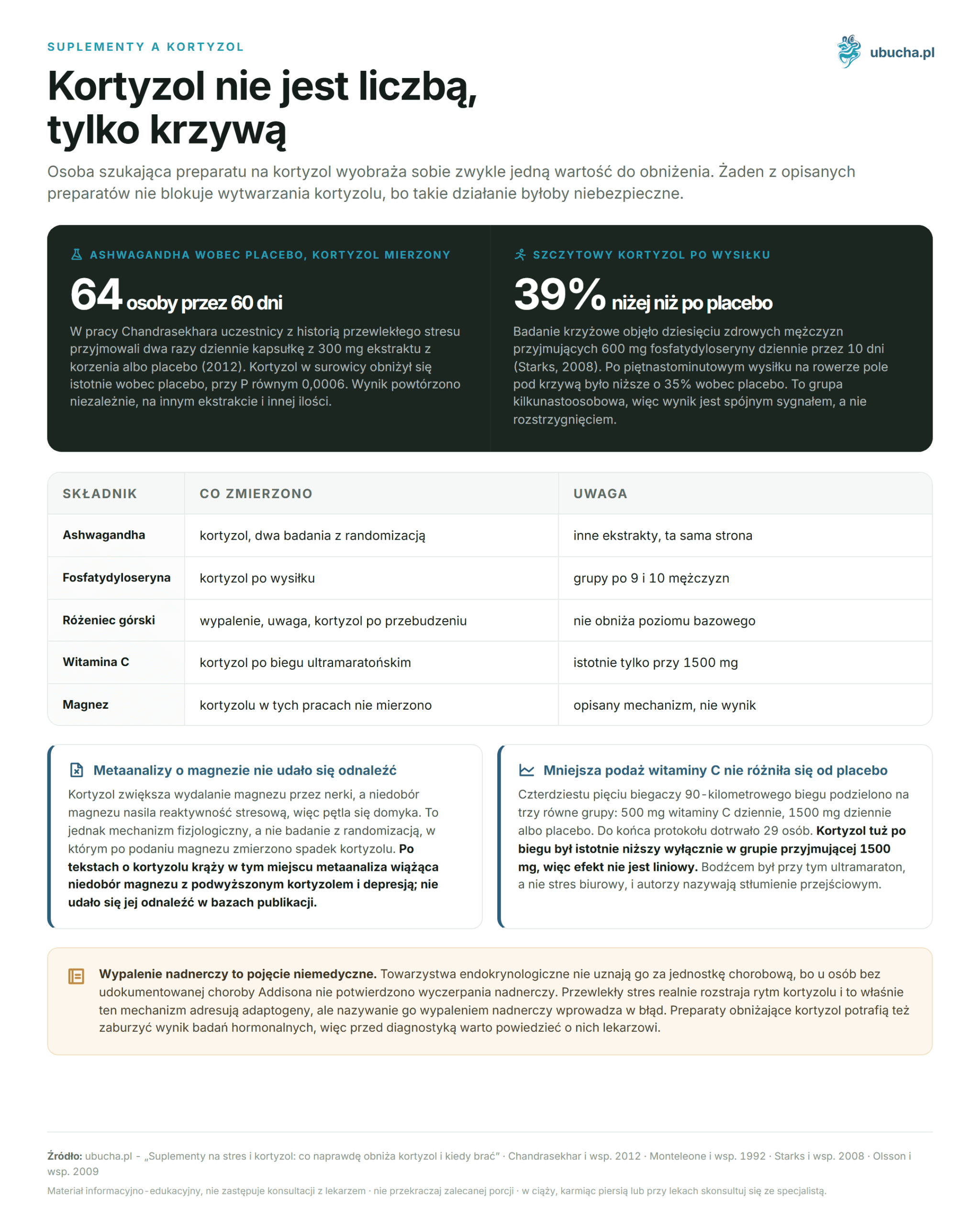
• In a randomized study of 64 individuals with chronic stress, ashwagandha root extract significantly lowered serum cortisol compared to placebo (P = 0.0006) after 60 days (Chandrasekhar et al., Indian Journal of Psychological Medicine, 2012).
• Phosphatidylserine suppressed the cortisol response to exercise in 9 men after 10 days of use (Monteleone et al., 1992).
• Rhodiola improved burnout scores after 28 days in 60 individuals (Olsson et al., Planta Medica, 2009).
• Supplements modulate the cortisol response; they do not block cortisol, as blocking it would be dangerous.
What is cortisol and when does it become a problem?
Cortisol is a glucocorticoid produced by the adrenal cortex under the control of the hypothalamic-pituitary-adrenal axis. The problem is not its presence, but a disrupted rhythm: normally, the peak occurs around 8 AM, then the concentration drops, and the minimum occurs at night. This rhythm connects sleep, activity, and metabolism.
It has many tasks. It releases glucose from the liver, regulates blood pressure and electrolyte balance, suppresses the inflammatory response in the short term, and affects mood. Chronic stress flattens the morning peak and delays the evening drop. The effect is felt very concretely: you wake up tired, can't fall asleep in the evening, and feel irritable all day.
We have noticed that people looking for a supplement "for cortisol" usually imagine one number to lower. Cortisol is not one number, but a curve that changes multiple times throughout the day. Its shape determines well-being, and that is the goal of the preparations described below. None of them block cortisol production, as such action would be dangerous. For the same reason, a single laboratory measurement tells little: the timing of the sample and how the result relates to the rest of the day matters.
Does ashwagandha really lower cortisol?
It is one of the few ingredients with direct cortisol measurement in a randomized study. In the work of Chandrasekhar et al., 64 individuals with a history of chronic stress were randomly assigned to either the extract or placebo. Participants took one capsule twice a day for 60 days; each contained 300 mg of a high-concentration full-spectrum root extract. Results on all stress scales significantly improved compared to placebo (P < 0.0001), and serum cortisol significantly decreased (P = 0.0006). Adverse effects were mild and comparable in both groups (Chandrasekhar et al., Indian Journal of Psychological Medicine, 2012).
The result was independently replicated with another preparation. In the study by Lopresti et al., 60 healthy adults with elevated stress took either placebo or 240 mg of standardized extract once daily for 60 days. In the ashwagandha group, the decrease in morning cortisol was greater than in the placebo group (P < 0.001), as was the decrease in DHEA-S, and the Hamilton anxiety scale score significantly improved (P = 0.040) (Lopresti et al., Medicine, 2019).
It is worth noting that both studies used different extracts and different amounts, yet they went in the same direction. However, ashwagandha has clear contraindications: do not combine it with thyroid medications without consultation, as it may alter thyroid hormone levels, and discontinue it during pregnancy and with autoimmune thyroid diseases. The amounts and duration of use should be determined by a doctor or pharmacist, not by an article.
How does phosphatidylserine affect cortisol after exercise?
It suppresses its release in response to exercise, which was measured in three small blinded studies. Phosphatidylserine is a phospholipid of cell membranes, particularly abundant in the pituitary and hippocampus, and it limits the release of ACTH, the hormone that tells the adrenal glands to produce cortisol. Limited ACTH means a weaker cortisol response.
In the study by Monteleone et al., nine healthy men took 800 mg of phosphatidylserine orally daily for 10 days in a placebo-controlled setup. The preparation clearly suppressed the ACTH response (P = 0.003) and cortisol (P = 0.03) to physical exertion, without changing the increase in growth hormone or prolactin (Monteleone et al., European Journal of Clinical Pharmacology, 1992). The same group previously achieved a similar effect by administering phosphatidylserine intravenously to eight men (Monteleone et al., Neuroendocrinology, 1990).
A newer crossover study involved ten healthy men taking 600 mg of phosphatidylserine daily for 10 days. After a fifteen-minute moderate-intensity cycling exercise, peak cortisol levels were 39% lower, and the area under the curve was 35% lower compared to placebo (Starks et al., Journal of the International Society of Sports Nutrition, 2008). In all three studies, participants ranged from a few to several men, so the results should be read as a consistent signal, not as a definitive conclusion.
What did the rhodiola study show?
Improvement in burnout and attention after 28 days, not a simple lowering of cortisol. In the study by Olsson et al., 60 individuals aged 20 to 55 diagnosed with fatigue syndrome according to the criteria of the Swedish health authority participated. Half received four tablets of standardized SHR-5 extract daily, providing 576 mg of extract, while the other half received placebo.
After 28 days, both groups improved in several measures, which the authors attribute to the placebo effect. The extract gained an advantage over placebo in the Pines burnout scale and in some attention test indicators. The cortisol response to awakening differed significantly before and after treatment in the treated group compared to the control group (Olsson et al., Planta Medica, 2009).
This shows what adaptogenic action is about: it is about smoothing the response to a stressor, not lowering the baseline level. Rhodiola can also be stimulating, so taking it in the evening may hinder falling asleep. More about the raw material itself is discussed in the text about the properties of rhodiola in stress and fatigue.
Do vitamin C and L-theanine lower cortisol?
Vitamin C does, but under conditions of extreme load and only with high intake. This was studied on participants of the 90-kilometer Comrades run. Forty-five runners were divided into three equal groups: 500 mg of vitamin C daily, 1500 mg daily, or placebo, administered for a week before the run, on the day of the run, and for two days after. By the end of the protocol, 29 individuals completed it, and their results were used for analysis. Serum cortisol immediately after the run was significantly lower only in the group taking 1500 mg daily (Peters et al., International Journal of Sports Medicine, 2001).
Two things arise from this study, both inconvenient for marketing. First, lower intake did not differ from placebo, so the effect is not linear. Second, the stimulus was an ultramarathon, not office stress, so transferring the result to a regular workday has no basis. The authors themselves call the observed suppression transient.
L-theanine, an amino acid from green tea, is associated with modulation of GABA receptors and an increase in alpha wave activity, which is a state of calm focus. However, we did not find a study for it with direct cortisol measurement meeting the same criteria as the works described above, so we leave it here as a described mechanism, not as a cortisol-lowering ingredient.
What role does magnesium play in all of this?
The role of the background on which the rest unfolds. Magnesium is a cofactor at NMDA receptors in the hippocampus, and the hippocampus acts as a brake for the stress axis: it sends a negative feedback signal that extinguishes cortisol production. With magnesium deficiency, this brake works less effectively, so the stress response can be excessive.
The relationship runs both ways, and this is its most interesting part. Cortisol increases magnesium excretion through the kidneys, so prolonged stress depletes magnesium, and magnesium deficiency increases stress reactivity. It closes a loop where one drives the other.
However, it must be stated clearly where the evidence ends. The above description is a physiological mechanism, not a result of a randomized study in which magnesium was administered and cortisol decrease was measured. A meta-analysis circulating in texts about cortisol is said to link magnesium deficiency with elevated cortisol and depression; we could not find it in publication databases, so we do not cite it here. Magnesium remains a sensible dietary supplement for other reasons, but it is not a documented cortisol-lowering agent. This difference has practical significance: the mechanism suggests that it is worth avoiding deficiency, but it does not promise that adding magnesium to a well-nourished person will change anything in their stress response.
Which habits raise cortisol in the evening?
Three: late coffee, intense training after dark, and irregular sleep times. Caffeine blocks adenosine receptors, thus masking sleepiness and delaying evening relaxation. Its concentration in the blood peaks after half an hour to an hour, but the half-life is several hours, so coffee consumed in the afternoon still works in the evening, exactly when cortisol should be lowest and melatonin should be rising.
Strength and interval training raise cortisol by definition, as that is the physiology of exertion. In a rested person, this is not a problem, as cortisol levels have time to drop in the evening. With chronic stress, the same training can shift the peak to bedtime. A calmer form of movement in the evening, such as stretching or walking, stimulates the parasympathetic system instead of the stress axis.
The most underrated factor is regularity. The cortisol rhythm is a clock, and the clock gets disrupted by variable bedtimes and wake-up times, even with the same number of hours of sleep. Morning daylight acts as a setting for the hands. What to take and what not to take before sleep is laid out separately in the text about the evening supplementation protocol.
When does elevated cortisol require medical diagnosis?
When the symptoms fit the picture of an endocrine disease, not just ordinary fatigue. Cushing's syndrome, or excess cortisol usually caused by an adrenal or pituitary tumor, presents quite characteristic symptoms: abdominal obesity with a characteristic fat pad on the neck, wide red stretch marks, a rounded face, weakness of the thigh and arm muscles, and hypertension with hyperglycemia. It is a rare disease, but its diagnosis requires tests ordered by a doctor, including a dexamethasone suppression test.
On the other side lies Addison's disease, or primary adrenal insufficiency. It manifests as chronic fatigue, nausea, skin darkening, and low blood pressure. It is also rare and requires urgent diagnosis, as untreated it can be dangerous.
Separately, it should be mentioned about "adrenal fatigue." This is a non-medical term that endocrine societies do not recognize as a disease entity, as adrenal exhaustion has not been confirmed in individuals without documented Addison's disease. Chronic stress does disrupt the cortisol rhythm, and this is precisely the mechanism that adaptogens address, but calling it adrenal fatigue is misleading. We discuss this more extensively in the text about supplements for so-called adrenal fatigue. Supplements that lower cortisol can also interfere with hormonal test results, so before diagnosis, inform your doctor about them.
Frequently Asked Questions
What really lowers cortisol?
The best documented are ashwagandha and phosphatidylserine, as cortisol was actually measured in their studies. Ashwagandha significantly lowered serum cortisol compared to placebo in 64 individuals after 60 days (Chandrasekhar et al., 2012). Besides supplements, regular sleep, morning light, and shifting the last coffee to an earlier time also work.
Does ashwagandha really lower cortisol?
Yes, this has been shown in two independent randomized studies. In 64 individuals with chronic stress, serum cortisol significantly decreased compared to placebo after 60 days (P = 0.0006). In another study with 60 individuals, morning cortisol decreased more than in the placebo group (P < 0.001). Both used different extracts.
How does phosphatidylserine work?
It limits the release of ACTH from the pituitary, and ACTH stimulates the adrenal glands to produce cortisol. In nine men taking it orally for 10 days, it suppressed the cortisol response to exercise (P = 0.03). In a crossover study with ten men, peak cortisol after exercise was 39% lower compared to placebo.
Does rhodiola help with cortisol?
It does not lower it directly, but smooths the response to stress. In a study of 60 individuals with fatigue syndrome, the SHR-5 extract improved burnout scores and some attention indicators compared to placebo after 28 days, and the cortisol response to awakening changed significantly (Olsson et al., 2009).
Does magnesium lower cortisol?
There is no randomized study with direct measurement for this. The mechanism is described: magnesium supports the inhibition of the stress axis through NMDA receptors in the hippocampus, and cortisol increases magnesium excretion through the kidneys. This is an argument for monitoring magnesium intake, not proof of cortisol-lowering action.
Does vitamin C lower cortisol after exercise?
In one study, yes, but with high intake and extreme load. In runners of a 90-kilometer ultramarathon, cortisol immediately after the race was significantly lower only in the group taking 1500 mg daily, not in the group taking 500 mg (Peters et al., 2001). The authors call this effect transient.
When should adaptogens for cortisol not be taken?
Do not combine ashwagandha with thyroid medications without consultation and discontinue it during pregnancy and with autoimmune thyroid diseases. Rhodiola can be stimulating, so avoid it in the evening. Before hormonal tests, inform your doctor about all supplements taken, as they may affect the results.
If you are looking for specific raw materials described in this text, you can find them in the adaptogens category.
This article is for informational and educational purposes and does not constitute medical advice. Before starting supplementation, consult your doctor, especially if you are taking medications regularly, are pregnant or breastfeeding, or have chronic illnesses.
Author: Michał Waluk · Published: 2026-06-22 · Updated: 2026-08-11