
Chamomile for Sleep and Generalized Anxiety: Where It Helps and Where It Doesn’t
A meta-analysis of twelve studies separates what is usually lumped together: sleep quality, insomnia, acute anxiety, and generalized anxiety. The results are varied.
Chamomile is one of the most commonly consumed medicinal plants in the world and is often described in bulk: it helps to fall asleep, calms, and soothes nerves. Clinical studies from the last fifteen years allow us to separate these promises, as they measured four different things: sleep quality, insomnia severity, acute anxiety, and generalized anxiety disorder. The results for each of them are different, and for two, simply negative. This text shows where the evidence is, where it is not, and what the official European monograph says about chamomile, which lists completely different indications than those for which readers reach for it. Each number was read from the summary or the full text of the work to which we refer, and the official records from the agency’s document itself.
KEY INFORMATION
• A meta-analysis of twelve randomized studies showed improvement in sleep quality and symptoms of generalized anxiety, but did not show a difference for acute anxiety or insomnia severity (Hieu et al., Phytotherapy Research, 2019).
• The first placebo-controlled study in generalized anxiety yielded a borderline significant result, and the authors called the effect moderate (Amsterdam et al., Journal of Clinical Psychopharmacology, 2009).
• The study on preventing relapses did not achieve its primary endpoint.
• The European Medicines Agency monograph for chamomile flower includes only traditional use and does not mention sleep or anxiety among its indications.
Does chamomile really help you fall asleep?
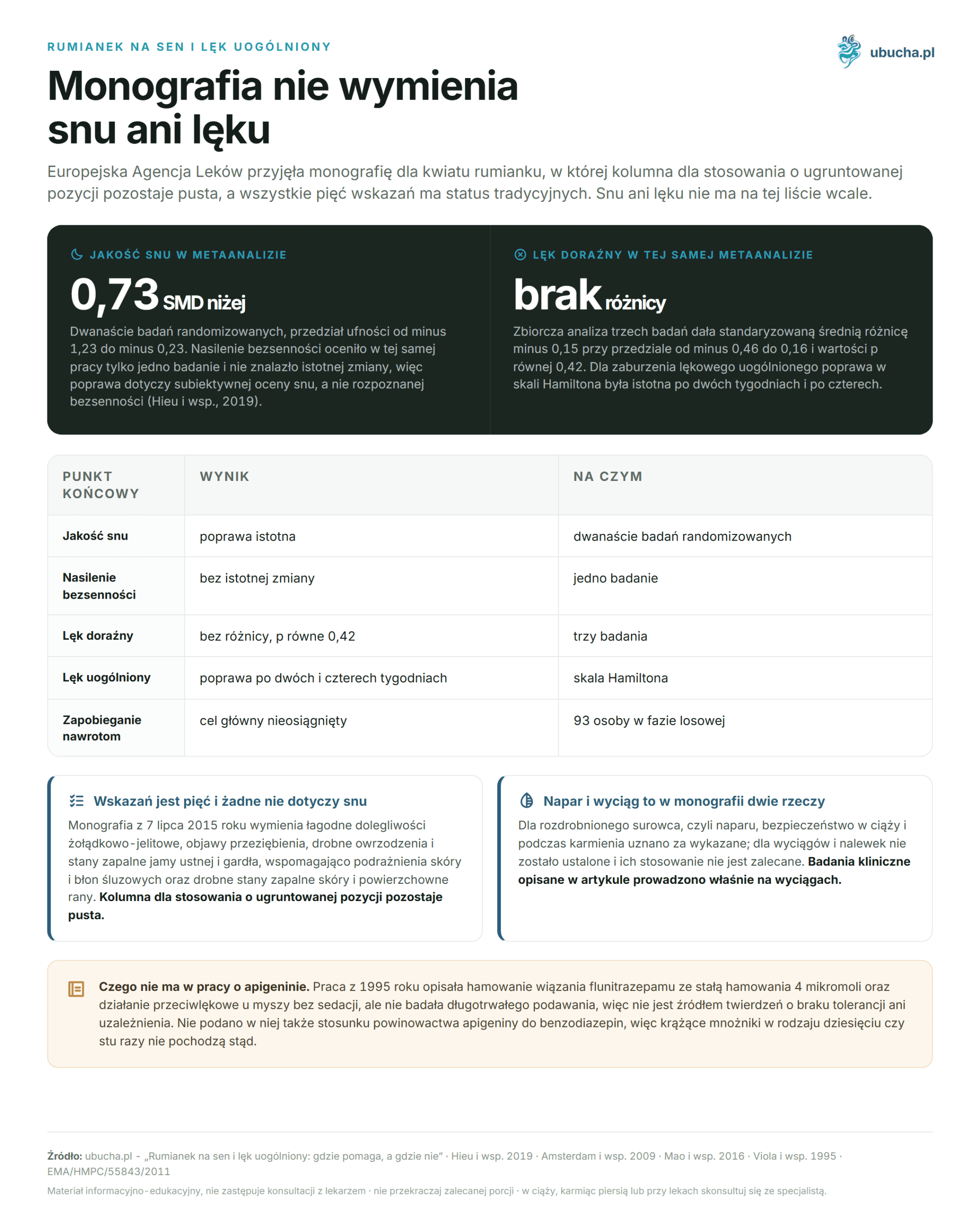
Sleep quality improves in a measurable way, but that is not the same as treating insomnia. A meta-analysis from 2019, encompassing twelve randomized studies, showed a significant improvement in sleep quality after chamomile, with a standardized mean difference of minus 0.73 with a 95% CI from minus 1.23 to minus 0.23 (Hieu et al., Phytotherapy Research, 2019). In the same study, insomnia severity was assessed by only one study and found no significant change.
The most frequently cited study on sleep is a trial conducted in a nursing home near Karaj in Iran. Sixty individuals aged sixty and older were assigned to capsules containing chamomile extract at 200 mg twice daily or to capsules with wheat flour for 28 days. Sleep quality was measured using the Pittsburgh questionnaire, and after the intervention, it was significantly better in the treated group (Adib-Hajbaghery and Mousavi, Complementary Therapies in Medicine, 2017). The study was single-blind, which is significant given that the endpoint was based on a survey.
A newer meta-analysis from 2024, involving ten studies and 772 participants, breaks this effect down into parts. The Pittsburgh questionnaire score improved by 1.88 points, but sleep efficiency did not change in two studies and worsened in one, and daytime functioning did not improve in any of the three that measured it (Kazemi et al., Complementary Therapies in Medicine, 2024).
What does the meta-analysis say about chamomile for anxiety, and what does it not say?
It says two different things about two different states, and this distinction is lost in most discussions. For anxiety as an acute state, a pooled analysis of three studies showed no difference compared to the control: a standardized mean difference of minus 0.15 with a 95% CI from minus 0.46 to 0.16 and a p-value of 0.42. For generalized anxiety disorder, measured on the Hamilton scale, improvement was significant after two weeks (mean difference of minus 1.43) and after four (minus 1.79).
The authors conclude with a sentence worth remembering: chamomile appears effective and safe regarding sleep quality and generalized anxiety disorder, and there is little evidence for its effect on acute anxiety and insomnia. This is precisely the boundary that the title of this article promises.
The first placebo-controlled trial in this indication was conducted at the University of Pennsylvania. Sixty-one outpatients with mild to moderate generalized anxiety disorder were qualified, and 57 were randomized to chamomile extract or placebo for eight weeks (Amsterdam et al., Journal of Clinical Psychopharmacology, 2009). The decrease in Hamilton scale scores was greater in the treated group with a p-value of 0.047, just below the conventional threshold of 0.05. The authors themselves describe a moderate anxiolytic effect and the need for further observation.
Does chamomile protect against relapse of generalized anxiety?
The study designed to test this did not achieve its primary goal. It was a two-phase design: for twelve weeks, all participants openly received chamomile extract at a dose of 1500 mg daily, and then those who responded to treatment were randomly assigned for 26 weeks to continue taking the preparation or to a substituted placebo (Mao et al., Phytomedicine, 2016).
A total of 179 individuals with moderate to severe generalized anxiety disorder entered the study, of which 93 responded to treatment and proceeded to the random phase. Relapse occurred in 12 of 47 individuals on placebo (25.5%) and in 7 of 46 on chamomile (15.2%). The difference was not statistically significant: hazard ratio 0.52 with a 95% CI from 0.20 to 1.33 and a p-value of 0.16. The authors explain this by the small sample size and a lower than expected relapse rate in the placebo group.
However, the result is not empty. Participants taking chamomile maintained significantly lower symptom severity than the placebo group (p equal to 0.0032), and both arms had similarly low rates of adverse events. A fair summary would therefore be: the preparation proved safe and was associated with lower symptom severity, but it was not proven to reduce the risk of relapse.
How does apigenin act on GABA-A receptors?
Apigenin is a flavonoid present in chamomile flowers, indicated as the component responsible for the calming effect in a 1995 study that isolated it from an aqueous extract (Viola et al., Planta Medica, 1995). Apigenin competitively inhibited the binding of flunitrazepam with an inhibition constant of 4 micromoles and did not act on muscarinic or adrenergic receptors, nor on muscimol binding.
The authors described a clear anxiolytic effect in mice in the elevated plus-maze test, without sedation and without muscle relaxation at doses comparable to those of benzodiazepines. Only a tenfold increase in the dose produced mild sedation: a 26% decrease in locomotor activity and a 35% worsening in the hole-board test. No anticonvulsant effects were observed.
Two things that are not in this work, but are often attributed to it. Long-term administration was not studied, so it is not a source of claims about the lack of tolerance or addiction. The affinity ratio of apigenin to the affinity of benzodiazepines was also not provided, so circulating multipliers like ten or a hundred times do not come from here. We discuss the family of these compounds more broadly in the entry about flavonoids and their effects, and another anxiolytic mechanism is described in the text about the 5-HT1A serotonin receptor.
What chamomile won’t do and when it may harm?
It will not replace psychiatric treatment or insomnia diagnosis. Sleep apnea, restless legs syndrome, chronic pain, and circadian rhythm disorders require identifying the cause, not a herbal extract. In anxiety disorders with significant functional impairment, a psychiatric assessment is decisive.
Surprisingly, the official monograph says a lot here. The European Medicines Agency adopted the monograph for chamomile flower on July 7, 2015 (EMA/HMPC/55843/2011), in which the column for established use remains empty, and all five indications have traditional status: mild gastrointestinal complaints, cold symptoms, minor ulcers and inflammatory conditions of the oral cavity and throat, supportive for skin and mucous membrane irritations in the anal and genital areas, and minor skin inflammations and superficial wounds. Sleep and anxiety are not on this list at all. The monograph adds that if symptoms persist for more than a week, a doctor should be consulted.
Hypersensitivity to chamomile and other plants from the Asteraceae family, which include mugwort, ragweed, marigold, and daisy, is a contraindication for any route of administration; a separate list is provided for baths. The monograph notes hypersensitivity reactions, including severe allergic reactions after contact of liquid chamomile preparations with mucous membranes. Regarding pregnancy, it distinguishes forms: for the crushed raw material, i.e., infusion, safety during pregnancy and breastfeeding has been considered demonstrated, while for extracts and tinctures, it has not been established, and their use is not recommended. This is significant because the clinical studies described above were conducted precisely on extracts.
Caution is also required when combining with medications. The monograph notes interactions based on the effect on cytochrome P450 in kidney transplant patients taking high doses for about two months. A case of a 70-year-old woman treated with warfarin, admitted to the hospital with numerous internal bleeding after using chamomile preparations, was also described (Segal and Pilote, CMAJ, 2006). The authors emphasize that such a case had not been previously described, and the theoretical risk was linked to the presence of coumarin derivatives in the plant. Similar considerations about another plant from the same family are discussed in the entry about yarrow.
Frequently Asked Questions
Does chamomile improve sleep quality?
Yes, a meta-analysis of twelve randomized studies showed a significant improvement in sleep quality. However, the severity of insomnia is a different endpoint: only one study assessed it and found no significant change. Therefore, the improvement pertains to the subjective assessment of sleep, not diagnosed insomnia.
Does chamomile work for anxiety?
It depends on the type of anxiety. In generalized anxiety disorder, the meta-analysis showed improvement on the Hamilton scale after two and four weeks. For anxiety as an acute state, a pooled analysis of three studies showed no difference compared to the control group.
Does chamomile prevent relapses of generalized anxiety?
This has not been demonstrated. In a study with a 26-week follow-up phase, relapse occurred in 15.2% of those on chamomile and 25.5% on placebo, but the difference was not statistically significant. However, the treatment maintained significantly lower symptom severity than placebo.
Can chamomile be addictive like benzodiazepines?
There is no data indicating such a mechanism, but this should not be confused with evidence. A 1995 study included acute tests in mice and did not assess tolerance or withdrawal symptoms. In clinical studies, the rate of adverse events was similar to that in placebo groups.
Does chamomile interact with medications?
The European monograph notes interactions via cytochrome P450 in kidney transplant patients taking high doses for about two months. A single case of severe bleeding in a patient treated with warfarin was also described, linked to the content of coumarin derivatives in the plant.
Who is chamomile contraindicated for?
Individuals with hypersensitivity to chamomile and other Asteraceae plants, such as mugwort, ragweed, or marigold. For extracts and tinctures, safety during pregnancy and breastfeeding has not been established, so their use is not recommended; for the infusion itself, the monograph considers safety to be demonstrated.
This article is for informational and educational purposes and does not constitute medical advice. Before starting supplementation, consult a doctor, especially if you are taking medications regularly, are pregnant or breastfeeding, or have chronic illnesses.
Author: Michał Waluk · Published: 2026-08-09 · Updated: 2026-08-16