
L-theanine and caffeine together: what has really been studied and at what doses
L-theanine with caffeine: what doses were actually given in the studies by Owen, Haskell, and Kelly, what was measured after an hour, and what these works did not check.
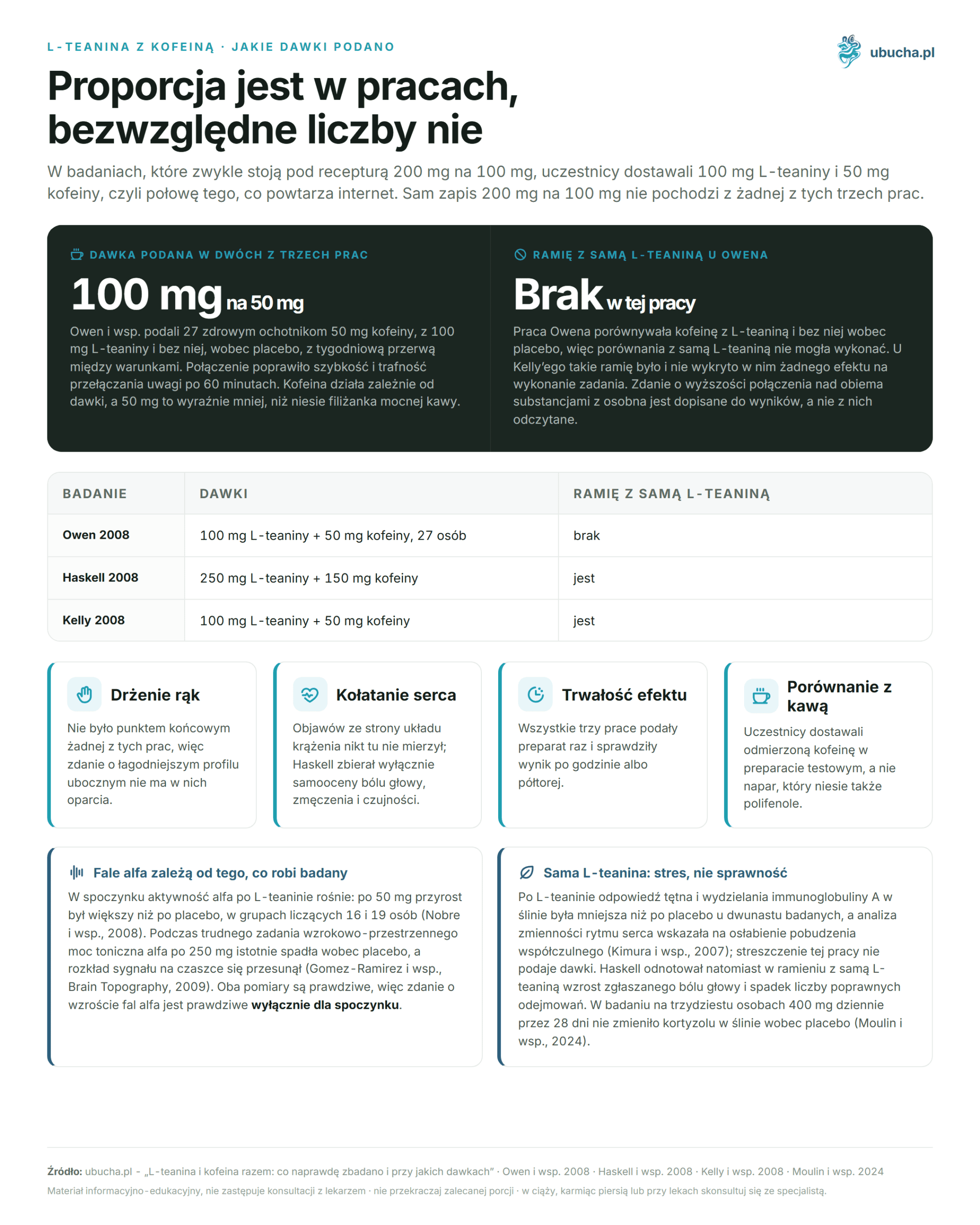
The combination of L-theanine with caffeine circulates online as a ready-made recipe: 200 mg of amino acid from tea leaves to 100 mg of caffeine, a two-to-one ratio, focus without hand tremors. We checked where these numbers come from. In the studies that usually stand behind this statement, participants received 100 mg of L-theanine and 50 mg of caffeine, which is half of what the internet repeats. What was measured has also changed: not hand tremors or heart palpitations, but reaction time and accuracy in attention tasks, one hour after a single dose. Below we describe what studies were actually conducted, on whom and with what results, and where the popular description diverges from the works it cites.
KEY INFORMATION
• Owen et al. (Nutritional Neuroscience, 2008) administered 27 healthy volunteers 50 mg of caffeine with 100 mg of L-theanine and without it, not 200 mg to 100 mg.
• There was no group with just L-theanine in this study, so it could not demonstrate superiority over each substance separately.
• In Kelly et al. (Journal of Nutrition, 2008), L-theanine alone did not produce any detectable behavioral effect.
• Alpha waves increase after L-theanine at rest, and during a challenging attention task, their tonic component decreases.
What exactly was studied in the combination of L-theanine with caffeine?
Three crossover studies on healthy adults, all after a single dose, with measurements taken within the first two hours. Attention and working memory test results and mood assessments filled out by participants were measured. None of them lasted longer than a few days of testing sessions, so they say nothing about the effects of daily use.
Owen et al. compared 50 mg of caffeine, with 100 mg of L-theanine and without it, against placebo in 27 individuals, with a week-long break between conditions. Caffeine alone improved subjective alertness after 60 minutes and accuracy in the attention-switching task after 90 minutes. The combination improved both the speed and accuracy of attention-switching after 60 minutes and reduced susceptibility to distracting information in the memory task.
Haskell et al. (Biological Psychology, 2008) used higher doses: 250 mg of L-theanine and 150 mg of caffeine, separately and together. Kelly et al. used 100 mg and 50 mg, adding EEG recording during a visuospatial task.
| Study | Doses | Participants | Group with just L-theanine |
|---|---|---|---|
| Owen 2008 | 100 mg L-theanine + 50 mg caffeine | 27 | none |
| Haskell 2008 | 250 mg L-theanine + 150 mg caffeine | not provided in the summary | yes |
| Kelly 2008 | 100 mg L-theanine + 50 mg caffeine | not provided in the summary | yes |
Where did the 2:1 ratio and the dose of 200 mg to 100 mg come from?
The two-to-one ratio is present in the studies, but the absolute numbers are not. Owen and Kelly administered 100 mg of L-theanine to 50 mg of caffeine, which is a 2:1 ratio at half the amounts that circulate as a “standard dose.” Haskell used 250 mg to 150 mg, which is roughly 1.7:1. The notation of 200 mg to 100 mg does not come from any of these three studies.
The discrepancy is not cosmetic. Caffeine acts dose-dependently, and 50 mg is clearly less than what a cup of strong coffee carries. The result obtained after 50 mg does not automatically transfer to 100 mg or to two cups a day, as the curve is not linear and higher amounts bring effects that these studies did not check.
The second correction concerns the statement of superiority over “each substance separately.” Owen’s work compared caffeine with L-theanine and without it against placebo. There was no group with just L-theanine in it, so such a comparison could not be made. In Kelly’s study, there was a group with just L-theanine, and no effect on task performance was detected. The statement about the superiority of the combination over both substances separately is therefore added to the results, not derived from them. Those looking for a broader overview of this category will find it in the text on supplements for concentration and memory.
Does L-theanine increase alpha waves in the brain?
It depends on what the subject is doing at the time of measurement, and this condition is missing from popular descriptions. At rest, alpha activity increases after L-theanine. During a demanding attention task, the tonic component of this rhythm decreases. Both measurements are true and come from separate experiments.
Nobre et al. (Asia Pacific Journal of Clinical Nutrition, 2008) recorded EEG in young healthy individuals at rest, with eyes closed, before administration and for nearly two hours after it. After 50 mg of L-theanine, the increase in alpha activity was greater than after placebo. The groups consisted of 16 and 19 individuals.
Gomez-Ramirez et al. (Brain Topography, 2009) recorded EEG with 168 channels in thirteen individuals performing a difficult visuospatial task. After 250 mg of L-theanine, the tonic power of alpha significantly decreased compared to placebo, and the signal distribution on the scalp shifted. The authors explain this as L-theanine’s role in maintaining attention for longer periods, rather than in momentarily switching it between stimuli. Kelly observed the same direction for the combination with caffeine. The statement “L-theanine increases alpha waves” is therefore true only for rest.
What does L-theanine alone, without caffeine, provide?
The best-documented effect concerns the response to acute stress, not cognitive performance. The measurements are physiological: heart rate and secretion from salivary glands. Improvements in cognitive tests were not provided by L-theanine alone in the cited works, and in one of them, it worsened one of the results.
Kimura et al. (Biological Psychology, 2007) studied twelve individuals in four conditions, with an arithmetic task as a stressor. After L-theanine, the heart rate response and immunoglobulin A secretion in saliva were lower than after placebo, and heart rate variability analysis indicated a weakening of sympathetic arousal. The summary of this work does not provide the dose.
Haskell noted an increase in reported headaches and a decrease in the number of correct subtractions in the serial test in the group with just L-theanine. This is the opposite result to the popular description and comes from the same study that is cited as evidence for the benefits of the combination. In a randomized study by Moulin et al. (Neurology and Therapy, 2024), thirty individuals with moderate stress took 400 mg of L-theanine daily or placebo for 28 days: the preparation proved safe, but cortisol in saliva did not differ between groups, and perceived stress decreased similarly in both. The topic of tension and cortisol is developed in a separate text on stress supplements.
What did these studies not measure?
They did not measure anything that the popular description states as the main advantage of the combination. Hand tremors, heart palpitations, or decline in performance after a few hours were not among the endpoints of any of these works. Haskell did collect self-reports of headaches, fatigue, and alertness, but cardiovascular symptoms were not measured here. The statement about a milder side effect profile therefore has no support in them.
They also did not measure the durability of the effect. All three administered the preparation once and checked the result after an hour or an hour and a half. The question of what happens after weeks of daily use remains unanswered from this data set, and the only longer study mentioned above lasted four weeks and concerned L-theanine alone.
Finally: they did not compare this combination with coffee. Participants received measured caffeine in the test preparation, not an infusion that also carries polyphenols and other components. The comparison “better than coffee alone” goes beyond what these works checked, and we treat it as a hypothesis, not as a result. If you are interested in how much caffeine alternative forms of administration carry, we described them in the text on caffeine bags.
Frequently asked questions
What dose of L-theanine and caffeine was given in the studies?
Owen and Kelly administered 100 mg of L-theanine with 50 mg of caffeine, Haskell 250 mg with 150 mg. All three studies involved a single dose in healthy adults with measurements taken after 60 and 90 minutes. The value of 200 mg to 100 mg does not come from any of them.
Does the combination work better than caffeine alone?
This has not been resolved. Owen did not have a group with just L-theanine, and reported comparisons were made against placebo. Kelly noted an increase in detection accuracy for both the combination and caffeine alone, while no behavioral effect was detected for L-theanine alone.
Can matcha replace such a combination?
Matcha naturally contains L-theanine and caffeine, as shading the bushes before harvest increases the accumulation of both compounds. In the study by Dietz et al. (Food Research International, 2017), 23 individuals after 4 g of matcha powder improved their performance in simple attention and psychomotor speed tests, but mood did not change.
Does L-theanine calm without drowsiness?
Kimura’s measurements indicate a weakening of the sympathetic response to stress: lower heart rate and less immunoglobulin A secretion in saliva in twelve subjects. This is not the same as a proven anxiolytic effect. Moulin’s study did not show a difference in cortisol compared to placebo after 28 days.
Is such a combination safe?
No serious events were reported in the described studies, but they lasted hours or weeks, not months. Caffeine remains a component that requires caution in individuals with hypertension, anxiety disorders, or reflux. Recommendations during pregnancy are separate and determined by the attending physician.
You can browse the current assortment in the supplements section of the store at Bucha; check the composition and content of each preparation on its card.
This article is for informational and educational purposes and does not replace consultation with a physician. If you are pregnant, breastfeeding, taking medications, or have chronic conditions, consult the use of supplements or herbs with a specialist.
Author: Michał Waluk · Published: 2026-06-22 · Updated: 2026-08-16