
Caffeine Tolerance: Does It Stop Working and How to Reset
Caffeine tolerance and reset: what the studies by Evans, Juliano, and Lara really measured, how long withdrawal symptoms last, and why the reset schedule lacks sources.
The first espresso worked stronger than today’s three coffees. This observation is supported by research, but much narrower than suggested by guides on resetting tolerance. It has been measured how quickly subjective stimulation weakens and how long caffeine’s advantage over placebo lasts in a performance test. It has also been precisely measured what happens after withdrawal and how long it lasts. However, it has not been measured what guides most often state: after how many days of break sensitivity returns to baseline. Below, we separate these three things and show where the data ends and where the repeated number without measurement begins. All values are provided along with the number of participants, dosage, and duration of the study, because without these three pieces of information, the number of days means nothing.
KEY INFORMATION
• Tolerance to subjective stimulation is documented in humans: after 18 days of taking 300 mg three times a day, the effect completely disappeared.
• The advantage of caffeine over placebo in peak power lasted for the first 15 days of daily intake of 3 mg/kg and only then weakened.
• Withdrawal symptoms begin 12-24 hours after the last dose, peak at 20-51 hours, and subside within 2-9 days. Headaches occurred in half of the subjects.
• Withdrawal symptoms have been described even with a daily intake of 100 mg, which corresponds to the amount in one strong cup of coffee.
• We did not find a study that measured the return of sensitivity after a break of a specified length. The reset schedules provided in guides do not have such measurements.
What is really known about the adaptation of adenosine receptors?
Caffeine blocks adenosine receptors rather than stimulating them. Adenosine accumulates in the brain during wakefulness and induces sleepiness, while caffeine occupies its binding sites. A review of caffeine’s action in the brain and factors determining its widespread consumption was published by Fredholm’s team in Pharmacological Reviews (Fredholm et al., 1999).
The popular explanation of tolerance suggests that the brain compensates for this blockade by multiplying adenosine receptors. Animal studies do not fit into such a simple picture. In mice, after fourteen days of drinking caffeine water, the number of A1 receptors did not change, while the increase concerned A2A receptors in the striatum (Johansson et al., Brain Research, 1997). In rats that developed tolerance to motor stimulation after fourteen days, A2A receptors in the anterior striatum were reduced, while the increase concerned the informational RNA of the A1 receptor in the amygdala (Svenningsson et al., The Journal of Neuroscience, 1999).
Thus, two animal models provided opposite directions of change for the same receptor. An earlier version of this article presented the increase in the number of A1 and A2A receptors as an established fact in humans. This is a hypothesis that animal data support unevenly, and when interpreting it for humans, it should be added that the measurement of receptor density in humans is not covered by these works.
How quickly does caffeine’s effect weaken?
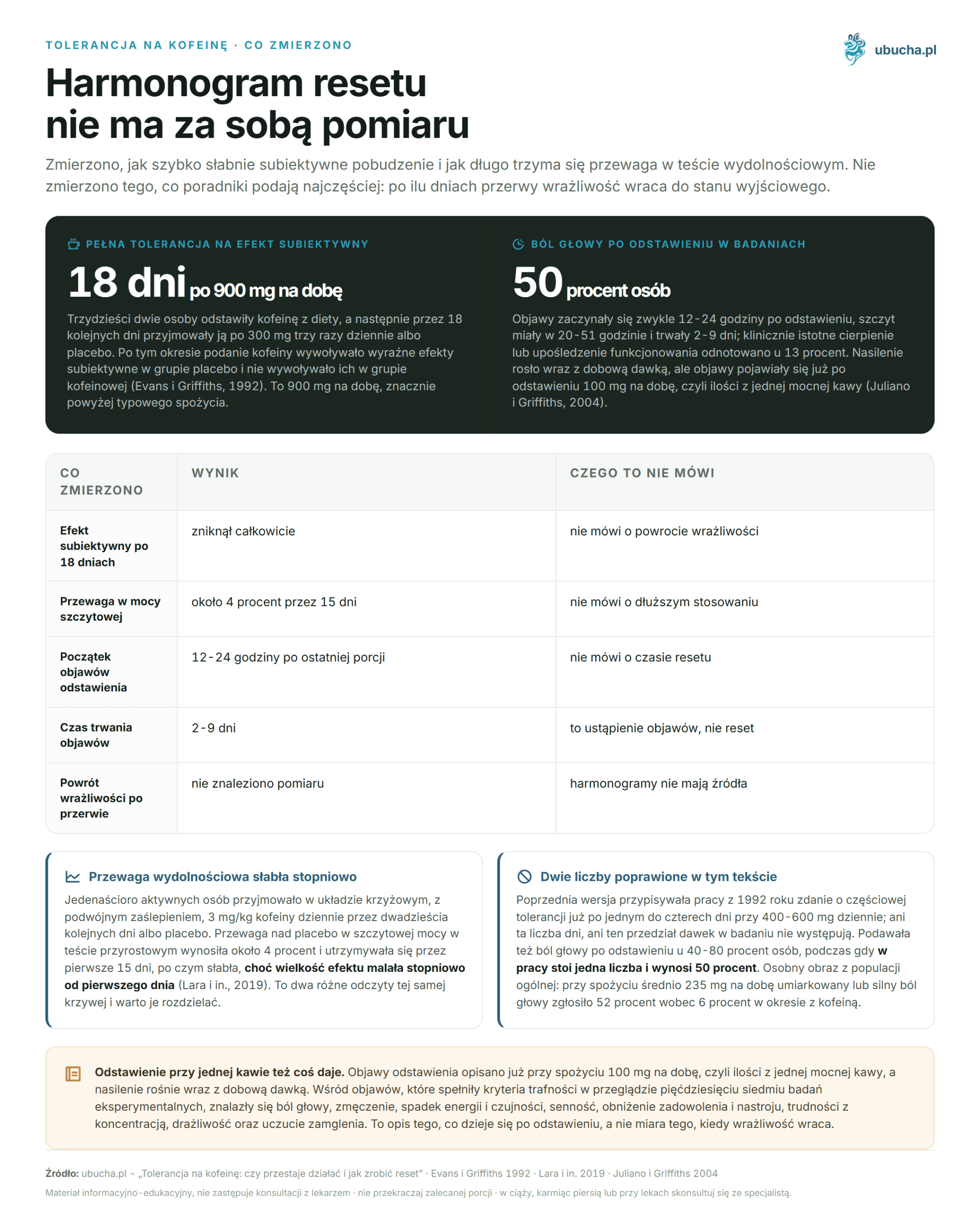
The purest measurement in humans comes from a study in which thirty-two individuals with moderate caffeine consumption eliminated it from their diet for the duration of the experiment, and then for eighteen consecutive days, they consumed caffeine at 300 mg three times a day or a placebo. After this period, caffeine produced clear subjective effects in the placebo group and did not produce them in the caffeine group. The authors called this the purest evidence of full tolerance to the effect of caffeine in the central nervous system in humans (Evans and Griffiths, Psychopharmacology, 1992).
It is worth noting the scale: 300 mg three times a day is 900 mg per day, significantly above typical consumption, and the period lasted eighteen days. An earlier version of this post attributed to this work a statement about partial tolerance after one to four days at 400-600 mg per day. Neither this number of days nor this dosage range appears in the study.
Separately, it was measured what happens to the performance advantage itself. Eleven active individuals consumed 3 mg/kg of caffeine daily in a crossover design, double-blind, for twenty consecutive days or a placebo. The advantage of caffeine over placebo in peak power in the incremental test was about 4 percent and lasted for the first fifteen days, after which it weakened, although the effect size gradually decreased from the first day (Lara et al., PLoS One, 2019).
What symptoms does caffeine withdrawal cause and how long do they last?
The answer comes from a review that gathered fifty-seven experimental studies and nine survey studies. Of the forty-nine described categories of symptoms, ten met the validity criteria: headache, fatigue, decreased energy, decreased alertness, drowsiness, decreased satisfaction, low mood, difficulty concentrating, irritability, and a feeling of fogginess. Flu-like symptoms, nausea with vomiting, and muscle pain and stiffness were also considered probably valid (Juliano and Griffiths, Psychopharmacology, 2004).
The numbers from this work are specific. In experimental studies, headaches occurred in 50 percent of individuals, and clinically significant suffering or functional impairment occurred in 13 percent. Symptoms usually began 12-24 hours after withdrawal, peaked at 20-51 hours, and lasted 2-9 days. Severity increased with daily dosage, but symptoms appeared even after withdrawing 100 mg per day.
The previous version of this post stated that headaches occurred in 40-80 percent of individuals. The work states one number, which is 50 percent. A separate picture from the general population is provided by a study of sixty-two adults with an average intake of 235 mg per day: during the placebo period, moderate or severe headaches were reported by 52 percent of them, compared to 6 percent during the caffeine period (Silverman et al., The New England Journal of Medicine, 1992).
Does withdrawal from one coffee a day do anything at all?
It does, and this has been measured. In a study on low-dose withdrawal, seven adults consumed 100 mg of caffeine per day, after which their capsules were substituted for placebo under double-blind control. In the first phase, during twelve consecutive days of placebo, an organized withdrawal syndrome occurred in four subjects, peaking on the first or second day and slowly returning to the pre-withdrawal state within about a week (Griffiths et al., The Journal of Pharmacology and Experimental Therapeutics, 1990).
In the second phase of the same study, placebo was substituted for single days, separated by an average of nine days of regular dosing. In this arrangement, a statistically significant withdrawal effect occurred in all seven individuals. The authors emphasized that the daily dose at which withdrawal produces symptoms is lower than previously thought, corresponding to roughly one cup of strong brewed coffee or three cans of caffeinated beverage.
This also answers the question of why morning coffee is often perceived as a condition for normal functioning rather than as stimulation beyond the norm. With regular consumption, part of the experienced effect is the alleviation of symptoms that have built up overnight. The question of the sense of a planned break returns with other substances, and we analyze it separately in the text about tolerance breaks with THC and CBD.
How long does it take to return sensitivity after a break?
No one has measured this in the referenced works, and this is the most important caveat of the entire article. The previous version of this post stated that sensitivity returns within 9-14 days of complete abstinence, that seven days is the minimum threshold, and that fourteen provides a safe margin. These statements were based on the work of Juliano and Griffiths, which is a review of withdrawal symptoms, not a study of the return of sensitivity. The 9-14 day range is not present in it.
What can be honestly gleaned from the available works? Withdrawal symptoms subside within 2-9 days, so after that time, the part of caffeine’s effect that consisted of alleviating them disappears. Separately, it is known that the performance advantage of 3 mg/kg lasts for at least fifteen days of daily intake, so tolerance to this particular effect builds up slowly. From these two measurements, no number of days of break can be derived.
However, something is known that contradicts the assumption that a few days of break is a condition for achieving the effect before starting. The position of the International Society of Sports Nutrition cites a study in which 3 mg/kg improved results in twelve trained cyclists regardless of whether they were previously given a four-day break, and another in which six regular consumers achieved increased endurance regardless of a zero, two, or four-day break (Guest et al., 2021). More about the doses themselves and what was measured in performance studies is discussed in the text about caffeine pre-workout.
Frequently Asked Questions
Is caffeine tolerance proven in humans?
Yes, for subjective effects. In the study by Evans and Griffiths, thirty-two individuals consumed 300 mg of caffeine three times a day or a placebo for eighteen days. After this period, caffeine produced clear subjective effects only in the group that had previously received the placebo.
How long does caffeine improve performance with daily intake?
In the study by Lara and colleagues, eleven active individuals consumed 3 mg/kg daily for twenty days. The advantage over placebo in peak power was about 4 percent and lasted for the first fifteen days, although its magnitude gradually decreased from the first day.
How long do caffeine withdrawal symptoms last?
According to the review by Juliano and Griffiths, symptoms begin 12-24 hours after the last dose, peak at 20-51 hours, and last 2-9 days. Headaches occurred in experimental studies in 50 percent of individuals, and clinically significant impairment in 13 percent.
Is there withdrawal with one coffee a day?
Yes. In the study by Griffiths and colleagues, seven adults consumed 100 mg of caffeine per day. With repeated one-day substitutions for placebo, a significant withdrawal effect occurred in all seven individuals. This amount corresponds to roughly one cup of strong brewed coffee.
How long does it take to reset caffeine sensitivity?
We did not find a study that measured the return of sensitivity after a break of a specified length. It is known that withdrawal symptoms subside within 2-9 days. The circulating reset schedules in guides, including the 9-14 day range, do not have such measurements in the cited works.
You can find caffeine in the store at Bucha only in the form of caffeine pouches, with varying content indicated on the packaging (as of August 16, 2026). We do not offer capsules or caffeine powder. The pouches themselves and what is known about them are described in a separate review.
This article is for informational and educational purposes and does not constitute medical advice. Before starting supplementation, consult your doctor, especially if you are taking medications regularly, are pregnant or breastfeeding, or have a chronic illness.
Author: Michał Waluk · Published: 2026-08-09 · Updated: 2026-08-16