
Fat Burners Under Research: What Really Works and What Doesn’t
Caffeine, EGCG, capsaicin, L-carnitine, and ephedrine compared with meta-analyses. We show what the numbers from studies say and where marketing diverges from the data.
Weight loss supplements are sold with the promise that they shift metabolism. Meta-analyses say otherwise: substances with the strongest data shift weight by a fraction of what a regular caloric deficit provides, and some popular ingredients do not even achieve that result. Additionally, there are preparations where the cardiovascular risk outweighs any benefit. This article compares the most commonly advertised ingredients with what has actually been measured in randomized studies and shows where the numbers on the label diverge from the numbers in scientific work. We start with the criteria by which we evaluate the evidence, so it is clear on what basis something ranks higher or lower. We warn right away: none of the substances described here changes the reduction outcome in a way that could be noticed without a scale and a notebook.
KEY INFORMATION
• In a meta-analysis of 13 randomized studies involving 606 people, doubling caffeine intake increased fat loss by 28% (Tabrizi et al., Critical Reviews in Food Science and Nutrition, 2019).
• Catechins with caffeine raised daily fat oxidation by 16% in respiratory chambers, caffeine alone did not significantly (Hursel et al., Obesity Reviews, 2011).
• Capsaicinoids before a meal lowered energy intake by 74 kcal (Whiting et al., Appetite, 2014).
• Ephedrine provides about 0.9 kg per month over placebo but increases the risk of psychiatric symptoms and palpitations by 2.2-3.6 times (Shekelle et al., JAMA, 2003).
• No supplement replaces a caloric deficit.
How do we evaluate evidence for fat burners?
According to the same hierarchy as with any supplement: meta-analyses of randomized studies rank highest, followed by single blinded studies, and then observational studies. Cell and animal studies are treated as hypotheses, not as evidence of action in humans. This order determines the ranking below.
| Criterion | Weight | What we check |
|---|---|---|
| Quality of the highest evidence | 45% | Meta-analysis of randomized studies ranks higher than a single study, and that ranks higher than observation |
| Clinical significance of the effect | 40% | Is the measured difference from placebo noticeable to a person, not just to a statistical test |
| Safety of use | 15% | Profile of adverse effects and interactions with medications |
One limitation applies to all these studies: most last from 8 to 12 weeks, while overweight is a long-term problem. Therefore, the result after three months does not indicate whether anything will remain after a year. This is directly visible in the meta-analysis of L-carnitine, as the effect size decreased with the length of the study. A second limitation concerns the reference point: some studies measure body weight, some measure only fat mass, and some measure only energy expenditure in laboratory conditions. These are three different questions, and the result of one should not be presented as an answer to the other two.
Which substances have the strongest evidence?
The strongest evidence is for caffeine, followed by green tea catechins and capsaicinoids. All three provide small effects. Below is a complete list of eight ingredients that most often appear in products advertised as fat burners, ranked by the strength of the data, not by the promises of the manufacturer.
| Position | Substance | Mechanism | What was measured | Evidence rating |
|---|---|---|---|---|
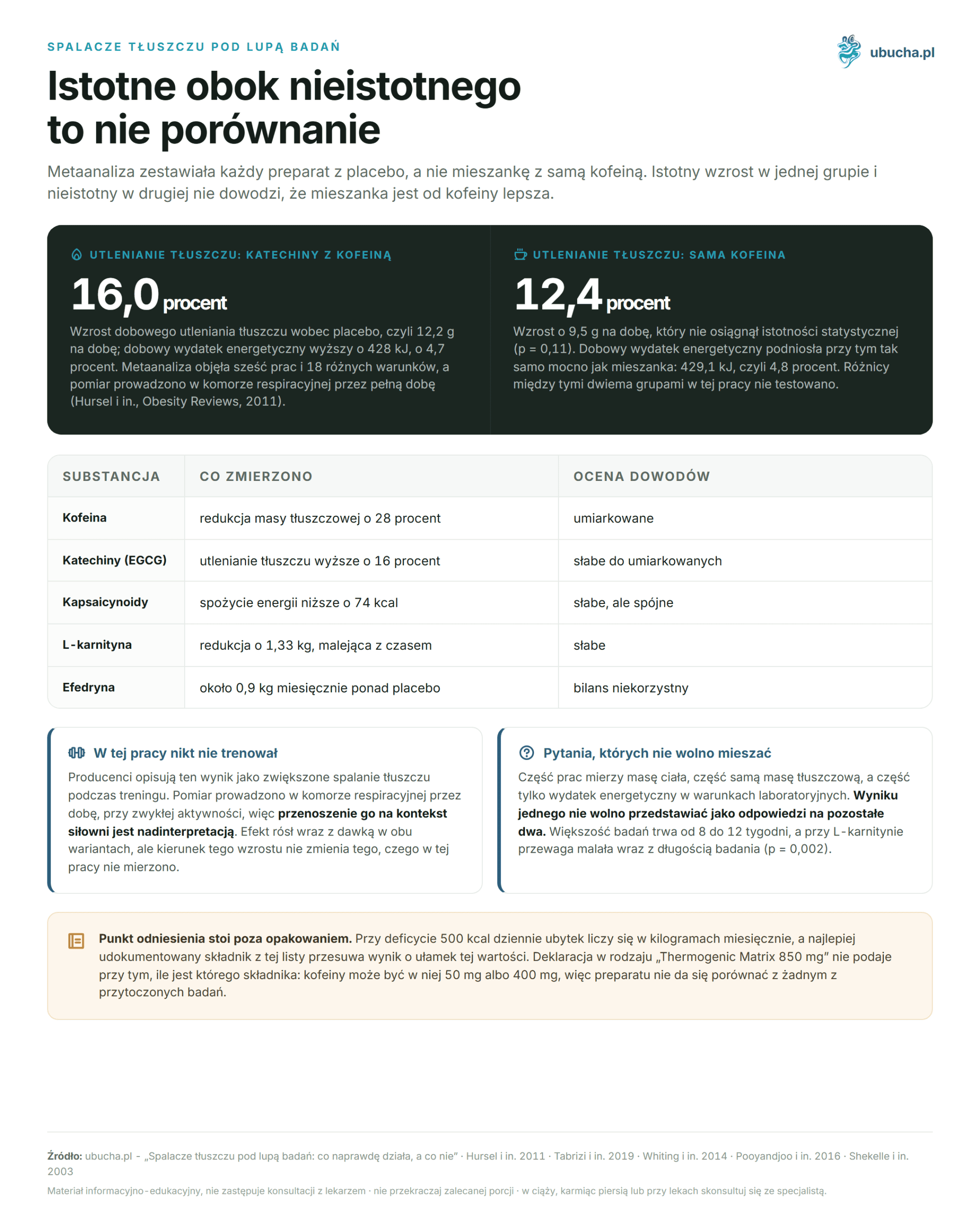
| 1 | Caffeine | Adenosine blockade, adrenaline release, lipolysis | Doubling intake increases fat loss by 28% (13 studies, 606 people) | Moderate, best available |
| 2 | Green tea catechins (EGCG) | COMT inhibition, increased thermogenesis | Daily fat oxidation higher by 16% in a mixture with caffeine | Weak to moderate |
| 3 | Capsaicinoids (chili pepper) | TRPV1 activation, appetite suppression | Energy intake in a meal lower by 74 kcal | Weak but consistent |
| 4 | L-carnitine | Transport of fatty acids to mitochondria | Reduction of 1.33 kg compared to control, but decreasing over time | Weak |
| 5 | CLA | Modulation of lipid metabolism | Effect on the borderline of clinical significance | Weak |
| 6 | Guarana | Natural caffeine and other xanthines | No advantage over pure caffeine; variable content makes dosing difficult | Comes down to caffeine |
| 7 | Green coffee extract | Chlorogenic acid | Data based on small studies of low methodological quality | Very weak |
| 8 | Ephedrine and synephrine | Adrenergic agonism, strong thermogenesis | About 0.9 kg per month over placebo, with increased risk of adverse symptoms | Real effect, unfavorable benefit-risk balance |
Does caffeine really burn fat?
Yes, but on a scale that disappoints. A systematic review with a meta-analysis of dose-dependent relationships included 13 randomized studies and 606 participants. The authors do not provide the result in kilograms, only as a relationship: each doubling of caffeine intake increased body weight reduction by 22%, BMI by 17%, and fat mass by 28% (Tabrizi et al., Critical Reviews in Food Science and Nutrition, 2019). The heterogeneity between studies was very high, which the authors note directly.
The mechanism is well described. Caffeine increases adrenaline release, adrenaline activates hormone-sensitive lipase in fat cells, and these release fatty acids into the blood. The catch is tolerance: the thermogenic effect weakens with regular use, so caffeine as a weight loss agent works best for someone who does not drink it daily. For someone who drinks three coffees a day, a caffeine supplement mainly adds nervousness.
A separate issue is the pre-workout dose, which marketing mixes with weight loss, although it has been studied for a completely different outcome. We break this down in the text about how much caffeine is really needed before training.
What does green tea do to energy expenditure?
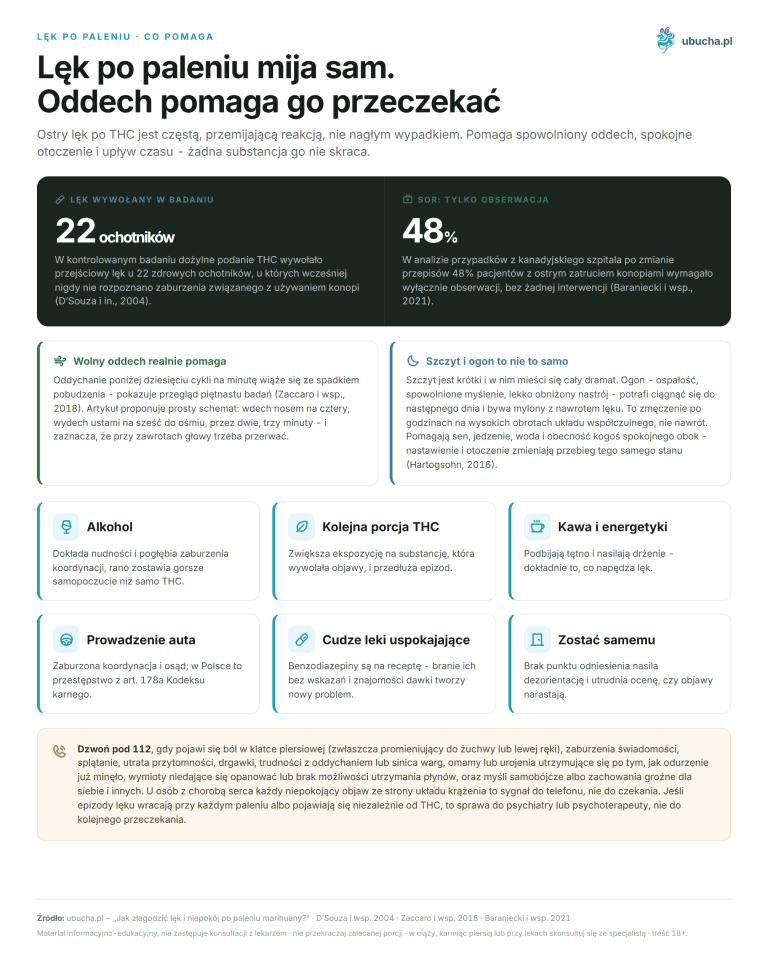
It raises it by a few percent per day, mainly in combination with caffeine. A meta-analysis by Hursel and colleagues gathered six studies covering 18 different conditions in which energy expenditure and fat oxidation were measured in respiratory chambers over a full day. Mixtures of catechins with caffeine raised daily energy expenditure by 428 kJ, or 4.7%, and daily fat oxidation by 12.2 g, or 16.0% (Hursel et al., Obesity Reviews, 2011).
An important detail that disappears in product descriptions: caffeine alone raised daily energy expenditure just as strongly (429.1 kJ, 4.8%), but the increase in fat oxidation did not reach statistical significance (9.5 g, 12.4%, p = 0.11). Note how this result is read: the meta-analysis compared each preparation with placebo, not the mixture directly with caffeine alone. A significant result in one group and not significant in the other does not prove that the mixture is better than caffeine; it only shows that the evidence for the mixture is stronger. The effect increased with the dose in both variants.
We noticed that manufacturers describe this result as “increased fat burning during training.” In this work, no one trained. The measurement was conducted in a respiratory chamber over a day, with normal activity, so transferring it to the gym context is an overinterpretation. We break down the composition and metabolism of catechins in a separate text about green tea extract.
At higher amounts of EGCG from the supplement, there is a signal from the liver. In the EFSA assessment, from 800 mg per day taken as a supplement, aminotransferases increase, and the threshold that could be considered safe has not been established by the authority for such preparations. Brewed tea is a different situation than concentrated extract in a capsule.
Why are ephedrine and synephrine a bad idea?
Because they work the strongest from the entire list and at the same time put the most strain on the cardiovascular system. A meta-analysis published in JAMA included 52 controlled studies. Ephedrine provided about 0.6 kg per month over placebo, ephedrine with caffeine about 1.0 kg, and the authors’ collective conclusion states about 0.9 kg per month over placebo (Shekelle et al., JAMA, 2003). None of the studies lasted longer than six months, so this work says nothing about the durability of the effect.
On the risk side, data from 50 studies showed an increase in the chances of psychiatric, autonomic, and gastrointestinal symptoms, as well as palpitations by 2.2 to 3.6 times. The authors note that the sample was too small to comment on events rarer than one in a thousand. This distinction matters: the work documents frequent troublesome symptoms, but does not confirm heart attacks or strokes. The authors did review descriptions of individual cases but deemed most of them too poorly documented to draw any conclusions.
Synephrine from bitter orange is sometimes marketed as “natural and safe ephedrine.” It has the same type of adrenergic action with weaker thermogenesis, so the argument comes down to it being a weaker version of a substance that is not worth taking anyway.
Does L-carnitine help with weight loss?
In a meta-analysis, yes, although the effect is small and diminishes over time. The work included nine randomized studies with a total of 911 people. Groups taking carnitine lost significantly more body weight than control groups: the difference was 1.33 kg (95% CI from -2.09 to -0.57), and the BMI dropped by 0.47 kg/m2. Regression analysis showed, however, that the longer the study lasted, the smaller the advantage of carnitine (p = 0.002) (Pooyandjoo et al., Obesity Reviews, 2016).
The theory behind supplementation sounds solid: carnitine transports long-chain fatty acids to mitochondria, where they are oxidized. The problem is that in a healthy, well-nourished person, there is no lack of carnitine in the muscles, so adding it does not increase the capacity of this transport. The diminishing effect over time fits this explanation better than a permanent change in metabolism.
A real deficiency occurs with a meat-free diet, in some kidney diseases, and in some older individuals. There, supplementation makes sense, but it is filling a deficiency, not weight loss. Similarly, one should read data about CLA cautiously, which we discuss in the text about the real scale of the CLA effect.
Capsaicin: less appetite instead of more thermogenesis
The best-documented action of capsaicinoids is appetite suppression, not boosting metabolism. A meta-analysis of energy intake data included ten clinical studies, of which eight with a total of 191 participants could be combined in the analysis. Capsaicinoids taken before a meal lowered free energy intake in that meal by 309.9 kJ, or 74 kcal (Whiting et al., Appetite, 2014). The authors advise treating this cautiously, as the heterogeneity was 75.7%, and the minimum amount giving an effect is 2 mg of capsaicinoids.
On the energy expenditure side, the data is more modest. In a double-blind study, twelve healthy men took 10 mg of capsinoids, which are non-pungent analogs of capsaicin. At rest, oxygen consumption and norepinephrine levels increased, and the body shifted towards drawing energy from fat. During cycling and recovery, there were practically no differences compared to placebo (Josse et al., Nutrition & Metabolism, 2010).
The practical conclusion is the opposite of the advertising. Capsaicin is not a workout booster, but an ingredient that may make you eat a little less. Non-pungent analogs are also better tolerated by the stomach than the pepper itself.
Why is a “proprietary blend” a red flag?
Because it hides doses, and without doses, you cannot assess either effectiveness or safety. The manufacturer provides the total mass of the blend and a list of ingredients, but does not say how much of each there is. With a declaration like “Thermogenic Matrix 850 mg: caffeine, synephrine, EGCG,” there could be 50 mg or 400 mg of caffeine in it, and the difference matters for someone who also drinks coffee.
EU regulations on informing consumers about food require the amount of the ingredient that has been highlighted in the product name or distinguished on the label to be stated. In practice, enforcing this requirement for supplements can be uneven, and manufacturers circumvent it by not highlighting the name of any single ingredient.
We also noticed another consequence of such a description. All the numbers cited in this article refer to specific amounts given in studies, so with unknown content of the preparation, it cannot be compared with any of these studies. You do not even know if you are buying active substances or a cheap filler with a trace of them. If the label does not provide milligrams for each item, treat it as a reason to put the package down.
What really works for weight loss?
A caloric deficit and a change in habits, not the contents of the package. The order of magnitude is visible in a simple comparison: with a deficit of 500 kcal per day, the loss counts in kilograms per month, while the best-documented supplement from this list shifts the result by a fraction of that value. A supplement can therefore be an addition to a working plan, but never a substitute for it.
A separate category is prescription medications used in obesity, such as orlistat, semaglutide, or tirzepatide. They have solid evidence for lasting weight loss but require a prescription, medical supervision, and specific clinical indications. This is not the same shelf as products from the supplement store, neither in terms of potency nor in terms of regulation and control.
If you were to look for one purchasing rule, it would be this: buy the ingredient, not the formula. A known ingredient in a known dose can be compared with a study, while a blend with undisclosed content cannot be compared with anything. The same way of reading labels is applied in a broader comparison, which supplements are really a waste of money.
Frequently Asked Questions
Do fat burners really work?
Partially and weakly. Caffeine has the strongest data: in a meta-analysis of 13 studies involving 606 people, doubling its intake increased the amount of fat loss by 28% (Tabrizi et al., 2019). However, ready-made formulas combine many ingredients without proven synergy, and the dominant factor in reduction remains a caloric deficit.
What is the difference between a thermogenic and an appetite suppressant?
A thermogenic increases energy expenditure by acting through the sympathetic nervous system, like caffeine. An appetite suppressant reduces food intake, like capsaicinoids, which lowered energy intake in a meal by 74 kcal. These are two different mechanisms, and only the latter directly affects the caloric balance.
Does green tea burn fat?
In a mixture with caffeine, it raises daily fat oxidation by 16.0%, measured in a respiratory chamber over a full day (Hursel et al., 2011). Caffeine alone did not produce a significant increase in fat oxidation. The result does not come from studies during exercise, so it does not describe the training effect.
Can weight loss supplements be dangerous?
Some can be. Ephedrine and synephrine act adrenergically, and a meta-analysis from JAMA showed an increase in the chances of psychiatric symptoms, autonomic symptoms, and palpitations by 2.2 to 3.6 times (Shekelle et al., 2003). Dinitrophenol sold in the gray market can be deadly. Check the ingredients before purchasing.
How much can you lose on fat burners?
Less than advertising suggests. Even ephedrine, the strongest substance on this list, provided about 0.9 kg per month over placebo with an unfavorable safety profile. The other ingredients perform worse. In comparison, a caloric deficit of 500 kcal per day translates to kilograms, not fractions of them.
What is a ‘proprietary blend’ and why does it raise caution?
It is a declaration of the total mass of the blend without the dose of each ingredient separately. You then do not know how much caffeine or synephrine you are taking, so you cannot assess either safety or effectiveness. EU regulations require the amount of the ingredient highlighted in the name to be stated, but manufacturers circumvent this by not highlighting any.
This article is for informational and educational purposes and does not constitute medical advice. Before starting supplementation, consult with a doctor, especially if you are taking medications regularly, are pregnant or breastfeeding, or have chronic illnesses.
Author: Michał Waluk · Published: 2026-07-31 · Updated: 2026-08-11