
Chrom for Appetite and Blood Sugar: Does It Work (FAQ)
The Cochrane review found no reliable evidence for chromium in weight loss, and EFSA refused to establish a recommended intake. What remains of the manufacturers' promises.
Chromium is marketed as an element for sugar and appetite, and in the European Union, two claims are allowed: that it helps maintain normal macronutrient metabolism and normal blood glucose levels. Both formulations refer to trivalent chromium and both speak of maintaining a normal state, not improving it. Beyond this list, the picture becomes less favorable: the European Food Safety Authority refused to establish a recommended intake of chromium, and the Cochrane review concludes with a statement about the lack of reliable evidence. This article shows what exactly was measured in studies on chromium, on whom and for how long, how wide the confidence intervals around these results are, and which of them actually pertain to health, rather than just laboratory readings.
KEY INFORMATION
• The European Food Safety Authority stated in 2014 that there is no evidence of beneficial effects of chromium in healthy individuals and deemed the establishment of a recommended intake inappropriate.
• A Cochrane review involving nine studies and 622 participants concludes that there is a lack of reliable evidence for the efficacy and safety of chromium picolinate in overweight and obese individuals (Tian et al., Cochrane Database of Systematic Reviews, 2013).
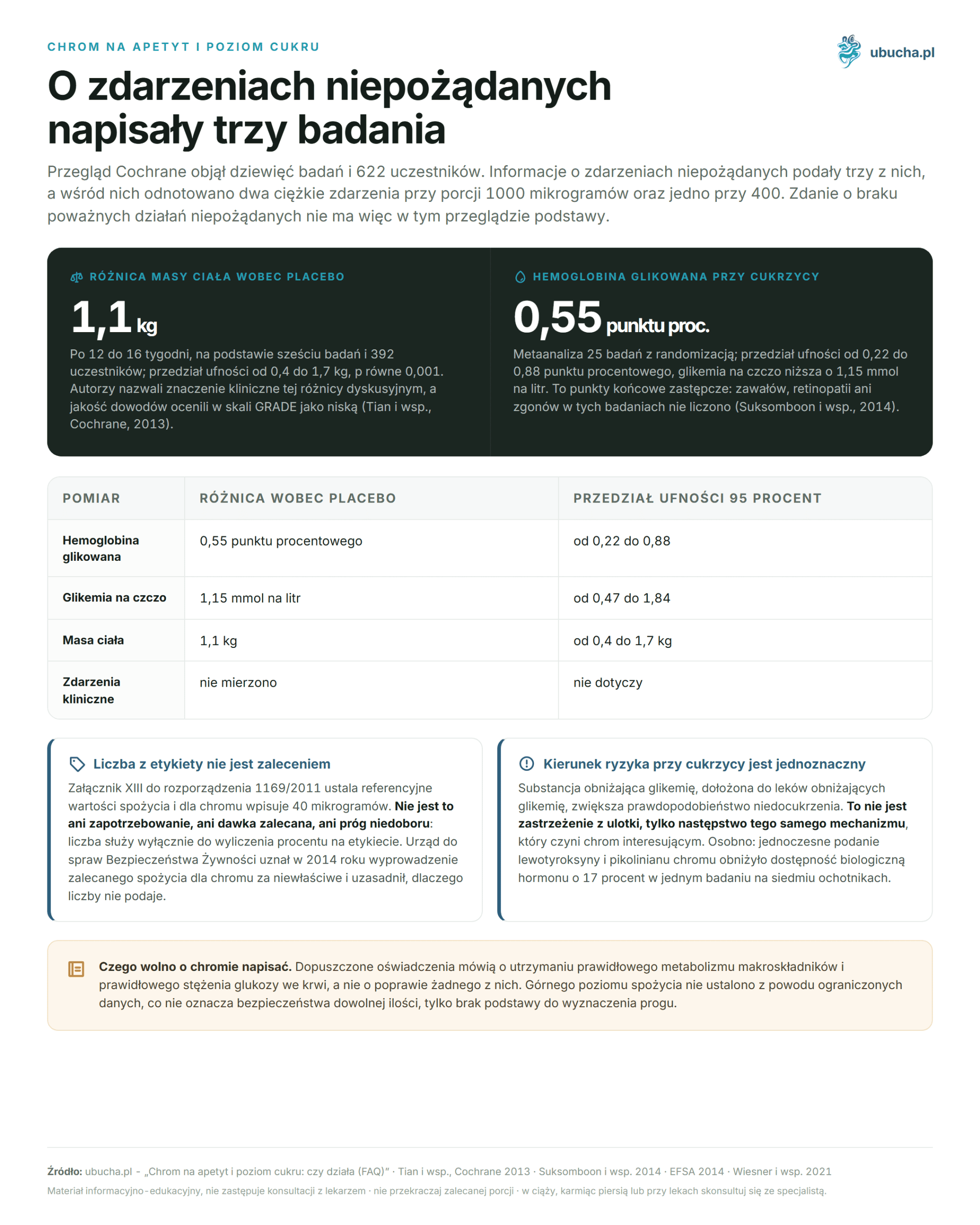
• The same review reports a weight difference of 1.1 kg compared to placebo, with a confidence interval from 0.4 to 1.7 kg, and calls its clinical significance debatable.
• In diabetic patients, a meta-analysis of 25 studies showed a reduction in hemoglobin A1c by 0.55 percentage points, with a confidence interval from 0.22 to 0.88 (Suksomboon et al., Journal of Clinical Pharmacy and Therapeutics, 2014).
• None of these measurements are clinical events. No one counted heart attacks, diabetes complications, or deaths.
• Chromium enhances the effect of blood glucose-lowering medications, so in diabetes, the decision to supplement should be made by the attending physician.
What does chromium do in the body and is it an essential element?
The description circulating in materials about chromium states: chromium is part of chromodulin, a low molecular weight oligopeptide, and chromodulin enhances the insulin receptor signal inside the cell. This is a hypothesis from the 1990s, based on studies of isolated protein and insulin receptor kinase.
The problem is that the essentiality of chromium for humans remains unresolved. The Food Safety Authority states directly that the mechanisms attributed to chromium and its essential role in metabolism have not been confirmed, and the assumption of essentiality was based almost exclusively on case reports of patients fed long-term parenterally. The author of some cited works on chromodulin published an article in 2017 titled directly as new evidence against recognizing chromium as an essential element, stating that chromium can today be regarded solely as a pharmacologically active substance (Vincent, The Journal of Nutrition, 2017).
A separate issue is the chemical form. In supplements and food, trivalent chromium is present, and only this form is subject to approved health claims. Hexavalent chromium is a toxic substance, but it is not present in preparations: the authority notes that the energy required to oxidize the trivalent form to the hexavalent form is so great that such oxidation does not occur in biological systems.
Does chromium reduce the craving for sweets?
The data comes from two small studies and is weaker than advertising suggests. Docherty and colleagues administered 600 micrograms of elemental chromium in the form of chromium picolinate or placebo to 113 adults with atypical depression for eight weeks, in a two-to-one ratio. The primary efficacy measures were the Hamilton Depression Scale and the Clinical Global Impression Scale, and no difference was found between the groups in either of them (Docherty et al., Journal of Psychiatric Practice, 2005).
The improvement pertained to four individual items on the scale, including carbohydrate craving, and a subgroup of 41 individuals with heightened craving, identified after data collection. This is a secondary outcome in a study that did not achieve its primary goal, and not evidence of an appetite-reducing effect.
The second study is closer to the topic. Anton and colleagues administered chromium picolinate or placebo to 42 overweight women reporting carbohydrate cravings for eight weeks, measuring food intake directly rather than from a diary. Chromium reduced food intake and the feeling of hunger and craving for fat, while the weight loss remained at the threshold of significance. The abstract provides only p-values, without confidence intervals (Anton et al., Diabetes Technology and Therapeutics, 2008). The second part of the same work is an experiment on rats, in which chromium was injected directly into the brain chamber, a route without a human equivalent.
Does chromium help with weight loss?
Here the answer is best documented and least favorable for manufacturers. The Cochrane review led by Tian included nine randomized studies and 622 participants with overweight or obesity, with follow-up lasting up to 24 weeks, and compared various dosages of chromium picolinate with placebo.
After 12 to 16 weeks, the weight difference favored chromium and amounted to 1.1 kg, with a confidence interval from 0.4 to 1.7 kg, with p equal to 0.001, based on six studies and 392 participants. The authors deemed the clinical significance of this difference debatable, and assessed the quality of evidence on the GRADE scale as low. For body mass index, percentage of body fat, and waist circumference, neither a certain effect nor a dose-dependent relationship was demonstrated.
The authors’ conclusion is that they found no current and reliable evidence to determine the efficacy and safety of chromium picolinate in overweight and obese individuals. It is worth noting the section regarding safety: only three studies reported information on adverse events, among which two serious events were noted at a dose of 1000 micrograms and one at 400 micrograms. The statement about the absence of serious adverse events in this regard is therefore not supported by this review.
Does chromium lower blood sugar in type 2 diabetes?
This is the only area where the meta-analysis shows a statistically significant result. Suksomboon and colleagues collected 25 randomized studies comparing chromium with placebo in individuals with diabetes, of which 22 concerned chromium alone, and the others its combinations with vitamins or biotin.
| Measurement | Difference from placebo | 95 percent confidence interval |
|---|---|---|
| Hemoglobin A1c | 0.55 percentage points | from 0.22 to 0.88 |
| Fasting blood glucose | 1.15 mmol per liter | from 0.47 to 1.84 |
| Clinical events | not measured | not applicable |
Both confidence intervals lie on one side of zero, so the effect is statistically significant. However, these are surrogate endpoints: hemoglobin A1c and fasting blood glucose describe diabetes control, not what happens to the patient. No one in these studies counted heart attacks, retinopathy, or deaths, so this meta-analysis does not imply that chromium reduces the risk of diabetes complications (Suksomboon et al., Journal of Clinical Pharmacy and Therapeutics, 2014).
The authors also note where the effect was more pronounced: in individuals with poorly controlled diabetes at the beginning of the study and when using picolinate. The abstract does not indicate chromium deficiency as a condition for efficacy, although such wording circulates in supplement materials. The authors themselves conclude the work with a note that long-term benefits and safety require further research. A comparison of chromium with other substances studied in this indication can be found in the text about supplements for insulin resistance.
Where does the number 40 micrograms on the label come from?
From food labeling regulations, not from the authority’s recommendations. Annex XIII to Regulation 1169/2011 establishes reference intake values for vitamins and minerals, and for chromium, it states 40 micrograms. This number is used solely to calculate the percentage on the label. It is neither a requirement, nor a recommended dose, nor a deficiency threshold.
The Food Safety Authority resolved this issue in 2014 and did so in a way that advertising materials usually do not cite. The panel deemed deriving the average requirement and population reference intake for chromium inappropriate, stating a lack of evidence for beneficial effects of chromium in healthy individuals, and on this basis deemed the establishment of adequate intake also inappropriate. In other words: the authority not only did not provide a number but justified why it does not provide one.
The same applies to the upper limit. The Scientific Committee on Food was unable to establish a tolerable upper intake level for chromium due to limited data. This does not mean that any amount is safe, only that there is no basis for setting a threshold. In practice, the only claims that can be made about chromium on packaging pertain to maintaining normal macronutrient metabolism and normal glucose levels, and require that the product be at least a source of trivalent chromium.
When is chromium not a good choice?
The first case is a healthy person with normal blood glucose. The meta-analysis shows an effect where diabetes control is poor, and the authority states a lack of evidence for benefits in healthy individuals. The approved claim speaks of maintaining normal glucose levels, so promising improvement goes beyond what regulations allow.
The second case is diabetes treated pharmacologically, and here the risk direction is clear. A substance that lowers blood glucose, added to blood glucose-lowering medications, increases the likelihood of hypoglycemia. This is not a theoretical caveat from a leaflet, but a predictable consequence of the same mechanism that makes chromium interesting. The decision to add chromium to diabetes treatment should be made by the attending physician, as it may require changes in medication dosages.
The third case is the treatment of hypothyroidism. A systematic review of interactions between levothyroxine and food and supplements found one study on this topic, conducted on seven healthy volunteers: simultaneous administration of levothyroxine and chromium picolinate reduced the bioavailability of the hormone by 17 percent. The authors of the review state directly that due to a lack of further studies, detailed recommendations regarding the interval between the two cannot be formulated (Wiesner et al., Pharmaceuticals, 2021). Specific hours provided in guides have no basis in data, and the very fact of interaction is a reason to discuss it with an endocrinologist. Another molecule studied in glucose metabolism is discussed in the text about THCV and type 2 diabetes.
Frequently Asked Questions
Does chromium actually reduce the craving for sweets?
The evidence is weak. In a study of 113 people with atypical depression, chromium did not improve scores on either of the two primary scales, and the improvement in carbohydrate craving was a single secondary outcome. In a second study involving 42 overweight women, chromium reduced food intake, but the weight loss remained at the threshold of significance.
Does chromium help with weight loss?
A Cochrane review involving nine studies and 622 participants found a difference of 1.1 kg compared to placebo, with a confidence interval from 0.4 to 1.7 kg, and deemed its clinical significance debatable due to low-quality evidence. The authors conclude the review by stating that there is a lack of reliable evidence for efficacy and safety.
Does chromium help with type 2 diabetes?
A meta-analysis of 25 randomized studies showed a reduction in hemoglobin A1c by 0.55 percentage points and fasting blood glucose by 1.15 mmol per liter, in both cases with confidence intervals not including zero. However, these are surrogate endpoints: the impact on diabetes complications or survival was not studied.
Is chromium an essential element?
This remains disputed. The European Food Safety Authority stated that the essential role of chromium in metabolism has not been confirmed and refused to establish a recommended intake due to a lack of evidence for beneficial effects in healthy individuals. Some researchers consider chromium solely as a pharmacologically active substance.
Can chromium in supplements be toxic?
Supplements contain trivalent chromium, and it is this form that is subject to approved claims. The toxic hexavalent form does not arise from it in the body, as such oxidation does not occur in biological systems. This does not mean that any amount is safe: an upper intake level has not been established.
Does chromium interact with medications?
Yes, in two known directions. It enhances the effect of blood glucose-lowering medications, increasing the risk of hypoglycemia. It also reduces the bioavailability of levothyroxine by 17 percent, although this was shown in one study on seven volunteers, based on which a recommended interval between preparations cannot be established.
This article is for informational and educational purposes only and does not constitute medical advice. Before starting supplementation, consult your doctor, especially if you are taking medications regularly, are pregnant or breastfeeding, or have a chronic illness.
Author: Michał Waluk · Published: 2026-08-09 · Updated: 2026-08-16