
Collagen for Joints and Skin: Which to Choose, How to Dose, and When to See Effects (2026)
Collagen for joints and skin: 7 products from the offer at Bucha in a table, cost of 10 g of collagen, doses confirmed by studies, and real time for effects.
Collagen is the most abundant protein in the human body and the main building material for skin, cartilage, and bones. Its supply in the skin decreases with age, and in women, it is lower in every age group (Shuster et al., British Journal of Dermatology, 1975). Hence the popularity of supplements and the problem: labels are poorly comparable because one product lists grams of powder, another milliliters of liquid, and a third just the number of servings. We checked what is really on the shelf at Bucha, recalculated each product to a common denominator, and compared it with doses from clinical studies. You will learn which form of collagen is absorbed, how much is needed daily, how much such a serving costs, and after how long the assessment of effects makes sense.
KEY INFORMATION
• 2.5 g of collagen peptides daily for 8 weeks significantly improved skin elasticity compared to placebo (Proksch et al., 2014).
• Peptides are absorbed, not native collagen.
• Bucha has 7 collagen products, the cost of 10 g of collagen: from 3.97 PLN to 45.02 PLN.
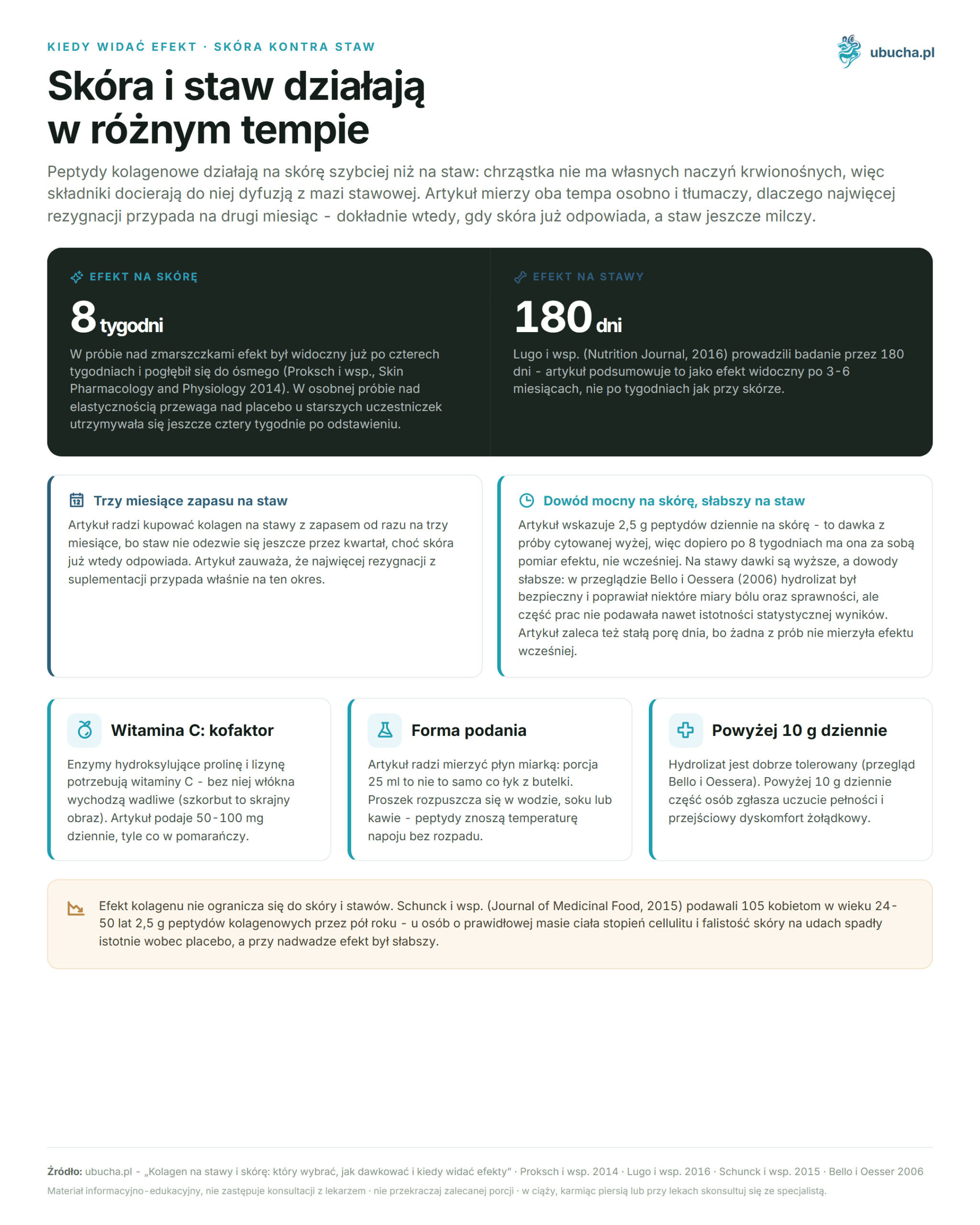
• Skin responds after 8 weeks, joints after 3-6 months.
What is collagen and why does its supply decrease with age?
Collagen is a family of fibrous proteins with a triple helix, forming the scaffolding of skin and cartilage. Shuster et al. (British Journal of Dermatology, 1975) measured collagen in the skin of the forearm in a large group of healthy individuals and showed that it decreases with age, and in women, it is lower in every age bracket.
Type I predominates in skin and bones, type II builds articular cartilage, and type III accompanies type I in the walls of blood vessels. This difference matters when choosing a product, as manufacturers declare the type on the label.
Synthesis is carried out by fibroblasts in the skin and chondrocytes in cartilage. Their work rate is reduced by UV radiation, smoking, and vitamin C deficiency. The latter factor is often overlooked, although without it nothing will work: enzymes that hydroxylate proline and lysine need vitamin C as a cofactor. Without it, fibers with defective structure are produced, the extreme example of which is scurvy.
We noticed in conversations with customers that almost no one knows this. People take powder on an empty stomach, wash it down with water, and after two months are surprised by the lack of effect.
Hydrolysate or native collagen, what is really absorbed?
Peptides are absorbed, not whole protein. Native collagen is a molecule of about 300 kDa, which the intestine does not fully pass, and digestive enzymes break it down into ordinary amino acids. Hydrolysate has been enzymatically broken down at the production stage, into di- and tripeptides weighing 500-2000 Da.
Iwai et al. (Journal of Agricultural and Food Chemistry, 2005) administered gelatin hydrolysates to healthy volunteers on an empty stomach and monitored plasma. The peptide form of hydroxyproline, virtually absent before administration, rose to a maximum of 20-60 nmol per milliliter after 1-2 hours, and after four hours, it halved. The dominant fragment was the dipeptide proline-hydroxyproline. This is solid evidence that whole peptides circulate in the blood after hydrolysate, not just broken down amino acids.
The practical conclusion is simple. Look for the words “collagen hydrolysate” or “collagen peptides” on the label. The word “collagen” alone without this addition says nothing about the form and whether the raw material has undergone hydrolysis at all. An exception is undenatured type II collagen (UC-II), which works in a completely different way and therefore is dosed in milligrams, not grams.
What dose of collagen is confirmed in studies?
For skin, 2.5 g daily is confirmed. Proksch et al. (Skin Pharmacology and Physiology, 2014) in a double-blind placebo-controlled trial administered 2.5 g or 5 g of hydrolysate to 69 women aged 35-55 for 8 weeks. Skin elasticity significantly improved in both groups compared to placebo, and in older participants, the advantage persisted for another four weeks after discontinuation.
The same team separately checked wrinkles. In another trial (Skin Pharmacology and Physiology, 2014), 114 women aged 45-65 took 2.5 g of peptides for 8 weeks. The volume of wrinkles around the eyes decreased by 20% compared to placebo, and in skin biopsies, the content of type I procollagen increased by 65%.
For joints, the doses are higher, and the evidence is weaker. Bello and Oesser (Current Medical Research and Opinion, 2006) collected four open studies and three double-blind ones, then cautiously summarized them: hydrolysate proved safe and improved some measures of pain and function, but some studies did not even report statistical significance of the results. A separate pathway is UC-II at a dose of 40 mg daily.
Which collagen products are available at Bucha?
There are currently seven collagen products in the catalog: six fish ones from Aura Care and one bovine from Divine Goods. We ranked them by the cost of 10 g of collagen, as this is the only comparable quantity between powder, liquid, and coffee. The price of the package does not resolve anything since the daily serving ranges from 0.73 g to 10 g.
| Place | Product | Collagen per daily serving | What distinguishes it | Price | Cost of 10 g of collagen |
|---|---|---|---|---|---|
| 1 | Divine Goods by.herbs Divine Collagen, 315 g | 10,000 mg | bovine peptides type I and III plus 500 mg of tremella extract | 118.99 PLN | 3.97 PLN |
| 2 | Aura Care Collagen Power of Beauty 500 ml | 12,000 mg | liquid with hyaluronic acid and bamboo silica | 139.00 PLN | 5.79 PLN |
| 3 | Aura Care Collagen Power of Youth 500 ml | 11,000 mg | liquid with 1000 mg of MSM and plant extracts | 139.00 PLN | 6.32 PLN |
| 4 | Aura Care PREMIUM Activity Collagen 200 g | 5,500 mg | powder with glucosamine, chondroitin, and MSM, joint profile | 129.00 PLN | 7.82 PLN |
| 5 | Aura Care PREMIUM Beauty Collagen 200 g | 5,500 mg | powder with organic silica and biotin | 129.00 PLN | 7.82 PLN |
| 6 | Aura Care Collagen Coffee Arabica 220 g | 2,000 mg | collagen in instant coffee, 36 servings per package | 99.00 PLN | 13.75 PLN |
| 7 | Aura Care Collagen Essence 50 ml | 733 mg | concentrated drops with six B vitamins | 99.00 PLN | 45.02 PLN |
Prices are from the store, as of August 8, 2026. The cost of 10 g was calculated from the declared collagen content per serving and the number of servings in the package. The price list changes faster than the article, so check the amount in the supplements category before purchasing.
How much does 10 g of collagen cost in each of these products?
The range is elevenfold. The cheapest 10 g of collagen costs 3.97 PLN, the most expensive 45.02 PLN, and the difference does not come from the quality of the raw material, but from the form of administration and how much collagen the manufacturer packed into one serving.
Powders win because nothing needs to be preserved in them. Liquids pay for water and the bottle, but have an advantage in dosing: a serving of Power of Beauty provides 12 g of collagen, more than any powder in the table. Collagen coffee and drops are a separate category. Their serving provides 2 g and 0.73 g, so as a standalone source of collagen, they perform poorly, and make sense as a convenient addition.
If you are aiming for doses from joint studies, count the cost for a quarter, not the price of the package. At 10 g daily for 12 weeks, the cheapest option from the table is about 333 PLN, while Collagen Essence in the same role would cost over 3,700 PLN.
When do you see effects on the skin, and when on the joints?
Skin responds faster. In the Proksch et al. trial from 2014, measurement after 8 weeks showed a significant improvement in elasticity, and in the second work of the same team, the volume of wrinkles decreased after four weeks and deepened the decline to eight. Eight weeks is therefore a fair minimum after which assessment makes sense.
Joints require patience because cartilage does not have its own blood vessels, and components reach it by diffusion from the synovial fluid. Lugo et al. (Nutrition Journal, 2016) conducted a study over 180 days. 191 people with knee osteoarthritis were assigned to 40 mg of UC-II, glucosamine with chondroitin, or placebo. After six months, the UC-II group had a significantly lower total WOMAC score than the placebo group and the glucosamine group.
We noticed that the most resignations occur in the second month, which is when the skin is just starting to respond, and the joint will not respond for a quarter. When buying collagen for joints, plan a supply for three months right away. We compared the types in the text Collagen type I, II, III: what are the differences.
How to take collagen and who should be cautious?
Regularity matters more than the time of day. Choose a fixed hour and stick to it for at least 8 weeks, as all the trials cited above measured the effect only after such a period. The powder dissolves in water, juice, or coffee, and the peptides withstand the temperature of the drink without breaking down. Measure the liquid with a measuring cup, as a 25 ml serving is not the same as a free sip straight from the bottle.
Add vitamin C to the serving if it is not in the product’s composition. It is not about megadoses. A daily 50-100 mg covers the needs of hydroxylating enzymes, and you can find that in one orange or half a red pepper.
Collagen hydrolysate is well tolerated, as confirmed by the review by Bello and Oesser. At doses above 10 g, some people report a feeling of fullness and temporary stomach discomfort. Three situations require caution. An allergy to fish excludes all fish products, which means six out of seven items in the table. A vegan diet excludes them all, as collagen is an animal protein. Pregnancy and breastfeeding are areas without sufficient clinical data, so leave the decision to your doctor.
Frequently Asked Questions
Do you need to take collagen with vitamin C?
Vitamin C is a cofactor for prolyl and lysyl hydroxylase, without which collagen chains do not form a stable helix. You do not have to take it at the same second as the peptides, but a daily intake of 50-100 mg should be consistent. Both Aura Care PREMIUM powders contain wild rose extract.
Which type of collagen works for joints?
Articular cartilage is built from type II collagen, but clinical studies show two effective pathways. Hydrolysate types I and III in doses of several grams and undenatured type II (UC-II) in a dose of 40 mg. Lugo et al. (Nutrition Journal, 2016) showed the superiority of UC-II over glucosamine with chondroitin after 180 days of use.
Is liquid collagen better than powder?
There is no evidence for better absorption of liquid. The difference lies in convenience and price per gram. In our comparison, a liquid serving provides the most collagen at once, up to 12,000 mg, but 10 g of collagen from liquid costs 5.79 PLN compared to 3.97 PLN from powder. Keep an open bottle in the fridge.
Does collagen help with cellulite?
Schunck et al. (Journal of Medicinal Food, 2015) administered 2.5 g of collagen peptides to 105 women aged 24-50 for six months. In women with normal body weight, the degree of cellulite and skin waviness on the thighs significantly decreased compared to placebo. In overweight individuals, the effect was weaker.
Can collagen be combined with omega-3 acids?
Yes, this is a common combination for joint ailments and there is no known interaction between these components. Collagen provides building material, while omega-3 acids act on inflammation in the tissue. We outlined the dosing of fatty acids in the post Omega-3: dosing and what studies have shown.
Does collagen replace protein in the diet?
No. Collagen does not contain tryptophan and is deficient in several other essential amino acids, so it is not sufficient as the sole source of protein. A 10 g serving of hydrolysate provides about 10 g of protein with an incomplete profile. Cover your needs with meat, dairy, or legumes.
All seven products from this comparison can be found in the supplements at Bucha.
This article is for informational and educational purposes and does not constitute medical advice. Before starting supplementation, consult your doctor, especially if you are taking medications regularly, are pregnant or breastfeeding, or have chronic illnesses.
Author: Michał Waluk · Published: 2026-06-15 · Updated: 2026-08-08