
Herbs for Concentration: Ginkgo, Gotu Kola, Verbena, What to Choose and How to Use
Ginkgo, gotu kola, bacopa, and verbena for concentration: what has really been studied, on whom, for how long, and with what result. No dosage tables, but with study numbers.
Four herbs appear in every list for concentration: ginkgo biloba, gotu kola, bacopa monnieri, and medicinal verbena. However, the research basis for each of them looks completely different, and this difference is lost in guides that place them side by side as equivalent options. One has a meta-analysis of seven studies involving nearly three thousand people, another is based on a single trial with twenty-eight participants, and yet another has no clinical studies in humans at all. Below is a breakdown of what has actually been measured for each of them: who conducted the study, how many participants there were, how long it lasted, and what the outcome was. The numbers from the studies remain, but the dosage tables do not, as to how much to take is discussed with a doctor or pharmacist, not with an article.
KEY INFORMATION
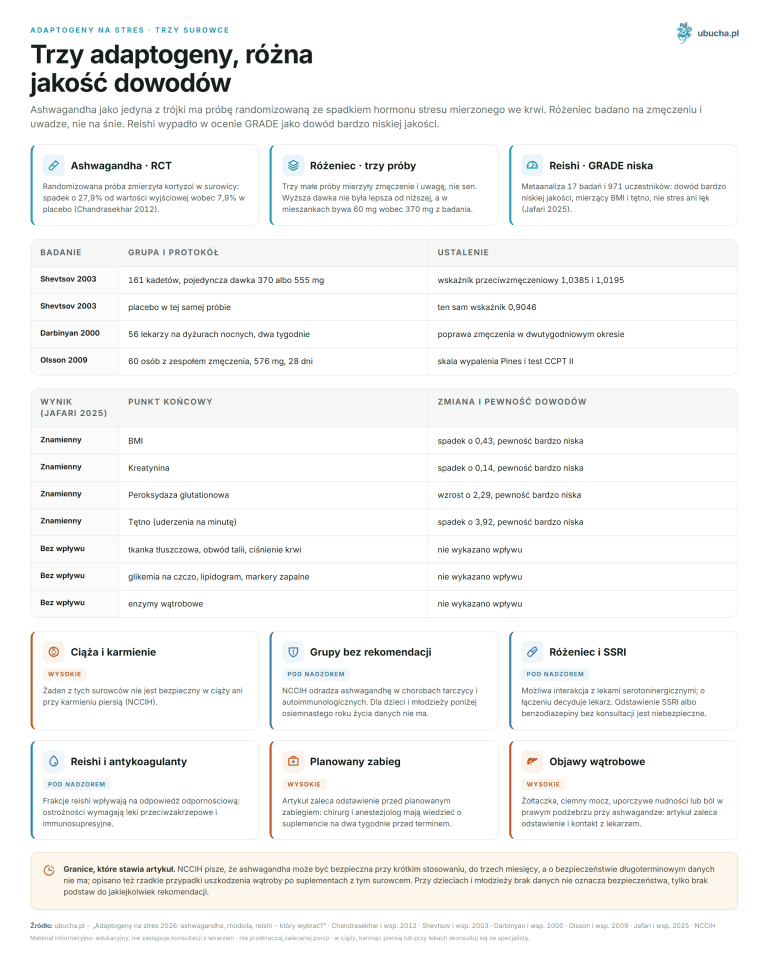
• Ginkgo has the strongest evidence in people with dementia, not in healthy individuals: a meta-analysis of seven studies involving 2684 patients showed superiority over placebo (Gauthier and Schlaefke, 2014).
• This analysis was funded by the producer of the studied extract, and one of the co-authors is an employee of the company.
• In healthy individuals under 60, a review of 15 studies found no convincing cognitive effect (Canter and Ernst, 2007).
• Bacopa improved information processing speed and memory consolidation in a study of 46 individuals, with the maximum effect only after 12 weeks (Stough et al., 2001).
• Medicinal verbena has no clinical study in humans for anxiety or concentration; the available data is preclinical.
What has been shown for ginkgo biloba?
The strongest data concerns individuals with dementia, not healthy adults. Gauthier and Schlaefke collected seven randomized studies with placebo control, in which 2684 patients were randomly assigned to extract EGb 761 or placebo, and 2625 individuals entered the full analysis. Treatment lasted from 22 to 26 weeks, at a dose of 120 or 240 mg daily. The standardized mean difference was -0.52 for cognitive functions and -0.44 for activities of daily living, in both cases favoring the extract (Clinical Interventions in Aging, 2014, PMC4259871).
This result should be supplemented with information that summaries usually do not provide. The statistical analysis was funded by Dr Willmar Schwabe, the producer of extract EGb 761, and a co-author works in its clinical research department. The second author received a speaking fee from the same company. This does not invalidate the result, as the data comes from randomized studies, but the reader has the right to know who paid for the analysis, especially since the repeated statement in guides about the uniqueness of EGb 761 comes from the same circle.
It is also worth knowing what extract EGb 761 is: a standardized preparation with a specific content of flavonoid glycosides and terpenoids, on which most clinical studies have been conducted. A product described on the package simply as “ginkgo leaf” may not have the same composition, and thus does not automatically inherit the results of those studies. We discuss the plant itself in the text about Japanese ginkgo.
Does ginkgo work for a healthy person?
The answer is: it has not been shown to work. Canter and Ernst updated their earlier review and included 15 randomized double-blind studies conducted on healthy individuals under 60. Seven of them checked a single dose, and eight included periods from two days to 13 weeks.
The authors’ conclusions are clear and are already visible in the title of the paper, which translates to “Ginkgo biloba is not a cure for cleverness.” Some studies with a single dose reported effects in selected tests and at selected time points, but these results were either not replicated or other studies directly contradicted them. The data from longer studies are mostly described as negative. Among studies measuring participants’ own feelings, only one of five short ones and one of six longer ones yielded a significant result (Human Psychopharmacology, 2007, PMID 17480002).
The practical conclusion is not that ginkgo “does not work” in every circumstance. It is that the evidence comes from a completely different population than a healthy person who wants to focus better at work. Transferring results from dementia studies to a thirty-year-old at a desk is extrapolation, not determination.
What has been studied for gotu kola?
Gotu kola, or Centella asiatica, has one often-cited placebo-controlled study in the cognitive context. Wattanathorn and colleagues conducted a randomized double-blind trial with 28 healthy older adults who took the extract for two months at one of three doses: 250, 500, or 750 mg once daily. Cognitive performance was assessed using a computerized battery of tests and evoked potentials, and mood was measured using visual analog scales (Journal of Ethnopharmacology, 2008, PMID 18191355).
The result requires precision, as it is often summarized too generously. Improvement in working memory and an increase in the amplitude of the N100 component were obtained only after the highest of the three doses. Self-rated mood also improved. The authors conclude cautiously: the results suggest the potential of the plant in alleviating age-related cognitive and mood decline, and the mechanism requires further research.
From a single trial on 28 individuals, nothing can be inferred about how many weeks the effect appears or whether the plant works faster than other herbs in this set. Such comparisons circulate in guides, but no studies directly comparing these plants have been found in the literature indexed in Europe PMC.
Does medicinal verbena really calm?
Here it must be stated plainly: for medicinal verbena, no clinical study in humans has been found that would check its effect on anxiety or concentration. A comprehensive review by Kubica and colleagues describes Verbena officinalis as a medicinal plant with a long tradition of use, with a raw material monograph in the European Pharmacopoeia since 2008, but the pharmacological works cited are in vitro studies and animal studies (Planta Medica, 2020, PMID 32937665).
Separately, it is worth untangling a frequent naming misunderstanding, which in this case comes out the opposite of what herb lists state. Medicinal verbena and lemon verbena are two different plants, and it is lemon verbena, or Aloysia citrodora, that has received a European herbal monograph from the European Medicines Agency. The monograph covers traditional use for sleep disorders and transient insomnia, as well as for mental stress and mood disorders. Traditional use means approval based on long-standing practice, not on clinical studies, but it is still more than medicinal verbena has.
The conclusion for the reader is that verbena can remain in a cup as an infusion that someone simply enjoys in the evening, but it should not be treated as a solution to concentration problems backed by evidence. The differences between the two plants are detailed in the text about lemon verbena.
Why does bacopa require weeks, not days?
Because that is how it turned out in the study that made it famous. Stough and colleagues randomly assigned 46 healthy adults to the extract Bacopa monnieri, marketed as Keenmind, at a dose of 300 mg or to placebo, in a double-blind setup with independent groups. Neuropsychological tests were performed before starting and after 5 and 12 weeks (Psychopharmacology, 2001, PMID 11498727).
Compared to placebo, bacopa significantly improved the speed of visual information processing measured by the inspection time task, the rate of learning, and memory consolidation measured by the word learning test, and also reduced situational anxiety. The authors emphasize that the effects were greatest only after 12 weeks. This is the source of the repeated advice about patience: the measurement taken after five weeks did not yet show the full effect, so a short trial does not determine effectiveness.
It is worth noting what this study did not show. There was no mention of visual-spatial memory or of bacopa’s superiority over other herbs, as no other herb was administered in it. We detail the plant itself in the guide to bacopa monnieri.
Which herb for which problem?
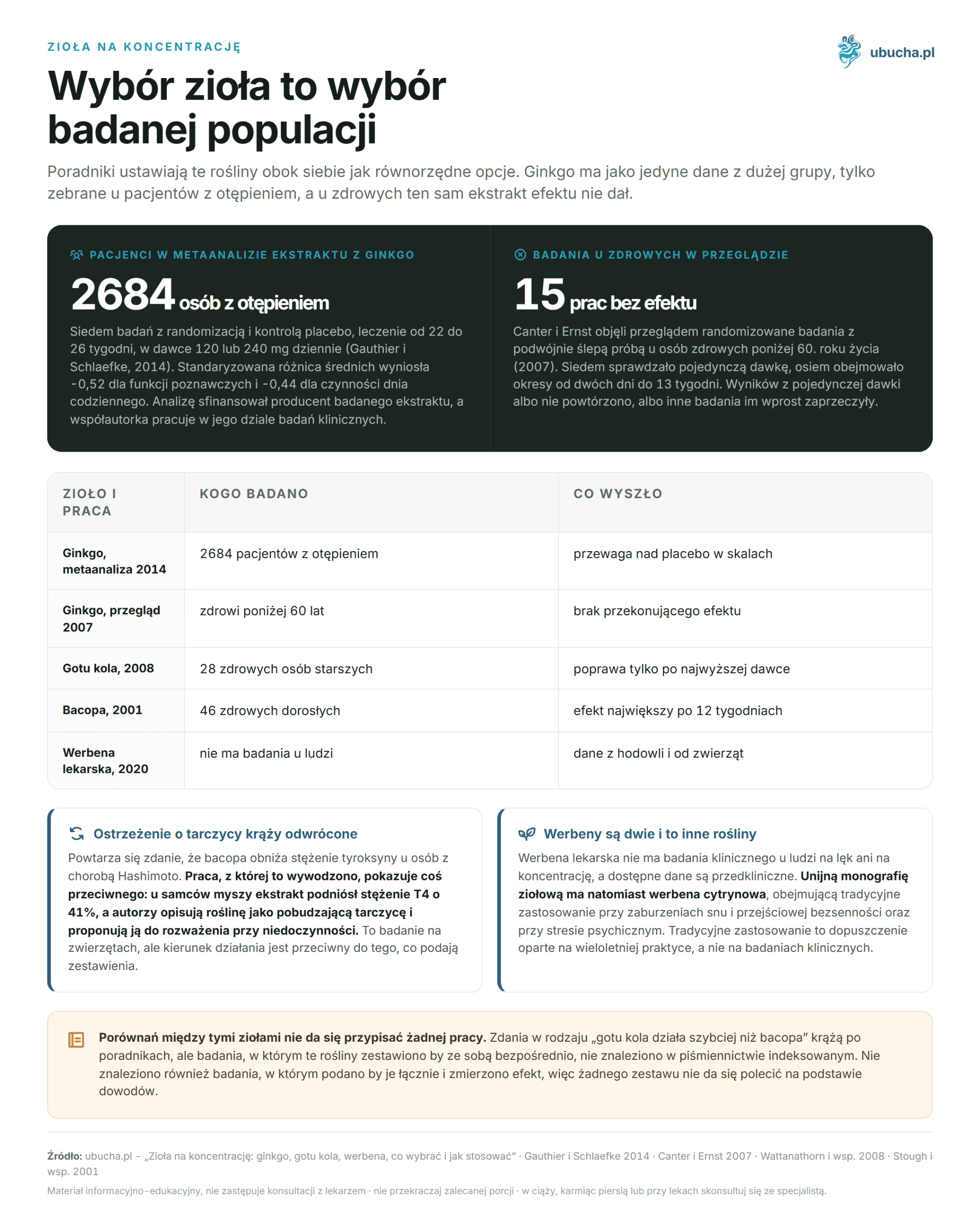
Instead of looking for the strongest herb, it is worth comparing what has been measured for each of them and checking if the studied group resembles you. The table below collects the four discussed plants along with the studies behind them. The column with the number of participants is more important here than the column with the result, as a trial of 28 individuals and a meta-analysis of 2684 patients represent two different levels of certainty.
| Herb | Study | Who was studied | What was found |
|---|---|---|---|
| Ginkgo biloba | Gauthier and Schlaefke 2014, meta-analysis of 7 studies | 2684 patients with dementia, 22-26 weeks | superiority over placebo in cognitive scales and activities of daily living |
| Ginkgo biloba | Canter and Ernst 2007, review of 15 studies | healthy individuals under 60, from a single dose to 13 weeks | no convincing cognitive effect |
| Gotu kola | Wattanathorn et al. 2008, placebo study | 28 healthy older adults, 2 months | improvement in working memory only after the highest of three doses |
| Bacopa monnieri | Stough et al. 2001, placebo study | 46 healthy adults, 12 weeks | faster information processing, better memory consolidation, less anxiety |
| Medicinal verbena | Kubica et al. 2020, review | no clinical study in humans | data only in vitro and on animals; raw material monograph in the European Pharmacopoeia |
This comparison primarily shows that the choice of herb is indeed a choice of the studied population. Ginkgo has data from a large group, but collected from patients with dementia, and in healthy individuals under 60, the same extract did not yield an effect. Bacopa was studied in healthy adults, gotu kola in healthy older adults, both in small trials and individually. Medicinal verbena has no point on this map. More comparisons between preparations are gathered in the text about what really works for concentration according to studies.
What should not be combined with these herbs?
The best-documented warning concerns ginkgo and bleeding. Bent and colleagues collected 15 published case reports of bleeding in individuals taking ginkgo, including eight episodes of intracranial bleeding. The authors are honest about the strength of the evidence: in 13 of these reports, other risk factors for bleeding were present, and only in six was it clearly described that after discontinuing the herb, the bleeding did not return. The conclusion of the paper is that a causal relationship is possible and that individuals at risk of bleeding should be warned about this (Journal of General Internal Medicine, 2005, PMC1490168). If you are taking anticoagulant or antiplatelet medications, this is a conversation to have with your doctor, not a decision to make on your own.
The second warning that circulates in guides is reversed and should be corrected. It is repeated that bacopa lowers thyroxine levels in individuals with Hashimoto’s disease. The study from which this was derived shows the opposite: in male mice, Bacopa monnieri extract raised T4 levels by 41%, and the authors describe the plant as stimulating the thyroid and suggest it for consideration in hypothyroidism, not hyperthyroidism (Journal of Ethnopharmacology, 2002, PMID 12065164). This is an animal study and does not directly transfer to humans, but the direction of action is opposite to what summaries state. In the case of treated thyroid disease, this means one thing: consult bacopa with your treating physician.
Aside from these two points, a general rule applies. Herbs taken in the form of concentrated extracts are pharmacologically active preparations, so during pregnancy, breastfeeding, and ongoing treatment, their inclusion requires consultation. Introducing several plants at once complicates the assessment of which one changes anything, and this is a practical argument, not a precautionary one.
Frequently Asked Questions
Which herb for concentration has the best evidence?
It depends on who you are. For people with dementia, ginkgo has the best-documented evidence, thanks to a meta-analysis of seven studies involving 2684 patients. For healthy adults, the placebo-controlled study has bacopa monnieri, with 46 participants, and for healthy older adults, gotu kola, with 28 participants.
Does ginkgo biloba help healthy individuals?
A review of 15 randomized studies in healthy individuals under 60 found no convincing evidence of improvement in any aspect of cognitive function, either after a single dose or after longer use. The results from studies in dementia patients do not automatically transfer to this group (Canter and Ernst, 2007).
How quickly do herbs for concentration work?
Reliable answers can only be given for bacopa: in Stough’s study, the effect was greatest after 12 weeks, and measurements after five weeks did not yet show it fully. For gotu kola, measurements were taken after two months. Comparisons like ‘gotu kola works faster than bacopa’ could not be attributed to any study.
Can these herbs be combined?
No studies have been found that administered them together and measured the effect, so no combination can be recommended based on evidence. A practical argument, however, favors single introductions: with several plants at once, it is impossible to assess which one changed anything.
Is bacopa safe with thyroid disease?
It requires consultation, and this is due to the opposite of what many summaries state. In a study on male mice, bacopa extract raised thyroxine levels by 41%, and the authors described it as stimulating the thyroid. If you have treated thyroid disease, make the decision to include it with your doctor.
What is the difference between medicinal verbena and lemon verbena?
They are two different plants. Medicinal verbena has no clinical study in humans for anxiety or concentration, and the available data is preclinical. Lemon verbena has a European herbal monograph covering traditional use for mental stress and sleep disorders.
Loose herbs and plant extracts are collected in the herbs category.
This article is for informational and educational purposes and does not constitute medical advice. Before starting supplementation, consult your doctor, especially if you are taking medications regularly, are pregnant or breastfeeding, or have chronic illnesses.
Author: Michał Waluk · Published: 2026-06-22 · Updated: 2026-08-15