


EGCG (green tea extract): metabolism and antioxidants (table)
EGCG and green tea extract in studies: metabolism, heart, liver, and interactions with medications. EFSA warns against 800 mg per day, not recommending this dose.
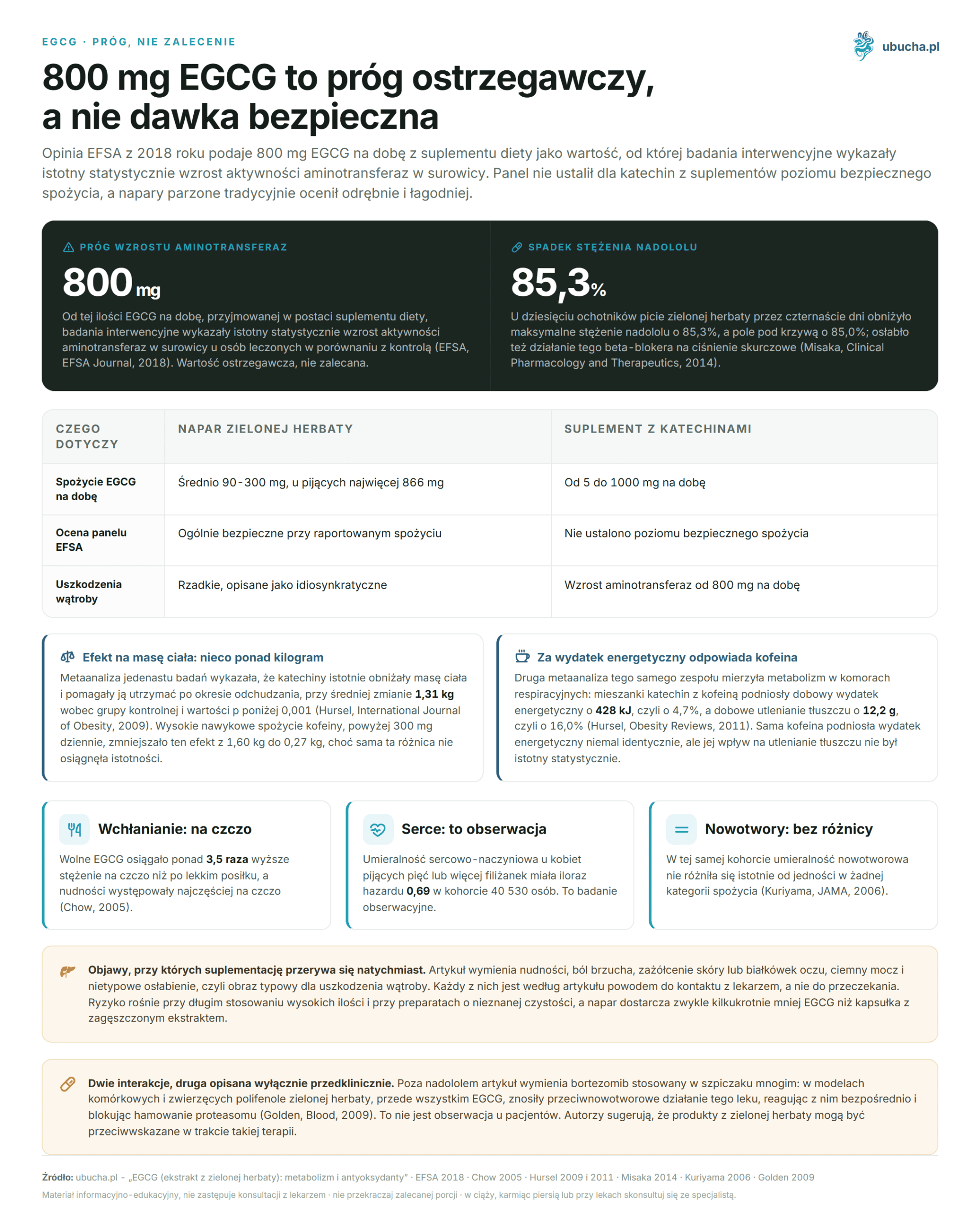
Epigallocatechin gallate, or EGCG for short, is the most active catechin in green tea. There is one number surrounding it that is worth reversing right at the beginning. In Polish and foreign descriptions of supplements, the statement is repeated that EFSA has recognized 800 mg of EGCG per day as a safe dose. The EFSA opinion from 2018 states the opposite: it is precisely from 800 mg per day from dietary supplements that interventional studies showed a statistically significant increase in serum aminotransferase activity (EFSA, EFSA Journal, 2018). This one reversed number is not an exception, as a similarly reversed statement can be made about the absorption of catechins with a meal. This article therefore collects what has actually been measured about EGCG: how much it provides in an infusion, how much in a capsule, how large the metabolic effect is, what studies have shown about the heart and cancer, and which interactions can nullify the effect of prescribed medication.
KEY INFORMATION
• EFSA indicated 800 mg of EGCG per day from supplements as the threshold at which aminotransferase activity increases, not as a safe dose (EFSA, EFSA Journal, 2018).
• Catechins reduced body weight by an average of 1.31 kg in a meta-analysis of 11 studies (Hursel, International Journal of Obesity, 2009).
• The bioavailability of free EGCG is over 3.5 times higher on an empty stomach than after a meal, although nausea occurs more frequently on an empty stomach (Chow, Clinical Cancer Research, 2005).
• Green tea reduced nadolol concentration in the blood by 85% and weakened its effect on blood pressure (Misaka, Clinical Pharmacology and Therapeutics, 2014).
• In the Ohsaki cohort, cancer mortality did not differ significantly between green tea consumption groups (Kuriyama, JAMA, 2006).
What is EGCG and how much does tea provide compared to supplements?
EGCG belongs to catechins, which are flavonoids with antioxidant properties, and is the dominant fraction among them. Black tea undergoes fermentation, during which catechins oxidize to theaflavins; green tea is subjected to heat treatment after harvesting that halts this process, thus retaining more catechins. However, the difference between the beverage and the capsule is not solely based on quantity.
The EFSA opinion provides specific exposure ranges. The average daily intake of EGCG from green tea infusions in the adult population of the European Union ranges from 90 to 300 mg, and among those who drink the most, it reaches 866 mg per day. Dietary supplements with catechins provide from 5 to 1000 mg of EGCG per day. The panel considered catechins from traditionally brewed infusions to be generally safe at consumption levels reported in member states, while also noting rare cases of liver damage from infusions, most likely of an idiosyncratic nature.
| Data Source | What it concerns | Value provided by authors |
|---|---|---|
| EFSA, EFSA Journal, 2018 | EGCG intake from infusions, adults in the European Union | On average 90-300 mg per day; among the highest consumers up to 866 mg per day |
| EFSA, EFSA Journal, 2018 | EGCG content in dietary supplements | From 5 to 1000 mg per day |
| EFSA, EFSA Journal, 2018 | Threshold for increased aminotransferases in interventional studies | From 800 mg of EGCG per day from supplements |
| Chow, Clinical Cancer Research, 2005 | 30 healthy volunteers, single dose of Polyphenon E, crossover design | Maximum concentration of free EGCG over 3.5 times higher on an empty stomach than after a light meal |
| Hursel, International Journal of Obesity, 2009 | Meta-analysis of 11 studies on body weight | Average weight change -1.31 kg compared to control (p below 0.001) |
| Misaka, Clinical Pharmacology and Therapeutics, 2014 | 10 volunteers, nadolol with green tea or water | Decrease in maximum nadolol concentration by 85.3% and area under the curve by 85.0% |
Is EGCG better absorbed with a meal or on an empty stomach?
On an empty stomach, and clearly so. The statement about several times better absorption with a fatty meal circulates in supplement descriptions in a reversed form. A pharmacokinetic study in 30 healthy volunteers administered Polyphenon E in a crossover design: once after overnight fasting, once with a light breakfast. The maximum concentration of free EGCG in plasma was over 3.5 times higher on an empty stomach, and similarly for free epigallocatechin and epicatechin gallate (Chow, Clinical Cancer Research, 2005).
This does not mean that taking it on an empty stomach is a better idea. In the same study, mild, transient nausea occurred most frequently on an empty stomach and with the highest tested amount of extract. The authors also noted that a preparation providing up to 800 mg of EGCG was well tolerated on an empty stomach, but this is an observation from a single dose, not from continuous supplementation, to which the EFSA warning refers.
The practical conclusion is therefore inconvenient for both sides. A meal lowers the concentration of free catechins in the blood, while simultaneously alleviating gastrointestinal symptoms and reducing the liver’s exposure to high peak concentrations. A review on the metabolic syndrome states directly that the optimal dose of green tea catechins has not yet been established (Thielecke and Boschmann, Phytochemistry, 2009). In the absence of such a value, the method of administration should be determined with a doctor or pharmacist.
Does EGCG help with weight loss and by how much?
It helps to a scale that is easy to overestimate: on average by just over a kilogram. A meta-analysis of eleven studies showed that catechins significantly reduced body weight and helped maintain it after a weight loss period, with an average change of 1.31 kg compared to the control group and a p-value below 0.001. The authors also checked what weakens this effect: high habitual caffeine intake, above 300 mg per day, reduced it from 1.60 kg to 0.27 kg, although this difference did not reach significance (Hursel, International Journal of Obesity, 2009).
The second meta-analysis from the same team measured metabolism directly, in respiratory chambers. Catechin-caffeine mixtures increased daily energy expenditure by 428 kJ, or 4.7%, and daily fat oxidation by 12.2 g, or 16.0%. Caffeine alone increased energy expenditure almost identically, but its effect on fat oxidation was not statistically significant (Hursel, Obesity Reviews, 2011).
From these two studies, a point emerges that advertisements overlook. The increase in calorie burning is largely due to caffeine, while catechins mainly contribute to fat oxidation. A person who drinks a lot of coffee has less to gain, and a caffeine-free preparation works less effectively on energy expenditure. We discuss how caffeine from various plants behaves in the body in more detail in the text about yerba mate and caffeine.
What do studies say about green tea and the heart?
The largest data comes from the Japanese Ohsaki cohort, which included 40,530 individuals aged 40 to 79, observed for up to eleven years. In women drinking five or more cups daily, cardiovascular mortality was lower, with a hazard ratio of 0.69 with a confidence interval from 0.53 to 0.90 and a significant trend. In men in the same consumption group, overall mortality had a hazard ratio of 0.88 with a confidence interval from 0.79 to 0.98. The strongest association concerned deaths from stroke (Kuriyama, JAMA, 2006).
This is an observational study, so it shows correlation, not causation. People who drink a lot of green tea may differ from the rest of the population in terms of diet, activity, and habits, which no statistical adjustment can completely eliminate. The authors note that for overall mortality, the association was stronger in women, and the interaction with sex reached statistical significance; for cardiovascular mortality, the same interaction did not reach significance.
A review on the metabolic syndrome summarizes this area cautiously: most epidemiological and interventional studies in humans show a beneficial effect of catechins on body weight, glycemic control, and cardiovascular risk factors, but the number of studies in humans is still small, and the mechanisms have mainly been described in cell and animal models. The same applies to the area of neuroprotection: a study showing that EGCG reduces amyloid beta deposition concerned cells and transgenic mice, not patients (Rezai-Zadeh, Journal of Neuroscience, 2005).
Does green tea reduce cancer risk?
The data is inconsistent, and the largest study turned out negative. In the Ohsaki cohort, cancer mortality did not differ significantly from unity in any category of green tea consumption, although overall and cardiovascular mortality decreased with the number of cups consumed. The authors concluded directly: green tea consumption is associated with lower overall and cardiovascular mortality, but not with lower cancer mortality.
Earlier, smaller prospective studies in Saitama Prefecture measured something different, namely incidence rather than mortality, and there the result was positive, but only in women. It included 8,552 individuals over forty, observed for nine years, during which 384 cancer cases were recorded. In the highest consumption group, the relative risk was 0.57 in women, with a confidence interval from 0.33 to 0.98, and 0.68 in men, with a range from 0.39 to 1.21, meaning in men it was not significant (Imai, Preventive Medicine, 1997).
The popular summary of this work speaks of a seven-year delay in cancer onset in men. This is doubly misleading: the effect concerned women, and in men, it did not reach statistical significance. The pharmacological review of green tea also emphasizes that transferring results from cell cultures to humans is complicated by the low bioavailability of catechins and the discrepancy between concentrations studied in vitro and those achievable in plasma (Zaveri, Life Sciences, 2006).
When does EGCG burden the liver and what symptoms should be concerning?
The threshold set by EFSA is at 800 mg of EGCG per day taken in the form of a dietary supplement. Above this value, interventional studies showed a statistically significant increase in serum aminotransferase activity in treated individuals compared to controls. The panel did not establish a safe intake level for catechins from supplements, and traditionally brewed infusions were assessed separately and more leniently.
Symptoms that should lead to immediate cessation of supplementation are typical of liver damage: nausea, abdominal pain, jaundice of the skin or sclera, dark urine, unusual weakness. Each of these is a reason to contact a doctor, not to wait it out. The risk increases with prolonged use of high amounts and with preparations of unknown purity.
It is also worth remembering the proportions. An infusion usually provides several times less EGCG than a capsule with concentrated extract, and the rare cases of liver damage from infusions alone are described by EFSA as idiosyncratic reactions, meaning unpredictable and not related to quantity. A supplement is a different category of exposure than tea for drinking, although the label of both suggests thinking about the same plant. A comparison with other infusions high in polyphenols can be found in the text about chaga and its antioxidants.
With which medications does EGCG interact and how to choose an extract?
Two interactions are documented strongly enough to change the decision about supplementation. The first concerns nadolol: in a study of ten volunteers, drinking green tea for fourteen days reduced the maximum concentration of this beta-blocker by 85.3%, and the area under the curve by 85.0%, while also weakening its effect on systolic blood pressure. The mechanism is the inhibition of the OATP1A2 transporter in the intestine (Misaka, Clinical Pharmacology and Therapeutics, 2014).
The second concerns bortezomib used in multiple myeloma. In cell and animal models, green tea polyphenols, primarily EGCG, negated the anticancer effect of this drug, reacting directly with it and blocking proteasome inhibition. The authors suggest that consuming green tea products may be contraindicated during bortezomib therapy (Golden, Blood, 2009).
When choosing a preparation, pay attention to three things. The label should provide the amount of EGCG in milligrams, not just the mass of the extract, because without this, it is impossible to relate the product to the values from the EFSA opinion. Information about caffeine content determines whether the preparation is suitable for the evening. A certificate of analysis from an independent laboratory protects against contaminants, which in some described cases of liver damage turned out to be co-responsible. How such declarations look for other standardized extracts is shown in the text about sulforaphane from broccoli.
Frequently asked questions
Has EFSA recognized 800 mg of EGCG per day as safe?
No. The 2018 opinion indicates that 800 mg of EGCG per day from dietary supplements is the value at which interventional studies showed a statistically significant increase in serum aminotransferase activity. For catechins from supplements, the panel did not establish a safe intake level. This is a warning, not a recommendation.
Does EGCG help with weight loss?
To a modest extent. A meta-analysis of eleven studies showed an average weight change of 1.31 kg compared to control. The effect weakened in individuals with high habitual caffeine intake. Catechins support diet and physical activity, but the magnitude of this change cannot be compared to the effect of lifestyle changes alone.
Should EGCG be taken on an empty stomach or with a meal?
Free catechins are absorbed over 3.5 times better on an empty stomach, but nausea occurs more frequently on an empty stomach, and peak concentrations are highest. No optimal dose or method of administration has been established in studies, so it is advisable to discuss the decision with a doctor or pharmacist, especially in cases of liver disease.
Does green tea protect against cancer?
The data is inconsistent. In the largest Japanese cohort, cancer mortality did not differ significantly between consumption groups, although overall and cardiovascular mortality was lower. A smaller study from Saitama Prefecture showed a lower risk of disease, but only in women.
Does EGCG interact with medications?
Yes, and seriously. Green tea reduced nadolol concentration by 85% and weakened its effect on blood pressure. In preclinical studies, EGCG negated the anticancer effect of bortezomib. For chronic medications, supplementation should be preceded by a conversation with the attending physician.
Standardized plant extracts with declared active substance content are collected in the category of plant extracts; before purchasing, compare labels for EGCG and caffeine content.
This article is for informational and educational purposes and does not constitute medical advice. Before starting supplementation, consult a doctor, especially if you are taking medications regularly, are pregnant or breastfeeding, or have chronic illnesses.
Author: Michał Waluk · Published: 2026-07-15 · Updated: 2026-08-11