
Chamomile for Relaxation and Sleep: What Placebo Studies Showed
Chamomile for relaxation and sleep: what placebo studies showed about oral extract, what they did not show, and which medications to be cautious with when using the infusion.
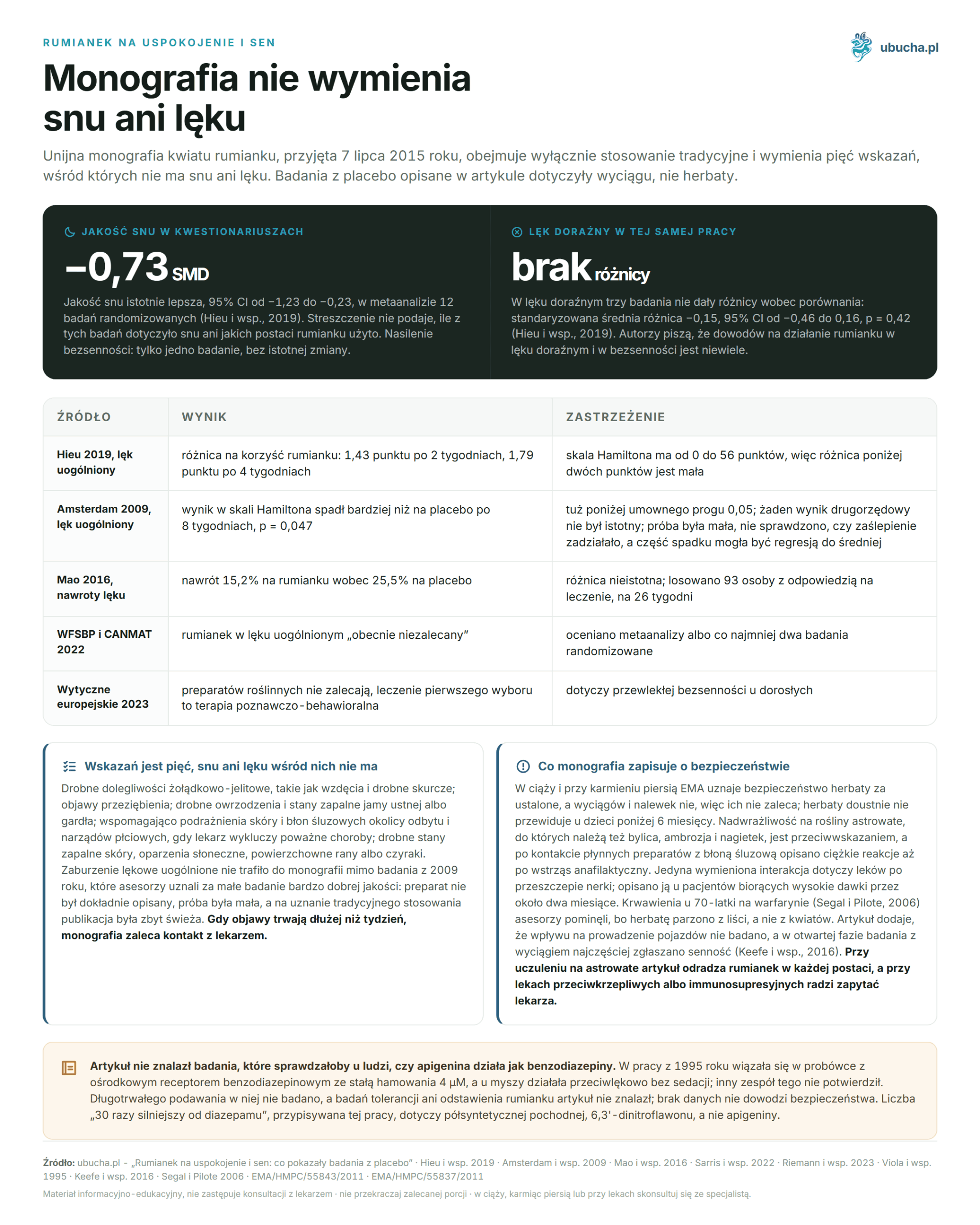
Does chamomile calm and help you sleep? Partially. In a meta-analysis of 12 randomized studies, sleep quality after chamomile was better than in control groups, with a standardized mean difference of -0.73. However, in this work, the only study on insomnia severity showed no change, and in acute anxiety, three studies showed no difference (Hieu et al., Phytotherapy Research, 2019). The placebo studies we describe were conducted on extracts in capsules or tablets, not on tea. From this text, you will learn what was measured regarding sleep and anxiety and what the guidelines say about chamomile. We also write about who may be harmed and which medications to be cautious with. For each number, we provide a source, and where studies are lacking, we state it directly.
KEY INFORMATION
• Meta-analysis of 12 studies: better sleep quality (SMD -0.73), insomnia severity unchanged (Hieu et al., 2019).
• In generalized anxiety, the first placebo study yielded p = 0.047.
• The found placebo studies concerned extracts, not tea.
• The WFSBP and CANMAT guidelines from 2022 currently do not recommend chamomile in generalized anxiety.
Does chamomile help you sleep?
Sleep quality assessed in questionnaires improves, although this is not the same as treating insomnia. In a meta-analysis of 12 randomized studies, sleep quality after chamomile was significantly better, with a standardized mean difference of -0.73, with a 95% CI from -1.23 to -0.23 (Hieu et al., 2019).
The summary does not state how many of these studies concerned sleep or what forms of chamomile were used. In a study from a nursing home near Karaj in Iran, 60 people aged at least 60 took capsules with 200 mg of extract twice a day for 28 days or capsules with wheat flour. In this single-blind study, sleep quality was significantly better in the chamomile group (Adib-Hajbaghery and Mousavi, Complementary Therapies in Medicine, 2017).
A newer review from 2024 included 10 studies and 772 participants. In the meta-analysis of 5 of them, the PSQI sleep quality questionnaire score improved by 1.88 points, but with very high heterogeneity of studies (I² 88.4%). Sleep efficiency did not change in two studies and worsened in one. Daytime functioning did not change in any of the three that measured it (Kazemi et al., Complementary Therapies in Medicine, 2024).
Does chamomile treat insomnia?
This has not been demonstrated. In the meta-analysis by Hieu et al., insomnia severity was assessed in only one study and found no significant change. In a pilot placebo trial, 34 adults with primary chronic insomnia took 270 mg of chamomile extract twice daily for 28 days. Sleep diaries showed no significant differences between groups (Zick et al., BMC Complementary and Alternative Medicine, 2011).
Does this mean that chamomile does not change anything? The numbers from this trial go in different directions. The time to fall asleep shortened on chamomile by about 16 minutes, while on placebo it lengthened by about a minute. However, the total sleep time increased more on placebo: by 0.8 hours compared to 0.2 hours. Both differences were not significant.
An older review assessed four oral herbal preparations used for insomnia, including chamomile and valerian. None differed significantly from placebo or from the comparative drug in 13 measures of effectiveness (Leach and Page, Sleep Medicine Reviews, 2015). European guidelines from 2023 recommend cognitive-behavioral therapy as the first-line treatment for chronic insomnia in adults, and do not recommend herbal preparations (Riemann et al., Journal of Sleep Research, 2023).
Does chamomile work for anxiety?
It depends on what kind of anxiety it is. In the meta-analysis by Hieu et al., three studies of acute anxiety showed no difference compared to control: the standardized mean difference was -0.15 (95% CI from -0.46 to 0.16, p = 0.42). In generalized anxiety disorder, the difference on the Hamilton scale favored chamomile by 1.43 points after 2 weeks and 1.79 points after 4 weeks (Hieu et al., 2019).
The Hamilton anxiety scale ranges from 0 to 56 points, so a difference of less than two points is small. The authors write that chamomile seems effective and safe regarding sleep quality and generalized anxiety disorder. According to them, there is little evidence of its effect on acute anxiety and insomnia.
The WFSBP and CANMAT guidelines from 2022 rated chamomile in generalized anxiety disorder as “currently not recommended” (+/-). Lavender was considered moderately supported in anxiety disorders (Sarris et al., World Journal of Biological Psychiatry, 2022). The team evaluated meta-analyses or at least two randomized studies. They did not consider individual studies and open trials.
What did the first placebo study in generalized anxiety show?
It showed a decrease in symptoms at the border of statistical significance. In the study from the University of Pennsylvania, the Hamilton scale score decreased after 8 weeks more on chamomile than on placebo, with p = 0.047. This is just below the conventional threshold of 0.05, and the authors called the anxiolytic effect moderate (Amsterdam et al., Journal of Clinical Psychopharmacology, 2009).
61 patients with mild to moderate generalized anxiety disorder were qualified, and 57 were randomly assigned to extract (28 people) or placebo (29 people). The capsule contained 220 mg of extract standardized to 1.2% apigenin, and the dose could be increased to five capsules daily.
No secondary outcome was significant, including the percentage of people with a treatment response: 57.13% on chamomile compared to 37.93% on placebo (p = 0.146). The chamomile group had a slightly higher score at the start, so part of the decrease could have been regression to the mean. It was also not checked whether the blinding worked, and the trial was small.
There were 11 adverse events on chamomile and 22 on placebo. Assessors from the European Medicines Agency considered this work a small study of very good quality. Nevertheless, generalized anxiety disorder did not make it into the EU monograph. The preparation was not precisely described, the trial was small, and the publication was too recent for recognition of traditional use (EMA assessment report, EMA/HMPC/55837/2011).
Does chamomile protect against relapse of generalized anxiety?
This has not been proven. In a study from Philadelphia, 93 people who responded to treatment were randomly assigned for 26 weeks to continue taking the extract or to placebo. Relapse occurred in 15.2% of those on chamomile and 25.5% on placebo, but the difference was not statistically significant (Mao et al., Phytomedicine, 2016).
The hazard ratio was 0.52 (95% CI 0.20-1.33, p = 0.16). The average time to relapse was 11.4 weeks on chamomile and 6.3 weeks on placebo, and the GAD-7 score was lower on chamomile (p = 0.0032). The authors link the lack of a significant difference to the fact that there were fewer relapses on placebo than they had assumed.
Only those who responded in the open phase were included in the random phase. In it, 179 people with moderate to severe generalized anxiety disorder took 1500 mg of extract daily without placebo: 8 weeks of treatment, and responders also had 4 weeks of maintenance. 58.1% responded (95% CI 50.9-65.5%), and the average GAD-7 score dropped from 15.1 to 6.7 points (Keefe et al., Phytomedicine, 2016).
15.6% of people discontinued. Adverse events related to treatment occurred in 11.7%, most commonly drowsiness (7.2%) and taste disturbances (3.9%). The authors write that the decrease in symptoms could have resulted from the placebo effect or regression to the mean.
Does a 58% response prove the extract’s effect? Not directly. The authors themselves compared this number to the 57.13% response on chamomile in the earlier placebo study from the same center. They concluded that the effectiveness might have been similar. However, in that study, 37.93% responded to placebo, and the difference was not significant. The response was also counted using a different scale and in people with milder symptoms, so the percentage from the open phase does not show how much improvement is due to the extract.
Does apigenin from chamomile work like benzodiazepines?
We found no study that tested this in humans, and the data on the effect comes from test tubes and studies on mice. Apigenin, a flavonoid extracted from the aqueous extract of flowers, bound to the central benzodiazepine receptor with an inhibition constant of 4 µM. It did not act on muscarinic or alpha1-adrenergic receptors, nor on muscimol binding to the GABA-A receptor (Viola et al., Planta Medica, 1995).
In mice, apigenin acted anxiolytically without sedation, at doses similar to benzodiazepines. Only a tenfold higher dose caused mild sedation: activity decreased by 26%, and results in the hole board test decreased by 35%. No anticonvulsant effect was observed.
Another team did not confirm this. According to the EMA report, Avallone et al. administered apigenin in doses from 0.5 to 10 mg/kg and did not demonstrate an anxiolytic effect. Sedation at higher doses was attributed more to other transmitters than directly to benzodiazepine receptors.
The 1995 study did not investigate long-term administration, so it does not say anything about tolerance or addiction. The number “30 times stronger than diazepam” that Keefe et al. attribute to this work refers to a semi-synthetic derivative, 6,3′-dinitroflavone, and not to apigenin or the infusion. We discuss this group of compounds in our post about flavonoids and their effects.
Does chamomile tea work like the capsules from studies?
This is unknown, as the found placebo studies were conducted on extracts in capsules or tablets. The only study with tea we found involved 80 postpartum women with poor sleep quality. After 2 weeks of drinking tea, they had fewer physical symptoms disrupting sleep and fewer depressive symptoms than the group under standard care. After 4 weeks, the results were similar (Chang and Chen, Journal of Advanced Nursing, 2016).
Tea mainly contains flavonoids and mucilage, and only about 10-15% of the oil’s components pass into it (EMA assessment report).
In the table, we compared forms and doses from the studies described above. One capsule from the relapse study corresponded to 2 g of flowers, and the portion of infusion according to the EMA monograph is 1.5-4 g of flower per 150 ml of boiling water, for digestive complaints. However, none of these works compared the infusion with capsules, so such a conversion proves nothing.
| Study | Form and Dose | Comparison | Result |
|---|---|---|---|
| Adib-Hajbaghery and Mousavi, 2017, sleep | Capsules with extract, 200 mg twice daily, 28 days | Capsules with wheat flour | Better sleep quality |
| Zick et al., 2011, insomnia | Tablets with extract, 270 mg twice daily, 28 days | Placebo | No significant differences |
| Chang and Chen, 2016, postpartum sleep | Tea, 2 weeks | Standard care | Improvement after 2 weeks, no differences after 4 |
| Amsterdam et al., 2009, generalized anxiety | Capsules 220 mg extract, up to 5 daily, 8 weeks | Placebo | p = 0.047 on the Hamilton scale |
| Keefe et al., 2016, generalized anxiety | Extract, 1500 mg daily, 8 weeks | None | Response in 58.1% |
| Mao et al., 2016, anxiety relapse | Extract, 1500 mg daily, 26 weeks | Placebo | Relapse 15.2% vs 25.5%, not significant |
If you choose an infusion, check the packaging to ensure it is chamomile flower, as the EU monograph concerns the flower, not the leaves. You can find dried herbs in the herbs category.
Does EMA recommend chamomile for nerves and sleep?
No. The EU monograph on chamomile flowers, adopted on July 7, 2015, covers only traditional use. It lists five indications, and sleep or anxiety is not among them (monograph EMA/HMPC/55843/2011). If symptoms persist for more than a week, the monograph recommends contacting a doctor. The indications are:
- minor gastrointestinal complaints, such as bloating and minor cramps;
- cold symptoms;
- minor ulcers and inflammatory conditions of the oral cavity or throat;
- supportively for irritation of the skin and mucous membranes in the anal and genital area, when the doctor rules out serious diseases;
- minor skin inflammations, sunburns, superficial wounds, or boils.
For digestive complaints, the monograph provides for an infusion of 1.5-4 g of flower per 150 ml of boiling water, 3-4 times a day. Why only traditional use? In the final assessment, EMA assessors found one clinical study of good quality according to current standards: the aforementioned work by Amsterdam et al. on generalized anxiety. They rated the remaining clinical studies as mostly of average quality. In 2022, the agency called for new data to be submitted for the periodic review of this monograph. As of September 16, 2026, there was no new version of the monograph on the EMA website (EMA, chamomile flower page).
Who should not use chamomile?
Primarily those allergic to chamomile or other Asteraceae plants. The EMA monograph describes severe allergic reactions up to anaphylactic shock after contact with liquid preparations on the mucous membrane, with an unknown frequency (EMA monograph). Among 3851 adults referred for allergy tests, 3.1% had a positive result for a mixture of Asteraceae (EMA assessment report, Hausen data from 1996).
Of those with a positive result, 56.5% reacted to chamomile itself, and 51.8% to yarrow. We discuss this plant in our post about common yarrow. Other Asteraceae include mugwort and ragweed, as well as marigold. In people allergic to ragweed pollen, chamomile infusion may cause symptoms from conjunctivitis to anaphylaxis (Preda et al., 2024).
During pregnancy and breastfeeding, the EMA considers the safety of tea established, but does not recommend extracts and tinctures. Both anxiety studies with placebo excluded pregnant women. The monograph does not provide for oral tea in children under 6 months. The effect on driving has not been studied, and in the open phase, 7.2% of people reported drowsiness.
What should not be combined with chamomile?
Caution primarily concerns medications after kidney transplants, as only this interaction is mentioned in the EU monograph. It was described in patients who took chamomile in high doses for about two months. EMA assessors based this note on cases with cyclosporine, including a patient who drank at least 1.5 liters of chamomile tea daily (EMA assessment report). They rated the cases as inconsistent.
Segal and Pilote described a 70-year-old woman treated with warfarin, admitted to the hospital with numerous internal bleeding after chamomile tea and balm. The authors linked this to the coumarins present in the plant (Segal and Pilote, CMAJ, 2006).
EMA assessors did not include this case in the monograph because the patient drank up to 10 cups of tea made from dried leaves, while the monograph concerns flowers. They considered the mechanism through coumarins unlikely, as coumarins are found in many plants and most do not act pharmacologically.
If you are taking anticoagulants or immunosuppressants, consult your doctor before you start regularly drinking chamomile or taking the extract. We have compiled a table of plants that should not be combined with each other or with medications in which herbs should not be combined.
Can chamomile be smoked or vaporized?
It is unknown whether this is safe. A PubMed query for chamomile combined with smoking and vaporization terms yielded 15 results on September 16, 2026, none of which measured smoke or vapor from the flower. Studies on sleep and anxiety concerned extracts or tea, so their results cannot be transferred to smoke.
If chamomile replaces tobacco in a joint, nicotine disappears, but the smoke remains. In the only measurement of smoke from an herbal cigarette we found, a mugwort cigarette produced 12.3 mg of carbon monoxide per piece compared to 6.1 mg in a tobacco cigarette with the same declared tar (Bak et al., Toxicological Research, 2015). Similarly, a reference cigarette with higher declared tar produced 12.53 mg in this test. We describe what such a substitution changes in the text about what to smoke instead of tobacco. We have gathered data on the flower in our post about smoking dried chamomile.
In 24 people with asthma or rhinitis, mainly allergic to mugwort, bronchial provocation with chamomile pollen extract was positive in 16 (de la Torre Morín et al., 2001). This is an extract from pollen, not smoke, but the EMA monograph lists hypersensitivity to Asteraceae as a contraindication. We advise against smoking anything for people who are pregnant, breastfeeding, or suffering from asthma.
The range of 125-150 degrees for chamomile from our herb vaporization guide is based on device instructions, not measurements. You can find temperature-controlled devices for herbs in the vaporizers category. Cannabis material with a total delta-9-THC and THCA above 0.3% is a narcotic in Poland (art. 4 point 37, Journal of Laws 2023 item 1939 as amended), and the addition of chamomile does not change anything here. We discuss this more broadly in the text about tobacco substitutes.
What does this mean in practice?
The strongest data concern subjective sleep quality and generalized anxiety disorder. The placebo studies we describe were conducted on extracts, not on tea. In a meta-analysis of 12 studies, sleep quality improved, while insomnia severity did not (Hieu et al., 2019). In generalized anxiety, the result from placebo was at the border of significance (p = 0.047), and protection against relapse was not demonstrated (Mao et al., 2016).
The EMA has established the safety of tea during pregnancy and breastfeeding, but we found no studies on tea with placebo. For chronic insomnia, European guidelines emphasize cognitive-behavioral therapy. The WFSBP and CANMAT guidelines recommend that herbal preparations, where supported by research, be used as a complement to medical care, especially in more severe mental disorders.
If you are allergic to Asteraceae plants, refrain from chamomile in any form. If you are on medications after a transplant or anticoagulants, consult your doctor first. If symptoms persist for more than a week, the EMA monograph refers you to a doctor. Do not transfer results from extracts and tea to smoke, as we found no studies on that smoke.
Frequently Asked Questions
Does chamomile help with relaxation?
The data is weak. In acute anxiety, a meta-analysis of three studies showed no difference compared to control (Hieu et al., 2019). In generalized anxiety disorder, the first placebo study with capsules of extract yielded a result of p = 0.047 (Amsterdam et al., 2009). The WFSBP and CANMAT guidelines from 2022 currently do not recommend chamomile for this disorder.
Does chamomile help with insomnia?
This has not been demonstrated. In the meta-analysis by Hieu et al. from 2019, the only study on insomnia severity found no significant change. In a placebo trial with 34 adults suffering from chronic insomnia, sleep diaries showed no significant differences (Zick et al., 2011). European guidelines from 2023 do not recommend herbal preparations.
What should not be combined with chamomile?
The EMA monograph from 2015 lists interactions in patients after kidney transplants who took high doses for about two months. There were also reports of bleeding in a 70-year-old woman on warfarin (Segal and Pilote, 2006), but EMA assessors omitted this case because the tea was brewed from leaves, not flowers. With such medications, consult your doctor.
Does chamomile tea work like capsules?
This is unknown, as the found placebo studies concerned extracts in capsules or tablets. The only study with tea we found involved 80 postpartum women and had no placebo group. Improvement after 2 weeks did not persist to the 4th week (Chang and Chen, 2016). According to the EMA report, only about 10-15% of the oil’s components pass into the infusion.
Is chamomile addictive like benzodiazepines?
We found no studies on tolerance or withdrawal from chamomile, and the lack of data does not prove safety. A 1995 study on apigenin included acute tests on mice and did not study tolerance (Viola et al.). In the placebo study, there were 11 adverse events on chamomile compared to 22 on placebo (Amsterdam et al., 2009).
This article is for informational and educational purposes and does not constitute medical advice. Before starting supplementation, consult your doctor, especially if you are taking medications regularly, are pregnant or breastfeeding, or have chronic illnesses.
Author: Michał Waluk · Published: 2026-08-09 · Updated: 2026-09-17