
CBD Suppositories: Use, Dosage, and Who It’s For (FAQ)
Do CBD suppositories absorb better than capsules? We check what has really been measured, why there is no dosage here, and what is known about pelvic pain.
Suppositories with cannabidiol are sold with a convincing argument: the rectal route bypasses the liver, so more substances should reach the bloodstream than from a swallowed capsule. The argument is based on anatomy, not measurement. A systematic review of CBD pharmacokinetics in humans states that the absolute bioavailability of cannabidiol was determined only after smoking, at 31 percent, and that no one has attempted such a trial for any other route of administration (Millar et al., Frontiers in Pharmacology, 2018). This gap has practical significance, as suppositories are most often sought by those treated for pelvic pain, who are therefore taking other medications simultaneously. This text collects what has actually been measured, shows who it was measured on, and explains why you won’t find a dosage table here despite the title.
KEY INFORMATION
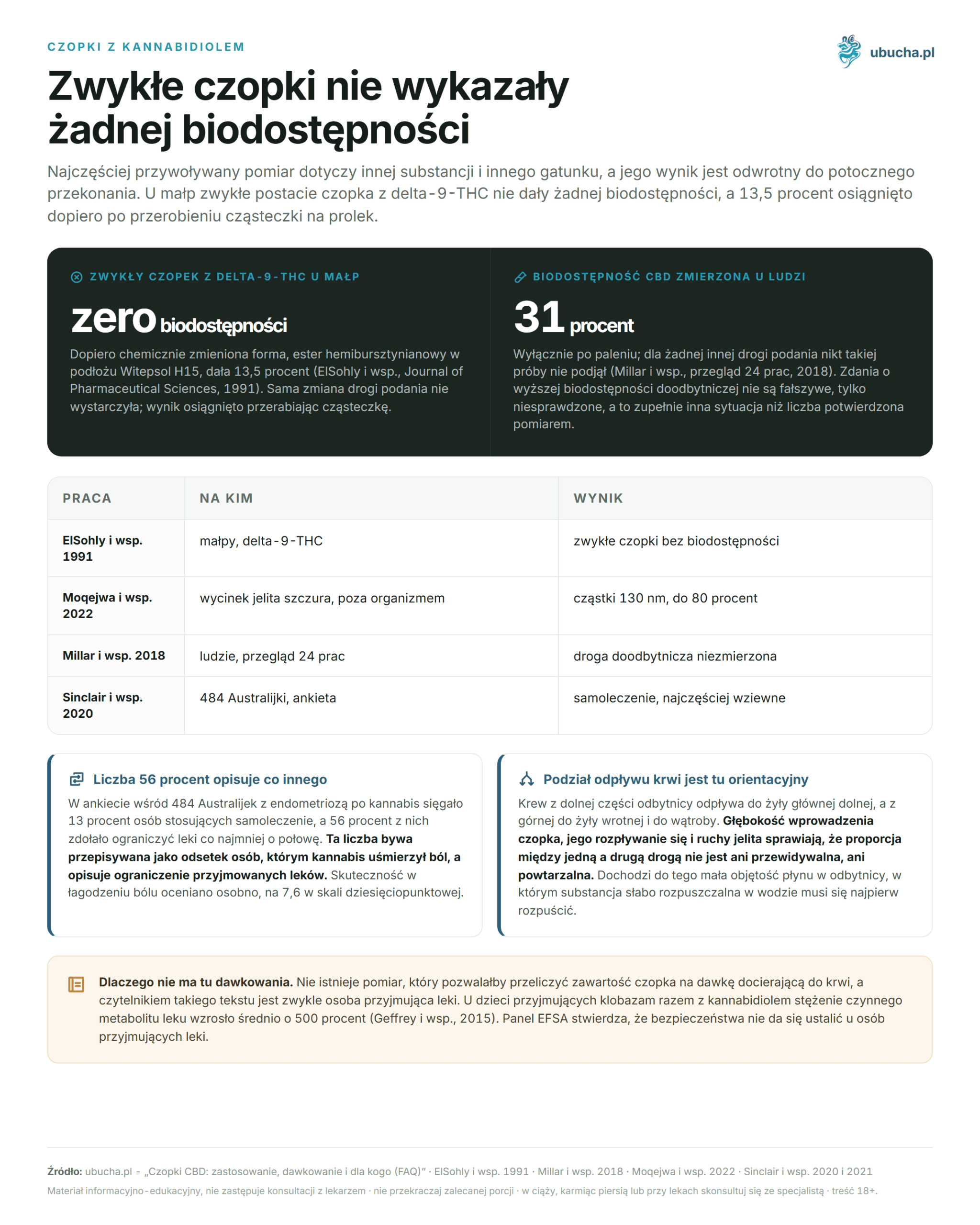
• Rectal bioavailability of CBD has not been measured in humans; the only value established in humans concerns smoking and is 31 percent (Millar et al., 2018).
• Regular delta-9-THC suppositories showed no bioavailability in monkeys; only a chemically modified ester gave 13.5 percent (ElSohly et al., 1991).
• Research on CBD suppositories is currently at the stage of drug formulation work, conducted outside the body, on rat intestinal sections (Moqejwa et al., 2022).
• In a survey of 484 Australian women with surgically confirmed endometriosis, 13 percent of those self-treating used cannabis, most often by inhalation, not in suppositories.
• The store ubucha.pl does not sell cannabidiol suppositories; catalog status as of August 16, 2026.
Does CBD from a suppository absorb better than from a capsule?
It is unknown because this has not been measured in humans. The reasoning behind suppositories is anatomical: blood from the lower part of the rectum drains through the iliac veins to the inferior vena cava, not to the portal system, so part of the dose should bypass the liver. However, blood from the upper part of the rectum goes to the portal vein and to the liver.
The problem is that this division is approximate. The depth of suppository insertion, its melting, and bowel movements mean that the ratio between one route and the other is neither predictable nor repeatable. Additionally, there is a small volume of fluid in the rectum, in which a poorly water-soluble substance must first dissolve.
Therefore, opinions about higher rectal bioavailability of CBD, repeated in guides and product descriptions, have no supporting studies in humans. This does not mean they are false; it means they are unverified, and that is a completely different situation than a number confirmed by measurement. We explain where the difference between routes of administration comes from separately in the text about the first-pass effect.
What has really been measured with rectal administration of cannabinoids?
The most frequently cited measurement concerns another substance and another species, and its result is contrary to common belief. In the study of delta-9-THC suppositories in monkeys, regular suppository forms showed no bioavailability. Only a chemically modified form, hemibutyrate ester in Witepsol H15 base, gave a bioavailability of 13.5 percent (ElSohly et al., Journal of Pharmaceutical Sciences, 1991).
This finding is worth reading carefully. It does not say that suppositories work better, only that the mere change of route of administration was not enough, and the result was achieved by converting the molecule into a prodrug. The substance was tetrahydrocannabinol, not cannabidiol, the subjects were monkeys, and the Witepsol base comes from this work, although it appears in product descriptions without it.
Newer work on CBD suppositories is at the stage of developing drug formulations. The team studying transfersomes as a rectal carrier obtained particles of 130 nm encapsulating up to 80 percent of cannabidiol and stable for six months, and permeation was tested on an excised rat intestinal fragment, outside the body (Moqejwa et al., Pharmaceutics, 2022). This is promising work and clearly preclinical.
| Study | Substance | On whom | Result |
|---|---|---|---|
| ElSohly et al. 1991 | delta-9-THC | monkeys | regular suppositories with no bioavailability; ester 13.5 percent |
| Moqejwa et al. 2022 | CBD in transfersomes | rat intestinal section, outside the body | 130 nm particles, up to 80 percent encapsulated substance |
| Millar et al. 2018 | CBD | humans, review of 24 studies | rectal bioavailability not measured |
What is known about cannabis in relation to endometriosis and pelvic pain?
There is a lot about self-treatment, almost nothing about suppositories. Endometriosis affects about 10 percent of women of reproductive age, or about 190 million people worldwide (WHO, fact sheet, October 15, 2025), and available treatment can be insufficient, so some patients seek supplementation on their own.
In a nationwide survey of 484 Australian women with surgically confirmed endometriosis, 76 percent of respondents reported self-treatment, and among them, 13 percent used cannabis. These individuals rated the effectiveness in pain relief at 7.6 on a ten-point scale, and 56 percent of them managed to reduce their medication intake by at least half. Adverse effects were reported by 10 percent, which were mild (Sinclair et al., Journal of Obstetrics and Gynaecology Canada, 2020).
This number 56 percent is often misquoted as the percentage of people for whom cannabis alleviated pain. It describes something else: the reduction of medication intake. The second work of this team, based on 16,193 sessions recorded in an app by 252 individuals, shows that the most common route of administration was inhalation, chosen in 67.4 percent of sessions, and pain was the most frequently alleviated symptom, in 57.3 percent (Sinclair et al., PLoS One, 2021). The authors conclude that clinical trials are urgently needed.
Both studies are based on what the participants reported themselves, neither had a control group, and neither concerned suppositories or solely cannabidiol. No conclusions about the effectiveness of CBD suppositories for endometriosis can be drawn from them.
How much CBD is safe and why is there no dosage here?
The only number given in this text as a limit comes from an EFSA assessment. The panel on nutrition and new food established in 2026, using the benchmark dose method with an uncertainty factor of 400, a temporary safe dose of 0.0275 mg per kilogram of body weight per day, which is about 2 mg daily for a person weighing 70 kg (EFSA, EFSA Journal, 2026). This value applies only to supplements with a purity of cannabidiol of at least 98 percent and without nanoparticles.
The panel also states that the safety of CBD cannot be established in individuals under 25 years of age, in pregnant and breastfeeding women, and in individuals taking medications simultaneously. The last group is numerous here, as suppositories are often chosen by patients treated for pelvic pain.
Interactions have been demonstrated in humans. In thirteen children taking clobazam along with cannabidiol, the concentration of the active metabolite of the drug increased by an average of 500 percent, and adverse effects occurred in ten of them (Geffrey et al., Epilepsia, 2015). In a phase 1 study in adults, at a dose of 750 mg twice a day, CBD increased exposure to caffeine by 95 percent, and six participants discontinued participation due to elevated liver transaminases (Thai et al., Clinical Pharmacology in Drug Development, 2021). The interaction raises the concentration of the drug, so there is a risk of overdose.
For these reasons, there is no dosage scheme here, despite what the title suggests. There is no measurement that would allow converting the content of a suppository into a dose reaching the bloodstream, and the reader of such a text is usually someone taking medications. The dose is determined by the attending physician.
Are CBD suppositories legal and can you buy them in Poland?
Cannabidiol does not have authorization as a novel food in the European Union, and the EFSA assessment from 2026 does not change this: it is a safety assessment with conditions, not a permission for marketing. A sanitary notification submitted by the product introducer to the market is also not authorization for novel food and does not change the status of the ingredient.
With suppositories, there is a second question that is not resolved by the composition alone: in which category does the product fall for marketing. Dietary supplements, cosmetics, medical devices, and medicinal products are subject to separate registration regimes, and this also determines what can be said about the product. If the seller cannot say which category their suppository falls into, that in itself is an answer.
As for purchasing: in the catalog of the store ubucha.pl, as of August 16, 2026, there are no cannabidiol suppositories in any form and they are not in any category. If you are looking for other routes of administration that bypass the stomach, we have described them in texts about CBD chewing gum and about how cannabinoids affect the human body.
Frequently Asked Questions
Do CBD suppositories absorb better than capsules?
This has not been measured in humans. A review of CBD pharmacokinetics found that absolute bioavailability was established only after smoking and was 31 percent, and no study has done this for the rectal route (Millar et al., 2018). The advantage of the suppository remains an anatomical reasoning, not a measurement result.
Is there a study on cannabinoid suppositories?
The closest study concerns delta-9-THC in monkeys and gives a result contrary to expectations: regular suppositories showed no bioavailability, and 13.5 percent was achieved only after converting the molecule into a prodrug (ElSohly et al., 1991). Research on CBD suppositories is at the preclinical stage.
Do CBD suppositories help with endometriosis?
There is no study that answers this. Surveys among women with endometriosis describe self-treatment with cannabis most often taken by inhalation, not in suppositories, and are based on self-assessment without a control group (Sinclair et al., 2020 and 2021). The authors themselves call for clinical trials.
Where does the number 56 percent in texts about endometriosis come from?
From a survey of 484 Australian women with endometriosis. It represents the percentage of cannabis users who reduced their medication intake by at least half, not the percentage of those whose pain subsided (Sinclair et al., 2020). This measure conversion circulates in many guides.
How much CBD is safe to take daily?
EFSA established a temporary safe dose in 2026 of 0.0275 mg per kilogram of body weight per day, which is about 2 mg for a person weighing 70 kg. This applies only to products with a purity of at least 98 percent and without nanoparticles. This is a limit, not a recommendation.
Can CBD suppositories affect medications taken?
Yes. In children taking clobazam along with cannabidiol, the concentration of the active metabolite of the drug increased by an average of 500 percent (Geffrey et al., 2015), and in adults, CBD nearly doubled exposure to caffeine (Thai et al., 2021). EFSA does not establish the safety of CBD in people taking medications.
This article is for informational and educational purposes only and does not constitute medical advice. Before starting to use cannabis or CBD for therapeutic purposes, consult a doctor, especially if you are taking other medications, are pregnant, or breastfeeding.
Author: Michał Waluk · Published: 2026-08-09 · Updated: 2026-08-16