
Cannabis Extraction: CO2 vs Ethanol vs Rosin vs BHO (Table)
What are the differences between the four methods of cannabis extraction, what has actually been measured in this field, what solvent limits apply, and what does Polish law say.
The extraction method determines the composition of the cannabis extract more than most information you will find on the label, and yet it is almost never mentioned on the label. Behind the abbreviations CO2, ethanol, rosin, and BHO are four different physicochemical processes, four different sets of impurities to be removed, and four completely different levels of risk, including one measured by the number of patients in burn units. This article explains the mechanism of each of these methods, shows what has actually been measured in this field and what is just a repeated industry story, and explains what to look for in the batch testing certificate. It also separately answers the question that usually disappears in texts about extraction: what is allowed to do in Poland and what is a crime. However, we start with the issue that determines the rest, which is why the process changes the product at all.
KEY INFORMATION
• In supercritical CO2 extraction, efficiency mainly depends on pressure and raw material composition (Rovetto and Aieta, 2017).
• Ethanol also extracts waxes and chlorophyll, so it requires a separate purification step.
• Rosin does not use a solvent, but home processing of cannabis other than fiber hemp is punishable in Poland.
• Home production of BHO is noted in the literature as a cause of severe burns.
Why does the extraction method matter for product quality?
Extraction is separation. It is about removing cannabinoids along with terpenes from the plant material while leaving behind waxes along with chlorophyll and other lipids. What passes into the extract is determined by three process parameters: the polarity of the solvent, temperature, and pressure.
Polar solvents, such as ethanol, extract lipophilic cannabinoids along with pigments and sugars. Non-polar solvents, such as butane, are more selective in this regard and mainly take lipophilic compounds. Supercritical carbon dioxide occupies a separate place because its solubility changes smoothly with pressure and temperature, allowing control over the composition of the extract during the process itself.
Terpenes behave separately. Monoterpenes such as myrcene or limonene have low boiling points and evaporate or decompose faster than sesquiterpenes like beta-caryophyllene. Therefore, processes conducted at lower temperatures preserve a fuller aroma profile. However, this is where the boundary of knowledge lies, which industry texts remain silent about. We did not find a direct comparison of how many more monoterpenes remain after CO2 than after ethanol in the reviewed literature, although the statement about such an advantage circulates throughout the industry. Treat this dependence as a direction resulting from boiling temperatures, not as a measured quantity.
How does supercritical CO2 extraction work?
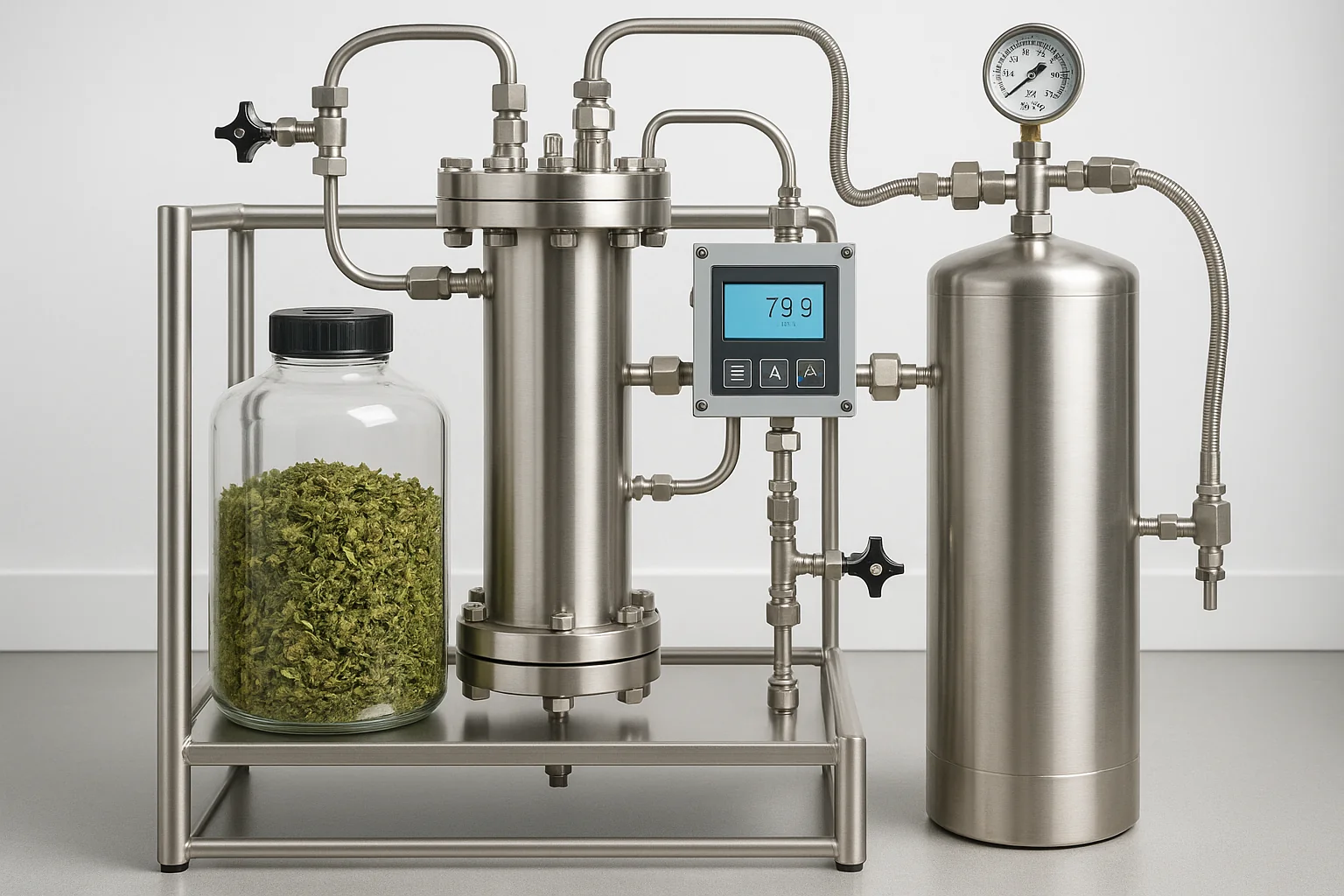
Carbon dioxide above the critical temperature of 31.1 degrees and critical pressure of 73.8 bar enters a supercritical state. It then retains a density and solubility similar to that of a liquid, while having low surface tension and gas diffusivity, allowing it to penetrate the pores of the plant material. In this state, it dissolves cannabinoids, and after expansion, it evaporates completely, leaving no trace of solvent in the product.
The best-documented feature of this method is its controllability. Rovetto and Aieta conducted extraction at pressures of 17, 24, and 34 MPa at a temperature of 328 K, and the obtained extract was fractionated in a cascade of three separators at decreasing pressure and temperature. The efficiency turned out to be strongly dependent on pressure and the initial composition of the raw material, and the efficiency of the extraction itself reached 92 percent (Rovetto and Aieta, The Journal of Supercritical Fluids 2017).
This same work clarifies the popular opposition between CO2 and ethanol. The authors studied ethanol not as a competing method but as a co-solvent added to the CO2 stream, in two variants: continuous flow and pulses applied at different moments of the process. In industrial practice, these two technologies are therefore often elements of one system, not alternatives. The price paid for this is the complexity of the pressure installation, and it is this, not the raw material cost itself, that positions CO2 extract products at a higher price point.
Why does ethanol dominate in mass production?
Because it scales the easiest and does not require a pressure installation. The plant material is immersed in ethanol, either at room temperature or very cold, and left for several minutes to several hours. Ethanol effectively extracts cannabinoids and terpenes, but it is not selective: along with them, chlorophyll passes, which is responsible for the green color and bitter taste, as well as waxes and lipids.
This is where an additional step called winterization comes from. The extract is dissolved in cold ethanol and cooled until waxes and lipids crystallize, after which they are filtered out of the solution. Then, ethanol is evaporated under reduced pressure, meaning at a temperature lower than its normal boiling point. There may also be decolorization with activated carbon or diatomaceous earth, which lightens the extract.
Extraction at very low temperatures shortens this process. Chilled ethanol extracts fewer waxes and chlorophyll right from the start, so winterization may be unnecessary, and the lower temperature preserves terpenes. This is today a compromise chosen by producers who care about costs and aroma profile at the same time. However, one difference from CO2 remains unchanged, and it is from it that the safety of the product depends: the solvent must be removed, and then it must be proven that this has been achieved.
What is rosin and is it allowed to make it at home?
Rosin is the only method discussed that does not use any solvent. The plant material is placed between two heated plates of a press and squeezed, and the heat along with pressure extracts the resin from the glandular hairs onto silicone paper. The result is a golden, translucent resin with a consistency ranging from oily to waxy, depending on the moisture of the raw material and the press settings.
The advantage is the lack of a solvent removal step, as there is nothing to remove, and the relatively low temperature of the process preserves terpenes. The disadvantage is efficiency. The press operates solely mechanically, so some resin remains in the pressed material, and there is no solvent that could take it away from there by design. In industrial scale, the method does not compete with the others precisely for this reason. The temperatures given in workshop descriptions usually range from 60-100 degrees, but no standard establishes them, and they do not come from peer-reviewed research.
The answer to the second part of the question is unequivocal and does not depend on the scale. Extracting resin from cannabis flower other than fiber hemp is giving a psychoactive substance a new form, which is processing in the sense of Article 4 point 20 of the Act on Counteracting Drug Addiction, prosecuted under Article 53 of this Act (Journal of Laws 2023 item 1939). Possessing a press is not punishable, but using it for such raw material is, and the law does not exempt even a patient with a prescription from responsibility. We wrote separately about variations of this technique in the text Live resin and live rosin.
Comparison Table of Four Extraction Methods
The table organizes the methods according to seven features that can be verified: the solvent used, controllability of composition, process temperature, presence of waxes and chlorophyll, required residue testing, risk of the process itself, and typical application. There is no column for efficiency expressed as a percentage, and this is intentional, as this quantity depends on the raw material and parameters more than on the method itself.
| Parameter | Supercritical CO2 | Ethanol | Rosin | BHO |
|---|---|---|---|---|
| Solvent | CO2, evaporates completely | Ethanol, to be removed | None | Butane, to be removed |
| Controllability of composition | High, through pressure and temperature | Low, extracts everything at once | Low, press settings | Medium, through condition selection |
| Process temperature | Moderate | From room to very low | Elevated, briefly | Low during extraction |
| Waxes and chlorophyll | Controlled by fractionation | Requires winterization | Remain in the resin | Very few pass through |
| Residue testing | Not applicable | Required, ethanol class 3 | Not applicable | Required, limit from national regulations |
| Process risk | Pressure, industrial installation | Ethanol is flammable | Thermal burn | Explosion, described in the literature |
| Typical application | Products with repeatable composition | Mass production | Craft product | Concentrates |
The row on solvent residues is based on the ICH Q3C guideline in version R9, the row on controllability on the work of Rovetto and Aieta from 2017, and the row on BHO risk on two series of cases described below. Status as of August 15, 2026.
Why is BHO efficient and why does it end up in the burn unit?
BHO, or butane hash oil, uses liquefied butane. It is very non-polar, so it selects cannabinoids and terpenes, leaving most waxes and chlorophyll in the raw material. This is where the intense aroma of concentrates of this type and their consistencies known as wax, shatter, or budder come from.
The problem is physical, not technological. Butane boils below zero degrees, is heavier than air, and creates an explosive mixture with it over a wide range of concentrations. During extraction in an open system, vapors accumulate near the floor, and any electrical device in the room can be a source of ignition.
The scale of this phenomenon has been measured and looks different than what industry texts report. In one burn center in Colorado, from January 2008 to August 2014, 29 patients were admitted with burns related to BHO production. The median burn area was 10 percent, ranging from 1 to 90 percent, the median hospital stay was 10 days, 21 percent of patients required intubation, and 19 required skin grafts (Bell et al., Journal of Medical Toxicology 2015). The second series, from 2007-2014, included 101 patients: average burn area 26.8 percent, average hospital stay over 27 days, three deaths (Romanowski et al., Journal of Burn Care and Research 2017).
These are data from individual centers, not national statistics, so they should not be multiplied or presented as “hundreds of accidents per year.” However, they say enough: injuries are severe, mainly involve young men, and in both series, their number increased. Industrial production is conducted in closed systems with butane recovery, in rooms with explosion-proof ventilation, and it is this infrastructure, not the chemistry itself, that separates a safe process from a disaster.
How to choose a product based on the extraction method?
The decision comes down to the batch testing certificate, not the name of the method on the packaging. Look for a section regarding solvent residues and check two things: whether it exists at all and whether it includes the solvent that the producer used. The absence of such a section for a product extracted with ethanol or butane means that no one has checked it.
For ethanol, there is a clear reference point. The ICH Q3C guideline classifies it as a class 3 solvent, with low toxic potential, and states that amounts up to 50 mg per day, which corresponds to 5000 ppm or 0.5 percent, are acceptable without separate justification. A result below this threshold is therefore information that can be compared between producers.
For butane, there is no such threshold in this guideline because butane is not mentioned at all. Limits are then determined by the regulations of the country of production, and these are not uniform. If you are buying a concentrate, check which standard the laboratory refers to, because the numerical result without this reference means nothing. For CO2 extract, the residue section remains empty for the obvious reason: carbon dioxide evaporates on its own. Products sold in Poland from cannabis extract, for which you can ask for such a certificate, can be found in the oils category.
How does decarboxylation affect the final product profile?
In a living plant, cannabinoids mainly occur in acidic forms, as CBDa and THCa. Only heat removes the carboxyl group from them and converts them into neutral forms, namely CBD and THC. Each extraction method has a different thermal profile, so each leaves a different proportion of these two forms in the finished extract.
Ethanol extraction at very low temperatures does not decarboxylate the raw material at all because there is simply not enough heat for the transformation. The extract is then by definition raw. Supercritical CO2 conducted at moderate temperatures also changes little. Rosin, conducted at elevated temperatures, partially decarboxylates, and the longer and hotter, the closer to neutral forms.
This leads to a practical conclusion for the reader regarding the composition. If the certificate shows mainly CBD and not CBDa, the producer performed a separate, conscious decarboxylation step, before or after extraction. The order matters because heating the raw material before extraction destroys some terpenes in the process. The mechanism of the reaction itself is detailed in the text Decarboxylation of Marijuana, and the difference between the raw and decarboxylated version in the text CBD Oil Raw vs Decarboxylated.
Are there newer methods of cannabis extraction?
Yes, although none have yet replaced the four described above. Ultrasound-assisted extraction uses waves to mechanically break down cell walls, allowing the solvent to reach the cell contents faster. This shortens the process time and allows it to be conducted at lower temperatures, but it still requires a solvent, so it does not remove the residue problem.
Microwave-assisted extraction heats the material from the inside by absorbing radiation through intracellular water, which ruptures the cells from the inside. It is fast and energy-efficient, but the heat acts on the entire raw material at once, so if the process is not conducted carefully, it removes terpenes and decarboxylates cannabinoids earlier than the producer intended.
The furthest from implementation are deep eutectic solvents, which are mixtures of two substances that melt together at a temperature significantly lower than each separately. They are sometimes made from food ingredients, so they tempt to be called green, but for cannabis, they remain today a subject of laboratory research, not a market technology. When assessing a product on the shelf, what matters is what is stated in the batch certificate, not what the latest publication promises.
Frequently Asked Questions
Which cannabis extraction method is the best?
None is the best unconditionally, as each optimizes something different. CO2 provides the greatest control over composition and leaves no solvent. Ethanol scales the cheapest but requires winterization and testing for residues. Rosin does not use a solvent but has low efficiency. BHO produces aromatic concentrates with the highest risk of the process.
What is the difference between CO2 and ethanol extraction?
Supercritical CO2 allows control over the extract’s composition through pressure and temperature and separates fractions in a cascade of separators, and after expansion, it disappears from the product. Ethanol extracts everything at once, including waxes and chlorophyll, so it requires purification and testing for residues. In industrial installations, ethanol is often a co-solvent added to CO2, not a competing method.
Is it allowed to make rosin at home?
No, if the raw material is cannabis flower other than fiber hemp. Extracting resin is giving a psychoactive substance a new form, which is processing in the sense of Article 4 point 20 of the Act on Counteracting Drug Addiction, prosecuted under Article 53 of this Act. The press itself is not a prohibited item, but its use for such material is a crime, even for a patient with a prescription.
Why is BHO dangerous?
Butane boils below zero and creates an explosive mixture with air, and during extraction in an open system, vapors accumulate near the floor. In one burn center in Colorado, 29 patients were admitted for this reason between 2008-2014, and in another series, 101 people between 2007-2014, including three deaths. Industrial production requires a closed system and explosion-proof ventilation.
How to check if there are no solvent residues in the product?
In the batch testing certificate, look for a section on solvent residues and check if it includes the solvent used in production. For ethanol, the reference point is the ICH Q3C guideline: class 3 and a threshold of 50 mg per day, which is 5000 ppm. For butane, this guideline does not provide a limit, so the regulations of the country of production decide.
Does the extraction method affect the content of CBDa and CBD?
Yes, through the thermal profile of the process. Ethanol at very low temperatures does not decarboxylate the raw material at all, supercritical CO2 at moderate temperatures changes little, and rosin partially decarboxylates. A certificate showing mainly CBD instead of CBDa means that the producer performed a separate decarboxylation step, before or after extraction.
This article is for informational and educational purposes. It contains internal links to product categories available in the store at Bucha. Prices and specifications may change: check the current data on the product page before purchasing.
Author: Michał Waluk · Published: 2026-08-09 · Updated: 2026-08-15