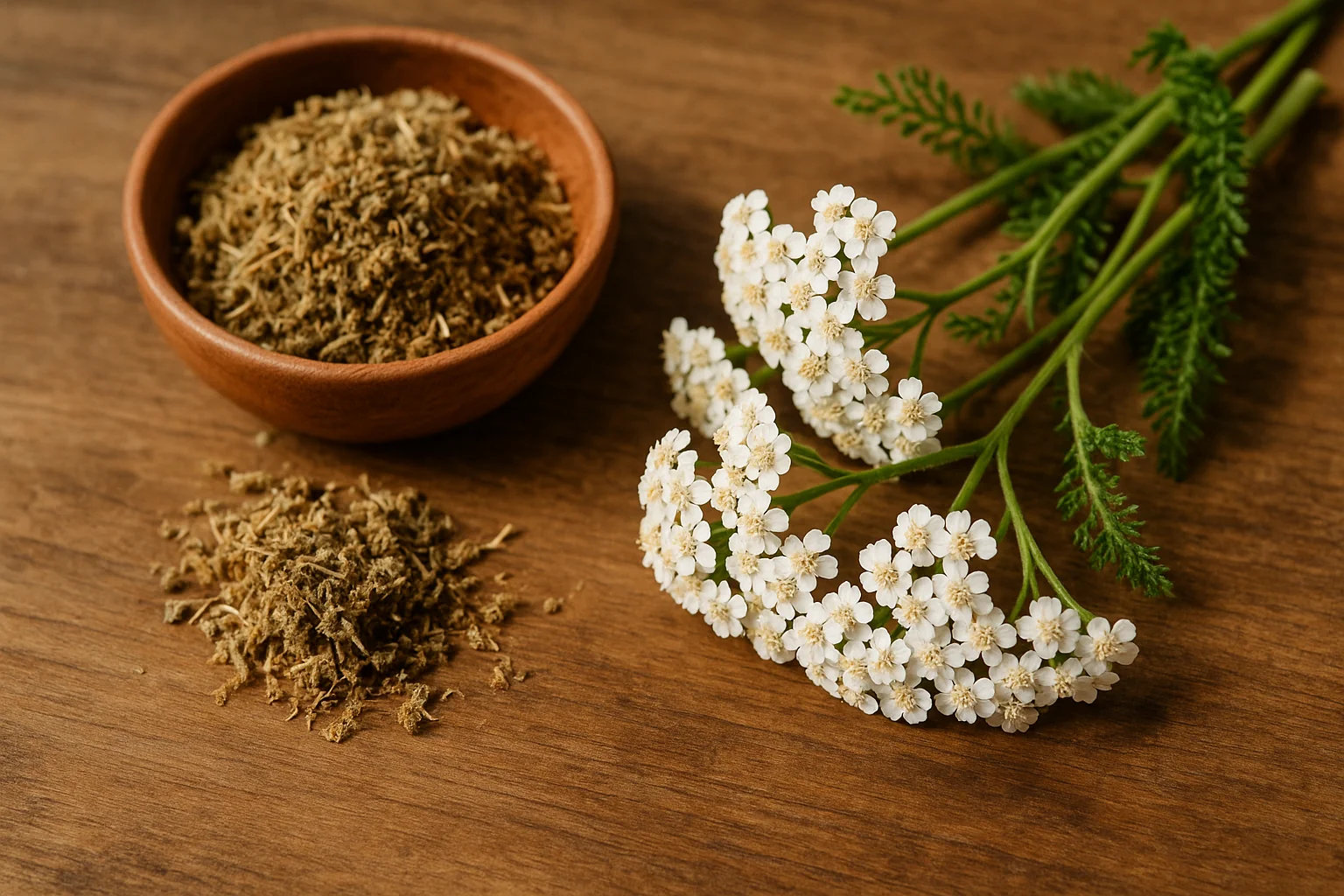

Common Yarrow: Properties and Uses (FAQ)
Common yarrow has an EMA monograph based solely on traditional use. Check the four registered indications, contraindications, and time limits.
Common yarrow (Achillea millefolium L.) grows in every Polish wasteland and has a reputation as a remedy for everything: for the stomach, for menstruation, for wounds. Part of this reputation is supported by an official document. The Committee on Herbal Medicinal Products of the European Medicines Agency has issued a monograph for yarrow and lists four indications. The registration is based solely on long-term use, not on clinical trials, and the document states this explicitly (EMA, Millefolii herba). This distinction changes the way every sentence about the action of this plant is read. Below you will find what is actually stated in the monograph, what is not included, and who is advised against using yarrow.
KEY INFORMATION
• The EMA monograph for yarrow is based solely on traditional use, not on clinical trials (EMA, Millefolii herba).
• There are four indications: appetite, gastrointestinal discomfort, menstrual cramps, and small superficial wounds.
• The only contraindication is allergy to Asteraceae plants.
• Use during pregnancy and breastfeeding is advised against due to lack of data.
• The monograph does not report interactions with medications.
What substances does yarrow contain?
The raw material is the herb, meaning the above-ground parts of the plant, and its quality is described in the European Pharmacopoeia monograph number 1382, to which the herbal monograph directly refers. The chemical composition includes essential oil, lactone sesquiterpenes responsible for the bitter taste, and flavonoids.
A review of the literature on this species was summarized by Ali and colleagues. They collected ethnobotanical data from Europe and Asia, where yarrow appears in spastic gastrointestinal discomfort, liver-biliary disorders, gynecological issues, and wound healing. From a chemical perspective, they state that monoterpenes constitute about 90% of the essential oil compared to sesquiterpenes (Ali et al., Phytotherapy Research, 2017).
The best-described group of components are flavonoids. A separate review lists among them kaempferol, luteolin, and apigenin and attributes to them most of the antioxidant and anti-inflammatory activity observed in studies on this herb (Ayoobi et al., Iranian Journal of Basic Medical Sciences, 2017).
The limit of this knowledge must be set immediately. The activities described in both reviews come from laboratory and animal models. The authors of the first review conclude that more clinical studies are needed to assess the potential of this plant. The registration of yarrow as a herbal medicine did not require any data on the mechanism of action, and such data are not present in the monograph.
What can yarrow be used for according to the European Medicines Agency?
The monograph lists four indications, all marked with the formula “traditional herbal medicinal product” (EMA, Millefolii herba). Three of them relate to oral use, one to topical use. The table below summarizes them along with the time limit after which the document requires contacting a doctor.
| Indication from the monograph | Route of administration | Forms mentioned in the document | When to see a doctor |
|---|---|---|---|
| Temporary loss of appetite | orally | infusion, juice from fresh herb, liquid extract, tincture | after 2 weeks |
| Mild, spastic gastrointestinal discomfort with bloating and gas | orally | infusion, juice, liquid extract, tincture, dry extract | after 2 weeks |
| Minor menstrual cramps | orally | infusion, dry extract | after 1 week |
| Small superficial wounds | topically, in the form of a soaked dressing | infusion of crushed herb | after 1 week or with signs of infection |
The quantities of raw material are given separately for each form and each indication, and the binding data for a specific preparation are those from its leaflet. Two things from this document are worth remembering regardless of the numbers: the infusion for digestive discomfort is taken between meals, not with food, and liquid preparations for loss of appetite are taken half an hour before meals.
There is no mention of fever, even though the use of yarrow for sweating has appeared in Polish herbal guides for generations. There is also no mention of urinary tract infections or hypertension. The lack of indication in the monograph does not prove that the herb does not work. It only means that this application is not included in the document, so citing the European Medicines Agency in this regard is unwarranted.
What does it mean that registration is based on traditional use?
This means that the manufacturer did not have to demonstrate effectiveness through clinical trials. The traditional path under Directive 2001/83/EC requires documentation of an appropriately long period of use and safety data, not proof that the preparation works better than a placebo. The monograph states this in a way that is easy to overlook.
In the sections on pharmacodynamic and pharmacokinetic properties, there is one sentence: data are not required under Article 16c paragraph 1 letter a point three of the directive. It does not say “no effect” or “effect confirmed”. It states that this section for this registration path is not filled out by anyone.
The monograph provides little preclinical data. The dry extract obtained with water, at a ratio of raw material to extract from six to nine to one, did not show mutagenic activity in the Ames test. Appropriate reproductive toxicity studies have not been conducted, nor have carcinogenicity studies. This second gap returns below, in the warning regarding pregnancy.
The practical conclusion for the reader is this: the presence of yarrow in the EMA monograph indicates that the herb has been used for a long time and that no serious safety signals have been collected from this use. It does not say how large an effect you should expect. The claim “effectiveness confirmed by EMA” is an abuse in this case.
Who should not use yarrow?
The monograph lists one contraindication: hypersensitivity to the raw material and to other plants from the Asteraceae family. This is a very large family, so cross-reactivity is a real problem for people allergic to chamomile, arnica, or marigold. Symptoms most often concern the skin with external use.
Separately from contraindications, the document advises against use during pregnancy and breastfeeding, justifying this by the lack of established safety and insufficient data. There is no statement about abortifacient action or stimulating uterine contractions. The reason is a gap in research, not established harm, but the practical conclusion remains the same: do not use yarrow during pregnancy.
The third group is children. The monograph states that use in children under twelve years of age has not been established due to a lack of appropriate data, and it does not recommend it. Among the reported adverse effects, only skin hypersensitivity reactions of unknown frequency are mentioned.
Before the first external use, it is wise to check tolerance on a small patch of skin, especially with a known allergy to pollen. Similar caution applies to other bitter herbs from the same family, including wormwood, and chamomile, which we dedicated a separate entry to about where it helps and where it does not.
Does yarrow interact with medications?
In the interactions section, the monograph has two words: no interactions reported. This is a lack of reports, not proof of no interactions, and the difference has practical significance. The traditional path does not require interaction studies, so no one has systematically conducted them for this raw material.
Guides repeat warnings about yarrow in combination with anticoagulant, diuretic, and sedative medications. None of these come from the monograph, which in this section states only “no interactions reported”. This does not mean they are untrue. It means they are not supported by this document and should not be presented as the agency’s position.
A separate note concerns alcoholic forms. The yarrow tinctures described in the monograph contain ethanol at a concentration of 45% or 31.5%, and the document requires appropriate warnings about alcohol content to be placed on the packaging. For someone avoiding ethanol or taking medications for which alcohol is contraindicated, the appropriate choice is infusion or dry extract.
If you are taking medications regularly, talking to a pharmacist is cheaper than guessing. The pharmacist sees your entire list of medications and works on the characteristics of medicinal products, which are data that are not present in the herbal monograph by design.
How long can yarrow be used without consultation?
The monograph divides this according to indication. For loss of appetite and gastrointestinal discomfort, the limit is two weeks. For menstrual cramps and superficial wounds, the limit is one week. After this time, the persistence of symptoms is a signal to contact a doctor or another qualified healthcare professional.
The second condition is independent of time. If symptoms worsen during use, the document requires immediate discontinuation of self-treatment, without waiting for the end of two weeks. For wounds, a separate signal is signs of skin infection.
These limits do not arise from established harm from prolonged use. They arise from the same reason as the entire monograph: from a lack of data outside of tradition. Two weeks is the period after which a mild digestive complaint ceases to be a mild digestive complaint and requires diagnosis, not another glass of infusion.
The last thing that is easy to forget when foraging. The monograph concerns raw material that meets pharmacopoeial requirements, meaning of verified species identity and purity. Herb collected by the roadside or in a field after spraying is not the same material that this document refers to, regardless of how good it looks.
Frequently Asked Questions
What does common yarrow do?
The EMA monograph lists four indications based on traditional use: temporary loss of appetite, mild spastic gastrointestinal discomfort with bloating and gas, minor menstrual cramps, and small superficial wounds. The first three relate to oral use, the fourth to topical use (EMA, Millefolii herba).
Has the effectiveness of yarrow been confirmed by studies?
Not in the sense of clinical trials. The registration followed the traditional path, which does not require proof of effectiveness, and the sections on pharmacodynamic and pharmacokinetic properties are left unfilled by the monograph by virtue of regulation. Available reviews describe anti-inflammatory and antioxidant activity, but in laboratory and animal models.
Is yarrow safe during pregnancy?
The monograph advises against use during pregnancy and breastfeeding, as safety has not been established and there is a lack of sufficient data. Appropriate reproductive toxicity studies have not been conducted. This is a precaution arising from a gap in knowledge, not from established harm, but the practical conclusion is clear: do not use yarrow during pregnancy.
Does yarrow interact with medications?
The EMA monograph states in the interactions section: no interactions reported. The traditional registration path does not require interaction studies, so this is a lack of reports, not proof of safety. Popular warnings against combining yarrow with anticoagulant medications are not supported by this document. If you are on regular pharmacotherapy, ask your pharmacist.
Who should not drink yarrow infusion?
People allergic to plants from the Asteraceae family, as this is the only contraindication mentioned in the monograph. The document also does not recommend use in children under twelve years of age, in pregnant women, or breastfeeding mothers. Reported adverse effects include skin hypersensitivity reactions of unknown frequency.
How long can yarrow be used without consulting a doctor?
Two weeks for loss of appetite and gastrointestinal discomfort, one week for menstrual cramps and superficial wounds. If symptoms worsen, the monograph requires discontinuation of use earlier. For wounds, a separate signal to contact a doctor is signs of skin infection.
Yarrow is not available in the Bucha store. In the herbs category, you will find extracts from valerian, marshmallow, and mullein, among others.
This article is for informational and educational purposes and does not constitute medical advice. Before starting supplementation, consult a doctor, especially if you are taking medications regularly, are pregnant or breastfeeding, or have a chronic illness.
Author: Michał Waluk · Published: 2026-08-09 · Updated: 2026-08-15