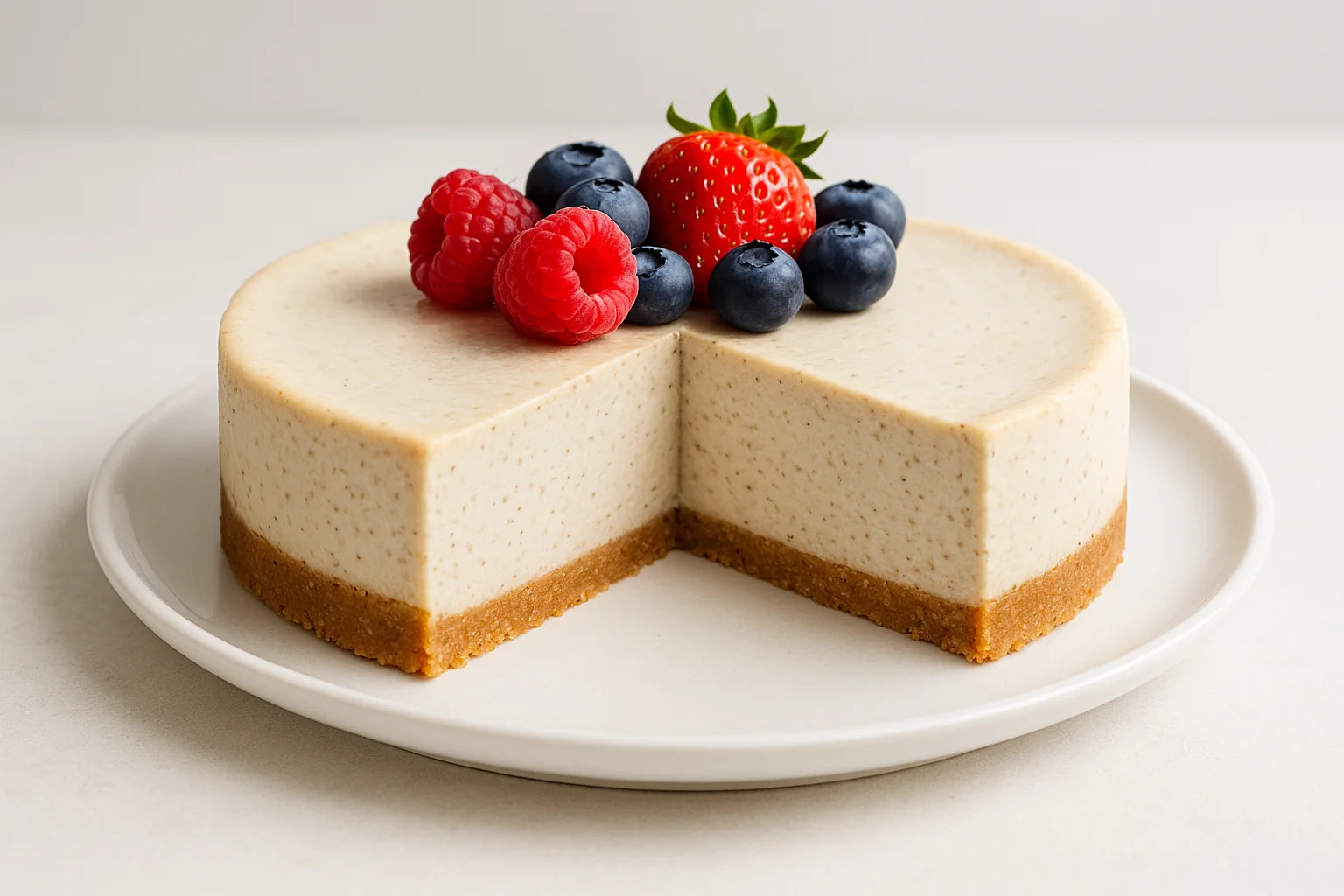

Protein cheesecake with hemp protein: a light dessert
Protein cheesecake with hemp protein step by step: how much powder for a springform pan, why you bake at 160 degrees, and how the powder differs from flour.
Protein cheesecake with hemp protein is a dessert where most of the protein comes from cottage cheese and eggs. The hemp powder adds the rest and changes the texture: it absorbs moisture, so the mixture thickens faster than usual, and with too much, it becomes grainy. This is the most common reason for a failed protein cheesecake, not the oven temperature. I will show you how much powder goes into one springform pan, why the hemp cheesecake is baked at 160 degrees, and what to do to prevent the top from cracking. I will also explain how hemp powder differs from hemp flour and hulled seeds, as these three products have completely different compositions, and recipes often confuse them.
KEY INFORMATION
• The cake residue after oil pressing, from which hemp powder is made, has an average of 40.7% protein and 10.2% fat (House et al., J Agric Food Chem 2010).
• Hulled seeds have the highest PDCAAS in the same study: 63-66%.
• Hemp flour is not the same as powder: it has 30.7% protein compared to 24.8% in seeds (Siano et al., Molecules 2018).
• Bake hemp cheesecake at 160 degrees: at higher temperatures, the protein sets too quickly and the top cracks.
What does hemp protein do in cheesecake?
Hemp powder increases the protein content and binds water. Cottage cheese and eggs provide most of the protein in this recipe, and three tablespoons of powder, about 25 g, add roughly 10 g of protein to the entire springform pan. The effect is more visible in texture than in the nutritional table: the mixture thickens and holds together better after baking.
Hemp protein is mostly edestin, a storage globulin from the seed, followed by albumin. A review by Rizzo et al. (Foods, 2023) describes edestin as the fraction with the highest biological value in this seed, rich in branched-chain and sulfur-containing amino acids. Callaway (Euphytica, 2004) lists these same two proteins as the main storage proteins of the seed and notes the very high arginine content. None of these studies examined baked goods, so do not transfer their conclusions to the finished cheesecake.
The taste of the powder at three tablespoons is barely noticeable. The grassy aftertaste, prominent in a smoothie, disappears here behind the cottage cheese and vanilla. Above four tablespoons in a springform pan, it starts to dominate, and the mixture becomes dry because the powder absorbs the water needed by the cottage cheese. That is why honey in this recipe is liquid and not replaced with powdered sugar. More ways to use the powder in the kitchen are described in our post on how to use hemp protein.
Powder, flour, or seeds: what are you actually adding to the mixture?
These are three different products from one plant, and they differ in composition, not just name. Whole seeds are fatty, hulled seeds are even fattier, and the cake residue, which is what remains after oil extraction, has the most protein. Protein powder and hemp flour are made from the same cake, just ground differently, so do not substitute seeds in the mixture.
House et al. (Journal of Agricultural and Food Chemistry, 2010) examined 30 commercial batches from western Canada and measured the composition of each using the same method. The results below are given in dry mass.
| Hemp seed product | Protein | Fat | PDCAAS |
|---|---|---|---|
| Whole seeds | 24.0% | 30.4% | 49-53% |
| Hulled seeds | 35.9% | 46.7% | 63-66% |
| Cake after oil pressing | 40.7% | 10.2% | 46-51% |
The hull increases digestibility and the PDCAAS score because the hull is mainly fiber. The cake has the most protein, yet its PDCAAS was the lowest of the three, so a higher content does not automatically mean better quality. Siano et al. (Molecules, 2018) measured the same on the Fedora variety: the flour from the cake had 30.7% protein compared to 24.8% in seeds, and fat dropped from 24.5% to 13.6%.
What do you need for protein cheesecake?
The list is short and contains nothing difficult to obtain except for the hemp powder itself. You won’t find hemp protein powder, hemp flour, or hulled seeds today at Bucha’s store, so for this ingredient, go to a health food store. The rest are regular grocery items.
- 500 g of semi-fat cottage cheese or ricotta, drained of excess whey
- 3 tablespoons of hemp protein powder, about 25 g
- 2 eggs size M
- 3 tablespoons of honey or agave syrup or 4 tablespoons of erythritol
- 1 teaspoon of vanilla extract and a pinch of salt
- for the base: 120 g of oats, 30 g of peanut butter, 2 tablespoons of honey, a pinch of salt
- optional: zest of half a lemon, 100 g of raspberries or blueberries for decoration
The springform pan should be 24 cm in diameter. In a smaller one, the mixture will be higher and needs an extra fifteen minutes of baking, making it easier to crack the top. Choose semi-fat cottage cheese in a block, not ground in a bucket: the latter has more water, and the mixture will be loose. Erythritol is less sweet than honey, so add it by the spoonful and taste after each addition.
How to bake protein cheesecake step by step?
Preparation time at the counter is about 20 minutes, baking 40 to 45 minutes, and cooling at least three hours. Preheat the oven to 160 degrees before you start mixing the filling. The entire recipe boils down to five steps, and only two of them can be messed up: the density of the mixture and the cooling speed.
- Grind the oats into flour, mix with peanut butter, honey, and salt, press into the bottom of the springform pan, and chill.
- Blend the cottage cheese, hemp powder, eggs, honey, vanilla, and salt into a smooth mixture without lumps.
- Check the density: the mixture should flow slowly from a spoon. If too runny, add a tablespoon of powder; if too thick, add a tablespoon of milk.
- Pour the mixture onto the chilled base and bake for 40 to 45 minutes until the edges are set and the center is gently jiggly.
- Turn off the oven, leave the cheesecake inside for fifteen minutes with the door ajar, then cool on the counter and refrigerate.
The protein cheesecake gains firmness only in the fridge, as the fat from the cottage cheese and the egg protein set there. A warm cheesecake will fall apart even if you baked it perfectly.
How to modify this recipe to your taste?
The base of cottage cheese and hemp powder is neutral, so it accepts additions without altering the proportions. Change one element at a time and monitor the density of the mixture, as it determines the texture of the finished cheesecake.
Lemon version: add the zest of a whole lemon and two tablespoons of juice to the mixture, and reduce the honey by a tablespoon. The acidity of the citrus masks the grassy aftertaste of the powder well. Chocolate version: mix in two tablespoons of cocoa and add a tablespoon of honey, as cocoa is bitter. After cooling, sprinkle the cheesecake with fresh raspberries.
We noticed in tests that cheesecake made with ricotta seems too soft when taken out of the oven and tempts you to bake it for another five minutes. This is a mistake: after four or five hours in the fridge, the mixture becomes firm and smooth on its own, while overbaking makes it dry. With ricotta, extend the cooling time instead of extending the baking time.
If you are looking for other desserts using the same powder, check out homemade protein bars or chia pudding with cocoa. Both are made without baking, so the powder does not undergo heat treatment, making it easier to feel how much you really like it in a dessert.
Frequently asked questions
How much protein is in one serving of protein cheesecake?
From the recipe’s weight, there is about 130 g of protein in the entire springform pan, which is about 10 to 11 g per one of the twelve servings. Most comes from the cottage cheese and eggs, while the hemp powder adds about 10 g to the whole cheesecake. This calculation is from the ingredient list, not a laboratory measurement.
Can you make cheesecake with hemp protein without baking?
Yes. Replace the eggs with gelatin or agar and skip the baking. The mixture will be creamier and less dense, and the cooling must last longer, preferably overnight. Hemp powder binds water just as well cold, so add it carefully: too much will make the mixture grainy.
How long can you store protein cheesecake?
In the fridge in an airtight container for up to five days, in the freezer for up to two months. Thaw in the fridge, not on the counter. Cottage cheese releases whey after thawing, so drain it with a paper towel before serving. Cheesecake made with ricotta freezes worse and can become grainy afterward.
What can replace cottage cheese in hemp cheesecake?
Ricotta gives a creamier texture and requires longer cooling. Philadelphia cheese gives a thick consistency, close to American cheesecake. A plant-based version can be made with cashew cream soaked for four hours and blended with lemon juice. Each substitute changes the water content, so adjust the amount of powder according to the density of the mixture.
Why does protein cheesecake crack on top?
Most often due to too high baking temperature or too rapid cooling. Bake at 160 degrees, not 180. After turning off the oven, leave the cheesecake inside for fifteen minutes with the door ajar. A sudden temperature change shrinks the top faster than the center, causing cracks.
This article is for informational and educational purposes and does not replace consultation with a doctor. If you are pregnant, breastfeeding, taking medications, or have chronic conditions, consult the use of supplements or herbs with a specialist.
Author: Michał Waluk · Published: 2026-06-22 · Updated: 2026-08-16