
Ashwagandha and Male Fertility and Semen Parameters: What RCTs Show
A 167 percent increase in sperm concentration sounds strong, but it is calculated against the baseline. We check what was really measured and against what.
Male infertility accounts for nearly half of the cases where a couple cannot conceive. The first test is usually a sperm analysis, and when the results are poor, many men look for something to improve them before visiting a fertility clinic. Ashwagandha regularly appears in these searches, usually accompanied by the number 167 percent. This number is true, but it means something different than the headlines suggest. This text shows what exactly was measured in studies on ashwagandha and semen, against what these increases were calculated, and why a better sperm analysis is not yet news of a baby. We checked every number in the summary or in the full text of the work from which it comes, along with who funded the study.
KEY INFORMATION
• The systematic review included four clinical studies described in five publications, of which one was randomized; the authors did not conduct meta-analyses of randomized studies (Durg et al., Phytomedicine, 2018).
• Increases in semen parameters were calculated against the baseline values of the same men, not against a placebo group.
• The percentage of pregnancies among partners was 14% in a study without a control arm for this endpoint (Mahdi et al., eCAM, 2011).
• The most frequently cited study on testosterone was conducted on healthy men engaged in strength training, and the extract was provided by its manufacturer.
What did the review really show about ashwagandha and semen?
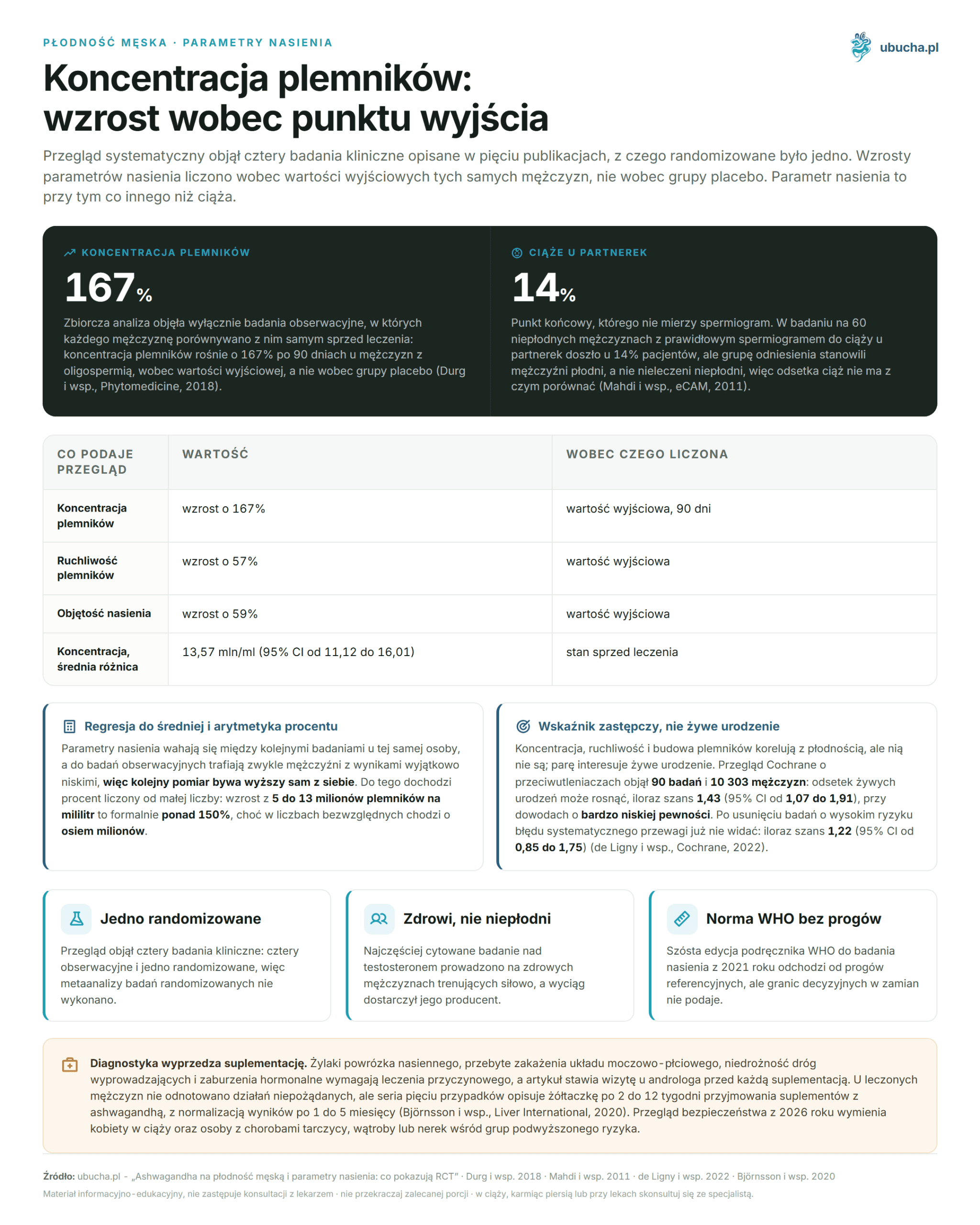
The basis of this topic is the systematic review by Durg and colleagues published in the journal Phytomedicine (Durg et al., Phytomedicine, 2018). It included four clinical studies, described in a total of five publications: four observational and one randomized. The authors state directly that since only one was randomized, they did not perform meta-analyses of randomized studies. Therefore, the aggregate analysis included only observational studies, in which each man was compared to himself before treatment.
| What the review reports | Value | Calculated against |
|---|---|---|
| Sperm concentration | increase of 167% | baseline value, men with oligospermia, 90 days |
| Semen volume | increase of 59% | baseline value |
| Sperm motility | increase of 57% | baseline value |
| Serum testosterone | increase of 17% | baseline value |
| Luteinizing hormone | increase of 34% | baseline value |
| Concentration in the meta-analysis of observational studies | mean difference of 13.57 million/ml (95% CI from 11.12 to 16.01) | state before treatment |
The authors’ conclusion is more cautious than their own numbers. They write that due to the small number of qualifying studies, the available data, while promising, are too limited to provide sufficiently strong evidence of benefits in male infertility, and that larger, high-quality randomized studies are needed. No adverse effects were reported in treated men.
Why does a 167 percent increase not mean what it seems?
Because the reference point is the same man from three months ago, not a man who received a placebo. These are two different measures, and only the latter says anything about the effect of the preparation. Semen parameters fluctuate between successive tests in the same person, and observational studies usually involve men with exceptionally low results, so the next measurement may be higher by itself. Statisticians call this regression to the mean.
Additionally, there is the arithmetic of percentage calculated from a small number. An increase from 5 to 13 million sperm per milliliter is formally over 150%, although in absolute numbers it is about eight million. Therefore, the review provides alongside percentages the absolute value: a mean difference of 13.57 million per milliliter compared to the state before treatment. This second number is much less impressive and much more useful.
A separate complication concerns the very concept of norm. The sixth edition of the World Health Organization’s manual for semen analysis, published in July 2021, moves away from the concept of reference thresholds and instead proposes decision limits, but does not provide any such limits for either basic or extended parameters (Boitrelle et al., Life, 2021). The statement about exceeding WHO norms is therefore today less precise than it sounds.
Does ashwagandha raise testosterone in men with infertility?
The most frequently cited work on this topic did not study men with infertility. A randomized, double-blind, placebo-controlled study included 57 healthy men aged 18 to 50, with little experience in resistance training, who exercised for eight weeks and took 300 mg of extract twice a day or starch (Wankhede et al., Journal of the International Society of Sports Nutrition, 2015). The primary endpoint was muscle strength, and testosterone was a secondary endpoint.
The publication provides absolute increases, not percentages: in the placebo group, testosterone increased by an average of 18.0 ng/dl (95% CI from minus 15.8 to 51.8), and in the extract group by 96.2 ng/dl (95% CI from 54.7 to 137.5), p equal to 0.004. Popular discussions convert this to fifteen percent, but such a value is not in the work, and the conversion would require knowledge of the baseline level.
The origin of the studied raw material also matters here. In the acknowledgments, the authors thank two companies for providing the KSM-66 extract used in the study, with a declared lack of conflict of interest. The same was true in the study on cortisol, where the same extract was provided by its manufacturer, and the decrease in cortisol was 27.9% compared to baseline with 7.9% in the placebo group (Chandrasekhar et al., Indian Journal of Psychological Medicine, 2012). This does not invalidate the results, but the reader has the right to know about it.
Does a better sperm analysis mean a greater chance of having a child?
This distinction determines the value of the entire topic. Concentration, motility, and morphology of sperm are surrogate markers: they correlate with fertility but are not fertility itself. The endpoint that interests a couple is live birth, not a number from a test result.
Ashwagandha has one signal here. In a study of 60 infertile men with normal sperm analysis, divided into smokers, those under psychological stress, and cases of unknown cause, after three months of taking powdered root, pregnancy occurred in partners of 14% of patients (Mahdi et al., eCAM, 2011). The reference group in this study consisted of fertile men, not untreated infertile men, so the pregnancy rate has nothing to compare it to.
A broader picture is provided by the Cochrane review on antioxidants in male infertility, covering 90 studies and 10,303 men (de Ligny et al., Cochrane Database of Systematic Reviews, 2022). Antioxidants may increase the percentage of live births, odds ratio 1.43 with 95% CI from 1.07 to 1.91, evidence of very low certainty. After removing studies with high risk of systematic bias, no advantage is seen anymore: odds ratio 1.22 with 95% CI from 0.85 to 1.75. This is how the entire class of supplements looks when counting children instead of sperm analysis.
What ashwagandha cannot replace and who may be harmed by it?
It cannot replace diagnostics. Varicocele, past infections of the urogenital tract, obstruction of the excretory ducts, and hormonal disorders are organic causes that require causal treatment, and their diagnosis changes the entire approach. A visit to an andrologist precedes any supplementation, not the other way around.
It is also not neutral for health. A series of five cases from Iceland and an American monitoring network for drug-induced liver injury describes jaundice after 2 to 12 weeks of taking supplements with ashwagandha, with a cholestatic or mixed course, normalizing results after 1 to 5 months (Björnsson et al., Liver International, 2020). A safety review from 2026 indicates pregnant women and individuals with thyroid, liver, or kidney diseases as high-risk groups (Li et al., Phytotherapy Research, 2026). For a couple planning a child, this has practical significance, as pregnancy is usually recognized only after a few weeks of its duration.
Separately remains the question of the raw material itself. The Committee on Herbal Medicinal Products of the European Medicines Agency stated in a statement on July 9, 2013, that a monograph for the root of Withania somnifera cannot be established, among other reasons due to insufficient specification of extracts (EMA/HMPC/681519/2012). Therefore, the result obtained on one preparation does not automatically transfer to another, even if both are called the same.
Frequently Asked Questions
Does ashwagandha improve semen parameters?
A systematic review noted a 167% increase in sperm concentration, 57% in motility, and 59% in semen volume after 90 days in men with oligospermia. All these values were calculated against the baseline of the same men, not against a placebo, and they mainly come from observational studies.
How many randomized studies were there on this topic?
One. A review from 2018 included four clinical studies described in five publications: four observational and one randomized. The authors note that for this reason, they did not conduct meta-analyses of randomized studies, and the aggregate results pertain only to observational studies.
How much does ashwagandha raise testosterone?
In a study of 57 healthy men engaged in strength training, the increase was an average of 96.2 ng/dl compared to 18.0 ng/dl in the placebo group, with p equal to 0.004. This was a secondary endpoint in a study on muscle strength, and the participants were not diagnosed with infertility.
Does ashwagandha increase the chance of pregnancy?
It is unknown. The only data is a 14% pregnancy rate among partners in a study of 60 men without an untreated control arm, so there is nothing to compare it to. The systematic review from 2018 does not include a randomized study that measured pregnancy as an endpoint.
What is known about other antioxidants in infertility?
A Cochrane review from 2022 on 10,303 men suggests an increase in the percentage of live births with very low certainty of evidence, but after excluding studies with high risk of bias, the effect disappears. More frequent mild gastrointestinal complaints were also reported than in control groups.
Is ashwagandha safe when trying to conceive?
In men, no adverse effects were reported in studies, but cases of liver damage after supplements with this plant have been described. A safety review from 2026 lists pregnant women among high-risk groups, and pregnancy is usually recognized after a few weeks of its duration.
The same raw material is also described in relation to thyroid disorders, where the evidence looks completely different: we break it down in the post about ashwagandha and subclinical hypothyroidism. Two other ingredients in this area are discussed separately: zinc and semen quality and coenzyme Q10 and male fertility. Herbal raw materials in herbal form can be found in the herbs category.
This article is for informational and educational purposes and does not constitute medical advice. Before starting supplementation, consult your doctor, especially if you are taking medications regularly, are pregnant or breastfeeding, or have chronic illnesses.
Author: Michał Waluk · Published: 2026-08-09 · Updated: 2026-08-16